


SIGA
| November 26, 2025
Yearly Interest on 1 Million Dollars: Passive Income Strategies for Retirement
Table of Contents
Economic Forecasts for 2026 and Their Effect on Your Expected Yearly Interest
Understanding how much yearly interest $1,000,000 can generate in 2026 requires examining late-2025 financial conditions and forward-looking projections across high-yield savings accounts, CDs, Treasuries, and stock market returns.
As of November 2025, the top high-yield savings accounts were offering up to 4.20% APY, while the highest 1-year Certificate of Deposit was reaching 4.25% APY – so you could get between $42,000 and $42,500 per year on a $1 million balance.
On the other hand, the average APY for 12-month CDs was 1.64%, which would give you $16,400 per year.
And then there’s the little-known fact that banks can actually pay out as much as 5.19% in capped rates, although that’s only according to the FDIC data.
Government-backed investments, though, are still pretty competitive: the 10-year Treasury is sitting near 4.1% and we’re expecting that to probably creep up to around 4.21% next year, which would result in an estimated $41,000 to $43,000 per year on that $1 million saver of yours.
On the other hand, long-term equity benchmarks like the S&P 500 have been delivering an average annual return of 10.54% since 1957, which means you could see a gain of $105,400 per year, though there is the added downside of significantly higher volatility.
And it’s worth noting that these returns have ranged from -18% in 2022 to 25% in 2024 in recent years.
Taking all this into account, along with rate forecasts suggesting that the Fed might actually cut rates a little this year, it looks like the earning potential of $1 million next year will range from around $16,000 per year in a low interest bank CD to $105,000+ in a growth focused portfolio, with the more stable income products like high-yield savings, top CDs and Treasuries clustering in between $40,000 and $43,000 annually.
So for 2026, it looks like investors will have the chance to lock in some reliable income while also getting a little exposure to higher return opportunities – as long as you’re comfortable with the level of risk you’re taking on, of course.

Working Out What You Can Expect in Yearly Interest (2025–2026)
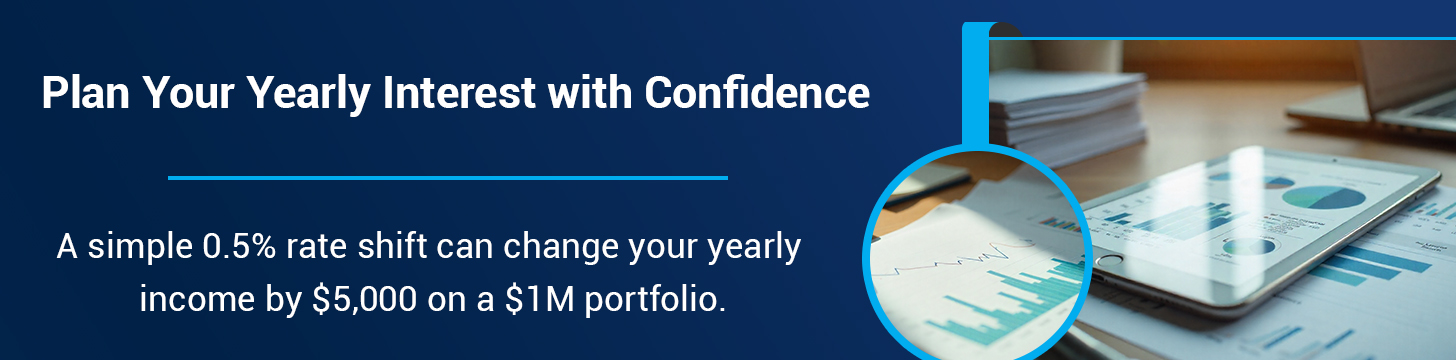
Getting a sense of what you can expect in yearly interest on a $1 million portfolio is the foundation of any smart retirement income plan.
To make solid decisions, you need to think not just about how things are right now, but also about how things are likely to change between 2025 and 2026.
This involves taking a close look at interest-rate cycles, trying to forecast what kind of stable returns you can expect, and comparing how sensitive your yearly interest is to changes in the economy.
Why We Need to Forecast Earnings
Yearly interest is the real deal – it determines
- how much you can safely pull out as income,
- whether you’ll be able to keep your capital intact, and
- how long your retirement funds are likely to last.
A tiny 0.5% change in yearly interest can add up to $5,000 a year on a million-dollar balance – that’s a big deal.
And that’s why stability – how steady the rates are from one year to the next – becomes a really important part of this process.
What’s Happening with Yearly Interest Right Now (2025)
According to the numbers for 2025:
- Low-risk investments like savings accounts and bonds generally offer interest rates of 4.1% a year.
- That works out to an income of $41,000 a year.
These kinds of investments are getting a bit of a boost in 2025, thanks to the relatively high cash rates on offer.
What’s Expected to Happen with Yearly Interest in 2026
The experts think the RBA may decide to ease up on interest rates in 2026. Based on that, the expected safe returns are likely to be 3.8% a year.
This means we can expect a drop in income from $41,000 a year to $38,000.
Just shows how important it is to be able to forecast how rates are going to move – even small changes can have a big impact on your retirement cashflow.
Income Shifts Across 2025–2026
| Year | Safe Yield (%) | Yearly Interest on $1M | Change |
| 2025 | 4.1% | $41,000 | — |
| 2026 | 3.8% | $38,000 | –$3,000 |
A retiree relying solely on safe interest will need to have a plan in place to deal with the fact that interest rates can change dramatically to avoid shortfalls.
Essential Tips for Planning Your Wealth
- Rate stability can give you a pretty good idea of how much you can forecast for income, at least in the short term.
- Yearly interest rates will go up and down, which is why it’s so essential to plan for multiple years at a time. That way, you can adjust to changing circumstances as you go along.
- This bit of planning is a stepping stone for all your later investment decisions – it’s a foundation to build on.
Compare High-Interest Savings for the Best Liquidity Returns
When it comes to reliable ways to generate some cash without putting your foot in it, high-interest savings accounts still come out on top.
They give retirees yearly interest while keeping their cash nice and liquid – something that’s super important for them.
The trick to this bit of planning is understanding that your money is doing something very useful – it’s giving you interest with no strings attached – you can access your cash when you need to without any hassle.
Why Cash Assets Matter in Retirement
Retirees need something they can fall back on when things get tight – namely:
- Access to cash in a jiffy
- A steady yearly income
- Low-risk income that won’t see-saw like shares or property
As far as the low-down goes, high-yield savings accounts check all three boxes – you get the lot.
This combination of having cash at your fingertips and keeping your money safe is why they’re still central to retirement planning.
2025 High-Interest Savings Account Trends – What to Expect
In 2025, Australian high-interest savings accounts are offering an average of 4.35% interest per year – that’s a pretty healthy rate, thanks to the fact that cash rates are currently elevated.
This means:
- If you put $1,000,000 in one of these accounts, you can expect to earn $43,500 per year – not bad going!
- Even the more conservative banks are still doing above 4.0% interest per year.
These accounts are outperforming government bonds in terms of liquidity in 2025, which gives retirees more leeway to act.
What Savings Account Rates Might Look Like in 2026 – A Projection
Forecasts are suggesting that interest rates might drop a bit due to monetary easing.
This means that in 2026, we might see something like an average of 4.0% interest per year.
That would translate to an income of $40,000 per year, rather than $43,500 as we’ve got now.
Now, even though the rate has come down a bit, these accounts are still a pretty competitive low-risk option for anyone wanting to protect their capital – even for retirees who are after that sort of thing.
Passive Earnings Change Over One Year
| 2025 | 4.35% | $43,500 | Full |
| 2026 | 4.00% | $40,000 | Full |
Liquidity remains solid even when interest rates start to wobble.
This gives savings accounts a clear distinction from term deposits, which require committing your cash for the long haul.
Key Benefits of This Liquid Strategy
This strategy gives retirees instant access to their cash, so they can jump into action when emergencies or changing needs pop up.
Plus, it comes with less volatility, making income a lot more stable compared to those investments that rise and fall with the market.
Retirees also find it reassuring to have a predictable yearly interest rate, making it a whole lot easier to plan the household budget and finances.
And in times when cash rates go sky-high, like in 2025, this approach really delivers.
All these advantages put together show how retirees can create a super easy, rock-solid, and highly liquid passive income stream to keep them going throughout retirement.
Give Term Deposits a Close Look for Secure Fixed Returns

Term deposits offer something pretty unique for retirees: yearly interest that’s locked-in and secure.
Unlike savings accounts that change with cash rates, a term deposit fixes your return for the whole term, giving you predictable and guaranteed income.
This step looks at how term deposits keep your yearly interest stable, especially when the world around you is uncertain.
What Makes Locked-In Income Streams So Appealing
Retirees need an income stream that’s always on track, and unpredictable returns can create all sorts of stress and uncertainty.
This can lead to overspending or under-saving.
Term deposits solve this problem by guaranteeing your yearly interest for 6, 12 or 24 months, so your earnings stay steady even when the market changes.
And that fixed structure provides total peace of mind, strong protection for your capital, and total protection from the ups and downs of the market.
For retirees who need some stability and a predictable cash flow, this level of security is like a weight off their shoulders.
2025 Term Deposit Rates: The Black Stuff
In 2025, Australia’s average 12-month term deposit is clocking up 4.45% yearly interest, just a bit higher than those high-interest savings accounts.
Here are the numbers
- Yearly return on $1,000,000 is $44,500
- And that rate stays locked in for the whole term
- Doesn’t matter what the RBA does – you’re safe
This higher rate has made term deposits a really popular choice for retirees in 2025.
2026 Projected Term Deposit Rates: Not as Flashy but Still Solid
With the RBA looking to ease up on the monetary policy, 2026 term deposit rates are expected to ease off a bit to a projected 4.10% yearly interest. Your yearly income drops to $41,000.
But the good news is term deposits still outperform many government bonds while giving you those guaranteed returns.
Term Deposits Outperforming Savings
| Year | Term Deposit Rate | Yearly Interest on $1M | Rate Stability |
| 2025 | 4.45% | $44,500 | Fixed |
| 2026 | 4.10% | $41,000 | Fixed |
Savings account balances can go up & down every month.
Term deposits stay the same once they’re locked in – you can’t change your mind.
Key Drivers Behind This Reliable Option
- Retirees looking for guaranteed annual interest every year tend to love it
- You don’t have to worry about the ups and downs of the market
- It makes budgeting a whole lot easier
- You can usually get a higher fixed rate than with a savings account in many cases
Term deposits are probably the safest and most stable way to get a passive income for retirement planning – a bit like a guaranteed pension.
Use Bonds For A Low-Risk Interest Income That Keeps Pace
Government and corporate bonds are another super reliable way to get stable year after year interest that wont go haywire if the market gets a bit wild.
They’re a great fit for retirees looking for a safe bet rather than trying to get rich quickly.
This bit is all about how bonds can keep your income steady even when the markets are changing.
The Great Advantage of A Smoother Income Pattern
Retirees tend to prioritise stability over getting richer, especially when it’s a matter of living expenses.
And that’s where bonds come in – because they’re designed to deliver steady income without you having to worry about taking risks.
They do this by:
delivering a steady stream of interest payments, you can count on being less of a risk than shares or property investment, keeping your capital safe if you hold them till maturity
This makes bonds a no-brainer for a defensive retirement portfolio.
2025 Bond Yields – A Pretty Reliable Performance Forecast
In 2025, the 10-year Aussie government bond is forecast to yield a pretty strong 4.15% annual interest
Corporate bonds often offer a bit more, but there’s a risk involved – but the 4.15% govt yield is a pretty attractive safe bet driven by the higher interest rates right now.
That gives you:
- $41,500 annual interest on a $1,000,000 investment
- A steady stream of interest payments every year
- It’s less of a rollercoaster ride than shares or property – a lot less volatility than youd get from either
That’s why bonds are one of the top no-risk investments for 2025.
2026 Bond Yields – A Gradual Decline But Still Pretty Predictable
By 2026, we expect to see interest rates come back down a bit and see bond yields drop to 3.90% annual interest
That’s a bit less than before – $39,000 a year instead of $41,500. But the good news is the stability of bond payments stays the same even as the rates come back down.
Stable Returns From Government Securities
| Year | Gov Bond Yield | Yearly Interest on $1M | Volatility Level |
| 2025 | 4.15% | $41,500 | Very Low |
| 2026 | 3.90% | $39,000 | Very Low |
Shares can swing +10% or -10% in a year, but bonds rarely move from their coupon rate.
Benefits of Stability-Focused Vehicles
- Low volatility means predictable income
- Strong defensive hedge during market downturns
- Yearly interest in 2025 and 2026
- Suitable for retirees who want capital stability
Bonds are still the bedrock of secure, long-term passive income strategies.
Choose Dividend ETFs for Growth-Driven Annual Returns
Dividend ETFs give retirees a unique combination of yearly interest-like income and capital growth, which we call growth-enhanced yearly interest.
Unlike savings accounts or bonds that offer fixed returns, these ETFs deliver income from dividends and let your investment grow over time.
This makes them a hybrid – high-yield plus long-term wealth creation.
The Upside of Market-Linked Payout Structures
Dividend ETFs have many advantages:
- Higher yields than low-risk products
- Diversification across dozens or hundreds of companies
- Automatic reinvestment options for compounding
- Lower volatility than buying individual shares
This income + growth is what sets ETFs apart from defensive assets.
2025 Dividend ETF Yields: Strong Window
In 2025, the average dividend-paying ETF in Australia delivers a 5.2% yearly interest equivalent (dividend yield).
This means:
- $52,000 yearly income on a $1,000,000 investment
- Income is paid quarterly or monthly, depending on the ETF
- Exposure to top ASX companies with strong payout histories
ETFs like VHY, IHD and SYI benefit from higher corporate profits and stable bank dividends in 2025.
Yield Adjustments Through 2026
Projections for 2026 show a slight adjustment to 5.0% yearly interest equivalent, driven by normalised earnings.
Yearly income changes from $52,000 → $50,000, but is still higher than:
- Bonds
- Term deposits
- Savings accounts
So dividend ETFs are the way to go for income-focused retirees.
ETF Strength in Long-Term Growth
| Investment Type | 2025 Yield | 2026 Yield | Income on $1M |
| Dividend ETFs | 5.2% | 5.0% | $50,000–$52,000 |
| Government Bonds | 4.15% | 3.90% | $39,000–$41,500 |
| Term Deposits | 4.45% | 4.10% | $41,000–$44,500 |
Dividend ETFs outperform conservative assets on yearly income.
Key Strengths for Growth
Dividend ETFs offer higher yearly interest and long-term growth.
They give retirees exposure to strong dividend-paying companies so a stable and reliable income stream.
This is perfect for retirees who want growth and income without the complexity or risk of individual stocks.
Together, these strengths deliver long-term returns without high-risk stock picking.
Add REITs for Property Linked Income Growth
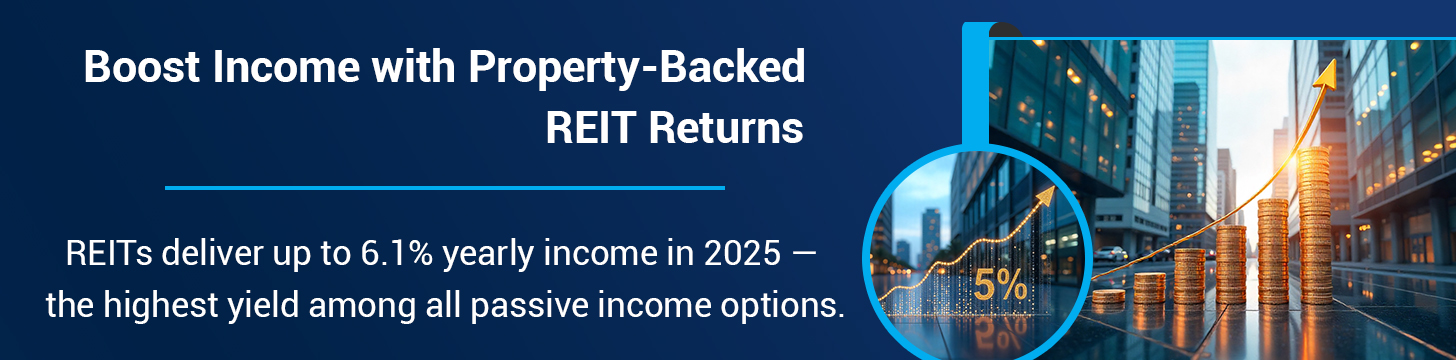
REITs (Real Estate Investment Trusts) give retirees a way to earn property-backed yearly interest acceleration, meaning your income grows faster than traditional safe products because it’s backed by rental yields from commercial and residential property portfolios.
This step shows how REITs boost yearly interest through higher yields, inflation-linked rents and diversified property exposure.
Real Asset Exposure
REITs offer several advantages over savings accounts, bonds and term deposits:
- Higher yields due to rental income and property appreciation
- Quarterly distributions for consistent cash flow
- Inflation protection as rents often increase annually
- Property exposure without owning a physical building
These factors generate above average yearly interest perfect for income focused retirees.
2025 REIT Yields: Highest in the Income Category
In 2025, Australian REITs average 6.1% yearly interest equivalent (distribution yield).
This means:
- $61,000 per year on a $1,000,000 investment
- More than ETFs, bonds or term deposits
- Recovery from earlier property market corrections
REITs are benefiting from stabilised rental markets and strong commercial occupancy in 2025.
2026 Projections
2026 forecasts suggest yields will moderate to 5.8% yearly interest equivalent due to easing interest rates and rising property values.
This means annual income will move from $61,000 → $58,000, but REITs will still be the highest yielding passive income assets.
Their property backing ensures long-term stability and inflation alignment.
Consistent Income Through Property Trusts
| Investment Type | 2025 Yield | 2026 Yield | Income on $1M |
| REITs | 6.1% | 5.8% | $58,000–$61,000 |
| Dividend ETFs | 5.2% | 5.0% | $50,000–$52,000 |
| Term Deposits | 4.45% | 4.10% | $41,000–$44,500 |
REITs beat all other passive income sources for retirees.
Why This Category Multiplies Income
REITs offer higher yields, so retirees get more income than traditional investments.
Their property backed returns are supported by real assets, not market speculation.
Rental contracts often go up each year, so REITs get inflation-linked rental income that boosts distributions.
They also show strong long-term performance across different interest rate cycles, so they are resilient when markets move.
For retirees who want premium income without the hassle of managing real property, REITs are one of the best annual interest strategies out there.
Annuities for Guaranteed Lifetime Income

Annuities offer something no other passive income product can match: guaranteed lifetime yearly interest guarantee.
This means your income never stops, never fluctuates wildly, and never depends on market conditions.
For retirees who want certainty and long-term security, annuities become a foundation of retirement planning.
This step focuses on how annuities stabilise yearly interest equivalent payouts throughout life.
Permanent Payout Mechanisms
Retirement can span 25–35+ years, exposing retirees to risks such as market volatility, interest rate fluctuations, sequence of returns risk and rising living costs.
Annuities eliminate these concerns by offering fixed or inflation-indexed payouts from day one, so income is stable regardless of external conditions.
With this structure, retirees get a predictable lifetime income, reduced financial anxiety, simplified budgeting and protection against outliving their savings.
These benefits make annuities one of the most reliable and strategically positioned tools for long-term retirement stability.
2025 Annuity Rates: Strong Payout Period
In 2025, indexed annuities offer 3.8%–4.5% yearly interest equivalent depending on age and annuity type.
For a $1,000,000 investment, this provides:
- $38,000–$45,000 per year
- Guaranteed payments for life
- No exposure to the share market or property volatility
Higher cash rates in 2025 make annuities more attractive.
Rate Shifts Anticipated for 2026
2026 annuity rates are projected to be 3.5%–4.2% yearly interest equivalent.
Income will change to $45,000 → $35,000–$42,000 depending on age.
Even with lower rates, annuities are one of the most stable, guaranteed income tools available.
Lifetime Earnings With Minimal Volatility
| Year | Annuity Payout (Equivalent %) | Income on $1M | Stability Level |
| 2025 | 3.8%–4.5% | $38,000–$45,000 | Lifetime Fixed |
| 2026 | 3.5%–4.2% | $35,000–$42,000 | Lifetime Fixed |
Unlike those ETFs, REITs, or property investments , annuity payouts don’t go up & down.
Advantages that Support Long Horizon Security & Peace of Mind
- A guarantee that your yearly interest is safe for the rest of your life
- Predictable payouts – no matter what happens in the economy
- Great for conservative & nervous retirees
- Helps make sure you don’t run out of money in your older years
Annuities are probably the safest bet for long-term passive income strategies when you’re getting towards retirement.
Look into Rental Property for Cashflow – it really is a game changer

Rental property does something that financial products just can’t do: it provides a cashflow return that’s almost the same as a yearly interest rate
Because rental income is real money coming from actual tenants & actual physical property, the returns are often higher than what you can get from a savings account, a bond or even some ETFs.
This step is all about how rental income turns into a yearly interest equivalent that will really boost your retirement passive income.
The Real-World Cashflow Streams that Really Matter
Property makes money through:
- Rent being paid out every week
- Annual rent rises that keep pace with inflation
- Long-term gains in value
- Tax breaks (depending on where you are)
All of these things combine to create a yearly interest equivalent return that is stronger than most defensive investments.
For retirees who’re after higher passive income, rental property can really make a big difference and boost your cash flow.
2025 Rental Property Trends: Solid & Rising Yields that are to be reckoned with
In 2025, Australia’s average net rental yield is around 4.4% in yearly interest equivalent – calculated after all the essentials like property management, council rates & insurance.
This means a $1,000,000 property will bring in $44,000 in yearly net income – that makes it a pretty competitive option compared to a lot of low-risk financial products.
These strong returns are backed up by high demand for rentals with low vacancy rates and continually rising rents because there just aren’t enough houses to meet demand, especially in big cities.
All of this makes the rental market a solid source of income in 2025, especially for retirees who are looking for a stable, real property cash flow.
Yield Progression Trends Projected for 2026
Looking ahead to 2026 and yields are expected to rise to 4.6% yearly interest equivalent due to:
- Too few houses are being built to meet demand
- Increased population
- Limited new homes are coming onto the market
That increases the yearly income from $44,000 → $46,000 and will make a real difference to the cash flow for retirees who are relying on rental income.
Property Cashflow Compared With Other Streams
| Asset Type | 2025 Yield | 2026 Yield | Annual Income |
| Rental Property | 4.4% | 4.6% | $44,000–$46,000 |
| Bonds | 4.15% | 3.90% | $39,000–$41,500 |
| Term Deposits | 4.45% | 4.10% | $41,000–$44,500 |
Rental property is consistently delivering competitive returns, and with long-term appreciation potential its a great way to build wealth.
What Really Drives the Appeal of This Kind of Investment
- Yearly returns that can easily rival those of other investments
- Rent increases that always seem to keep pace with inflation
- The stability you get from owning a real asset that’ll never go out of fashion
- The chance to really leverage growth over years to come
Rental property really stands out as a top choice for retirees who are after some passive income and a long-term boost to their wealth.
Diversify Your Income Streams to Get a Steady Annual Performance
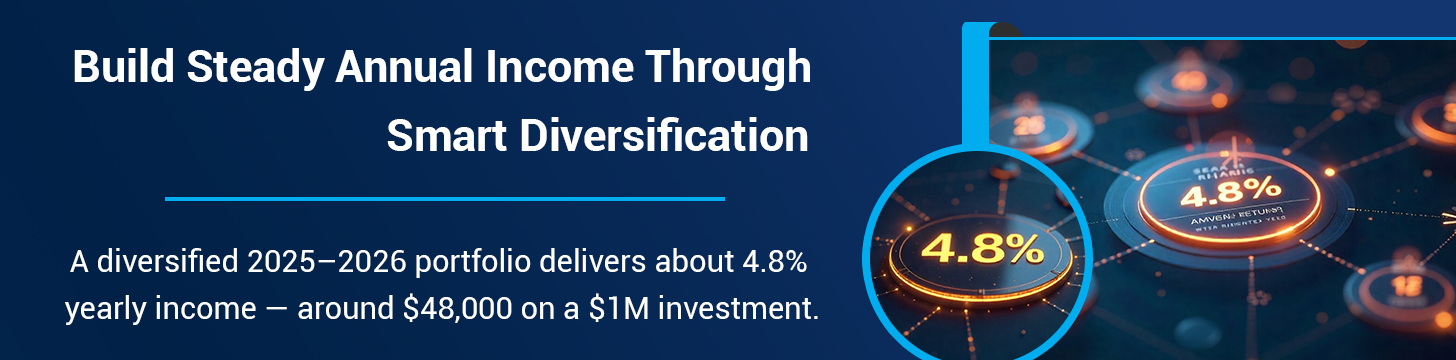
Diversification is the key to getting a yearly income that’s really resilient – if one of your investments tanks, the others can help pick up the slack.
Instead of putting all your $1,000,000 into one thing, spread it across different asset types, and you’ll bring down the risk and boost the reliability of your returns.
This step is all about showing how combining savings, bonds, ETFs, REITs and property can really help stabilise your yearly returns.
What Happens When You Try to Rely On Just One Investment
Relying on a single asset leaves you vulnerable to all sorts of risks – interest rate cuts, market downturns, falling rental demand and all the rest – and even the unexpected property maintenance bill.
But when you spread your investments across multiple asset types, you’ll notice that you don’t get hit as hard by the ups and downs – because if one thing isn’t doing so great, another one can step in and help out.
This balanced approach means you get a smoother, more predictable yearly income, even if one of your investments doesn’t quite perform as well as you’d hoped.
Portfolio Example for 2025-2026 Diversified Portfolio
So based on the income data you’ve got, a diversified retirement portfolio could be set up something like this:
- Bonds (30%) → 3.9–4.15% yearly return
- Dividend ETFs (30%) → 5.0–5.2% yearly return
- REITs (20%) → 5.8–6.1% yearly return
- Cash/Term Deposits (20%) → 4.0–4.45% yearly return
This blend of assets comes in at a combined yearly return of around 4.8% – which translates to a yearly income of about:
- $48,000
- Lower risk
- Protection from interest rate shifts
- More reliable long-term payouts
The Benefits of a Really Broad Range of Assets
Each one of these investments plays a unique role:
- Bonds add that extra layer of safety
- Dividend ETFs bring in both income and growth
- REITs offer those high yields
- Cash/TDs keep your capital safe and provide the flexibility you need
Together, they’ll give you a balanced yearly income that can ride out the ups and downs of the economy.
Balanced Portfolios Reduce Income Risk
| Portfolio Type | Yearly Interest | Risk Level | Notes |
| Diversified Mix | ≈4.8% | Low–Moderate | Smooth, predictable income |
| 100% Cash/TDs | 4.0–4.4% | Very Low | Lower income, exposed to rate cuts |
| 100% ETFs | 5.0–5.2% | Moderate | Higher income but market-dependent |
Diversification Protects Against Any Single Option’s Weaknesses
What Drives Balanced Allocation?
Some of the things that encourage a balanced yearly interest include:
- Providing a balanced yearly interest
- Reducing your exposure to risk
- Cushioning you against inflation and market downturns
- Maximising the reliability of your passive income
- Ensuring that your long-term financial stability is smoother
Diversifying across just 3 to 5 streams is the most resilient passive income strategy for retirees in 2025-2026.
Plan Withdrawals Using the 4% Rule for Long-Term Sustainability
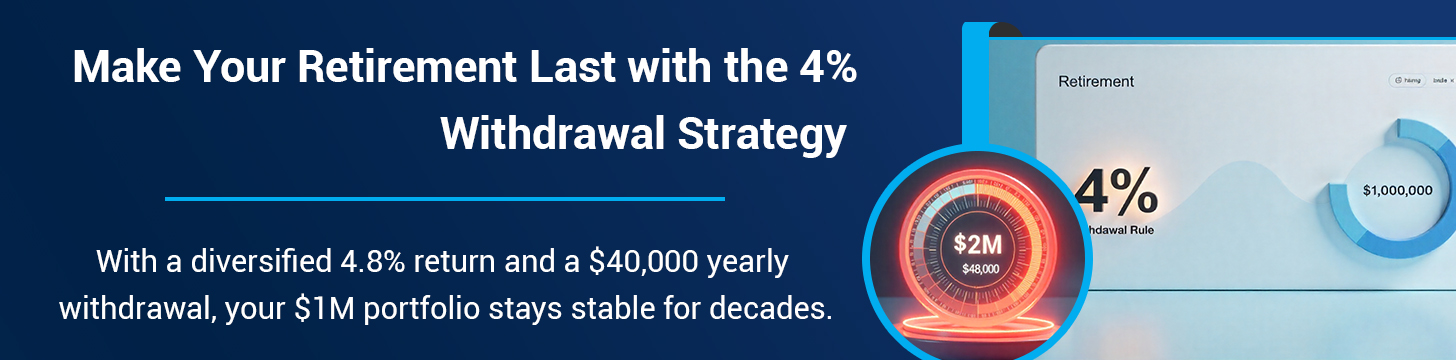
The 4% rule is a time-tested retirement strategy that’s all about preserving your yearly interest so you can have a predictable, long-term income stream – which means you can withdraw income without having to worry that it’ll eat away at your principal too quickly.
This final step shows you how to use a consistent withdrawal rate to keep your finances stable for decades to come.
Why a Structured Drawdown is So Important
Retirement typically lasts 25-35+ years, and without a disciplined plan, you can end up running through your savings long before you want to – leaving you with a big problem.
The 4% rule helps retirees:
- Not overspend
- Make stable withdrawals
- Preserve their hard-earned $1 million dollar principal
- Offset inflation through steady growth
- Plan with confidence every year
This rule is all about finding that delicate balance between getting an income and preserving your principal, which is absolutely critical for long-term financial security.
Putting the 4% Rule to Work for a Seven-Figure Balance
The rule says that a retiree can withdraw 4% of their portfolio each year, with a bit of inflation adjustment to keep things on track.
On a $1 million portfolio:
- 4% withdrawal works out to $40,000 per year
- That’s roughly in line with the interest you can earn from diversified investments
- This approach helps keep your portfolio stable even during the tough years.
This approach combines your yearly interest income with a manageable capital drawdown.
How the 4% Rule Relates to Real-Life Income Data from 2025-2026
We’ve already seen that diversified passive income can earn you ≈4.8% per year.
So that means:
- You earn about $48,000 from your investments
- You withdraw $40,000
- That leaves you with about $8,000 to help with any inflation or market volatility
This keeps your portfolio stable while giving you a comfortable lifestyle.
Retirement Withdrawals vs Real Earnings Power
| Strategy | Annual Income | Principal Stability | Notes |
| 4% Rule | $40,000 | High | Ensures funds last 25–30+ years |
| Passive Income (Avg 4.8%) | $48,000 | Very High | Covers withdrawal + buffer |
| Overspending (6–7%) | $60,000–$70,000 | Low | Risk of depletion |
The 4% rule remains in sync with the year-by-year interest ranges shown in those previous 9 steps.
The Perks of Ensuring Ongoing Financial Freedom
The 4% rule offers a nice & simple way to manage your retirement withdrawals, giving you peace of mind and confidence in your ability to manage your finances.
It lines up with real-life returns on investments, ensuring you’re always making sustainable choices when it comes to withdrawals.
By not spending too much, you build a safety net for the long haul, making sure your savings can last the distance in retirement.
And that puts a lid on financial worries, giving you a clear plan to stick to even when times get tough.
Because it works in all sorts of market conditions, the rule gives you a solid foundation for long-term planning that you can rely on.
And ultimately, it completes your passive income strategy by making sure your yearly interest pays for a comfy and sustainable retirement living.
FAQ: Yearly Interest on a Million Bucks
1. How much yearly interest can 1 million dollars earn in a high-interest savings account?
If you stash 1 million dollars in a high-interest savings account, you can expect to earn $40,000 to $55,000 a year, but the bank’s rate will make all the difference – usually it’s between 4% and 5.5% p.a.
Online banks can usually offer better rates than the old-style banks.
The interest gets calculated daily and paid out every month – that’s steady, reliable income.
But keep in mind, the taxman might come knocking, so check out the rules in your country.
2. How much yearly interest does 1 million dollars earn in a term deposit?
A 1-year term deposit will generally give you 3.5% to 5%, so you could earn $35,000 to $50,000 over 12 months all up.
Term deposits are popular because they’re so low risk and you get a guaranteed return – perfect for people who prefer stable income without all the market ups and downs.
Interest rates can vary depending on the length of the term, and the shorter the term the more you’re likely to get back.
3. How much can 1 million dollars generate in income from government bonds?
Government bonds typically yield 2.5% to 4%, which is $25,000 to $40,000 per year.
These are one of the safest income-producing assets as they are backed by the government.
While the returns are lower, they offer long-term stability, predictable payouts and lower risk during downturns.
4. How much can 1 million dollars generate in income from dividend-paying stocks?
A diversified dividend portfolio yields 4% to 6%, so you can earn $40,000 to $60,000 per year.
Some sectors yield higher, but they come with more volatility or cyclical risk.
Dividend-paying companies can also increase their payouts over time, so you can have a growing income rather than a fixed amount.
5. Can I earn $100,000 in interest from 1 million dollars?
You can earn $100,000 per year, but that requires around 10% return, which typically means higher-risk investments.
Options like aggressive stock portfolios, private lending or growth funds can generate these returns but come with more volatility.
Most low-risk or moderate-risk strategies will give you $40,000 to $60,000 per year.
It all depends on your risk tolerance, income goals and investment time horizon.

Valuable Insights On Property Development & Investment Opportunities
-

Top High Interest Short Term Investment Options for 2026
High Interest Savings Accounts for Liquid Cash Buffers Cash sleeve purpose and liquidity role High…
Read More -
Best Performing Managed Funds in Australia: Expert Tips & Strategies
Top-Performing Managed Funds in Australia: What Investors Need to Know In 2026, Australian investors are…
Read More -
Best Financial Advisor Perth: How to Choose the Right Expert for Your Goals
Financial Advisor Perth Key Criteria for Choosing the Best Adviser Choosing the best financial advisor…
Read More -
How to Make Money from Property Development in Australia: A Comprehensive Guide
High-Growth Cities Offering the Best Property Development Margins Australia’s property development landscape will be shaped…
Read More -
What Are the Best Low-Risk Investments in Australia for Beginners?
Low-Risk Investing in 2026: The Beginner Snapshot For Aussie beginners seeking low-risk investments in 2026,…
Read More


Our Project Site :


Exclusive waterfront living at the Lake Narracan Resort community.

Quick Links
The information provided is general in nature and does not constitute personal financial advice. The information has been prepared without taking into account your personal objectives, financial situation or needs. Before acting on any information on this website you should consider the appropriateness of the information having regard to your own objectives, financial situation and needs. All statements made on this website are made in good faith and we believe them to be accurate and reliable however do not guarantee its currency. You should seek legal or other professional advice before acting or relying on any of the content.
Please note that past performance may not be indicative of future results. Different types of investments involve varying degrees of risk, and there can be no assurance that the future performance of any specific investment, investment strategy, or product made reference to directly or indirectly on our website, blogs , newsletters.
Our Project Site :

Find premium land developments and new estates across Australia.
Exclusive waterfront living at the Lake Narracan Resort community.

Quick Links
The information provided on this website including blogs is general in nature and does not constitute personal financial advice. The information has been prepared without taking into account your personal objectives, financial situation or needs. Before acting on any information on this website you should consider the appropriateness of the information having regard to your own objectives, financial situation and needs. All statements made on this website are made in good faith and we believe them to be accurate and reliable however do not guarantee its currency. You should seek legal or other professional advice before acting or relying on any of the content.