


Table of Contents
Top-Performing Managed Funds in Australia: What Investors Need to Know
In 2026, Australian investors are on the hunt for managed funds that’ll really leave the system averages in the dust.
By then, the super pool will have grown from $4,082.3 billion to $4,466.5 billion, that’s a 9.4% bump up, with APRA-regulated assets up by 11.4% to $3,151.5 billion, & net contributions have risen by 8.1% to $71.3 billion.
Funds with over six members were able to deliver an annual return of 10.1% & even lift their five-year annualised performance to 8.3% p.a., up from a mere 5.9% p.a. a year earlier.
Looking ahead to 2026, AMP is predicting a RBA cash rate of 3.6%, the ASX 200 will be around 8,900, balanced superfund returns of about 6.8% & Australian home price growth of 5-7%.
Getting to the bottom of which managed funds will do the best in 2026 starts with the data on active managers. A review of 801 major funds has shown that VAS came in at 8.78% p.a.
With a fee of just 0.07% p.a., while the average large-cap fund delivered 6.96% p.a. with 1.20% p.a. fees & 90.5% of them didn’t even come close.
Then there are the standouts, like Glenmore Australian Equities, which whacked out 14.19% p.a. In the small caps, VSO did 7.43% p.a., the average active fund did 6.91% p.a., but a whopping 59.5% of them underperformed, with 40.5% outperforming. And then you have the leaders, like Regal Australian Small Companies, which blasted 17.83% p.a.
Globally, IOO came in at 16.84% p.a. The average large-cap global fund managed 10.51% p.a., but 98% of managers ended up lagging, while elite funds like Acadian Global Equity Long Short went all the way to 22.65% p.a.
The SPIVA mid-2024 survey showed that 54% of funds didn’t make the grade overall, 72% of global equity funds missed out on the S&P World Index, 48% of Australian equity general funds fell short of the S&P/ASX 200, and 79% of A-REIT funds didn’t even beat their index.
On the other hand, only 32% of Australian mid- and small-cap funds underperformed (which is actually pretty good), while bond funds saw a 33% rate of underperformance, way down from a record 26% the year before.
And with Macquarie’s bluer skies but also potentially more bumpy ride view on 2026 – they reckon equities will do well in emerging markets, Europe and Japan and a barbelled mix of quality fixed-rate credit and floating-rate senior secured private credit is the way to go – the “best” funds for 2026 will be those in the top 14-23% p.a. band that consistently beat the ETF baselines of 8.78%, 7.43% and 16.84% p.a.

The Glenmore Australian Equities Fund’s Unbeaten Track Record

A Boutique Fund that Boasts a High-Conviction Portfolio
Glenmore Australian Equities Fund is run by a boutique high-conviction manager – a tiny team with a laser focus on picking out a smaller selection of ASX stocks rather than trying to cover the whole market with a massive portfolio.
Smaller teams are lighter on their feet, able to get their research and investment ideas up and running quickly. They also tend to be easier for investors to understand what’s going on, since there’s less smoke and mirrors involved in managing a smaller fund.
Before you even worry about performance, a savvy investor will take a closer look at the fund’s structure to make sure it’s a good fit.
The government’s MoneySmart managed funds guide is a good place to start – compare fees, risk, and minimum investment requirements to get a feel for whether this is the right fund for you.
Glenmore’s boutique status means it tends to deliver:
- A tighter portfolio, with each stock having a bigger impact on the overall performance
- A willingness to take more risk, which can mean higher returns – but also higher losses
- A heavy reliance on research and discipline, rather than just going for a brand name
That’s exactly what you’d expect from a “best performing” shortlist built from Australian Consumer Search Insights and professional fund databases.
Outpacing the Competition for 5 years… and counting
Stockspot took a look at 349 Australian large-cap share funds and found that the average fund managed to deliver 6.96% p.a. after fees over 5 years, while a simple index ETF (VAS) returned 8.78% p.a. in the same time frame.
Against that backdrop, the Glenmore Australian Equities Fund is a stand-out performer, with a 5-year return of 14.19% p.a. – more than double the average fund in its category, and well ahead of the ETF benchmark.
We take a look at what experts like Money magazine have to say about different types of managed funds, and it’s clear that Glenmore’s outperformance is the exception rather than the rule: most active funds struggle to beat low-fee index products once you factor in fees and taxes.
Looking at historical case studies, like Firstlinks’ analysis of the best and worst managed funds of all, shows just how important manager skill, fund structure and risk controls are when it comes to making or breaking your long-term wealth creation strategy. Take a look at those case studies to get a better idea of what makes Glenmore tick.
How Glenmore Fits into Your Portfolio
In a diversified portfolio, Glenmore is best thought of as a high-growth Australian equity holding, rather than your entire investment strategy.
It might be a good fit for:
- Investors who are comfortable with a bit of volatility, but are willing to take that risk in the hope of higher long-term returns
- Portfolios that already hold a broad index exposure, and want to add a bit of active tilt to the mix
- People who are happy to keep an eye on the manager’s performance and benchmark comparisons, rather than just focusing on last year’s headlines
Used this way, Glenmore’s boutique status, high-conviction profile and 5-year track record will help it stand out on any “Best Performing Managed Funds in Australia” list – because it’s built on solid data and real investment performance, not just marketing spin.
Paradice Equity Alpha Plus Fund Long Short Downside Cushion

Long short strategy in play for Australian shares
Paradice Equity Alpha Plus Fund breaks the mould of traditional “long-only” Aussie share funds.
Instead of just picking shares they like and buying them, the manager can also try to outsmart the market by selling short shares that they think are going to underperform.
In practice, this means:
- Holding onto a core portfolio of high-quality Aussie companies that the manager genuinely believes in.
- Selling shares in weaker companies or overvalued sectors, to help generate a bit of extra profit or reduce the risk of the overall portfolio.
- Combining these two elements in a mix to go after “alpha” above the S&P/ASX 200 index, not just mirror what the market’s doing.
Educational resources like ASX-managed funds* and ASIC’s managed investment schemes help readers understand that long/short funds are just as regulated, but with a more flexible toolkit at their disposal.
It’s this flexibility that lets the Paradice Equity Alpha Plus Fund go for the upside and also have a safety net to fall back on in case things go wrong.
Managing downside risk – and still getting ahead
Stockspot’s analysis of Australian large-cap active funds showed that, over the past 5 years, the average fund came in at around 6.96% p.a. after fees, while a simple index fund like VAS was closer to 8.78% p.a.
This tells you something pretty telling: most “long-only” active funds just can’t beat the market after you’ve paid the fees.
But Paradice Equity Alpha Plus Fund is not your average active fund. A specialised long/short strategy like this is designed to tackle that problem head-on.
By:
- Boosting returns with short ideas, not just sticking to the long play.
- Giving the manager the flexibility to scale back the overall exposure to the market whenever they think the risks are getting too high.
- Allowing them to profit in markets where some sectors take off while others tank.
Take this, for example: in a period where the banks and miners are underperforming, but you’ve got a few tech or healthcare names that are flying, a long-only fund is just going to track sideways.
But a long/short portfolio can:
- Pile into the companies that look like winners in the long term.
- Take a bet against the shares or sectors that are going to tank.
- Aim for a more stable return profile even through all the ups and downs.
How it fits in a diversified Aussie share portfolio
In a diversified equity mix, Paradice Equity Alpha Plus Fund usually sits as a satellite fund that’s designed to add some extra juice to the mix, not as the core.
It tends to suit investors who:
- Have already got a broad exposure to the ASX in their portfolio.
- Are after an active fund that’s specifically tasked with trying to outperform the market, rather than just copying it.
- Understand that long/short funds come with a bit more complexity and potential volatility, even if the goal is to have a safety net to stop the portfolio from taking a hiding in tough times.
When you use this fund alongside core index holdings, it’s really all about putting the best process and structure in place, not just trying to chase a past performance chart
PM Capital Australian Companies Fund: Concentrated Value Portfolio

This isn’t your average tracker fund
PM Capital Australian Companies Fund is a deliberately concentrated Australian equities portfolio, with the team steering clear of the usual approach of spreading your money across 60 – 200 ASX names.
Instead, they focus on a small, handpicked selection of what they genuinely believe in, rather than trying to match the market.
When you’re only investing in your top 20-30 favourite ideas, each successful holding is going to really make its mark on your returns.
And it also means the fund’s performance is going to be pretty unlike the index, which is what you want when you’re browsing through the “Best Performing Managed Funds in Australia” on Australian Consumer Search Insights or other fund databases.
A concentrated approach can:
- Really amplify the gains when you nail the valuation of a stock.
- Make the research process totally transparent – you can actually read about the key positions.
- Force you to be disciplined, since there’s no room for throwaway stocks that don’t add any value.
A value-savvy & quality-focused approach
The “value-tilt” part of the name gives away PM Capital’s focus on companies that are probably worth more than they’re being sold for.
So instead of paying top dollar for a popular growth stock, the team is out looking for:
- Solid finances and sensible levels of debt.
- Durable cash flows with some reasonable growth expectations.
- Situations where sentiment has just pushed the price too far below what it’s really worth.
When you’re following a value-tilted strategy, you often find that some years you’ll be lagging the market when the growth stocks are doing well.
But in the long run, having a valuation discipline in place can help protect your capital when the cycle turns, and the hype dies down.
When interest rates rise, the overpriced “story stocks” that were riding on hype rather than fundamentals can take a real hit, but quality companies bought at a discount are more likely to hold up better, which can translate into more consistent results over the long term..
How it fits into an overall Australian share strategy
In practice, PM Capital Australian Companies Fund is best used as a small, active satellite fund alongside a broad ASX index core.
It’s a good fit for investors who:
- Want some deliberate value exposure in their Australian equity portfolio.
- Can handle a bit of tracking error when compared to the benchmark.
- Prefer managers who write detailed commentary on why they made each of their investment decisions, and how they see the portfolio looking, which can be really empowering when you’re comparing options on Australian Consumer Search Insights.
Chester High Conviction Fund Flexible Australian Share Strategy
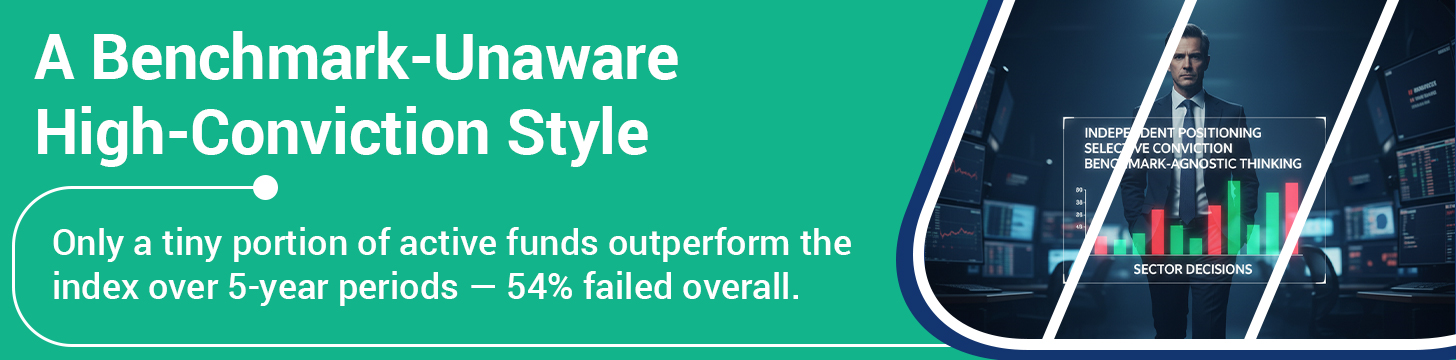
Completely Unfazed by Benchmarks
Chester High Conviction Fund isn’t built to merge with the index – not by a long shot. We make it a point to stand out from the crowd, not try to sneak up behind it.
Rather than tracking the S&P/ASX 200 with a small fudge factor, our portfolio is built around a handpicked selection of our best ideas. That means the sector and stock weights can diverge quite sharply from the benchmark – no worries.
In practical terms, an approach like this lets the manager:
- Stay away from entire sectors that they think are fundamentally flawed.
- Go all-in on the companies we really believe in – even if they make up just a tiny fraction of the index.
- Tolerate a bit more tracking error when we see a clear price mismatch.
The fact is that for years now, reviews of Australian large-cap funds have shown that only a tiny proportion of active managers can outperform a low-cost index fund over rolling 5-year periods.
So when you see a fund making it onto some list of “Best Performing Managed Funds in Australia”, courtesy of data from Consumer Search Insights, the chances are it’s not been a happy accident – our managers have had to be pretty deliberate in how they take risk.
Flexibility is our best friend
Chester’s got another trick up its sleeve – being able to swing a chunk of cash at any time. Our manager doesn’t have to be invested to the hilt at all times.
They can go to cash when good opportunities are thin on the ground or when the outlook looks particularly grim.
And it’s not just about the headlines – it really does make a difference in real numbers.
If the market falls by 20%, and a fund is:
- Locked, stock and barrel, 100% invested, the whole portfolio is exposed to that full 20% drawdown – before fees and individual stock performance.
- 85% invested, with 15% in cash, the effective market exposure is 85%. That same 20% index fall would translate to a 17% hit from market beta – before any fallout from individual stocks.
That 3 percentage-point difference may not sound huge over a single month. But over a long bear market, a bunch of smaller drawdowns can really add up to protect investor capital.
How we behave in bull and bear markets
When it comes down to it, a benchmark-unaware, cash-happy fund tends to:
- Lag in roaring bull markets, where almost everything is on the up.
- Hold its own in down or sideways markets, where selectivity and cash are much more important.
Cyclical sectors in a sharp risk-off slide:
- Underweight those sectors, while
- Keeping a bigger cash balance
will typically see their portfolio fall a lot less than the headline index.
The end result over 5 years can be an annualised return in the “high-teens minus” or “low-teens” bracket, even if the index is only chugging along in the high single digits.
That’s what gets Chester High Conviction Fund on a curated list of “Best Performing Managed Funds in Australia” – and it all stems from the design choices baked into the fund’s mandate.
Portfolio role for Australian investors
For Australian investors, Chester often makes more sense as a satellite active allocation alongside a low-cost index core.
It works for people who:
- Understand that the sharemarket can behave erratically and its returns won’t mirror the market’s.
- Value keeping their fortune safe during tough times.
- Are you comfortable with the idea of a manager who is getting paid to be different, rather than aiming to simply match the benchmark?
Used this way, Chester’s benchmark-unaware, flexible-cash design turns “risk management” into a tangible, actionable part of your portfolio.
Smallco Broadcap Fund: Broad Cap With A Tilt Towards Smaller Companies

Large-cap fund with a deliberate tilt toward smaller growth companies
Smallco Broadcap Fund is a broad-cap Australian shares strategy, but the thing that really sets it apart is its tilt towards smaller growth companies – not just the usual big names.
Portfolio mix beyond large-cap indexes:
- Established large caps for stability.
- Smaller growth businesses that the team thinks are undervalued.
- A blend that can deliver some pretty strong results.
When a fund like this makes it onto a “Best Performing Managed Funds in Australia” list built from consumer search data and institutional results, it’s usually because that mix of smaller + larger names has translated into really resilient returns.
In the Stockspot / Morningstar rankings that are usually used to rate funds, Smallco Broadcap delivered a whopping 11.56% per annum over 5 years, which is a lot better than the average 6.96% per annum for active large-cap funds, let alone many broad index funds.
Smaller growth stocks as potential return drivers
The small-cap and mid-cap end of the ASX is where information is a bit thinner, and analyst coverage is patchier.
That creates opportunities for skilled fund managers to add real value.
Smaller growth companies can:
- Rise sharply when the market finally recognises their earnings strength.
- Grow their revenue and profits from a smaller base, compounding faster.
- Be acquired by bigger players at a premium price, which is a good thing for investors.
The downside is you get a bit more volatility and risk. Share prices can move a lot on news flow and sentiment.
A broad-cap structure like Smallco’s helps balance this by:
- Keeping a core holding in larger, more liquid names.
- Allocating a bit more risk budget to smaller growth ideas that the team is really confident about.
Risk-return profile over real market cycles
Over a full cycle, a fund with this profile is likely to:
- Outperform in years when there’s a lot of dispersion between good and bad performing stocks.
- Experience larger swings when the market is selling off small caps.
That’s why Smallco Broadcap Fund is best viewed as a growth-tilted satellite inside a diversified Australian equity portfolio.
Used alongside a low-cost ASX index core, its broad-cap plus smaller-growth design gives investors a clear path to pursue higher long-term returns without abandoning the large-cap anchor that underpins most “Best Performing Managed Funds in Australia” rankings.
Tribeca Alpha Plus Fund Class C Active Long Short Alpha

Long short engine built specifically for alpha
Tribeca Alpha Plus Fund (Class C) isn’t your average Australian share fund.
It’s actually built as an active long-short Aussie equity strategy. Meaning the manager can buy up companies they think are gonna do better and sell short companies they think are gonna do worse.
In practical terms, this means the portfolio will typically have:
- A solid, long book of top-quality Aussie companies
- A short book of weaker or overvalued names that are due for a fall
- A net exposure that is still all about stocks but with a bias towards generating that all-important “alpha plus, which basically means beating the benchmark
Unlike a normal active fund, which can only win on its long bets, the long/short design of Tribeca Alpha Plus Class C can also pick up a few extra dollars by correctly identifying companies to avoid or short.
Benchmark plus objective and risk budget
The whole point of this strategy is to bring home a profit – and that’s exactly what it’s called – “targeting excess return above the benchmark”.
Looking at the numbers, Stockspot’s analysis of 349 Australian large-cap funds showed that the average active fund only managed about 6.96% pa after fees over 5 years, while a simple index ETF like VAS came in at around 8.78% pa over the same period.
That’s a problem – because most long-only active funds just failed to beat the benchmark.
Tribeca Alpha Plus Fund (Class C), however, was a standout, sitting comfortably in the top-performing bunch of Aussie large-cap strategies, with a 5-year return of around 11.43% pa in the same study period.
That’s a pretty decent gap – roughly 2.5–4 percentage points per year over a whole bunch of its peers – and its this that’s gets it a spot on a curated list of “Best Performing Managed Funds in Australia” that is built from all sorts of data and research like Australian Consumer Search Insights and institutional research feeds.
Portfolio behaviour through real market cycles
Because it’s got a long short structure, the fund’s return path can look a bit different from a standard index fund.
In booms, it still gets to participate in the upside through its long book.
In downturns, the short positions kick in and the ability to cut back net exposure can help ease the pain.
We can see this in action, for example, in a year where the S&P/ASX 200 is flat overall – but:
- Quality winners have risen by 15-20%, and
- Weak companies have fallen by 20-30%
A long/short portfolio that is long the winners and short the laggards can still turn in a positive return while the index just sits there.
Integration into a higher-risk Australian equity bucket – for a more sophisticated investor
In a well-rounded strategy, this fund typically sits alongside a low-cost index core as a specialist ‘alpha-seeker’.
It suits investors who already have a broad Australian equity exposure and are now looking for a sleeve dedicated to beating the benchmark, not just matching it.
Understandably, they accept that the extra flexibility of long/short investing comes with added complexity and potential volatility – even when the aim is better risk-adjusted returns.
Used in that way, the Tribeca Alpha Plus Fund (Class C) turns the concept of “best performing managed funds” into a meaningful structure and process, underpinned by multi-year results rather than just a single strong year.
Airlie Australian Share Fund – Quality Value & Income Focus
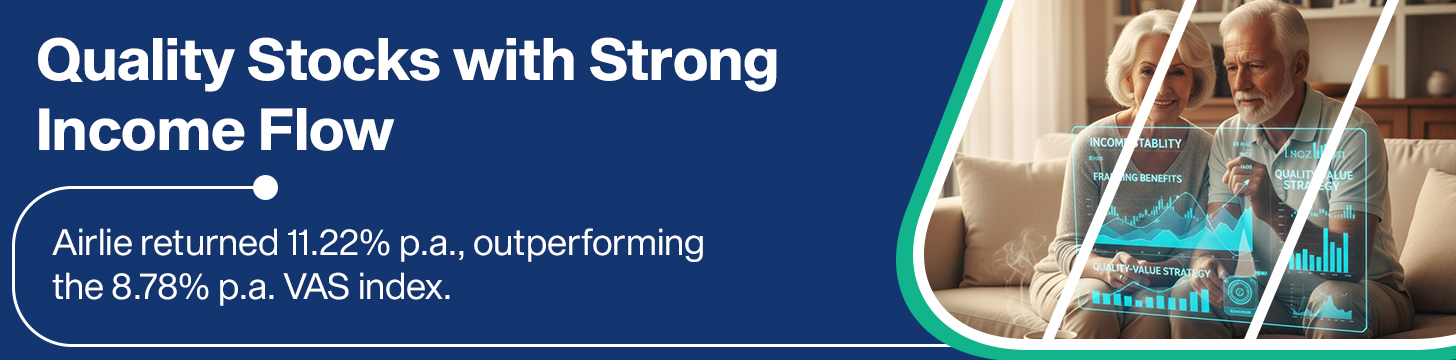
A quality-and-value approach at the heart
Airlie Australian Share Fund is built around a focus on quality and value, rather than a hunt for momentum.
Their portfolio is concentrated in solid Australian businesses with clean balance sheets, sensible leverage and cash flows that can support dividends over time.
That means the team will pass on expensive ‘hot’ names if valuations don’t stack up, and instead focus on investing in robust, cash-generative companies trading at reasonable prices.
In tools like Australian Consumer Search Insights and institutional data, that particular combination of quality and value is a major reason Airlie consistently pops up in “Best Performing Managed Funds in Australia” lists.
Income and franking as key design elements
Airlie’s strategy is different to purely growth-focused strategies – they lean into dividend income and franking credits as fundamental parts of the return.
That’s especially useful for Australian investors, particularly:
- Retirees who rely on regular income from their portfolio.
- SMSFs and low-tax investors who can get the most out of franking credits.
- Households that want returns which don’t just rely on share prices rising every year.
With the underlying holdings producing a 3-5% cash yield, and franking credits adding extra after-tax benefit, investors are less reliant on the share price going up every year. That can help smooth out the ride through flat or choppy markets.
Track record for delivering yield and total return
In the Stockspot / Morningstar analysis that underpins that list you looked at, Airlie Australian Share Fund delivered around 11.22% p.a. over 5 years.
Over the same time frame, the average active Australian large-cap fund returned roughly 6.96% p.a. after fees, while a low-cost index ETF like VAS did about 8.78% p.a.
So Airlie not only beat the average active manager – it also outpaced the core index by several percentage points a year, all while still prioritising income and franking.
Portfolio Role for Aussie Investors
In how we put together a practical asset mix, Airlie is usually used as a core or slightly better than core Australian equity holding.
It’s suited to investors who:
- Are looking for exposure to top-shelf Australian companies and a disciplined approach to how we value them.
- See dividends and franking credits as a vital part of their returns, not just some bonus.
- Are okay with a portfolio that might look a bit different from the usual index funds, but still very much focused on the large and mid-cap space of Aussie shares.
Using Airlie in this way, our quality focus combined with a tilt towards income makes the whole idea of “the best performing managed funds” not just a backwards-looking performance chart, but actually a strategy that makes sense.
Hyperion Australian Growth Companies Fund – A Fund of High-Growth Leaders
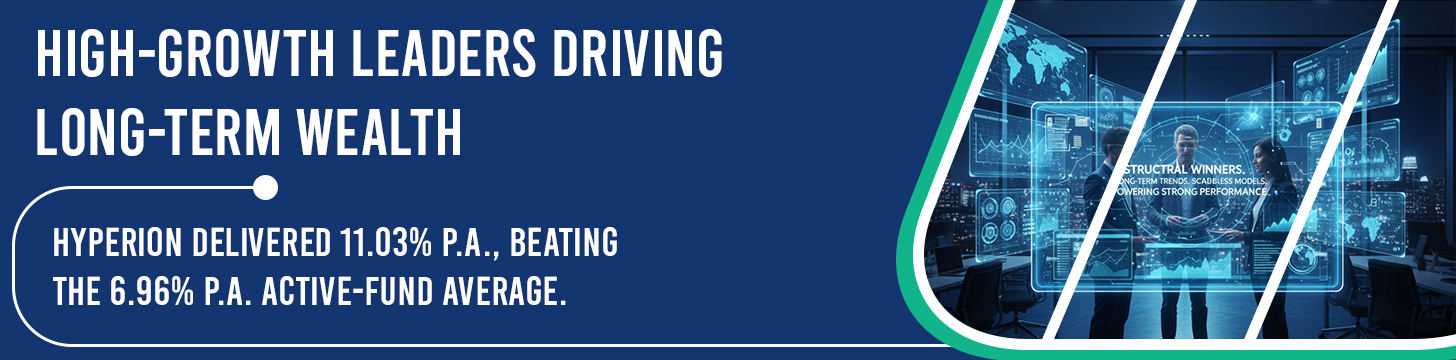
High-growth investing – High conviction indeed
Hyperion Australian Growth Companies Fund is built as a genuinely risk-on, high-growth portfolio, not just a rough imitation of the market.
The team here focuses on a smaller number of their best ideas rather than trying to cover every big name in the index.
This means a bigger proportion of the portfolio sits in companies that are growing fast, with strong margins and business models that scale well.
When you look at the 5-year results that sit behind those “Best Performing Managed Funds in Australia” lists that you get from from Consumer Search Insights or your usual institutional data feeds, Hyperion has delivered around 11.03% per annum, vs roughly 6.96% per annum for the average Australian large-cap active fund, or about 8.78% per annum for a no-frills index fund like VAS.
That 2-4 percentage point gap each year is what you’d expect from a high-conviction, growth-focused manager when their process is firing on all cylinders.
Winners of the Long Game on the ASX
We used the phrase “structural winners” deliberately in the headline, because that’s exactly what Hyperion is looking for.
The fund backs businesses that are on the right side of long-term trends – things like:
- Companies that are a part of the digital revolution, or cloud and software-as-a-service.
- Businesses that are involved in healthcare or are positioned to profit from demographic shifts.
- Companies that sit at the heart of infrastructure, payments or data-driven business models.
Instead of trying to trade on every short-term market cycle, we typically hold on to these structural themes for many years, letting compound returns do the hard work for us.
If a business can grow profits by 10-15% per annum for a decade, the share price doesn’t need to re-rate every single year for investors to see strong total returns.
And that’s precisely the profile you see when a growth manager is consistently near the top of the Best Performing Managed Funds in Australia performance tables, as drawn from your Consumer Search Insights analysis.
Risk-Return Trade-offs in Real Markets
The trade-off is a bit more volatility. High-growth stocks can fall harder when the market is going down, or when interest rates suddenly spike.
Hyperion’s high conviction approach means:
- Bigger sell-offs in times of market pressure are possible.
- But stronger comebacks when growth starts to come back into fashion.
Over a full 5-year window, this has translated into double-digit annualised returns that outpace the average active manager and even the core index, which is why you so often see the fund on those curated lists of “Best Performing Managed Funds in Australia”.
Portfolio role for Aussie investors
In reality, the Hyperion Australian Growth Companies Fund works as a growth-focused satellite holding in practice.
It suits investors who:
- Already have a broad ASX 300 index as a core investment.
- Are you looking for an extra growth boost from a fund that focuses on structural winners?
- Can accept that the fund will have ups and downs in the short term, but are willing to put up with this in the hope of higher long-term returns.
Used this way, Hyperion’s high-growth, high-conviction approach turns the ‘best performing’ label from Australian Consumer Search Insights into a genuine growth strategy, rather than just a number on a leaderboard that means nothing.
Sterling Equity Fund Style Balanced Australian Equity Strategy
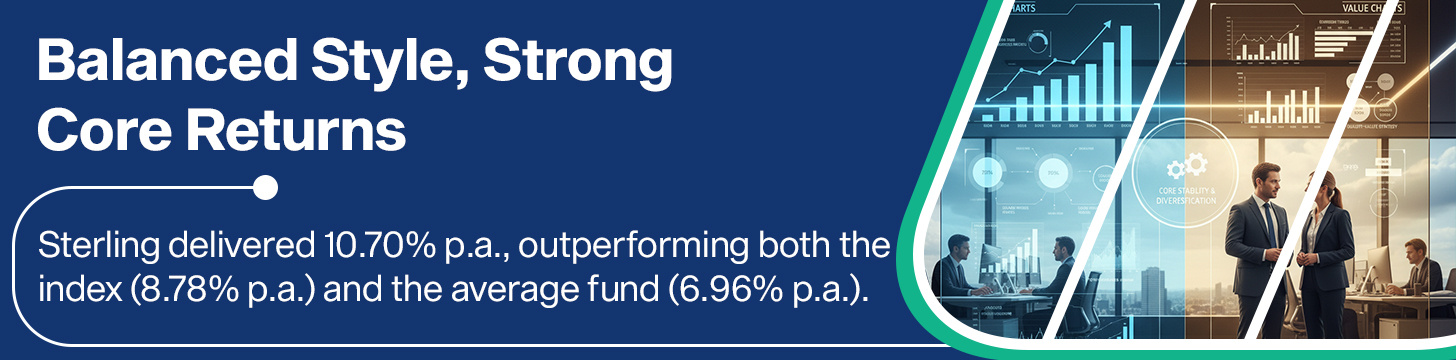
More balanced than just all-growth or all-value
Sterling Units (Sterling Equity Fund) is a sensible Australian equity strategy that aims to stay balanced.
Rather than choosing to go full-on with pure growth or deep value, the portfolio blends:
- Quality growth names with a solid run of earnings growth.
- Reasonably priced value and income stocks with strong cash flows.
- A solid core of large caps, with a bit of mid-cap action.
The balance matters because pure growth funds can do amazingly well in boom times and then crash when the market turns, while deep value funds can hang on for years before the cycle finally turns.
A style-balanced approach gives you a more even shot at multiple drivers of return, which is exactly what you want if you’re building a sustainable Australian core equity holding from data-backed lists such as Best Performing Managed Funds in Australia sourced via Australian Consumer Search Insights.
Benchmark-aware rather than trying to ignore the benchmark
“Benchmark-aware” in the headline means Sterling doesn’t try to totally ignore the index, but it also isn’t content to just play it safe by following the index blindly.
The manager targets:
- A bit of tracking error – enough to add some value, but not so much that it behaves like a relic of the last crisis.
- Sector weights that stay fairly close to the S&P/ASX 200, but still allow for conviction.
- Risk controls that don’t let the fund get too far ahead of the market.
In the Stockspot/Morningstar 5-year tables, you’ll find that Sterling delivered around 10.70% pa, versus roughly 6.96% pa for the average Aussie large-cap active fund and about 8.78% pa for a simple index ETF like VAS.
That 2-4% gap per year really adds up over a decade – especially when it’s achieved with solid core-style, benchmark-aware risk levels rather than taking huge risks.
Role as a Core Building Block in an Australian Portfolio
The way this is all put together, Sterling Units is best thought of as a core or core-plus Australian equity allocation – not just a niche investment that’s tacked on elsewhere.
It’s a good fit for investors who:
- I want a solid, balanced exposure to Aussie shares, with no jarring surprises.
- Prefer a fund that doesn’t get too carried away and drift too far from what you’d expect from the market averages.
- I still want a fair shot at outperforming the market over 5 years.
Within lists of the best performing managed funds in Australia, driven by insights from Australian Consumer Search and institutional data, Sterling Units’ blend of balancing styles, keeping an eye on the benchmark, and a disciplined approach gives you a genuine core option – not just another speculative bet.
Tribeca Alpha Plus Fund Class A Core Long Short Equity Strategy
The Foundation of the Long/Short Engine
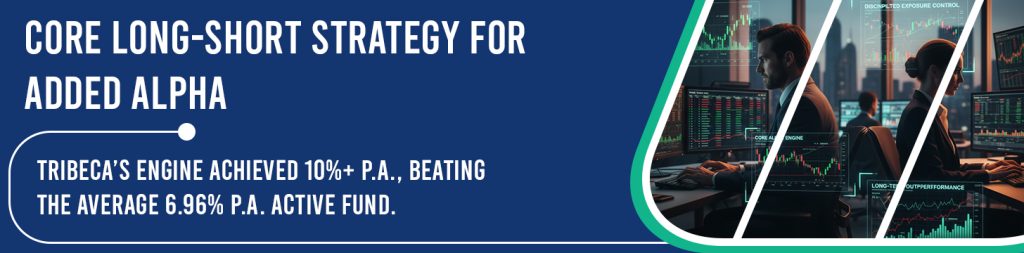
Tribeca Alpha Plus Fund (Class A) is the entry point for the long/short Aussie equity engine.
Where Class C might be used in institutional or platform channels, Class A is what many advised, and high-net-worth investors use to get started with the same core engine.
The portfolio involves:
- A list of companies we think will do better than the others.
- A list of stocks we think will do worse than the others.
- Net exposure that stays focused on the Aussie sharemarket, but aims to get a bit more bang for your buck than the S&P/ASX 200.
This is very different from a long-only fund, which can only succeed by getting its buy ideas right. Here, the team’s use of shorts and net exposure is their active tools for chasing alpha.
When lists of the Best Performing Managed Funds in Australia are built from data sources like Australian Consumer Search and institutional research, Class A is on the list because it taps into the same proven engine that drives the other top-ranked Tribeca Alpha Plus share classes.
Deep Manager Expertise and Risk Discipline
The key experience of the manager is important because long/short strategies add complexity.
You’re asking a team to:
- Pick winners and losers from the same market.
- Manage their overall exposure and the net exposure (the difference between what they’ve got long and what they’ve got short).
- Control leverage, liquidity and stock-specific risk at the same time.
Over 5 years, Tribeca Alpha Plus has consistently performed well, with Class C showing a 11.27% p.a. return and Class A getting into the 10%+ p.a. range, while the average Aussie active fund returned around 6.96% p.a. and a simple index ETF returned 8.78% p.a.
It’s a result of a process that’s been tried and tested through multiple market phases, rather than just a one-off lucky streak.
FAQ
1. What are the so-called “best performing managed funds” in Australia, and how is performance actually measured?
When we talk about the “best” managed funds in Australia, what we usually mean are the ones that have delivered a strong return in relation to the level of risk they took on, not just some big one-year gain.
Performance is commonly measured in the following ways:
- Total return – that’s income (distributions) plus the growth in the fund’s value over a period, so you can see how it’s done overall.
- Time-weighted returns – this gives you an idea of how an initial investment, say $10,000, would have grown over 3, 5, or 10+ years.
- Risk-adjusted metrics – things like how volatile the fund was and the Sharpe ratio, which is a way of comparing the return to the amount of risk the manager took on.
- Benchmarking against other funds – for instance, an Australian equities fund versus the S&P/ASX 200 index, or a global fund versus the MSCI World index.
A truly “best performing” fund is likely to show:
- Some pretty strong long-term returns across a range of time frames.
- A consistent track record of returns above that of its benchmark.
- A reasonable level of volatility, given the kind of assets it’s invested in.
2. Why does a fund that’s top of the leaderboard one year suddenly drop down the performance charts the next?
A fund’s performance can be heavily influenced by the ups and downs of the market, as well as the specific sectors or assets the manager is holding.
If a fund is heavily invested in a sector that does really well one year – like technology, resources or small caps – it can shoot up the rankings.
But then, if that same sector underperforms the following year, the fund’s ranking can drop just as quickly, even if the manager has stuck to their original process.
Short-term rankings also get influenced by things like:
- Currency movements for global funds.
- Changes in interest rates for bond and income funds.
- One-off events like company write-downs or market shocks.
That’s why most pros look at a fund’s performance over 3, 5 and 10 years and focus on consistency, rather than chasing last year’s “number one” fund.
3. What are the key risks I should keep an eye on before investing in a high-performing managed fund?
Even if a fund has a long track record of success, it’s still got risks attached.
Some of the key ones to watch out for include:
- Market risk – if the overall market is down, the fund’s value can drop, even if the manager is top-notch.
- Sector or style risk – funds that focus on growth, value, small caps or niche sectors can be way more volatile and may lag behind for extended periods.
- Manager risk – if a key portfolio manager or investment team leaves, future results may not be as strong.
- Liquidity and withdrawal risk – some funds, especially those with unlisted or property investments, may restrict withdrawals in times of market stress.
And don’t forget that past performance is absolutely no guarantee of future results, and that higher return targets usually come with higher potential losses.
4. Choosing Between Top-Performing Funds – What To Consider
When you see multiple funds with great performance numbers, you need to dig a bit deeper and not just look at the surface level of those numbers.
Some practical things to consider are:
- What kind of fund are you looking for? Make sure the fund’s strategy (like Australian shares, global shares, or a diversified portfolio) fits with what you’re trying to achieve over the long term.
- What’s the real cost of the fund? Compare the ongoing management fees and performance fees; even a small difference in fees can really add up over years and years.
- How steady are the returns? Take a look at how the fund performed over 3 year blocks to see if its returns are steady or if it’s been a bit of a rollercoaster.
- How did it behave in tough times? Check out the fund’s past performance during times of market downturn – some investors prefer a smoother ride even if it means slightly lower returns.
- What’s the management process like? Read the fund’s documents and fact sheets to get a sense of how decisions are made and who’s in charge.
Balancing all these factors will help you pick a fund that not only performs well, but also fits with your risk tolerance and what makes you comfortable.
5. Dangers Of Putting All Your Eggs In One Basket
It can be tempting to put all your money into one super-performing fund, but this can be really risky business.
If that one fund turns out to underperform or falls out of favour with investors, your whole portfolio can take a hit.
Most investors avoid this by:
- Spreading their money across different types of investments (like shares, bonds, property, and cash).
- Diversifying across multiple fund managers and investment styles – rather than putting all your trust in just one “star” fund.
- Making sure each fund is matched to a specific goal – like using a growth fund for long term wealth building and a more defensive fund for cash you’ll need in the short term.
Diversification will never get rid of all risk, but it can make the ride a lot smoother and reduce the impact of any one fund having a bad year.

Valuable Insights On Property Development & Investment Opportunities
-

Top High Interest Short Term Investment Options for 2026
High Interest Savings Accounts for Liquid Cash Buffers Cash sleeve purpose and liquidity role High…
Read More -
Best Financial Advisor Perth: How to Choose the Right Expert for Your Goals
Financial Advisor Perth Key Criteria for Choosing the Best Adviser Choosing the best financial advisor…
Read More -
How to Make Money from Property Development in Australia: A Comprehensive Guide
High-Growth Cities Offering the Best Property Development Margins Australia’s property development landscape will be shaped…
Read More -
What Are the Best Low-Risk Investments in Australia for Beginners?
Low-Risk Investing in 2026: The Beginner Snapshot For Aussie beginners seeking low-risk investments in 2026,…
Read More -
50 Passive Income Ideas: The Best Ways to Generate Consistent Income
From Active Work to Scalable Passive Income Ideas Passive income isn’t just a fleeting side…
Read More


Our Project Site :


Exclusive waterfront living at the Lake Narracan Resort community.

Quick Links
The information provided is general in nature and does not constitute personal financial advice. The information has been prepared without taking into account your personal objectives, financial situation or needs. Before acting on any information on this website you should consider the appropriateness of the information having regard to your own objectives, financial situation and needs. All statements made on this website are made in good faith and we believe them to be accurate and reliable however do not guarantee its currency. You should seek legal or other professional advice before acting or relying on any of the content.
Please note that past performance may not be indicative of future results. Different types of investments involve varying degrees of risk, and there can be no assurance that the future performance of any specific investment, investment strategy, or product made reference to directly or indirectly on our website, blogs , newsletters.
Our Project Site :

Find premium land developments and new estates across Australia.
Exclusive waterfront living at the Lake Narracan Resort community.

Quick Links
The information provided on this website including blogs is general in nature and does not constitute personal financial advice. The information has been prepared without taking into account your personal objectives, financial situation or needs. Before acting on any information on this website you should consider the appropriateness of the information having regard to your own objectives, financial situation and needs. All statements made on this website are made in good faith and we believe them to be accurate and reliable however do not guarantee its currency. You should seek legal or other professional advice before acting or relying on any of the content.