


Table of Contents
Low-Risk Investing in 2026: The Beginner Snapshot
For Aussie beginners seeking low-risk investments in 2026, the picture is that cash style returns are still in the running – if interest rates stay put that is.
The scene right now is that some top High Interest Savings Accounts are offering rates of up to around 5.10% per annum – though as you might expect these are usually tied to some conditions and have a limited shelf life. Now you can get term deposits too, which are a pretty simple and reliable option, with top rates coming in at around 4.40% for a 6-month stint and 4.45% for a year.
But we can’t ignore the bigger picture here. With the RBA’s cash rate target stuck at 3.60% & the market now thinking the cash rate is going to be steady through 2026, the argument for stable cash returns playing a key role in a beginner portfolio is definitely holding up.
For new investors, after a bit of cash like stability without having to jump ship out of their brokerage account, you might want to take a look at cash ETFs too.
Options like BetaShares AAA are built around giving you access to a bundle of bank deposits so you don’t have to worry about them going up or down, and you get your dividends monthly to boot – offering a relatively easy way to bridge the gap between traditional savings and managed investments.
All in all these numbers point to a clear beginner strategy for 2026 – use High Interest Savings accounts for a bit of flexibility, term deposits for certainty, and cash ETFs for getting access to cash inside a brokerage account – & just remember when investing low risk the real trade off is probably not so much capital loss but the slow creep of inflation eating away at purchasing power over time.

Getting the most out of high-interest savings accounts for new investors

Building a solid financial base
High-interest savings accounts are a pretty straightforward way for newcomers to get some momentum going in their finances without having to deal with all the ups and downs of share market fluctuations.
They’re cash-based, so you don’t have to worry about your money being affected by the share market going up or down.
They’re really easy to get into, manage and top up – making them a pretty painless first step for anyone just starting out. Plus, it helps you keep your day-to-day expenses separate from your long-term savings goals by giving you a dedicated spot to build some savings momentum.
According to ASIC’s info on Savings Accounts, you can find savings accounts that offer interest rates of anywhere from 4 to 5% – sometimes even more – which is a lot better than what you’d get from a standard transaction account.
A reassuring safety net from the government
The best part about this option is that it’s got government-backed deposit protection.
If your bank goes under and you’ve got an account with an eligible deposit-taking institution, the Financial Claims Scheme will protect your deposit up to $250,000 per account holder, per bank.
APRA lays out the details of the scheme, and APRA explains FCS coverage in a bit more detail if you want to look into it further.
Getting the most out of current interest rates
Interest rates play a big role in how much you can earn from your savings.
When the RBA kept the cash rate at 3.6% in December last year, it made deposits a lot more attractive – especially for beginners looking for a low-risk way to get into building wealth.
Short Horizon Goals – HISA Fits the Bill
A HISA is perfect for whenever you just need a bit of stability and easy access to your cash.
Examples of when it suits include:
- Building a decent 3-6 month emergency fund to keep you going in case things go pear-shaped.
- Saving up for big-ticket items like rego, insurance, or a new laptop.
- Use it as a stepping stone to stash cash while you learn more about investing for a house deposit.
Making the Most of a HISA
To really get your money working for you with a HISA:
- Do a bit of shopping around and compare the bonus rates – make sure you know what’s needed to qualify, like how often you need to top up your account and the minimums you need to keep in there.
- Keep your balance under the FSCS cap for each banking licence you have – don’t want to go over that limit.
- Think of it as your ” easy money” stash – stick it in there while you gradually build up the courage to experiment with bonds or a diversified fund later on.
This is what makes a HISA a first-class cash buffer for new Aussie investors, backed by the FSCS for peace of mind.
Term Deposits for Peace of Mind and Goal-Oriented Savings
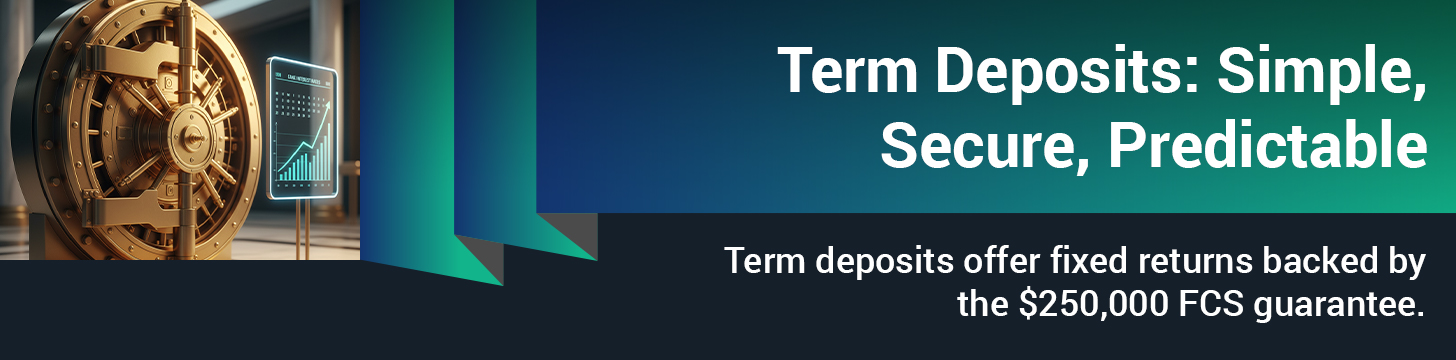
Locked-rate planning comfort
Term deposits offer a classic low-risk option by replacing uncertainty with structure – after all, most people love a good plan.
You can select a term that fits your savings goal, so you’ve got your money locked away for a well defined period.
You get a fixed interest rate upfront, which should give you some peace of mind knowing the return on your cash won’t get whacked by short term rate fluctuations while the term is on.
At the end of the day, the outcome is clear because the interest is all pre-set – which makes it easier to get on and plan your next financial step with some real confidence.
According to ASIC, bank term deposits are pretty low-risk thanks to government backing and APRA oversight, which is probably one of the main reasons they suit first-timers who just want something simple.
Added Security of FCS Protection
A big reason beginners trust term deposits is the protection you get from the Financial Claims Scheme.
If your term deposit is with an Aussie bank, the FCS will cover you up to $250,000 per account holder per bank in case the worst happens, and the bank goes under.
You can find all the details on this in ASIC’s MoneySmart guide to Term Deposits – or over at APRA to get the lowdown on FCS coverage.
Benefits of Putting a Deadline on Your Savings
Term deposit returns are closely tied to the general interest rate cycle.
With the RBA setting the cash rate at 3.60% on 9 December 2023, rates have remained relatively strong – significantly stronger than when rates were at historic lows.
That gives you a good case for using term deposits as a stable starting point while you get up to speed with using other investment tools.
Laddered Maturity Strategy
Time deposits work a treat for goal-based saving
They’re great when you can’t resist the temptation to part with the funds early.
Examples include:
- Having a time deposit to save for a 12-month car upgrade, so you can watch that balance creep up steadily without dipping into it for the day-to-day stuff.
- A time deposit can sit on top of a wedding or education buffer, just keeping the money stashed away, earning a solid return until the big day.
- A time deposit can act as a house deposit savings plan alongside a high interest savings account by locking away a portion of your cash for a set amount of time while the rest stays free for spontaneity.
Best Fit Milestones
Keep the strategy super simple
Use these everyday habits:
- Ladder your time deposits (e.g, 3, 6, and 12 months) so you’re not locked out of any of your cash at once.
- Stick to the FCS limit per bank licence, as a rule of thumb.
- Take a close look at the break fees and early withdrawal rules before committing – it can make a big difference.
Early Access Rule Awareness
- A time deposit isn’t in this game to smash the market – it’s a low risk, stable option that prioritises certainty over the possibility of great returns, so beginners can steer clear of the ups and downs of share investing.
- It’s there to help you smash your goals by locking in a known rate for a set time, stop you splurging the cash and help you stay on track with clear, goal based saving.
- That’s why it earns its place as the go to option for conservative beginners who want predictable progress and peace of mind, without the stress of the share market – it’s as good as solid gold.
ADI cash accounts for everyday cash flow and low-stakes money management
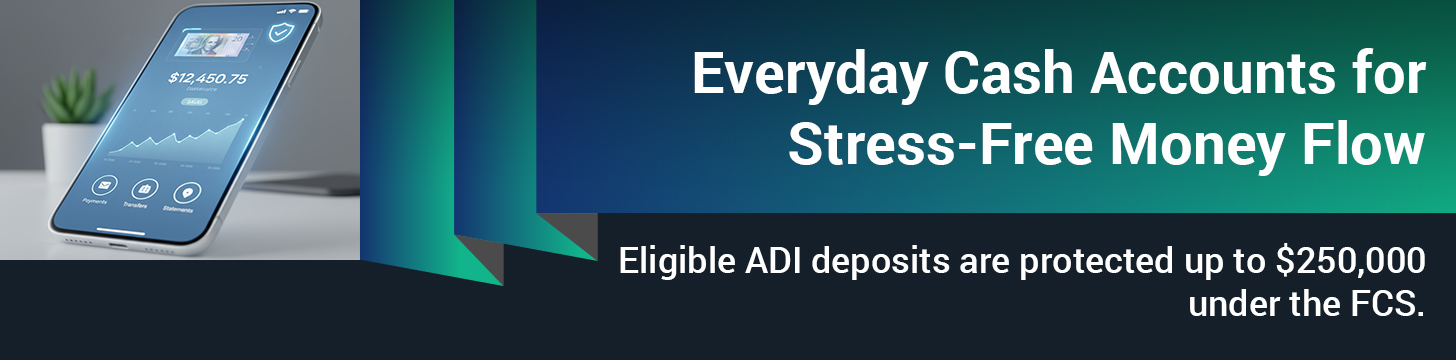
A daily-access safety net
ADI cash accounts come with everyday savings and at-call deposit accounts that are offered by banks that you can actually trust, making them a pain-free low-stakes starting point for people who are just getting started.
These accounts are designed to be as hassle-free as possible, giving new investors a chance to get their feet wet with money management without feeling overwhelmed.
The beauty of these accounts for newbies is that they’re super convenient – no fuss, no muss – and let you get into the habit of saving without having to worry about anything too complicated.
The great thing about these accounts is that you can move your money in and out whenever you need to, which is perfect for short-term goals and for getting your finances in order as you’re just starting.
By using these accounts to get a regular savings habit going you can get yourself set up for future success and be ready to move on to more advanced investment products.
ASIC MoneySmart reckons that ADI cash accounts are a solid foundation for smart personal finance for Aussies.
A simple way to protect your buffer
A key low-risk perk is that eligible deposits are covered by the government’s Financial Claims Scheme (FCS) in case a bank goes belly up.
This means that you’re protected up to $250,000 per account per bank in the super unlikely event that a bank fails. You can find more about this in APRA’s Banking & FCS FAQs and also in ASIC MoneySmart’s Government deposit guarantee glossary.
That $250,000 limit is a reassuring benchmark for anyone worried about safety.
Keeping your spending and savings separate
The point of an ADI cash account isn’t to outperform inflation every year – that’s not its job.
It’s there to protect your short-term plans and provide you with instant access to your cash, so you can focus on other options like term deposits or government bonds later on.
Short-term stability role
Common uses for beginners include:
- A basic ADI cash account can be a lifesaver as an emergency fund to cover unexpected car repairs, medical bills or when you lose your job – and you can access the cash quickly when you need to.
- It’s a good fit for people who want to smooth out their bills such as quarterly insurance premiums, rego, power, water and school fees by breaking them down into smaller, manageable savings efforts.
- If you’re just starting and need to hold onto your cash for the short term while deciding what else to do with it (like term deposits or bonds), then this is a solid option for you.
- One of the best things about it is that you can set up automatic transfers that quietly build up a reliable cash cushion without you having to think about it – no investment decisions needed.
The simple way to get started
A beginner might keep a transaction account for everyday expenses then use a separate ADI savings account as a cash buffer that you’re not allowed to touch.
This can make it easier to avoid impulse buys and help you get your head around your money system.
Practical cash system
This is a solid option as your everyday cash base because it offers:
- Easy in and easy out means your day-to-day cash is always available for short-term goals, emergency funds, or just routine spending and the good news is that it’s very easy to use alongside your regular expenses.
- Protection – all eligible ADI savings are covered by the Financial Claims Scheme so you can feel safe putting your cash here.
- Beginner-friendly features make it easy to get into a regular saving habit, helping you build a stable cash base before you start to think about other investments like term deposits or bonds.
It’s a solid foundation to build from – low risk and easy to use.
Taking the Leap with Exchange Traded Aussie Gov Bonds
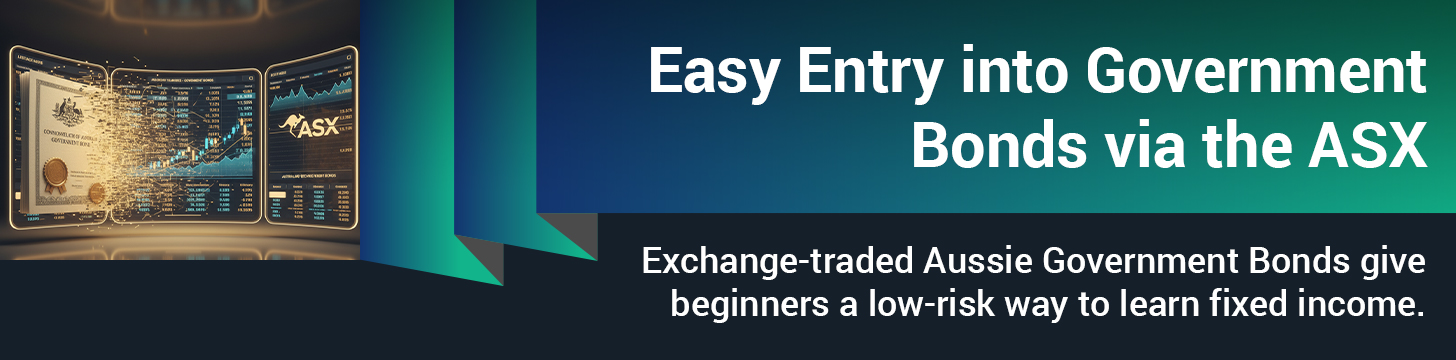
Getting into Gov Bonds via the ASX – a Route for Beginners
eAGBs are a great way for newbies to take their investing a step further from a standard savings account, but without getting into the more volatile world of shares.
They let you buy Aussie Government bonds through the ASX with the help of a broker – which makes the whole buying process a whole lot simpler for retail investors.
The best bit is that this ASX structure gives you a simplified way to own government bonds without altering the underlying asset in any way.
This makes it a nice, newbie-friendly way to get a handle on fixed income investing within a framework that feels nice and familiar.
If you want to learn more, the official Lowdown on Aussie Gov Bonds – How to invest is a good place to start, as is the AOFM’s retail investor guide.
A Defensive Anchor for Your Portfolio
What sets eAGBs apart is that they’re backed by the Aussie Gov.
These are bonds that’ve been issued by the Australian Government, made more accessible to everyday investors through the ASX.
If you’re just starting, that’s a big deal – gov bonds are considered some of the safest assets you can buy in the public markets.
That creates a “safe space” for learning about how fixed-income investing works without jumping straight in and taking on riskier investments.
A good place to start learning is with the ASX’s bond market prices and education.
The eTB and eTIB Pathways – Getting Clarity
As we mentioned earlier, eAGBs are an umbrella that covers:
- Exchange-Traded Treasury Bonds (eTBs) – which are a bit more traditional, with a predictable interest payment structure and all the features you’d expect from a standard Treasury bond.
- Exchange-Traded Treasury Indexed Bonds (eTIBs) – which are designed to add a bit of inflation sensitivity, helping to keep your purchasing power stable over time with an indexed bond framework.
That means you get to choose between:
- Predictable interest payments, which are great if you’re a conservative planner looking for a clear income-style cash flow and a guaranteed nominal return.
- Inflation-aware support, which is perfect for cautious starters who want to keep their investments safe and sound, and respond to inflation conditions over time.
Learning the ropes of fixed income – a gentle start
When interest rates are on the rise, even new investors start to think about defensive assets a bit more.
That’s what’s been happening with the RBA leaving the cash rate at 3.6% on the 9th of December 2025 – a lot of people are getting re-familiar with the idea of using fixed income or interest-based investments as a way to balance out some of the bigger risks out there – before they jump into anything too scary with equity investments.
It makes sense then to think about using eAGBs as a gentle way into investing.
Getting started with short-horizon bills
eAGBs are a good fit for:
- people who want to build a steady core to their investment portfolio
- investors who know they want to have a certain number of shares in their super but are worried they might be taking on too much risk, so want something a bit more stable to mix things up
- newbies who are just starting to get their head around bond pricing and yields and want to keep things nice and simple in a market that’s easy to understand
Making everyday money decisions
eAGBs earn their place as the ASX gateway to government bonds because they bring a few important things together:
- Having the Australian Government behind them means eAGBs are a pretty safe bet – a strong foundation for beginners who don’t want to be taking a lot of risk with their investments.
- You can buy them through a broker on the ASX – that means that if you already understand how shares work, you’ll be able to get a feel for buying eAGBs pretty quickly.
- They’re a great way for new investors to get a handle on how bond pricing, yields and maturities work in a straightforward, no-nonsense way – without having to get tangled up in anything too complicated or riddled with risk.
They’re not all about getting caught up in the hype – it’s about building your confidence and getting into the habit of making steady, defensive investment choices early on.
Exchange-Traded Treasury Bonds (eTBs) – a safe bet for defensive investors
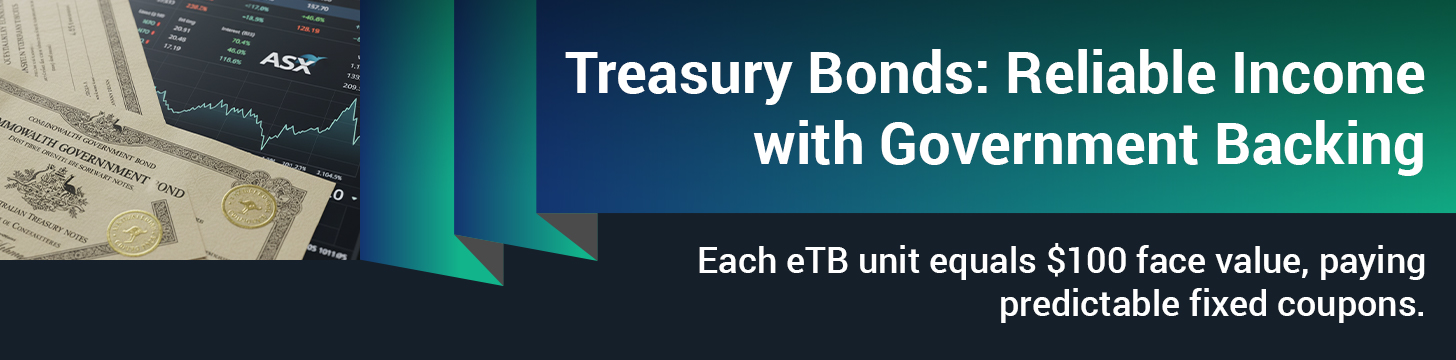
Coupon income – plain and simple
Investors can now get in on Australian Government Treasury Bonds easily through the ASX. That’s right, you can buy and sell them just like shares – through a broker.
But here’s the thing: although the trading part looks just like buying shares, what you’re actually investing in is a good old-fashioned government bond.
You can check out how it all works from the Australian Government Bonds – How to invest page, while the AOFM – Retail investors site explains that eAGBs are the way to go for everyday investors looking to get into this market.
Choosing the right maturity for your goals
For beginners, the big advantage is that you know exactly what you’re getting from your eTBs.
These bonds pay out a fixed interest rate, and you get that interest plus the face value at the end of the bond’s life.
Each eTB unit is worth $100, which makes it easy to understand how the interest works.
For example, a 5% coupon means you’ll get $5 per year for every $100 of face value. That works out to $2.50 every six months until the bond matures.
Price movement basics
Compared to shares, eTB prices tend to be a lot less volatile. And that’s because they’re backed by the Australian Government, which makes them a super secure investment option. Plus, you can sell them on the ASX market whenever you like.
Want to learn more about eTBs? The ASX education material has a useful course on Australian Government bonds.
Role in a low-volatility Core
Retail investors hold a relatively small amount of Aussie Government bonds directly, but there are around $200 million worth of CDIs floating around out there through exchange-traded structures.
That tells you eTBs are a real, tried and tested way for individual investors to get in on the action.
Blending with Cash Holdings
eTBs are a good fit when you’re looking for:
- A safe-haven core to pair with your future equity investments.
- A reliable income stream that comes with clear rules and no surprises.
- A long-term plan that ties in with a specific bond maturity date.
Small, Steady Starter Approach
eTBs earn their spot as the go-to reliable income ladder because they offer:
- Sovereign backing, so eTBs are issued by the Aussie government, giving beginners a solid foundation to work with – a lot more trustworthy than most private credit options.
- Fixed, known coupon payments, which means the interest payments are set in stone upfront, so you can plan your income expectations and match them to your personal goals without all the uncertainty of the stock market.
- ASX listing means eTBs are as easy to buy and sell as any other listed investment, making them a practical, easy-to-use way for everyday folk to get a feel for how bonds work.
- All these features put together make eTBs a great, low-risk way to dip your toes into fixed income without needing to take on higher-risk assets too soon.
They’re the perfect way to learn about bonds without having to jump right into higher-risk territory.
eTIBs Government-Backed Bond Stability With A Safety Net
Your Money Will Keep Up With The Times
eTIBs are for the newcomer who wants to know that their fixed income is underpinned by government guarantees, plus that little bit extra to shield against rising costs.
They’re a part of the Australian Government Bonds family, which offers a bit more peace of mind.
You get access to them on the ASX via a broker, so it’s not as intimidating as it would be with other investments.
The basic idea makes a lot of sense – why let inflation silently chip away at the purchasing power of your money when you can have a product that helps adjust for it?
For the full lowdown, have a look at Australian Government Bonds – eTIBs explained – its a pretty clear breakdown.
Comfort From Inflation
That’s the bit that sets eTIBs apart from good old Treasury Bonds.
They’re not just about tossing you some interest – they’re about trying to keep the real value of your investment stable even when inflation is soaring.
So check out the details in the product information document and take a glance at the AOFM Retail Investors guidelines for an even broader context.
Low-Risk Investing For The First Time
Lots of new investors will worry about two main things at once:
- A sudden market downturn: New investors worry that one day the market could plummet and their savings would be reduced just when they really need them.
- Your money quietly loses value: They also worry that even if their account balance looks okay, inflation will slowly erode the buying power of their cash.
eTIBs take the sting out of those worries with a low-risk, straightforward approach.
You won’t make wild returns, but you will get a product that’s a smart move for beginners looking to build some confidence.
ASX Access with a Government Safety Net
eTIBs make a lot of sense when you are:
- Building a low-volatility core by adding some stability to your portfolio – you get the security of government-backed, inflation-linked returns without having to ride the ups and downs of the share market.
- Saving for medium-term goals and trying to keep your money ahead of rising costs. This stops the real value of your cash from being eroded.
- Trying to balance a cash-heavy portfolio by investing in something a bit more defensive without jumping in at the deep end and taking on too much risk.
Pairing with Fixed Coupon Bonds – a Simple Approach
If you’re new to this, here’s a simple way to get started:
- Start small and put a tiny bit of your money into eTIBs first so you can see how they work without risking too much. That way you can learn the ropes without putting your immediate needs at risk.
- Pair eTIBs up with a cash or HISA account so you still have plenty of liquid cash for emergencies and add a layer of protection on top that’ll help keep your spending power in check over time.
- Once you’re more confident, you can add some standard Treasury bonds to balance out the mix and get a bit more predictable income. That way you can start to mix and match different options to get the right balance.
Cautious Allocation Ideas – A Safe Bet
eTIBs earn their place as a trustworthy government option because they offer:
- The full weight of the Australian Government is behind them, which is reassuring for beginners who want a solid defensive asset that’ll help protect their capital more reliably than most other investments.
- The bonus of being tradable on the ASX through a broker makes it a lot easier to get started and manage your investments than going through traditional bond channels.
- A very clear purpose that makes sense for cautious investors – to help keep your buying power ahead of inflation, which is exactly what cash can struggle with over time – that’s a really useful safety net for beginners.
Cash ETFs: Your Easy Ticket to Monthly Income on the ASX
Getting Your Cash Fix Without All the Red Tape
Cash ETFs do one thing really well: they keep your money nice and safe and hand over a regular income – by plonking it into top-notch, short-term investments that won’t keep you up at night.
You can buy, sell and trade them just like any other share on the ASX – through a broker.
That makes it a pretty hassle-free way for anyone new to investing to get into cash-style investments without having to juggle heaps of different bank accounts.
The ASIC describes exchange-traded products as basically just registered investment schemes that issue units that trade on a licensed exchange, so that’s the regulatory foundation that underpins most ETFs.
A Cash Investment That’s Dead Easy to Trade
Cash ETFs are often highlighted as a low-risk option by beginners because they’re so simple.
It’s meant to act like cash – only with the bonus of being able to trade on the share market, which makes life a whole lot easier.
For instance, the BetaShares AAA fund is trying to give investors a steady stream of income and a safe place to stash their cash by putting it into Aussie dollar interest-bearing bank accounts that churn out interest every month.
It’s all laid out pretty clearly on their website, so you don’t have to worry about being lost in a sea of jargon.
The same goes for BlackRock’s iShares Core Cash ETF, which is trying to match the S&P/ASX Bank Bill Index and claims that with this one, you can get your cash back in no time flat because the underlying investments have same-day liquidity.
Liquidity and fee awareness
When interest rates rise, people start taking a closer look at cash-style investments all over again.
Now that the RBA is getting a bit more serious about upping interest rates, the timing is right for investors to start hunting out some income tools that won’t wipe out their entire war chest.
Product Structure Differences
A good place to start is to think of a cash ETF as a piggy bank to stash the money you’re going to invest later on. Or you can use it as a safety net alongside more conservative investments like bonds or diversified holdings.
The Role of Cash ETFs in a Short-Goal Portfolio
Cash ETFs are deliberately designed to be low-risk investments. Although they’re not the same thing as a bank savings account – there’s a significant difference in the risk profile when compared to term deposits. The Australian Securities Exchange (ASX) actually warns investors to do their research when it comes to using ETFs for cash.
That’s something that aligns with ASIC’s MoneySmart website when it comes to ETF investing.
Sensible Sizing for Beginners
Cash ETFs have become a popular choice for those looking for a simple, hassle-free way to earn regular income because they offer:
- Convenience – being listed on the ASX means you can buy and sell them just like shares through a brokerage account, making it easy to keep track of your cash-style investments in one place.
- A defensive approach – these funds are designed to preserve your capital and keep things calm by holding high-quality short-term cash or money-market type investments.
- A clear goal in mind – they’re structured to deliver regular income distributions, which is perfect for beginners who just want a steadier, more predictable income stream.
For those new to investing, cash ETFs can be a practical stepping stone between keeping your cash in the bank and actually building a more diversified investment portfolio.
Australian Aggregate Bond ETFs for a Go-To Defensive Play
One-Stop Exposure to All the Major Players
Australian aggregate bond ETFs are the perfect one-ticket ticket to the whole local bond market. That means you get a mix of Commonwealth government, state/semi-government, and top-notch corporate bonds all in one trade.
As per the ASX fixed income education, fixed income ETFs can track indices covering government, semi-government, corporate bonds, or a combination of the lot.
And it’s that ‘composite’ approach that makes aggregate-style bond ETFs the ideal entry point for beginners.
Balanced Defensive Mix in One Easy Fund
The beauty of it is that you don’t have to pick just one type of bond – you can have broad exposure without being tied to a single issuer type.
So it’s not just government bonds, and not just corporate credit, but rather a solid defensive foundation right across the big bond segments.
Take Vanguard Australian Fixed Interest Index ETF (VAF) for example – this style of fund invests in top-notch securities from the Commonwealth and state governments, and other top Aussie issuers.
A More Relaxed Path to Income for Newbies
ASIC reminds us that bonds can be a rock-solid source of income and help safeguard your money – and they’re generally considered less risky than growth assets like shares and property.
So for new investors, that means you can learn the ropes of investing without all the emotional ups and downs.
Confidence building through exposure – beyond just cash alternatives
Aggregate bond ETFs can be a good fit for:
- Adding a defensive layer to your portfolio, next to a high-interest savings account or term deposit.
- Gradually getting out of a purely cash-based investment strategy.
- Balancing out the volatility of shares, whether that be in your super or personal portfolio.
Putting them to use in conservative portfolio planning
A cautious new investor might start with a small allocation to an aggregate bond ETF while still keeping most of their short-term cash in a safe and easy to access savings account.
This creates a two-tier system
- You’ll keep most of your short-term cash in a safe place – like a savings account – so you can cover bills, emergencies and near term goals without having to dip into your investments.
- A small allocation to an aggregate bond ETF introduces some more steady, low risk income potential and lower volatility as you start to move away from purely cash-based holdings.
A two-layered approach to cash and bonds
Even low risk bond ETFs can move around when interest rates change.
The aim isn’t to have zero movement, but to achieve stability.
If you need a structured learning path, ASIC MoneySmart – ETFs and the ASX – ETFs course & ETFs course offer a solid grounding in the basics.
Setting realistic expectations around interest rate movements
This makes it a one-ticket defensive diversifier as it gives new investors broad, rules-based exposure to high-quality Australian bonds in a single, straightforward holding.
It takes the pressure off trying to pick between government, semi-government or corporate issuers before you’re ready.
It also helps build a more solid base that can balance out future growth assets, especially for new investors moving gradually out of cash and into market-based investments.
Investment-grade corporate bonds – the low-volatility income option
Getting the balance right – credit quality vs spread potential
Investment grade corporate bond ETFs are often the next move after a high-interest savings account or term deposit – you know, a safe and stable bet.
They’re all about providing a bit of income and spreading your investments around to cut down on risk while still keeping your money in the mix.
The ASIC reckons bonds are a great way to get a stable income and protect your money, and generally are considered a lower-risk option than shares and property.
For now, we’re keeping things defensive because these bond ETFs are all about prioritising steady income and stability over trying to make a killing on volatility.
Thanks to being listed on the market, it’s much easier to get your hands on these defensive-style investments without having to rely on bank deposit products.
Taking it one step at a time, corporate bond exposure through an ETF brings a more gradual risk step, allowing you to learn about fixed income without getting caught up in the wild swings that come with shares.
Spreading the risk – multi-issuer benefits
If you buy a single corporate bond, you’re putting all your eggs in one basket.
But an ETF spreads that risk out across many different issuers, so your returns aren’t dependent on just one company’s financials.
That’s why this structure is often promoted as a simple way to get into the corporate bond market – just buy and hold, and you’ll be following the index.
Conservative investors – a safe bet on corporate income
When we say ‘investment grade’, we mean the higher quality companies in the corporate market, not the high-risk, high-yield ones.
If you’re a conservative investor looking for a taste of corporate income without taking on too much risk, these bonds are the way to go.
To get an idea of how these products work, take a look at ASIC’s Investing in corporate bonds, or MoneySmart’s Bonds article – it’s a good place to start.
Interest Rate Impact Awareness
Some of the Australian-listed options that are good examples of this category are:
- The Vanguard Australian Corporate Fixed Interest Index ETF (VACF), which is a well-known fund.
- The iShares Core Corporate Bond ETF (ICOR) too.
- And the VanEck Australian Corporate Bond Plus ETF (PLUS).
In all honesty, these aren’t a guarantee of any returns.
They’re also examples of how investors can access a range of corporate bonds through the ASX, which is handy.
Return Expectations Range
The thing you need to remember about Bond ETFs is that they don’t quite work in the same way as individual bonds.
The ASX mentions that fixed income ETFs don’t have a maturity date or a face value – like they do with a bond.
Which means the prices can still change when interest rates do.
Portfolio Placement for Beginners
These can be a good choice for:
- Building a defensive base with a little more income than cash in the bank by adding a mix of diversified corporate bonds that can generally be steadier and less volatile than shares.
- Adding a bit of extra stability to a mixed portfolio by balancing out the growth assets with some higher quality credit to help smooth out the returns over the ups and downs of the market.
- Even learning how bonds behave in a safe, regulated format because an ETF spreads out the risk across a bunch of different issuers, so you can see how the yields and prices move without being stuck on a single bond.
That’s why investment-grade corporate bond ETFs earn their place as the go-to choice for careful beginners looking for some stability with a bit of extra income.
Conservative Diversified Funds for a Steady Hand-off Investing Foundation
The Defensive-First Asset Mix in a Nutshell
Conservative diversified ETFs and funds are for those who want to invest with minimal fuss, no juggling multiple assets, just simplicity.
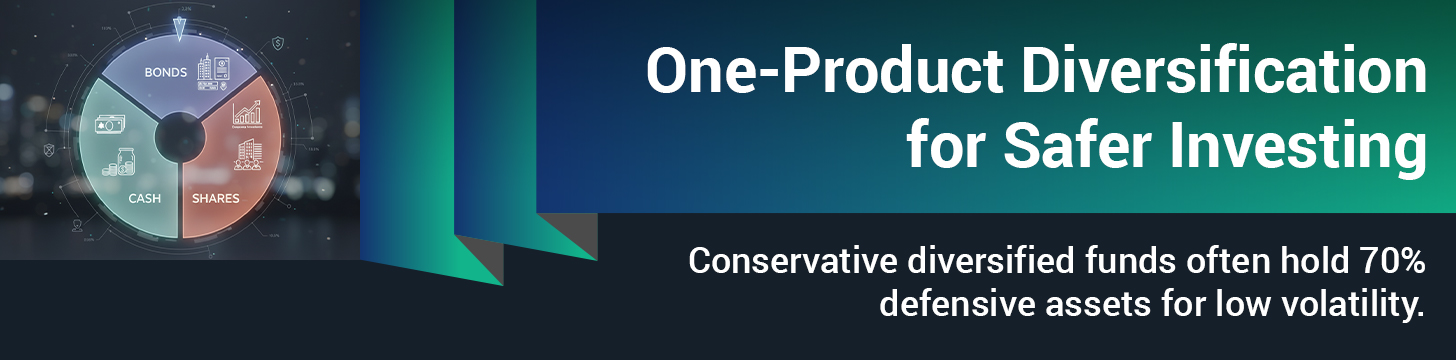
They take the concept of diversification – that spreading your money across different types of assets reduces risk – and wrap it up in one neat portfolio, combining cash, Aussie bonds, global bonds, and a smaller portion of shares.
That way you get the benefits of diversification, as outlined in ASIC MoneySmart (that’s the Australian authority on personal finance), in a single, straightforward product.
The One-Product Discipline for New Investors
The big deal about these funds is they’re super defensive; as a result the mix is heavily weighted this way.
Vanguard’s Diversified Conservative is a well-known Aussie example – it’s a model portfolio that splits between 70% defensive assets and 30% growth assets.
Within that defensive chunk, you get a tenth in cash, a sixth in Aussie fixed interest, and nearly half in international fixed interest (all hedged for good measure).
All this is laid out in the Vanguard Diversified Index ETFs PDS – it’s a clear sign that they’re aiming for low-volatility.
The “Low-Volatility” Deal
The idea here is not to get all excited – it’s steady rather than thrilling.
What you get with these funds is:
- The benefits of diversification all in one goes – no need to spend time choosing and managing multiple assets yourself, so you can start investing sooner.
- A gentler ride than those that are heavily invested in shares – the bigger allocation to defensive assets is designed to calm the ups and downs of the market.
- A way to get your feet wet in the market – build up your confidence with a low-volatility fund and then gradually shift to more growth-oriented ones as you get more comfortable.
ASIC MoneySmart has some valuable advice – “read the PDS, check the fees, and don’t be afraid to ask questions” when it comes to buying an ETF or managed fund – and it’s worth taking note.
Minimum Timeframe Mindset
This option is a good fit for:
- New investors who want to set it and forget it, rather than constantly monitoring their investments.
- People building a defensive core outside of superannuation, looking to protect principal.
- Anyone who’s used to keeping cash on hand and is now looking to transition to a more structured investment approach.
A Practical Example:
You might put your short-term money into a High-Interest Savings Account, and then allocate a smaller portion of your portfolio to a conservative, diversified ETF for medium-term stability.
Suitable Goals for a Conservative Balanced Portfolio
The products listed here aren’t designed for short-term gains – we’re talking about a long game here.
For example, the Vanguard conservative structure suggests a minimum investment timeframe of 3 years, which is a good benchmark to hold to.
Next-Step Transition to Growth
This earns its place as the low-volatility all-in-one starter because it lets beginners access a disciplined, defensive, multi-asset portfolio with just a single, simple investment.
It’s a pretty calm way to start investing because the strategy prioritises stability and diversification over trying to make a quick buck. This should help reduce that early-stage stress that can come with investing.
And it’s a smart way to learn how diversified assets work together because you can see firsthand how cash, bonds and a smaller share allocation balance risk and returns before you start to move into higher-growth strategies.
Low Risk Investments in Australia for Beginners: The FAQs You Need to Know
1. What does the term “low risk” actually mean when it comes to investing in Australia?
A low risk investment helps keep your capital safe and delivers a steady return without any major hiccups.
These types of investments tend to offer predictable income and lower volatility compared to, say, shares.
You’ll often find them in the form of high-interest savings accounts, term deposits and high-grade bond funds.
When we say “low risk” for beginners, we also mean they’re easy to grasp and easy to get your hands on.
And even though low-risk investments are less volatile, they can still be affected by inflation, so it’s worth keeping that in mind when you’re looking at returns.
2. Where do beginners even start when it comes to investing in low-risk options?
Pretty simply, start with a high-interest savings account if you’re still building up that emergency fund of yours.
It’s a great way to keep your money safe while you get a feel for how all this investing business works.
Only once your safety net is sorted should you consider splitting your new savings between a savings account and a short-term term deposit.
That way you get some flexibility and a bit of a higher return on your investment to boot.
Plus, you’ll be building up your confidence without having to take on any of that complicated market risk.
3. Are term deposits worth considering for first-time investors?
Yeah, term deposits can be a great starting point for risk-wary beginners.
You essentially lock your cash away for a fixed period in return for a known return rate.
It’s a simple, low-key way to budget and plan for the future.
The only catch is that you won’t be able to get your hands on that money again before the term is up.
One way to get around that is to “ladder” your term deposits – just set up different ones with different maturity dates.
4. Should Beginners Consider Bonds or Bond Funds?
Bonds offer a more stable vibe than stocks, which can really help spread out your money.
Government bonds and high-grade corporate bonds are considered pretty low-risk – at least compared to most shares.
New investors often have an easier time with bond funds or ETFs than buying up individual bonds on their own.
But here’s the thing – bond prices can shift a bit when interest rates change.
If you’re looking for a smoother ride, short-duration bond funds might be a better bet for your first foray into bonds.
5. How can Beginners Keep Risk Low While Still Growing Wealth Over Time?
It all comes down to using a layered strategy, rather than putting all your eggs in one basket.
First, stash an emergency fund in some cash-like stuff you can rely on.
Next, allocate the rest to term deposits or some super-conservative, fixed-income thingummies.
As you get more comfortable with how investing works, you can start by adding a small chunk to some diversified ETFs to give yourself a bit of balance between risk and long term growth.
The key is just to stick with it, spread your bets around, and avoid buying into all that short-term market hype.

Valuable Insights On Property Development & Investment Opportunities
-

Top High Interest Short Term Investment Options for 2026
High Interest Savings Accounts for Liquid Cash Buffers Cash sleeve purpose and liquidity role High…
Read More -
Best Performing Managed Funds in Australia: Expert Tips & Strategies
Top-Performing Managed Funds in Australia: What Investors Need to Know In 2026, Australian investors are…
Read More -
Best Financial Advisor Perth: How to Choose the Right Expert for Your Goals
Financial Advisor Perth Key Criteria for Choosing the Best Adviser Choosing the best financial advisor…
Read More -
How to Make Money from Property Development in Australia: A Comprehensive Guide
High-Growth Cities Offering the Best Property Development Margins Australia’s property development landscape will be shaped…
Read More -
50 Passive Income Ideas: The Best Ways to Generate Consistent Income
From Active Work to Scalable Passive Income Ideas Passive income isn’t just a fleeting side…
Read More


Our Project Site :


Exclusive waterfront living at the Lake Narracan Resort community.

Quick Links
The information provided is general in nature and does not constitute personal financial advice. The information has been prepared without taking into account your personal objectives, financial situation or needs. Before acting on any information on this website you should consider the appropriateness of the information having regard to your own objectives, financial situation and needs. All statements made on this website are made in good faith and we believe them to be accurate and reliable however do not guarantee its currency. You should seek legal or other professional advice before acting or relying on any of the content.
Please note that past performance may not be indicative of future results. Different types of investments involve varying degrees of risk, and there can be no assurance that the future performance of any specific investment, investment strategy, or product made reference to directly or indirectly on our website, blogs , newsletters.
Our Project Site :

Find premium land developments and new estates across Australia.
Exclusive waterfront living at the Lake Narracan Resort community.

Quick Links
The information provided on this website including blogs is general in nature and does not constitute personal financial advice. The information has been prepared without taking into account your personal objectives, financial situation or needs. Before acting on any information on this website you should consider the appropriateness of the information having regard to your own objectives, financial situation and needs. All statements made on this website are made in good faith and we believe them to be accurate and reliable however do not guarantee its currency. You should seek legal or other professional advice before acting or relying on any of the content.