


SIGA
| December 10, 2025
How to Make Money from Property Development in Australia: A Comprehensive Guide
Table of Contents
High-Growth Cities Offering the Best Property Development Margins
Australia’s property development landscape will be shaped by a mix of factors, including price growth expectations, demand fundamentals, the state of supply, government policy targets, and a steady-looking rate outlook
On the price front, SQM Research’s 2026 outlook is calling for a national growth of anywhere between +6% +10%, with some cities expected to lead the way.
Top performers will be Perth (projected to grow by +12% to +16%), Brisbane (+10% to +15%), Adelaide (+10% to +14%), and Darwin (+12% to +16%). In contrast, Sydney and Melbourne are expected to see more modest gains – roughly +3% to +6% and +4% to +7% respectively.
These growth figures are worth paying attention to because developers are still going to need a strong end value to get their heads above water, both in terms of construction and finance costs.
Demand is still looking pretty good, even though it’s slowing a bit. SQM assumes that population growth will ease off to around 390,000 people (1.4%), which is roughly 150,000 new homes’ worth of demand.
Meanwhile, supply indicators are also flashing a warning, the ABS reported that total dwelling approvals fell by a pretty significant 6.4% to 15,832, and the value of residential buildings plunged by 11.8% to $9.03b.
On top of that, government policy is pushing developers to get moving on building more homes. The National Housing Accord is aiming for 1.2 million homes, and in the first quarter of the Accord, there were nearly 45,000 new homes completed.
Financing assumptions are still cautious – but just about workable. A Reuters poll suggests that the RBA cash rate might stay steady at 3.60% through 2026.
Taking all that in, SQM Research’s base case is that there will be about 180,000 new homes completed in 2026, which means there will likely be a small surplus of around 30,000 dwellings.
For developers, this points to a 2026 strategy that focuses on location-led infill – using DA-ready sites to build efficient townhouse and small subdivision type projects, with a careful approach to staging projects that can still work even when costs and feasibility are a major concern.

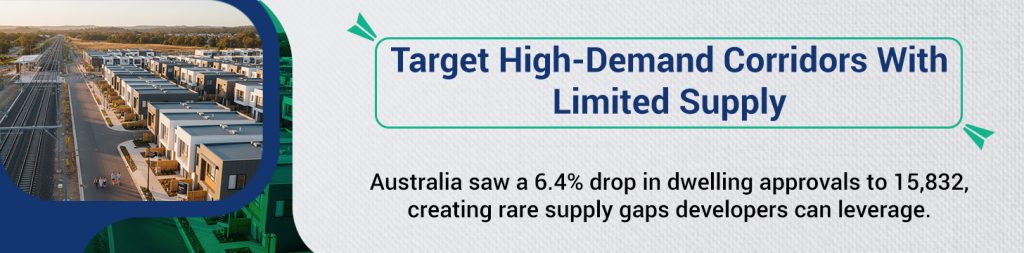
Pick demand-led corridors with a tight supply advantage
Don’t think “cheap land”, think micro-markets
A successful development doesn’t usually start with finding cheap land; it’s all about having a crystal clear understanding of a specific micro-market rather than just a broad story.
In practice, that means keeping an eye on the numbers – buyer interest levels, rental vacancy rates, how long homes are sitting on the market, and how deep the resale market is – and matching those numbers up with hard evidence that there’s a strong appetite for homes at your target price point.
And you want to do that because the broader policy picture is sending a pretty clear message: look at the National Housing Accord – the Treasury is set to deliver 1.2 million new homes in good locations over the next few years, which tells us that governments are trying to push new supply into specific growth corridors and infill areas, rather than just throwing new homes everywhere.
That’s a pretty big message for developers: it tells you where to expect to see extra infrastructure, planning effort and investment being focused, and where adding new supply is likely to either make your job easier or harder.
When you marry that up with data at a suburb level, you can stop just grabbing whatever land is cheap and start deliberately picking out sites in areas where the demand is strong, there’s not much new supply coming in, and government policy is on your side.
Using approvals as an early warning signal
Using approvals as an early signal of what’s coming down the track in terms of new supply can help you read the market before prices react fully, because the approvals pipeline is one of the clearest indicators of how much new stock may hit your target area over the next 18-24 months.
If approvals start shooting up, you can expect competition to heat up even if demand is still strong, and vice versa – if approvals start to fall off, the opposite can happen, and your project may find it easier to get off the ground at completion.
That’s why developers keep an eye on approvals, alongside other market indicators like buyer interest, rental pressure and comparable listings.
For example, back in October 2025, the ABS Building Approvals data showed that total dwellings approved had dropped by 6.4% to 15,832 on a seasonally-adjusted basis – and the numbers were down even further in the private dwellings excluding houses area.
What to look for in a target corridor
When you’re looking for a corridor to focus on, start by prioritising areas with:
- Good transport and employment links
- A good selection of schools, services and lifestyle attractions
- Population and household growth
- Tight rental conditions
And try to pick areas where there’s limited comparable new stock
Price Bands with Fast Absorption
An infill suburb adjacent to a rail line with tightly packed blocks can make room for:
- A duplex or two-townhouse, this is a product that can sit right on budget with locals.
- A product that local budgets can get on board with.
- A faster sales rate because of the scarcity.
This is the “supply-squeeze benefit,” where the real advantage isn’t just building but grabbing a slice of a scarce market.
In this scenario, you’re setting your product up to be a contender in a micro-market that’s got a lot of buyer interest and not a whole lot of comparable new stock. So, when buyers are ready to move, your project becomes one of the few genuine options.
That’s a pretty powerful position because it lets you go for cleaner pricing, a faster absorption rate, and lets you get by with fewer incentives to get people in the door.
Instead of being another new project jostling for position in a crowded release cycle, you’re effectively timing and placing your development so it meets the right buyers when they’re looking for options and those options are limited.
The result is a bit of a protective shield around your margin, a shield that comes from getting the timing and placement right, not just hoping that the whole market will start moving up and rescue your project.
Risk Filters Before Land Commitments
Corridor selection chases down two major risks – slow sales cycles and having to discount to shift stock – because it lines up your project with buyers who are actually out there, and not into a bunch of other new stock flooding the market.
When you pick a corridor based on real buyer interest, good local amenities, transport access and not a whole lot of other new projects, you’re stacking the odds in your favour of a quicker absorption rate.
And speed – it matters because the longer it takes to sell stock, the higher the holding costs and the more pressure you get to throw some incentives at people to get them to buy.
Even more importantly, though, it reduces the chance you’ll end up in a crowded competitive window with multiple similar projects all hitting the market at the same time.
When your end buyers are already fighting it out for limited options, your project becomes more of a real solution to a genuine housing need rather than just a wild guess on what the market might do next.
The result is a much cleaner and controlled sales campaign, stronger pricing discipline and a more consistent protection of the margin you’ve modelled in the feasibility phase.
Choosing a Development Strategy That Suits Your Bank Balance and Deadline

Development Strategy Has to Match Your Cash Flow and Timeline
The best strategy is the one you can finance, get signed off on, build and then sell without running out of money.
The Victoria Residential Development Guide says that the different ways to develop residential property include starting from scratch, doing some renovations, creating new subdivisions or apartments through planning and building permits.
The NSW DA Process Guide walks you through the formal stages and what each person needs to do in the process of getting approval.
What this really means is that your strategy choice will determine how complex getting approval is going to be and how much you’ll be risking by holding onto the project.
Common Development Strategy Levels
Most small-to-medium developers tend to fit into one of these categories:
- Subdivision (fairly low-to-medium complexity, all things considered)
- Building a duplex or dual occupancy (usually pretty efficient when it comes to risk and return)
- Townhouses (can have strong profit margins, but are more complicated and require more coordinated effort)
- Building small units (can be sensitive to planning rules)
The ‘Capital vs Timeline’ Match Principle
Ask yourself these two questions early on:
- How long can you afford to hold onto the project?
- What happens if the approvals take 3-6 months longer than you expected?
If you’re short on cash:
A smaller infill duplex project might be a better bet than a big townhouse site if your priority is keeping control, moving fast and keeping your exposure to approval and holding risks down.
Duplex projects tend to have simpler design coordination, clearer demand from buyers and shorter delivery timelines, which makes the risk vs reward a bit more comfortable for developers who are short on cash or operating on a tight budget.
On the other hand, multi-stage townhouse sites can introduce lots of moving parts – longer approvals, more consultants, bigger construction projects, and more sensitivity to cost increases and sales timing.
That’s not to say townhouses are a bad idea. If you’ve got a bit of wiggle room in your budget and a good team in place, townhouses can offer real scale benefits through more efficient land use and spreading certain fixed costs across multiple dwellings.
The key is matching the project to your current financial situation and execution strength, so you can deliver consistent results without overstretching yourself.
The Complexity vs Control Trade-Off
Your goal isn’t just to make as much money as possible – it’s reliable profit that you can generate time and time again without relying on perfect timing or unusually good market conditions.
In property development, the biggest theoretical profit often comes with higher approval complexity, longer holding periods and greater exposure to cost and demand changes.
A strategy focused on reliability aims for disciplined site selection, conservative feasibility assumptions, tight control over the project scope and a product that a lot of buyers will want.
A right-sized strategy helps you:
- Avoid selling the project at a loss because you have to
- Keep your design costs in check
- Negotiate better terms with your builder
- Keep a realistic buffer for unexpected costs
Profit Pathways by Project Type
On paper, profit pathways can look deceptively similar, even when the risks involved are as different as night and day. That’s why comparing nearby sites requires more than just a casual glance at the margins.
Two sites in the same general area might both appear to be profitable at first glance, but the real difference usually boils down to the fine print.
One block might be bogged down by complex overlays, tighter neighbourhood character rules, or high-density permit conditions that turn the approval process into a marathon.
Meanwhile, the other site might just happen to be a perfect fit for a simpler dual occupancy outcome that’s easier to design, easier to price with builders, and more predictable to deliver.
In reality, the simpler pathway usually comes out on top:
And it’s not hard to see why. The four factors that usually hold the most sway over development outcomes are time, finance costs, stress, and how well things get executed.
A straightforward approval route means fewer redesign cycles, quicker sign-off on the documentation, and a much clearer build program that lets you keep a tight grip on your timeline and keeps costs down.
That time saving, in turn, gives you a big boost in financial efficiency because shorter projects tend to incur less interest and reduce the risk of needing extra funding extensions. And let’s not underestimate the importance of lower stress levels – projects that are under pressure are notorious for jumping to hasty conclusions, scope creep, and costly variations.
Get a Strong Pipeline Timing Edge by Reading Approvals Cycles

Approvals are your early warning system – don’t get caught out
The step is all about timing your project to land in a space where demand is at its strongest and supply is going to be thinner, so your finished product hits the market when there are fewer options for buyers to choose from.
Prices tend to react after the fact, not as supply conditions start to change, which is why approvals act like a forward-looking indicator rather than a lagging one.
When you track approvals alongside local buyer activity, rental pressure and comparable listings, you get a better sense of whether your target suburb is heading into a crowded delivery phase or a quieter time – just when you need that extra edge.
In simple terms, approvals help you get a feel for what the next 6-24 months might bring in new stock, so you can line up your build and sales timeline with a period that supports faster absorption and steadier pricing – without relying on market-wide growth to bail you out.
Get a Turn in the National Data to Spot the Turning Points
The ABS Building Approvals October 2025 release showed that total dwellings approved dropped by a fair bit – 6.4% to 15,832 (seasonally adjusted), that is.
Private sector dwellings excluding houses took a pretty big hit too – 13.1% to 6,253, while private sector houses slipped 2.1% to 9,251.
That sort of pullback can be a warning sign that a future competition slowdown is on the way – especially for multi-unit categories.
Filter the National Signal to Get a Local Decision
You’re not in the business of trading the whole country.
You’re in the game of asking:
- Is my target suburb already undersupplied?
- Are comparable projects being approved at the moment?
- Will my product finish in a quieter pipeline and get a better price for it?
If the answer starts to look decent, your “pipeline timing edge” starts to grow.
Understand the Stages That Create Time Risk
The NSW Planning Portal DA Stages show you the structured path from pre-lodgement through to assessment, determination, construction certificate and occupation certificate.
Every stage adds some time, some consultant cost and some holding cost.
Bottlenecks That Stretch Holding Costs
If a well-connected pocket with a good vibe shows fewer new approvals while buyer demand stays steady,
a small project like a townhouse or duplex might finish:
- A thinner competitive set.
- Better pricing discipline.
- Faster absorption.
Decision Triggers for Safer Starts
You’re not trying to be a market forecaster – you just need to use the approvals data to reduce competition risk by understanding what may be delivered around you over the next development cycle.
This is the real value of approvals analysis: it helps you figure out whether your project is likely to finish in a crowded pipeline or a thinner supply window – and that insight can make all the difference to your pricing assumptions and sales strategy.
That’s why approvals analysis has to be part of your feasibility planning, not something you add on later. When you integrate it early on, it shapes smarter buying decisions and more realistic numbers – when you add it late, it becomes just commentary rather than a tool.
Run Feasibilities Like a Cautious Developer

Feasibility: The Ultimate Gatekeeper of Your Profit
We often decide whether a development win will happen before we even break ground, because the quality of your feasibility is what sets you up for a controlled opportunity or a nightmare deal.
This step is all about building some real-world numbers that can withstand reality – delays, creeping construction costs, slower sales, and higher holding expenses.
A strong feasibility doesn’t just pretend everything will go off without a hitch. It puts your margins to the test and forces you to validate your assumptions right from the start, so you only proceed if the project still adds up under conservative pricing, realistic timelines, and a healthy dose of contingency.
In short, it’s not just about proving the math works, but making sure it still stacks up when the going gets tough.
Include Every Cost You Can Think of
A feasibility that’s worth its salt should cover:
- Buying the land and paying any stamp duty
- Designing and engineering the project
- Paying off the authorities and making your contributions
- Building materials and labour costs
- Interest on finance and holding costs
- Marketing and sales expenses
- A contingency for the unexpected
- Any tax and GST assumptions you’re making
Treat Tax like a Given, not a Maybe
The ATO has some guidance on how tax works when you sell a property as part of a development business – basically, your profits are treated as ordinary income, not a simple capital gain. And that can make a big difference to your bottom line.
Don’t Even Think About GST Until You’ve Modelled It
The ATO’s guidance on GST and property development is clear – if you’re selling certain types of property, or building new homes to sell, you need to factor in GST obligations and potential credits.
So your feasibility should compare the outcomes under:
- Standard GST assumptions
- Margin scheme scenarios (with professional advice where relevant)
Stress-test Like You’ve Got Skin in the Game
Run some “what if” scenarios:
- Build costs go up by 5% and 10%
- Sales prices fall by 3% and 5%
- Approvals slip by 3-6 months
- Settlements take a bit longer than expected
The Downside Scenarios You Need to Worry About
A deal that only works in perfect conditions is a trap – real projects rarely go to plan. Approvals get delayed, quotes expire, materials get harder to find, and buyer sentiment changes. A “margin filter with a dose of reality” lets you buy with confidence because you’ve already built in a buffer for the three big profit-killers: time uncertainty, cost drift, and tax hit.
When you factor in a longer approval window, realistic construction costs, and early tax and GST modelling, your feasibility becomes a decision-making tool that’s actually worth listening to, rather than just a hopeful forecast.
Keeping build costs under control – a pre-construction battle won on the drawings

The profit battle is often won before you start pouring the first slab
This step is all about making sure you’ve got your cost control nailed before things get underway, because that’s the moment when it’s easiest – and your leverage is highest. Build costs don’t usually go haywire because of some massive mistake.
More often, it’s the small stuff that adds up – late changes to the plan, splurging on fancy finishes or unclear specifications, substituting materials, or just little delays that cost you money while you’re waiting.
Each change might seem manageable on its own, but together they can quietly chomp away at your profit margin and turn what was a healthy feasibility into a precarious one.
That’s why all that pre-construction planning is so important: get your scope locked in early, get your drawings and budget aligned, and limit all that discretionary spending on fancy extras. By limiting variation risk and keeping your build timeline on track, you reduce the risk of cost blowouts.
In simple terms, this step is about making sure your profit comes from picking up good deals and delivering projects well, not from relying on your sale price to cover all the little cost escalations.
According to the ABS, building construction prices rose by 1.3% in September (certainly driven by labour costs). The ABS was also saying back in March that building construction prices had gone up 2.9% in the past year, with labour and trade pressures the main drivers.
Scope-lock is like having cost insurance
‘Scope-lock discipline’ means you lock in exactly what you’re building as early as you possibly can – layout, finishes, inclusions, structural choices and even what’s acceptable as a substitute – so your builder knows exactly what to price and you can be confident in your timeline.
The idea isn’t to remove flexibility altogether, but to steer clear of the costly trap of mid-project changes that seem like no big deal, but end up having a ripple effect and triggering expensive reworks – all that revised drawing, re-approvals, changes to material lead-times or re-sequence trades, for example.
This is particularly important when skilled labour is tight, because availability constraints can amplify the cost of HIA, those late decisions, and just push your program further out, which increases holding costs.
In the real world, scope-lock keeps your feasibility intact by keeping variations rare, reducing delays and stopping all those “nice to have” tweaks from quietly chomping away at the profit you worked so hard to create when you acquired the project.
The Ai Group’s Key Australian Industry Indicators for July highlights how trade shortages are going to be an ongoing problem, which will keep pricing firm even when material inflation cools.
A Supplier Strategy for keeping prices stable
Give these a go:
- Get your floor plans and all your façade decisions sorted out before going to the builder for a price.
- Keep a short list of approved alternatives for key materials.
- Avoid all those custom elements that just cause delays and headaches.
- Specify “like-for-like” substitutions in the contract.
Use a quantity surveyor for multi-dwelling builds.
Variation Traps to Steer Clear Of
Two townhouse projects can end up costing the same but don’t count on that being the case in projects with a solid scope.
One that’s well-planned wins because:
- Builders can price with a lot more confidence, knowing where they stand.
- Variations just turn out to be fewer.
- Protecting that build timeline becomes a heck of a lot easier.
- Your holding costs stay more or less as you’d expect.
Even people in the industry will reference CoreLogic Cordell Construction Cost Index and you’ll see that, over recent periods, construction costs are staying way above where they were – that’s why a variation-heavy approach can be your worst enemy when it comes to getting a return on your investment.
The Calm of Knowing You’re Staying on Track
When you keep costs in check, your development numbers stay honest because what you agreed to pay at purchase still lines up with what you’re actually paying out during the build.
That’s what sets a reliable, repeatable development process apart from one where you’re basically just crossing your fingers and hoping for the best.
If your scope is locked in early on, your consultant knows exactly what to expect and you’re only dealing with a few variations at a time, then you’ve got a team of people working to protect the assumptions behind your profit.
As a result, your sale price doesn’t have to “bail out” your margin by relying on some last-minute market growth or buyer enthusiasm. Instead, your profit comes from doing the right things – finding a good deal, designing something that works, and getting the project finished with as little hassle as possible.
That’s the quiet edge that keeps developers making a profit, no matter what the market is doing, because even when conditions soften up a bit, cost-controlled projects can still meet their targets without having to resort to discounting or holding on for dear life.
Affordable Design to Speed Up Sales and Demand

Affordability is the secret to making sales happen
This step builds on the previous logic because to make a profit, you don’t design the perfect home that suits you – you design one that the biggest pool of real buyers can comfortably afford and buy with confidence.
When affordability is tight, the difference between a project that sells quickly and one that lingers on the market comes down to small, smart decisions – like making your floor plans a bit more modest, cutting back on unnecessary space, going for standard mid-range finishes, and keeping a lid on the fancy upgrades that push prices beyond what people in your area are willing to pay.
According to the Cotality Housing Affordability Report (September 2025), a new loan’s mortgage burden is about 45% of the median household income nationwide – and that’s a pretty tight constraint on just how many buyers you can expect to be interested.
When affordability is stretched that thin, even a small price hike can start to shrink your buyer pool, drag out the time it takes to sell, and force you into offering incentives to get people to buy. That’s why an affordability-led design approach isn’t a compromise; it’s a deliberate strategy to boost profits, make sure your project stays on track, and reduce your reliance on the market growing in a way that keeps your margins safe.
The fastest profits usually lie in the middle ground
A ‘fast sell product bias’ means designing and pricing your development for the middle of the market, where demand is strongest, where you’ve got the biggest pool of qualified buyers who can still get a loan and make a decision without hesitation.
You don’t go for the cheapest possible option because ultra-budget homes can struggle with perception and have more competition to fight off. And you don’t go all out for luxury either because that just narrows your buyer pool and ups the risk if the market takes a turn.
Instead, you aim for the area where buyers can realistically stretch – with practical layouts, familiar finishes, and a price that feels reasonable compared to the local market.
And it matters even more in today’s policy and supply climate, where the National Housing Accord Target is pushing to get large-scale housing projects delivered, but the approvals and pipeline momentum are all over the place, so some areas will have to deal with more competition while others might get away with thinner new stock.
By sticking with high-demand mid-market positioning, you’ll be maximising your absorption potential and reducing the chances that your project gets stuck competing for a tiny slice of buyers.
The ABS Building Approvals October 2025 update shows that total dwellings approved actually dropped by 6.4% to 15,832, with higher-density approvals taking a hit.
When supply pipelines get wobbly and affordability is tight, homes that are priced right and offer enough space become the safest bet.
Layout Choices To Reduce Build Risk
Focus on getting the best value per square meter, not just the size.
- Use floor plans that are efficient and don’t waste space on hallways.
- Go for flexible second living zones instead of expensive room expansions.
- Choose standard, popular finishes that avoid the premium costs.
- Add in storage that improves the livability without breaking the bank.
Specs That Buyers Can Actually Afford
A two or three-bedroom townhouse with easy access to transport can actually do better in the same suburb than a bigger, more expensive option.
Why? Because:
- It’s a lot easier to get a deposit together for that smaller place.
- There are more buyers out there than for the fancy house.
- You can get finance approved a whole lot faster.
- And in areas where rentals are in short supply, there’s a real shortage of investors knocking on the door.
You know the Cotality Housing Affordability Report found that people in this country are waiting about 12 years just to save for a 20% deposit, on average.
So it’s only sensible to design with that reality in mind.
Selling Out Your Product in No Time Can Be a Huge Profit-Booster
When your product is actually what buyers can afford, you’ve got a real commercial advantage because you’re selling into the bit of the market where people actually qualify for a mortgage and can act on it right away.
That means your project gets sold off quickest because buyers can actually qualify and go ahead without hesitation – rather than waiting.
It also means you’re less likely to have to offer discounts, because you’re not stuck with buyers who are only looking at this type of property in perfect market conditions.
And most importantly, it gives you more certainty about how much cash you can expect to get, because you’re not stuck with a bunch of unsold stock and worried that the market is going to drop out from under you.
In real terms, this is why affordability-led design isn’t about sacrificing quality – it’s about making sure your product is priced and laid out just right so it’s appealing even when the market gets a bit tight.
So the result is a profit that comes from having a whole lot of buyers wanting your product, rather than just hoping for a market upswing or a last-minute special deal.
Treat Price Growth as the Bonus it is, Not the Plan

The Mindset that Stops Profit Leaks Dead in Their Tracks
This step is about not relying on the market growing to bail you out because – let’s be honest – the most reliable (and profitable) deals are built on the numbers that are actually on the table right now, not some gung-ho hope for tomorrow.
When your deal works with reasonable numbers – thinking conservative sale prices, realistic build costs and sensible time allowances – you protect yourself from getting caught out by a market downturn or a slow buyer market.
And in that setup, any market growth is genuinely a bonus, not some lifeline you’re just holding on to in order to break even.
This discipline is important because the market does move, but it’s not exactly on your schedule – and it’s certainly not moving evenly across every suburb and product type.
By making your feasibility solid and not relying on growth to make you profitable, you keep control of your margin and reduce the chance of having to cut your prices or hold onto a property for longer than you wanted to.
The Cotality Home Value Index October 2025 showed that combined capital city values rose by 1.1% in October, which, according to Cotality, worked out to an extra $10,000 in the median dwelling value for the month.
NAB pointed out that the 1.1% October gain was the fastest growth since June 2023, and that the momentum has been building since those rate changes back in 2025.
Build Your Feasibility as if Growth has Ground to a Halt
Your base case should be that growth has stalled and look like this:
- It’s a flat market out there.
- Houses are taking a lot longer to sell.
- Buyers are a lot more price-sensitive.
The ABS Building Approvals October 2025 numbers showed that – yeah, you guessed it – total dwellings approved fell 6.4% to 15,832, with a sharp drop in approvals for higher-density projects.
Conservative Assumptions that really do Win
You treat growth as the bonus it is when you lock in these rules early on:
- Don’t even think about buying unless your numbers work with pretty conservative sale prices.
- Add in a realistic contingency for all the things that can go wrong with the build and timeline.
- Make sure your product is in a price band that people actually want to buy in.
- Don’t go making upgrades just because you can – if the buyers aren’t there to pay for them, then don’t waste your money.
Buffering Against Buyer Pullbacks
Two duplex projects in the same location might look pretty similar on the surface,
But the stronger deal is the one that still clears its profit target even if:
- Sale prices drop by 3-5%.
- Approvals get delayed.
- Holding costs creep up.
Profit Thinking that Actually Works
Using the Totality Home Value Index October 2025 as a bit of a reality check and the NAB Australian Housing Market Update – October 2025 as another bit of context, this approach keeps your profits driven by smart buying, clean scope and realistic exits – not just wishful thinking about when the market will magically pick up.
Don’t Just Finance – Build a Safeguard for Your Project

Your finance setup is your risk gauge
This step is about keeping your project afloat when timelines get blown out or costs start soaring. Because let’s face it, finance is often the unsung hero that decides whether a development stays in the black or starts to struggle.
Even a top-notch site with heaps of demand can still underperform if your funding model is wobbly – especially when approval processes drag on longer than expected, build timelines slip, or variations start piling up on top of each other.
A solid finance plan gives you breathing space to make level-headed decisions rather than rushed ones, and it helps prevent you from being forced into cutting prices just to pay off debt.
That’s why the most important thing you need to plan around is the real-world interest rates – not as a reason to hit the brakes, but as a reason to put extra buffers in place, tighten up your assumptions, and make sure your numbers still add up even if interest rates are higher or if your project takes longer to complete than expected.
The RBA Monetary Policy Decision of December 9 2025, held the cash rate steady at 3.60%, a reminder that interest rates are still a serious factor to consider for your feasibility projections going into early 2026.
The ‘cash-buffer first rule’ in practice – what does it mean?
The ASIC MoneySmart Borrowing to Invest guidance suggests you should consider whether you could still afford repayments if interest rates suddenly shot up (like, by a few per cent).
Building a smarter funding plan
Create a plan that can handle the ups and downs:
- Work with your broker to model out some more conservative LTC/LVR scenarios.
- Keep in mind, lenders are going to look at the current value of your property, not what you think it’ll be worth in the future.
- Use staged drawdowns tied in with different stages of the construction process.
- Make sure you’ve got a contingency fund that covers both time and cost overruns – not just the build items.
- Don’t rely too heavily on one exit strategy.
Interest and Drawdown Reality Checks
A small house project might look identical in two different scenarios – one where interest rates are low, and one where they’re higher.
But the one with:
- Lower debt exposure.
- A bit more breathing room (3-6 months) before you need to sell.
- A modest assumption about how sensitive people are to price.
Smooth Delivery Through Liquidity Planning
When your finances are solid, everything else gets easier:
- You’ve got more clout to negotiate with builders.
- You don’t rush approval decisions.
- You can pace up or slow down your marketing and settlement plans.
In a nutshell, the “cash-buffer first rule” turns your feasibility projections into a real-world plan – one that can still work even if the market doesn’t give you a free pass.
Working with Lead Consultants like a Co-CEO

Coordination is a profit generator
This step is all about treating your consultant team like a finely-tuned machine rather than a bunch of freelancers working in isolation.
In property development, you’ve probably seen the chaos that can ensue when planners, designers, engineers, certifiers, and builders all work separately. Small misalignments turn into redesign loops, delayed submissions, and costly changes when construction actually starts.
That’s why we want to run our consultant team as a cohesive unit – sharing the same goals, working to the same timeline, and having one single version of the truth when it comes to scope. This gives us smoother handovers and faster decision-making.
And that’s where clear communication comes in – its financial impact is huge. Approvals get faster when documentation is on point, variations drop when drawings and specs are in sync, and build programs stay on track when everyone knows what they’re aiming for.
The planning system itself breaks things down into stages, so we should do the same in our coordination, making sure the right expert is leading at the right moment, and we’re resolving issues before they turn into costly blowouts.
The NSW Planning Portal DA Process sets out a roadmap from pre-lodgement, lodgement, assessment, to determination and finally construction and occupation steps.
Understand that sequence, and you’ll be able to brief the right expert at the right time.
Your team and what each role brings to the party
A top-performing small-to-mid development team typically includes:
- Town planner
- Architect or building designer
- Surveyor
- Civil and structural engineers
- Private certifier
- Builder
- (Finance and legal support as needed)
In Victoria, the residential provisions cover all sorts of things like new homes, extensions, subdivisions, and apartments – all through the planning and building permit systems.
That context, outlined in Victoria Residential Development Provisions, is why your designer and planner need to be aligned from the get-go.
Use approvals data to set the pace of your project
You may have seen the ABS Building Approvals report for October, which showed total dwellings approved fell by a sizable 6.4% to 15,832. Higher-density approvals took a hit, especially.
In a market like that, where the pipeline is patchy, execution quality can be the thing that sets you apart from the competition.
Your ‘friction-reduction’ operating groove
Run your project in the following way:
- Kick things off with a joint meeting where everyone’s on the same page.
- Lock down the development intent before designs start getting out of hand.
- Get the planner to sound the alarm on risk triggers early on.
- Build a simple approvals calendar outlining who’s responsible for what.
- Submit a package ready to go to reduce all that back-and-forth.
The NSW Councils Development Assessment Guide points out practices that support timelier DA determinations – which just reinforces how important coordination is, really.
The Winning Formula For A Smoother Build
Two townhouse proposals may look identical in terms of site economics but it’s the one with a well laid out workflow that ultimately comes out on top. The truth is, execution is where the real profit is made.
When your consultant team is on the same page from the start and working from the same plan, you avoid getting bogged down in redesign loops that just eat up time and cost you more in fees.
But it’s not just about avoiding wasted time – with a coordinated approach, you also speed up the DA process because your documents are consistent, issues are anticipated and your application looks like it’s ready for assessment rather than a bit of a hot mess.
That speed has a real financial payoff with lower holding costs and fewer hasty decisions later down the line. Plus, having clean construction documentation helps to reduce the risk of misunderstandings on site, which is a major driver of costly variations.
Pick an Exit Strategy That Works For Both Selling and Holding

The Exit Plan Should Start Before You Even Break Ground
This step is about getting your strategy, finance and product aligned with the kind of end game you can actually deliver, rather than just what sounds good on paper.
Your exit is not something you decide on at the end, it should be a key part of your design and influence every stage of the project – from what you build to how you stage it and structure your funding.
When you consider your exit from the start, you can optimise layouts, specifications and pricing for your likely buyer or tenant and build in options such as selling some of the dwellings and holding onto others.
If you leave it until construction is almost finished, you lose leverage and flexibility because your costs are locked in, your product is already decided and your finance timetable may force you into a single pathway.
Having an exit plan from the start protects your margins by reducing the need for rushed decisions, avoiding forced discounting and keeping your feasibility realistic even in changing market conditions.
Federal Policy Is Still Pointing Towards Long-Term Demand
Australia is still trying to meet the National Housing Accord Target of 1.2 million new homes in well-located areas over the next five years, from July 2024.
And the Budget 2025-26 Housing Pipeline notes government support for a social and affordable housing pipeline aiming for 55,000 homes across various initiatives, including HAFF and related programs.
It doesn’t guarantee an instant sale, but it does reinforce that supply and demand are going to remain a major theme right up to 2026.
Your Exit Options
Most small to mid developers tend to fit into one of these three categories:
- Sell on completion for a quick capital refresh.
- Hold and rent to build long-term equity with refinancing options.
- Hybrid exit to reduce your risk and stabilise your cash flow.
The hybrid approach has become more attractive because funding is still tight.
The RBA Monetary Policy Decision of 9 December 2025 left the cash rate at 3.60%, which keeps holding costs in check.
Working Out The Best Exit For You
This approach lets you:
- Sell the higher performing dwellings first.
- Hang onto the best rental or future-growth stock.
- Reduce the risk of having to discount your price.
Keep your options open for your next project.
Blended Outcomes for Shock Resistance
A three-townhouse infill project can be set up to:
- Use the sale of two to pay off debt and put a bit of a buffer in place.
- Keep one as a rental property – it might not make you rich, but it will certainly help with the bills.
That way you’re not left with a big hole in your finances if the market suddenly turns chilly when you’re trying to settle.
The Real Profit Logic
Your goal isn’t just to get a good sale – it’s to achieve a sale that you can repeat time and time again in all sorts of market conditions without having to be a genius or having the right timing.
A single big win is nice, but the real money comes from being able to do it again and again and again – that’s what builds a really sustainable business model.
That’s why it makes sense to think about multiple ways you can exit a project right from the get-go – like selling all, holding all, or using a combination of both – that way you’ve got some control over what happens to your profit.
When you build a product, put together a finance package and stage a project with flexibility in mind, you can adapt to whatever market comes along rather than just hoping it’s the one you wanted.
That upfront planning helps you manage timing, make more thoughtful decisions, avoid having to slash prices and keep the sales momentum going even if things don’t go according to plan.
It all comes down to – multi-path exit planning turns your project into a smart, controlled strategy rather than just a one-off punt.
Frequently Asked Questions
1: What typically goes into property development here in Australia?
Property development is the process of boosting the value of land or buildings by doing a bit of planning, some design work, getting approvals sorted, and then breaking ground.
It can be as simple as renovating an old place to give it a bit of a lift, or as involved as subdividing a block, building a duplex or cooking up a whole townhouse project from scratch.
As your experience and skills grow, eventually some people move on to bigger projects like apartments or multi-stage developments.
The common thread is that the profit is made by being super clever about choosing a site, creating a product that the market wants and keeping a close eye on costs and timelines.
2: What are the main ways you make money from property development?
Most developers make their money in three main areas: manufacturing equity, selling for a profit, or holding for long-term returns.
Equity creation means the finished project is worth heaps more than the total cost of land, approvals, construction and finance.
Selling for profit is all about having a clear exit strategy and selling up for a tidy sum at the end. Holding for returns is a bit more long-term and involves keeping the finished asset and growing wealth over time through rental income and future price growth.
A lot of developers mix these approaches by selling part of a project to get out from under debt and holding onto the rest to help with cash flow and long-term growth.
3: How much does a Small Development cost to get started?
It really depends on where you are, what type of project you’re looking at, and how much you can afford to borrow, but small developments usually need more than just a deposit.
You can get hit with a bunch of expenses before you even break ground – surveying, design, engineering, planning reports, and approval fees all come before construction even starts.
If things take longer than expected, you can suddenly find yourself with holding costs and interest piling up. And construction pricing can go up, down, or all over the place due to changes in supply, labour or the scope of the project.
Having a realistic buffer in case things go wrong can be the difference between a project that’s solid as a rock and one that becomes a nightmare to finance.
4: What are the biggest risks in property development, and how do you avoid them?
The biggest risks usually come down to getting feasibility wrong, blowing your budget, getting delayed approvals, or having the market shift out from under you.
A site might look great on paper, but if you misunderstand the zoning, building constraints, or what the buyers are looking for, your whole project can go pear-shaped.
Small variations in construction, unexpected site works, and delays can slowly but surely eat into your profit margin through higher costs and longer interest payments. And then there’s the market – if it changes while you’re building, you can end up with a product that’s worth less or harder to sell than you thought.
You can reduce these risks by keeping your feasibility assumptions pretty conservative, double-checking your end value with local market data, hiring experienced people to help with the build and design, and keeping your exit plans flexible, whether that means selling, holding or staging your project.
5: What mistakes do Beginner Developers usually make?
Beginners tend to get it wrong by buying a site without properly checking whether it’s a good fit.
They often underestimate hidden costs – things like site works, hooking up services, consultant fees and holding costs, or assume the project will go super smoothly and on time.
Designing a product that doesn’t match what local buyers or renters are looking for is another big mistake – it can reduce your sale price even if the build quality is top-notch.
If you start with simpler projects, really stress test your numbers, and focus on managing risks rather than just chasing those big profits, you’ll be a lot more likely to get consistent results and avoid those costly mistakes.

Valuable Insights On Property Development & Investment Opportunities
-

Top High Interest Short Term Investment Options for 2026
High Interest Savings Accounts for Liquid Cash Buffers Cash sleeve purpose and liquidity role High…
Read More -
Best Performing Managed Funds in Australia: Expert Tips & Strategies
Top-Performing Managed Funds in Australia: What Investors Need to Know In 2026, Australian investors are…
Read More -
Best Financial Advisor Perth: How to Choose the Right Expert for Your Goals
Financial Advisor Perth Key Criteria for Choosing the Best Adviser Choosing the best financial advisor…
Read More -
What Are the Best Low-Risk Investments in Australia for Beginners?
Low-Risk Investing in 2026: The Beginner Snapshot For Aussie beginners seeking low-risk investments in 2026,…
Read More -
50 Passive Income Ideas: The Best Ways to Generate Consistent Income
From Active Work to Scalable Passive Income Ideas Passive income isn’t just a fleeting side…
Read More


Our Project Site :


Exclusive waterfront living at the Lake Narracan Resort community.

Quick Links
The information provided is general in nature and does not constitute personal financial advice. The information has been prepared without taking into account your personal objectives, financial situation or needs. Before acting on any information on this website you should consider the appropriateness of the information having regard to your own objectives, financial situation and needs. All statements made on this website are made in good faith and we believe them to be accurate and reliable however do not guarantee its currency. You should seek legal or other professional advice before acting or relying on any of the content.
Please note that past performance may not be indicative of future results. Different types of investments involve varying degrees of risk, and there can be no assurance that the future performance of any specific investment, investment strategy, or product made reference to directly or indirectly on our website, blogs , newsletters.
Our Project Site :

Find premium land developments and new estates across Australia.
Exclusive waterfront living at the Lake Narracan Resort community.

Quick Links
The information provided on this website including blogs is general in nature and does not constitute personal financial advice. The information has been prepared without taking into account your personal objectives, financial situation or needs. Before acting on any information on this website you should consider the appropriateness of the information having regard to your own objectives, financial situation and needs. All statements made on this website are made in good faith and we believe them to be accurate and reliable however do not guarantee its currency. You should seek legal or other professional advice before acting or relying on any of the content.