

Table of Contents
Is 7 % Interest on Savings Still a Myth in Australia?
No Australian bank offers 7% interest on a standard savings account. The best headline rates are between 4.75% and 5.00% p.a. and often come with conditions.
Introductory offers can go up to 5.00% p.a. for a limited time (usually 4 months) but reverts back to lower standard rates after that. Even youth and under-25 savings accounts are below 7% and term deposits are in the mid-4% range.
This is due to the broader monetary settings: the RBA cash rate is 3.60% and banks price their savings products around this. Since rates follow the cash rate, a 7% saver return would be unusual under current conditions.
Looking forward, economists expect the RBA to keep or even cut rates in late 2025, so savings rates will likely stay flat or go down.
In short, for 2025–26, Australians should plan for 4–5% p.a. and focus on meeting bonus criteria and comparing top digital-first offers rather than chasing 7%.

Everyday Savers Are Seeing Maximum 5% — Not 7%

In 2025, Australian savers are getting better returns than a few years ago but the 7% savings account is still a myth.
Despite the competition from digital banks and fintechs, the top rates available today are around 5% p.a. mostly as short-term or conditional offers.
Why 7% Is Unrealistic Right Now
Australia’s cash rate is below the level that would support 7% deposit returns. Banks offer rates 1–1.5% above the Reserve Bank’s cash rate which limits the upside.
A 7% rate would require extreme inflation or a major monetary tightening cycle — neither is forecast for 2025.
What Savers Actually Get
Most banks now structure savings accounts with base rates and bonus or introductory rates. The base rate applies automatically and bonus interest is only available if you meet criteria such as monthly deposits or no withdrawals.
Example breakdown of leading 2025 savings offers:
| Bank / Provider | Introductory Rate | Ongoing (Bonus) Rate | Base Rate | Bonus Conditions |
| Ubank | 5.00% for 4 months | 4.75% | 0.10% | Deposit $200 + monthly |
| Rabobank | 5.00% for 4 months | 3.45% | 0.50% | No withdrawals |
| BOQ Future Saver | – | 5.10% | 0.05% | Age 14–35 + monthly deposit |
| NAB iSaver | 4.45% for 4 months | 1.25% | 1.25% | None (intro only) |
| CommBank NetBank | 4.65% for 5 months | 1.55% | 1.55% | None (intro only) |
Key Points for Everyday Savers
- Top rates (~5%) are time limited or conditional.
- Ongoing rates rarely go above 4.5% even for regular savers.
- Introductory periods are usually 3-5 months then drop off sharply.
- Base rates are under 1% so minimal passive growth.
In summary, Australian savers can earn 4.5-5.1% p.a. in 2025 with account selection — but 7% is out of reach unless you take on more risk.
New Customers Can Get 5% Bonuses for 3-5 Months

In 2025, Australian banks are competing for new depositors by offering introductory “bonus” rates of up to 5.00% p.a.
These rates are temporary incentives — usually 3-5 months — and are designed to attract new customers before reverting to a much lower ongoing rate.
How Introductory Savings Rates Work
An introductory rate is a short term promotional offer for new customers. It applies automatically when a new savings account is opened and rewards new deposits for a limited time. After that the rate drops to the standard variable rate, usually between 3.0% and 4.5% p.a.
These are good for savers who want to maximise short term returns or park funds temporarily during good market conditions.
Comparison of Leading Introductory Offers (as of 2025)
| Bank / Product | Introductory Rate | Duration | Reverts To | Balance Limit | Conditions |
| Rabobank High Interest Savings | 5.00% p.a. | 4 months | 3.45% p.a. | Up to $250,000 | New customers only |
| UBank Save Account | 5.00% p.a. | 4 months | ~4.35% p.a. | Up to $1 million | Deposit $200+ monthly |
| NAB iSaver | 4.45% p.a. | 4 months | 1.25% p.a. | No limit | New accounts only |
| CommBank NetBank Saver | 4.65% p.a. | 5 months | 1.55% p.a. | No limit | New customers only |
Key Takeaways for Savers
- Short term gain: You can earn around 5% p.a. on new deposits for up to 4-5 months.
- Post-bonus drop: After the promo ends rates usually drop by 1-2 percentage points.
- Balance caps apply: Higher balances above limits go back to the base rate.
- Terms vary: Conditions like monthly deposits or no withdrawals apply.
- Best for short term funds: Good for parking cash temporarily, not long term savings goals.
Introductory rates can be a great way to boost returns temporarily but you need to be vigilant. Always check the reversion rate, balance limit and eligibility conditions before opening a new account.
In Australia’s current market 5% is the realistic ceiling — and 7% is out of reach for mainstream savers.
Smart Savers Know High Rates Come with Hidden Conditions

In 2025 Australian banks are advertising savings rates of 5% p.a. — but those “headline rates” rarely tell the whole story.
Most of the highest earning savings accounts have bonus conditions and if you don’t meet one of them your return will be slashed to as low as 0.10% p.a.
Financially savvy Australians have learned to look beyond the numbers and read the fine print before locking in a “high interest” account.
The Fine Print Behind 5%+ Savings Rates
Loads of banks reward people for being disciplined savers but penalise them for missing a beat. Common gotchas include:
- Monthly Deposit Obstacle Course: For example, Ubank Save Account offers up to 5.00% p.a. only if you increase your balance by at least $1 per month (excluding interest). Miss that, and your rate drops sharply.
- Transaction Targets: Westpac’s recently got tough on young savers – they now need to make 20 debit transactions a month to keep that 5% rate, up from a paltry five a month before.
- No Withdrawal Rule: Some accounts at regional banks will yank the bonus if you make the mistake of withdrawing any cash in the month.
- Balance Caps: Most bonus rates only apply to the first $250,000 or so (Rabobank High Interest Savings is a good example of this), after which you get a much lower rate on the rest.
- Eligibility Deadlines: Banks calculate whether you’ve met the conditions by the last business day of every month – and if you’re a bit late with a deposit, you mightn’t get the bonus.
What the Numbers Say
Recent analysis crunched the numbers and found that more than 70% of Aussie savers can’t even be bothered to meet bonus conditions each month, so they’re stuck with base rates under 1%.
A Macquarie Bank review from 2025 found that people are really getting wound up about banks making their rules and communications inconsistent (Macquarie Research).
The Bottom Line
Smart money people know that “too good to be true” interest rates always come with a few strings attached. To really get 5% or more, you have to tick every box – on time, every time.
Missing just one withdrawal or deposit can send your return tumbling from 5% to 0.25% p.a. or lower. You need to be tracking your activity, automating deposits, and checking the terms to get the rate you thought you were getting.
Long-Term Savers Can Expect About 4.5% Ongoing Rates

In 2025, long-term savers in Australia are finding out that steady returns of 4.2% to 4.5% p.a. are actually the most realistic ongoing rates for savings accounts without any fancy intro bonuses.
These are the rates that keep on giving you a return long after the promotional period has ended – providing some real, long-term growth.
Getting Your Head Around Ongoing Savings Rates
Ongoing rates are the real deal – they’re what your savings will actually earn after the honeymoon period ends. Unlike all those tempting short-term “welcome bonuses” that top out at 5%, these accounts are all about being reliable and steady.
Savings.com.au reckon the average ongoing rate for standard savings accounts is around 4% to 4.5% p.a. – and that depends on the bank and the deposit limits.
Money.com.au says Police Bank and Border Bank are currently leading the charge with 4.50% p.a. ongoing returns on the first $30,000.
And comparison platforms like Finder are showcasing all sorts of banks that offer stable, long-term yields with relatively easy conditions – like just a small monthly deposit or some reasonable transaction activity.
Current Ongoing Savings Rates (2025)
| Bank / Provider | Ongoing Rate (p.a.) | Balance Limit | Typical Conditions |
| Police Bank | 4.50% | Up to $30,000 | Monthly deposit $500 |
| Border Bank | 4.50% | Up to $30,000 | Linked transaction account |
| Bank Australia | 4.25% | Up to $250,000 | Maintain monthly balance |
| ING Savings Maximiser | 4.25% | Up to $100,000 | Monthly deposit + card use |
| BOQ Future Saver | 4.50% | Up to $50,000 | Age 14–35 + monthly deposit |
Smart Savers Should Note
- Rate stability: Ongoing 4.5% p.a. accounts are less affected by rate cuts than promotional ones.
- Deposit caps: High rates often apply only up to a certain threshold (e.g. $30,000–$100,000).
- Simplicity: These accounts work best for consistent savers who don’t want to track multiple bonus conditions.
- Fallback risk: Missing simple conditions (like a $500 deposit) can still reduce returns to around 0.10% p.a.
The days of chasing short-term teaser rates are behind us. For savers who prefer predictability over promotion, ongoing rates around 4.2% – 4.5% p.a. are the way to go.
As the Reserve Bank of Australia maintains a steady policy stance through 2025, these rates are likely to be the practical ceiling for low-risk, long-term savings returns.
Rate Watchers Know RBA Decisions Drive Savings Yields
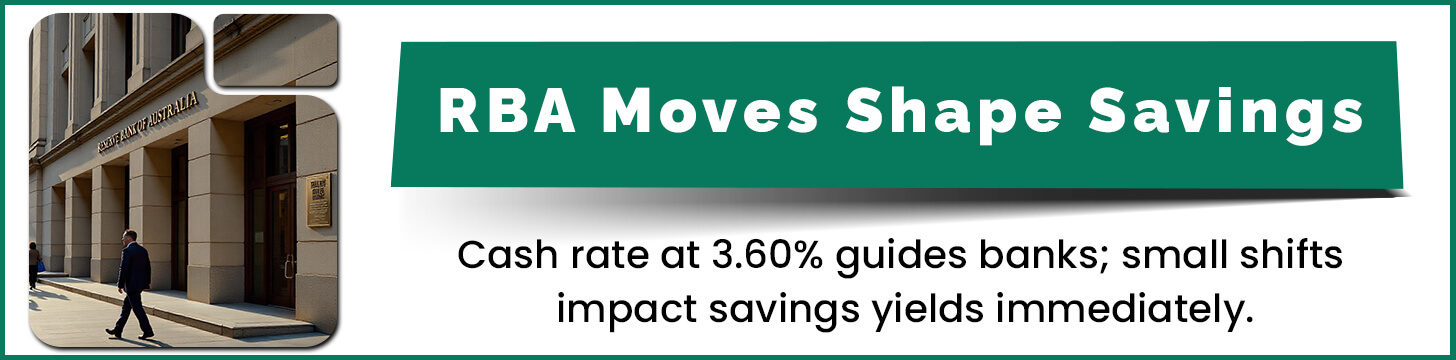
In Australia’s financial system, every Reserve Bank of Australia (RBA) decision sends ripples through the entire savings market.
The cash rate, currently 3.60% (August 2025), is the key lever that determines how much banks can pay depositors. When the RBA moves – even slightly – savings account rates follow.
How RBA Policy Affects Savings Returns
The RBA cash rate is the cost of overnight money between banks, the benchmark for deposit and lending rates across the economy.
When it moves, banks react quickly:
- RBA rate increases → higher savings returns
- When the RBA raised rates in 2023–2024, banks responded by offering bonus savings rates above 5% p.a. as competition for deposits heated up.
- RBA rate cuts → lower deposit yields
- In May 2025, the RBA cut by 0.25% to 3.85% and again in August 2025 to 3.60%.
- Within weeks, ANZ, Westpac and Commonwealth Bank reduced their savings rates by 0.10–0.25% citing reduced funding costs.
- Stable RBA policy → rate stagnation
- In neutral months, rates plateau as the market is uncertain and competitive rather than economic growth.
Why 7% Savings Rate Isn’t Realistic
With the cash rate at 3.60%, a 7% deposit return would mean banks pay out almost double their funding cost, which is impossible.
Even at peak 2024 tightening when the cash rate was 4.35%, the highest retail savings rates topped out at 5.50% p.a. according to Savings.com.au.
The Bottom Line for Rate Watchers
Seasoned savers watch the RBA board meetings every first Tuesday of the month. Each statement sets the tone for deposit rates.
When the RBA cuts or holds, banks adjust – proof that monetary policy and savings returns are connected.
For now, with a steady cash rate and falling inflation, Australians should expect savings rates to be between 4.2% and 5.0% p.a., not 7%.
Real Investors Know That 7% Is a Risky Business

In 2025, the idea of earning 7% per annum safely from a savings account remains far from reality.
In Australia, that level of return belongs to risk-based investments such as shares, ETFs, real estate, or corporate bonds — not standard bank deposits backed by the government. A 7% yield represents risk exposure, not stability.
Why 7% Returns Are Outside Safe Savings Territory
A government-backed savings account guarantees capital protection and liquidity but offers modest returns — typically around 4.2% to 5.0% p.a. at best. Achieving 7% means venturing into markets where values fluctuate daily and returns depend on risk and time.
According to Market Index Australia, the All Ordinaries Accumulation Index has averaged roughly 13% p.a. over the past century, including dividends.
However, The Motley Fool Australia notes that over the last decade, the ASX total return has moderated to about 9.35% p.a., reflecting a more balanced risk-reward environment.
Meanwhile, the RBA highlights that long-term bond yields in 2025 range between 4.2% and 5.3%, depending on maturity and credit rating — well below the 7% mark.
Typical 2025 Return Landscape by Investment Type
| Investment Type | Average Annual Return (2025) | Risk Level | Liquidity | Government Guarantee |
| High-Interest Savings Account | 4.5% | Very Low | High | Yes |
| Government Bonds | 4.2–5.0% | Low | Medium | Partial |
| Corporate Bonds | 5.5–7.0% | Moderate | Medium | No |
| ETFs / Index Funds | 7.0–9.0% | Moderate–High | High | No |
| Australian Shares | 8.0–10.0% | High | High | No |
| Property Investment | 7.0–11.0% | High | Low | No |
Key Insights for Smart Investors
- 7%? Are you joking: That level of return is not going to come without taking on some serious risk – you have to be prepared to put your money into something that can swing wildly in value.
- Savings accounts trade certainty for the high life: With them you get protection of your principal and the ability to get to your cash when you need it – but it comes at a price in terms of returns.
- Real inflation adjusted returns: Let’s face it inflation is around 3% so if you’ve got a 7% return – you’re only getting around 4% real growth after tax & fees.
- Diversify, diversify, diversify: If you want to get some growth while still looking after your cash – then you need to be smart about it – get a mix of equities, fixed income and savings in the mix.
It’s time to face facts – getting a 7% return safely in Australia is a myth – savings accounts will give you security and protection but not the kind of returns you’re after.
Investors who are chasing above 5% need to get their heads around the fact that they’re stepping into a risk-return zone where patience becomes a virtue – and diversification and discipline are the keys to protecting your wealth.
Comparison Hunters Find No 7% Offers in Australia

In 2025, no matter how many comparison sites you browse, you won’t find an Australian savings account paying 7% p.a.
The nation’s top finance platforms — Finder, Canstar, RateCity, and Savings.com.au — confirm that the highest available rates on genuine savings accounts hover around 4.75–5.00% p.a., and even these come with tight conditions or short-term promotional periods.
What the Big Comparison Sites Are Saying
Finder reckons the highest savings rates are around 5.0% p.a. – from banks like UBank, Westpac Life (Youth) and Rabobank.
Canstar’s Best Savings Accounts Report says the same thing – no Aussie provider is offering 7% – most of the competitive options are capped at around 5%.
And if you look at Savings.com.au which tracks heaps of banks and products they’re also saying there’s a ceiling on the top rates – with most deals limited to introductory rates or those that come with some kind of condition.
And to rub it in, RateCity and Canstar’s “Savers’ Rates Get the Chop” both highlight recent cuts by NAB and other majors, lowering the average ongoing rate to around 4.40% p.a.
Current 2025 Savings Account Landscape
| Bank / Provider | Highest Rate (p.a.) | Type of Rate | Duration / Conditions |
| Westpac Life (18–29) | 5.00% | Bonus Rate | Regular deposits, 5+ transactions |
| UBank Save | 5.00% | Ongoing Bonus | Deposit $200/month |
| Rabobank High Interest Savings | 5.00% | Introductory | 4-month welcome offer |
| NAB iSaver | 4.45% | Introductory | 4-month promo for new customers |
| CommBank NetBank Saver | 4.65% | Introductory | 5-month promo, then 1.55% |
Why 7% Don’t Exist
- RBA cash rate limits: With the RBA cash rate at 3.60%, banks can’t make 7% returns profitable.
- Regulatory safety: Government-guaranteed savings accounts are for stability, not high yield.
- Conditional structures: Most “high” rates require monthly deposits or no withdrawals — and revert to base rates below 1% if you miss a condition.
- Market trend: As banks like NAB, Westpac and ANZ cut rates, the competitive ceiling is getting lower.
For everyday Aussies, 7% in a savings account is a myth. As confirmed by comparison sites, 5% p.a. is the current market ceiling — only achievable through bonus or introductory offers.
Anything claiming 7% should be looked into closely, as it’s likely a riskier investment product, not a government-insured savings account.
Short-Term Teasers Can Mislead New Account Holders

In 2025, Aussie savers are still being lured in by high introductory “teaser” rates on savings accounts — rates that look too good to be true at first glance.
Many banks offer short-term deals for new customers with up to 5.00% p.a. — only to drop to much lower base rates once the promotional period ends.
While these promotions can help you earn short-term gains, they often mislead new account holders who think the high rate will last forever.
How Teaser Rates Work
Banks use teaser offers as a marketing tool — a quick boost to attract deposits. Once the promotional period ends, the account reverts to the standard variable rate, which can be 1–2 percentage points lower.
- Rabobank High Interest Savings has a 5.00% p.a. introductory rate for 4 months, then reverts to 3.45% p.a. on balances up to $250,000.
- UBank Save Account gives new customers 5.00% for 4 months, then an everyday bonus rate of around 4.35% p.a.
- CommBank NetBank Saver has 4.65% p.a. for 5 months, then 1.55% p.a. ongoing.
Common Features of Short-Term Deals
- Duration: Usually 3–5 months.
- Conditions: May require monthly deposits, no withdrawals, or a linked transaction account.
- Balance caps: Bonus applies only up to a certain amount (often $250,000).
- Automatic reversion: Rates drop sharply if you don’t switch or renegotiate.
2025 Market Moves
After the RBA cut the cash rate from 3.85% to 3.60% in May 2025, several banks cut their teaser and ongoing rates. Savings.com.au reported ING, CommBank and BOQ all reduced their introductory rates by 0.20–0.25%, indicating the market is tightening.
Savvy Saver Tips
- Bare in mind the reversion rate’s a sneaky thing – its usually hidden in the small print.
- Set a reminder to go over your rate or switch before your bonus period is up and gone.
- Compare current rates rather than getting caught up in temporary offers that are all flash but no substance.
Temporary teaser rates can be a good thing – they can give you a short term yield boost. But without paying attention they’ll quickly turn out to be lower than you thought they’d be.
The smartest savers are onto comparison tools and are on the ball when it comes to tracking expiry dates so your today’s 5% deal doesn’t quietly slip down to 3% tomorrow.
Watch out Cautious Savers -Online Ads Can Be Deceptive

In 2025, it’s getting harder for Australian savers to tell what’s real and what’s not with online promotions making big claims about returns of 7% or more. But most of these offers aren’t genuine savings accounts.
Instead, they’re often investments like peer-to-peer loans, fixed-income notes, or dodgy unregulated fintech offerings.
And the risks with these types of options are way higher than a straightforward bank deposit, backed up by the Government’s Financial Claims Scheme (FCS).
Where the Misleading Claims Come From
In the world of modern fintech, the lines between saving and investing get blurred. Companies use phrases like “earn 7% on your cash” or “secure yield accounts “ to get customers on board – but the way it actually works is a world away from a bank savings account.
- Peer-to-Peer (P2P) Lending Platforms
- Places like Plenti let you lend cash to consumers or businesses, and while they might advertise returns up to 8.0% p.a., your dough is out there exposed to borrowers defaulting, and the platform too, and you won’t get it back if they go under. And the Government won’t cover it either.
- The Australian Securities and Investments Commission (ASIC) says these platforms should be treated like investment products, not a way to save your cash.
- Fake or Fraudulent “Savings” Ads
- Scams are becoming more and more common. Some are passing themselves off as the real deal – Big Brands to get you to part with your cash.
- In 2025, fake ads using the Wise brand popped up all over Google and social media, promising a high fixed-rate savings product.
- The major banks have had to come out and warn their customers not to fall for it – ANZ and others have warned customers to check directly with them before handing over any cash.
- Misleading Marketing by Big Banks
- Even the established banks aren’t immune. In 2025 ANZ admitted to misleading their customers about some of their bonus interest deals – 26,000 of them got underpaid because of it.
Protecting Yourself
- Read the fine print carefully – is it a savings account or an investment product you’re looking at?
- Check if it’s licensed: Make sure the company has a proper AFS or credit license.
- Watch out for unrealistic promises: Any ad promising 7% guaranteed is probably up to no good.
- Use trusted sources: Don’t believe what you read in an ad – check the official bank or ASIC websites instead.
- Read the Product Disclosure Statement (PDS): Get a handle on where your cash is going and what kind of risks you’re taking.
True Australian savings accounts are low risk and Govt backed, and you can get around 4-5% p.a.
Any claim of 7% or more ain’t a genuine savings product – it’s either a risk-based investment or a scam. Savers need to stay on their toes, read the small print, and not get caught up in the hype of a flashy ad.
Growth Oriented Aussies are Looking for Safer Returns

With most saving accounts stuck at around 5% p.a., Aussies who are after a bit more are having a look at lower risk investments like term deposits, bond ETFs and managed funds.
These products have the potential to give you 5-7% a year – without taking the high risk route of speculating on the markets but by combining solid rules based structures, spreading the risk and a predictable income stream.
Why People Are Moving on From Basic Savings Accounts
The thrill of high yield savings has worn off now that the Reserve Bank of Australia has stabilised interest rates at around 3.6%. This means the banks just can’t afford to splash out on deposit rates any more.
As Canstar noted, the average 12 month term deposit rate in 2025 is around 4.75% p.a— a bit steady, but not exactly setting the world alight either.
A lot of Aussies are now looking to bond ETFs and multi – fund managed accounts in search of higher returns without having to put their money into the equities market.
These vehicles spread the risk out across heaps of different issuers, allowing investors to earn some income on their cash while also keeping their capital safe from any one company going bust.
Some Lower Risk Options Worth Considering in 2025
- Term Deposits (4.5-4.8% p.a.)
- Give you a fixed, guaranteed return up to $250,000 per bank under the Government Financial Claims Scheme (FCS)
- Perfect for people who just want the security of knowing how much they’ll get back.
- Bond ETFs (5-7% p.a.)
- Products like the SPDR S&P/ASX Australian Bond ETF give you a spread of investments across government and corporate debt
- These ETFs offer the flexibility to cash in and out when you need to, while also giving you regular interest payments that track the Australian bond market
- Managed & Corporate Bond Funds (5-7.5% p.a.)
- Betashares Australian Investment Grade Corporate Bond ETF has managed 7.67% average returns over three years
- While VanEck Corporate Bond Plus ETF has given a 6.2% return over the same period.
- These funds blend income with some risk taking on credit
Why People Like these Options
- Regulated and transparent: ASIC and APRA keep an eye on them to make sure investors are protected.
- Spread the risk: Across heaps of different bonds or issuers to make default less of a worry.
- Return that beats savings: Usually 1-2 percentage points more than a savings account
- Fairly easy to sell: You can trade Bond ETFs like shares, not like fixed-deposits that are stuck in place
Aussie savers so eager for growth are no longer chasing unrealistic 7% savings deals.
Instead, they are creating a balanced portfolio that combines fixed income, managed funds and term deposits to get a steady return of between 5-7% p.a. with security and transparency they can trust.
Its a smarter approach for those looking for growth but don’t want to lose their nerve.
Frequently Asked Questions
Why don’t any of the Australian Banks offer 7% interest on savings accounts?
To be honest, no Australian bank can really afford to pay 7% p.a. on a savings account in 2025. The Reserve Bank of Australia has set the cash rate at 3.6%, so banks can’t get their funding cheap enough to keep paying those sorts of rates.
They normally pay around 1-1.5 percentage points above that rate to attract customers.
Platforms like Canstar, Finder and Savings.com.au don’t list any 7% savings accounts, in fact the top offers usually sit somewhere between 4.5 and 5.1% & that’s already taking into account “bonus” components (such as regular deposits or no withdrawals)
Most online ads that quote a 7% interest rate are actually referring to non deposit investments such as private credit, unlisted bonds or peer to peer lending, all of which comes with a credit or liquidity risk & has no government guarantee.
In short savers should treat “7% savings” offers the way you’d treat an investment product – not a genuine bank deposit.
What’s the highest real savings rate available in 2025?
As of October 2025 the best verified savings rates in Australia are only just nudging 5% p.a. – and even then you have to go with one of those digital banks that are all feverishly competing for your deposits
Examples of these sorts of deals include:
- UBank’s Save Account for example offers 5% p.a. (but only if you deposit $200 a month).
- Rabobank High Interest Savings account will give you 5% p.a. for the first 4 months, then its down to 3.45% after that.
- Meanwhile Westpac Life is offering 5% p.a. to 18-29 year olds – but only if they’ve had 5 or more transactions in a month and they’ve also been putting money aside.
These rates all come with their own set of rules as well – for example, you’ve got to keep your balance under a certain cap (usually $250,000) and you’ve got to meet certain conditions (like keeping up a monthly deposit) – otherwise the rate drops right back down to 3-4% after the introductory period is over.
Compared to inflation (which is around 3%) the real return is still pretty respectable at 1-2% but its still pretty competitive compared to term deposits.
Savers who are after stable low risk income can realistically expect to earn something like 4.5% p.a over the long term, given the current state of the economy and how much it costs banks to fund themselves.
How long do these “teaser” rates last & what happens when they run out?
The sad fact of the matter is most of these introductory savings rates don’t last very long at all – they’re usually only on offer for 3 to 5 months. & when they run out the rate just drops right back down to something much lower (usually 1-2 percentage points less).
For example, the CommBank NetBank Saver offers 4.65% p.a. for 5 months, then its down to 1.55% after that; while the NAB iSaver will give you 4.45% for 4 months but then its down to 1.25%.
Unless you’re paying close attention to when these special rates are set to expire – and you actively switch to a better deal when they do – your returns are going to take a sharp hit.
These teaser deals can be useful for short-term parking of cash – but you do need to keep on top of things to get the best return.
Teaser rates, in essence are a brief boost – not a long-term solution. They can also be very confusing to newcomers who are expecting to get something like 5% interest all year round.
What are safer alternatives for higher yields above 5%?
Australians seeking growth beyond savings accounts are turning toward regulated, income-focused assets offering moderate returns with defined risk. Leading examples include:
- Term Deposits: Banks such as ING and Macquarie offer 12-month deposits around 4.6–4.8 % p.a. backed by the Financial Claims Scheme (FCS) up to $250 000 per institution.
- Or there are Bond ETFs like the SPDR S&P/ASX Australian Bond ETF which deliver yields of around 5-6% a year from a diversified portfolio of sovereign and corporate bonds.
- Managed Funds & Corporate Bond ETFs: Betashares Australian Investment Grade Corporate Bond ETF 7.6 % over 3 years, VanEck Bond Plus ETF 6 %.
These are regulated by ASIC and APRA, transparent and diversified. They still carry market risk but less volatility than shares – perfect for investors looking for steady income without the ups and downs of the share market.
How to avoid the “7 % return” scams online?
Scams and misclassified ads increased by over 40 % in 2025 according to the ACCC’s Targeting Scams Report. Many ads on social media or Google promote “secure 7 % savings” but they often refer to peer to peer lending, crypto yield products or outright frauds.
To stay safe:
- Check the product type. A real savings account will have an ADI number and be covered by the Financial Claims Scheme.
- Cross check provider licences on ASIC Professional Registers.
- Be wary of “guaranteed 7%” promises. Legitimate banks never guarantee that level of return for deposits.
- Avoid third party links; go to the bank’s website directly.
- Read the PDS to see how returns are generated and if capital is at risk.
As The Guardian and ANZ Newsroom reported, scammers recently impersonated Wise and several banks with fake fixed rate ads. The rule is simple: if it sounds too good to be true, it probably isn’t a savings account.

Valuable Insights On Property Development & Investment Opportunities
-

Top High Interest Short Term Investment Options for 2026
High Interest Savings Accounts for Liquid Cash Buffers Cash sleeve purpose and liquidity role High…
Read More -
Best Performing Managed Funds in Australia: Expert Tips & Strategies
Top-Performing Managed Funds in Australia: What Investors Need to Know In 2026, Australian investors are…
Read More -
Best Financial Advisor Perth: How to Choose the Right Expert for Your Goals
Financial Advisor Perth Key Criteria for Choosing the Best Adviser Choosing the best financial advisor…
Read More -
How to Make Money from Property Development in Australia: A Comprehensive Guide
High-Growth Cities Offering the Best Property Development Margins Australia’s property development landscape will be shaped…
Read More -
What Are the Best Low-Risk Investments in Australia for Beginners?
Low-Risk Investing in 2026: The Beginner Snapshot For Aussie beginners seeking low-risk investments in 2026,…
Read More


Our Project Site :


Exclusive waterfront living at the Lake Narracan Resort community.

Quick Links
The information provided is general in nature and does not constitute personal financial advice. The information has been prepared without taking into account your personal objectives, financial situation or needs. Before acting on any information on this website you should consider the appropriateness of the information having regard to your own objectives, financial situation and needs. All statements made on this website are made in good faith and we believe them to be accurate and reliable however do not guarantee its currency. You should seek legal or other professional advice before acting or relying on any of the content.
Please note that past performance may not be indicative of future results. Different types of investments involve varying degrees of risk, and there can be no assurance that the future performance of any specific investment, investment strategy, or product made reference to directly or indirectly on our website, blogs , newsletters.
Our Project Site :

Find premium land developments and new estates across Australia.
Exclusive waterfront living at the Lake Narracan Resort community.

Quick Links
The information provided on this website including blogs is general in nature and does not constitute personal financial advice. The information has been prepared without taking into account your personal objectives, financial situation or needs. Before acting on any information on this website you should consider the appropriateness of the information having regard to your own objectives, financial situation and needs. All statements made on this website are made in good faith and we believe them to be accurate and reliable however do not guarantee its currency. You should seek legal or other professional advice before acting or relying on any of the content.