

Table of Contents
Maximizing Returns on A$100,000: Current Strategies for Savers
Understanding interest rates is crucial to getting the most from your savings – particularly when we’re talking about big ticket sums like A$100,000.
As of late 2025, the major banks in Australia are offering pretty competitive interest rates – you’ll find high-interest savings accounts offering up to 4.75% p.a. and short-term deposit accounts coming in at around 4.25–4.40% p.a..
Take Bank Australia’s “mySaver” account, for example – they’re offering 4.00% p.a. for balances in between A$50,000 to A$250,000. You can also get a pretty stable return from term deposits if you’re willing to lock your funds in for a bit.
The Reserve Bank of Australia’s (RBA) cash rate is currently sitting at a pretty comfortable 3.60%.
This has a direct impact on the interest rates the banks are offering on savings – a lot of people are tipping it will either stay put or drop a bit in 2026 – and that could see deposit rates take a tumble, or even dip as low as 2.70% p.a. by mid-2026.
As we head into 2026, all eyes will be on the RBA to see if they make any changes to the cash rate and how that impacts the banks – and by extension – deposit rates.
While high-interest savings rates may take a hit if the RBA decides to cut rates, there are still a few people who are optimistic and tipping rates could still reach up to 4.50% p.a. for the most competitive accounts. Knowing what’s going on is key to making smart decisions about what to do with your A$100,000.

How Currency Conversion Impacts Aussie Interest Rates

In Australia, all banking products – be they savings accounts, term deposits or high-interest accounts – operate strictly in good old Australian dollars (AUD).
So, before you even think about trying to estimate how much interest you’d earn or compare bank rates, you need to express your deposit amount in AUD – not some useless “lakh” nonsense that nobody uses here.
That’s the starting point for understanding how interest actually works in Australian banks.
The Simple Truth About Aussie Banking: It’s All AUD
- All banks regulated by APRA (Australian Prudential Regulation Authority) handle customer deposits in Australian currency, no ifs or buts about it.
- Everyday savings products such as:
- High-Interest Savings Accounts (HISA)
- Standard Savings Accounts
Term Deposits are all about AUD only when it comes to being denominated and interest-calculated.
So, when you’re looking at interest earnings, you need to be thinking in amounts like:
- $1,000
- $10,000
- $50,000
- $100,000
Those are the benchmark amounts we use when trying to work out how much interest you’d earn.
Understanding the AUD Context for Accurate Interest Calculations
Australian banks publish interest rates in percentage per annum (p.a.) – and don’t you worry, it’s the same whether you’re depositing $10 or $10 million. They always apply to balances held in AUD, too.
A Glimpse into How Aussie Banks Structure Interest Rates
- High-interest savings accounts (HISAs) usually offer bonus rates between 4.35% and 5.10% p.a.
- Term deposits for 12 months are around 4.30% to 4.50% p.a.
- And just to give you the lowdown, interest is usually calculated on the daily balance, paid either monthly or annually, depending on the product.
Without converting that savings of yours into AUD, you’ll never be able to get a handle on how much interest you’d earn because banks just don’t do interest returns on any foreign denominator.
Aussie Banking – We Like Our Rules Consistent
- All the major banks – Commonwealth Bank, Westpac, NAB, ANZ, ING, UBank – follow the same simple rule:
Interest is applied only to Australian-dollar balances
And that means you get:
- clarity
- consistency
- regulatory transparency
It’s that Aussie banking magic that makes our banking system one of the world’s most stable and predictable environments for depositors.
Interest Rates Vary Depending On The Type of Bank Account You Have
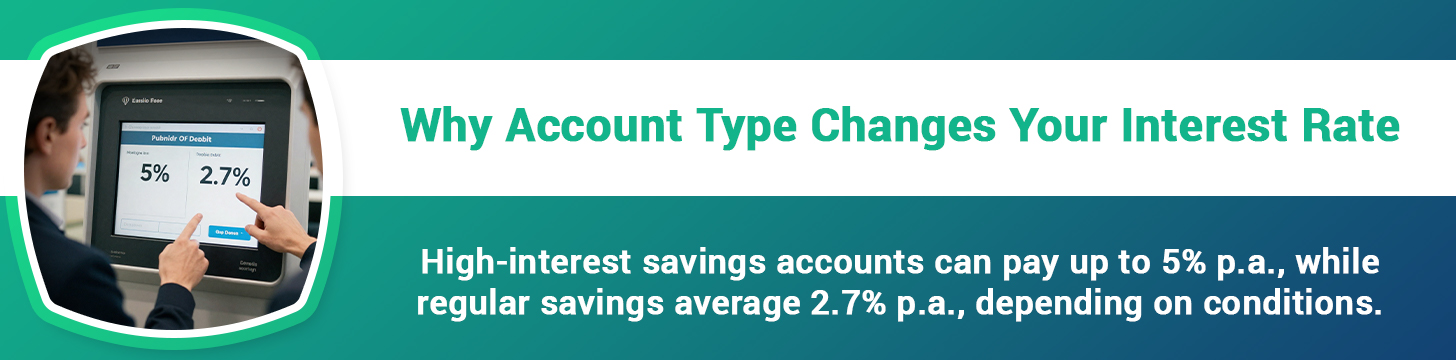
Different kinds of bank accounts in Australia have different ways of handing out interest.
You’re not just looking at a good rate when you choose between a “regular savings account”, a “high-interest savings account” or a “term deposit”. The type of account you go for also changes how your money works in practice.
Taking a Look at The Different Types Of Accounts
Savings Accounts (Standard or High-Interest Savings Accounts):
- These accounts let you put money in, add to it over time and take it out when you need it (subject to a few conditions, obviously, if you want that extra bit of interest).
- Some are pretty straightforward – “standard” types – while others, the “high-interest” ones, are designed to pay you more if you play by their rules (like making a regular deposit, keeping withdrawals to a minimum or linking them to other accounts).
Term Deposit Accounts:
- Where you put a big chunk of money in for a set period of time – could be as short as a month or as long as five years (or even longer, depending on the bank).
- During that time, the rate is fixed – if the market changes, so what, the rate won’t – and generally you won’t be able to get your money out without facing some sort of penalty (or charge).
Interest Mechanics by Product
Return Patterns To Expect
- A high-interest savings account might offer a really juicy bonus rate that’s currently the best or very competitive with term deposit rates. For example, some high-interest accounts have come in at a 5% a year rate when conditions are right.
- However, because the rate is all over the place and can change because of what the bank decides to do (or if the central bank cuts interest rates), the savings account rate can dive. That makes savings accounts less predictable over a long period of time.
- On the other hand, a term deposit gives you cold, hard certainty — you know exactly what return you’ll get right from the start, because the rate is fixed for the whole time. Which is pretty helpful if you like stability and are okay with tying your money up.
- On the flip side, term deposits take away flexibility — you can’t touch your money during the term without getting stung with a penalty, and you can’t add more funds to the same deposit.
Best Use Cases For Savings Accounts (And A Quick Explanation)
If you should use a High Interest Savings Account, if:
- You value being able to access your cash whenever you need it (you never know when you might need to withdraw)
- You want the option to top up your savings over time, or you expect to make a few deposits here and there (like with your salary or a bonus)
- You are cool with meeting the conditions (making a regular deposit, limiting your withdrawals) to get that bonus interest rate
Use a Term Deposit if:
- You have a big chunk of cash you know you won’t need for a while (like AUD 50,000 to 100,000)
- You want a fixed, guaranteed return that won’t be affected by market ups and downs
- You don’t need to add more funds or withdraw your cash during the fixed term
Why It’s A Big Deal To Choose The Right One
- The type of account you go for isn’t just about the rate; it’s also about the balance between risk and flexibility and the return that you get.
- It helps you match your choice to your financial goals — short-term savings with flexibility versus long-term savings with certainty.
Understanding this stops you from making silly mistakes or getting caught out with false assumptions — like expecting a high rate from a regular savings account without checking the conditions, or choosing a term deposit when you might actually need to get to your cash.
How Deposits and Conditions Really Affect Your Returns

Getting the right amount into an Aussie bank is part and parcel of calculating interest, but it’s the fine print on the account that really makes a difference to what you actually take home.
If you want to squeeze the most out of your savings or term deposits, understanding the nitty-gritty is key.
Separating Fact From Fiction – Balance Size vs Rate Myth
- Interest with Australian banks is all about a percentage of what you’ve got, not a fixed amount per deposit, no matter how big or small.
- Whether you’re putting in a tiny AUD 1,685 or a big AUD 100,000, the rate is applied to what you’ve got in there.
Example: Check out this high-interest savings account that’s offering a fat 5% per annum – you’ll get:
- AUD 1,685 – which roughly translates to around AUD 84 and a bit interest per year
- AUD 100,000 – which is roughly AUD 5,000 interest per year
- But watch this: If the terms for snagging that higher rate aren’t met, your effective interest rate can take a serious nosedive.
What Else Can Sneakily Cut Into Your Returns?
- Monthly deposits: Many of the high-interest savings accounts you see require you to chuck in a certain amount every single month, or they’ll yank the bonus rate.
- Limited withdrawals: A lot of the time, the higher rate will only kick in if you keep your hands off the cash for a month.
- Tying it all together with linked accounts or transactions: Some banks will base eligibility for the higher rate on a transaction account or regular payments for bills, and if you don’t tick those boxes, the interest rate can drop from a 5% p.a. to a paltry 2.7% p.a – the average ongoing rate at all of Australia’s banks.
Real-World Outcomes
| Account Type | Deposit Amount | Conditions | Effective Interest Rate |
| HISA – UBank | AUD 100,000 | Monthly deposits + limited withdrawals | 5% p.a. (bonus) |
| HISA – UBank | AUD 100,000 | No deposits/withdrawals exceed limit | 2.7% p.a. (base) |
| Term Deposit – 12 months | AUD 50,000 | Fixed for 12 months | 4.45% p.a. |
This shows that conditions can outweigh deposit size in determining returns.
Core Ideas
- The amount you deposit will have a big impact on the interest you get, but the rules of the account will decide exactly what rate you qualify for.
- Just having a big balance doesn’t automatically mean you’ll get the best return unless you’re also meeting the account’s conditions.
- Don’t overlook the small print: check for bonus interest rates, what you have to do to qualify and any penalties for taking your money out early.
By understanding the connection between how much you put in and what the account needs from you, Australians can make informed choices about which accounts will really help them earn the best returns – rather than just assuming a bigger deposit will always be a winner.
High-Interest Savings Accounts in 2025: Up to 5.1% a year

In 2025, High-Interest Savings Accounts (HISAs) in Australia are offering savers a way to earn more than the average standard savings account – but the really good rates often come with a catch. Several banks are now offering rates of up to 5.1% a year, which is making HSAs a popular choice for people saving for the short to medium term.
Making Sense of High-Interest Savings Accounts
- HISAs are variable-rate accounts and usually need you to do something to qualify for the top rate that’s being advertised.
- They’re different from standard savings accounts, which tend to offer around 2.7% a year – that’s the average ongoing rate in Australia.
- The bonus rate can be way higher than the base rate, but if you don’t meet the account’s conditions, then your effective interest rate will actually be a lot lower.
Common Conditions That Come With High-Interest Rates
- Monthly deposits: Some banks will only give you the top rate if you put in at least a certain amount each month.
- Withdrawal limits: There’s usually a limit on how many times you can take money out – if you go over that limit, then you may lose the bonus rate.
- Linked accounts: Some HISAs want you to link them to an everyday banking account – you’ll have to make transactions through that account to qualify for the top rate.
Example: UBank’s HISA in 2025 offers up to 5.1% a year if you put in at least AUD 200 per month and don’t make more than one withdrawal.
Comparative Rates and Impact
| Bank / Account | Base Rate | Bonus Rate | Conditions for Bonus |
| UBank HISA | 0.10% | 5.10% | Monthly deposit ≥ AUD 200, ≤1 withdrawal |
| ING Savings Maximiser | 0.15% | 4.50% | Minimum deposit + linked transaction account |
| Rabobank Online Saver | 0.20% | 4.75% | Monthly deposit + online banking only |
High Interest Savings Account (HISAs) have got a flexibility edge over term deposits: you can dip in and out of the funds, but you could very well lose the bonus payment if you don’t stick to the conditions laid out.
2025 The Drivers Behind The Attraction
- Better returns than your run-of-the-mill savings account – nearly twice the average rate (5.1% vs 2.7% p.a.) to be exact.
- Flexibility – unlike term deposits, you can pull your money out if needs must, even if it does mean sacrificing some of that bonus.
- A potential short-term growth option – which kind of makes them perfect for people who are saving up for something in the near future, or just want to park their cash without having to lock it away.
High Interest Savings Accounts in 2025 – it’s all about meeting the terms & conditions to get the most out of them, and making the right choice between base and bonus rates if you want to be raking in the interest.
Base Rates vs Promotional Rates at the Big Banks

High-interest saver accounts and term deposits typically flaunt big promotion or bonus rates, but the actual rate you’ll be earning daily – the base rate that stays on after the introductory period or if you’re not meeting your account’s requirements – is usually a lot lower.
Getting your head around this difference is pretty crucial if you want to have a realistic idea of what you can expect in terms of returns in 2025.
What’s the Base Rate
- The base rate is the standard interest rate a bank will give you, no bonus conditions required.
- It’s the rate that kicks in once the promotional period is over, or if you’re not meeting the monthly deposit, withdrawal, or linked account requirements.
- For example: A bank might be advertising a 5.1% p.a. bonus, but the base rate – the one that aligns with the average deposit rate you’d expect to see in Australia – might be 2.7% p.a.
Why The Gap Between Rates Exists
- Marketing ploy – banks use high promotional rates to get new customers in the door and attract some fresh deposits.
- Economic adjustments – the bonus rate is a temporary thing to help the bank manage its cash flow, while the base rate gives a more realistic idea of where the Reserve Bank of Australia (RBA) cash rate is headed.
- Risk management – if banks kept their rates super high all the time it’d eat into their profits, so they adjust them downward once the promotional period is over to keep things balanced.
Side-by-Side Bank Pattern
| Bank / Account | Bonus Rate | Ongoing Base Rate | Conditions for Bonus |
| UBank HISA | 5.10% | 0.10% | Monthly deposit ≥ AUD 200, ≤1 withdrawal |
| ING Savings Maximiser | 4.50% | 0.15% | Minimum monthly deposit + linked transaction account |
| Rabobank Online Saver | 4.75% | 0.20% | Monthly deposit + online banking only |
These examples make it pretty clear that unless conditions are right, you could end up earning less than half or just a tenth of the promo rate.
Take-Home Lessons
- Promotional rates might be great for a quick win, but don’t count on them as a permanent thing.
- Always crunch the numbers based on the base rate if you’re planning for the long haul.
- Check the fine print on those account conditions because – depending on what you’re after – your effective rate might revert to the base rate.
Getting a handle on the difference between a ‘special’ rate and the base rate will help you make good deposit decisions, avoid getting your hopes up, and actually know what you can expect from your Aussie bank accounts come 2025.
Term Deposits Guarantee a Set Return: 12-Month

Term deposits are one of the safest ways to let your savings grow in Australia. Unlike variable accounts, they give you a fixed rate of interest for a set period of time – and in 2025 that could be around 4.45% a year for a 12-month term.
Term Deposit
- A term deposit lets you put a lump sum aside for a fixed period, with no messing about.
- You can lock in a term for anywhere from a month to 5 years or more, but 12 months is the most common choice.
- Interest rates are locked in, so you know exactly what returns you’re going to get, no matter what happens to the markets during the term.
The Stability Bonus
- It’s a safe bet: You know exactly how much you’ll earn right from the start.
- Your money is secure: Unlike stocks or variable accounts, the principal is yours to keep, and the interest is guaranteed.
- Planning made easy: Ideal for short to medium-term goals, such as saving for a holiday or building up some emergency funds.
2025 Market Range
| Bank / Account | Term | Interest Rate p.a. | Minimum Deposit |
| Westpac Term Deposit | 12 months | 4.45% | AUD 1,000 |
| ANZ Term Deposit | 12 months | 4.40% | AUD 5,000 |
| Commonwealth Bank | 12 months | 4.35% | AUD 1,000 |
| NAB Term Deposit | 12 months | 4.50% | AUD 1,000 |
Rates slightly vary between banks, but a 12-month term consistently offers around 4.4 – 4.5% p.a. for competitive deposits.
Decision Pointers
- Early withdrawal penalty: Withdraw before the term is up & you might cut back on interest, or worse still, get charged.
- No adding funds: Unlike high-interest savings, you can’t just chuck in some extra cash mid-term.
- Return certainty over flexibility: Term deposits give you a rock-solid return, but at the cost of being able to withdraw whenever you want.
Worked Example (12 Months)
- We put in: AUD 100,000
- Rate: 4.45% per annum
- Interest earned in 12 months: a tidy AUD 4,450
- At the end of the year, we’d have: AUD 104,450
Term deposits in 2025 give you a nice, reliable way to earn some fixed interest, especially if you’re willing to sacrifice flexibility over the short term.
How Does Deposit Duration Affect Interest Rates?
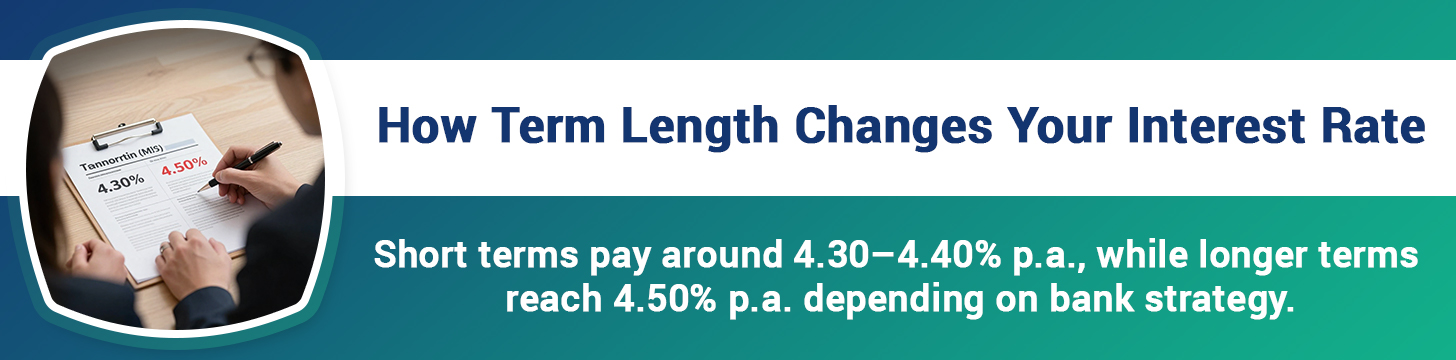
In Australia, term deposits come in all shapes & sizes, with the interest rate (or yield) really depending on how long you lock in your deposit. So if you want to build a savings strategy for 2025, it’s worth understanding how shorter & longer terms play out.
Short-Term Deposits
- What they are: Short-term deposits are generally 1-6 months.
- Interest rates: Not as high as 12-month terms, but still pretty good – around 4.30 to 4.40% p.a. in a competitive market.
- The upside: You can get your hands on your cash sooner rather than later.
- Best for: Savers who think they’ll be needing the cash in a few months or are a bit unsure about what’s up ahead.
Long-Term Deposits
- What they are: Long-term deposits usually last 2-5 years (or more).
- Interest rates: Can go either way, depending on market conditions & what the banks are up to in 2025 – 4.25 to 4.50% p.a. is a pretty typical rate for 2-3 year deposits.
- Trade off: You’re locked in for longer & will get penalised if you try & get your cash back early.
- Best for: Savers who just want a stable return they know they can rely on & don’t need access to their money all that quickly.
Duration-Based Comparison
| Term | Typical Interest Rate (2025) | Bank Example | Minimum Deposit |
| 3 months | 4.30% | ANZ Term Deposit | AUD 5,000 |
| 6 months | 4.35% | Westpac Term Deposit | AUD 1,000 |
| 12 months | 4.45% | NAB Term Deposit | AUD 1,000 |
| 24 months | 4.40% | Commonwealth Bank | AUD 1,000 |
| 36 months | 4.50% | NAB Term Deposit | AUD 1,000 |
The table shows that shorter terms are slightly lower in yield, while longer terms may offer marginally higher or similar rates depending on bank strategy.
The Bottom Line
- Yield is all about the term length: Generally, longer terms give you a bit higher – or the same – returns compared to short ones.
- The flexibility/return trade-off: Short-term deposits get you in and out quickly, but the returns are a bit lower. Long-term deposits offer stability, but you can’t get to your money as fast.
- Strategic planning: People can do this thing called “laddering” where you spread your deposits across different time frames so you’re getting the best of both worlds – easy access to cash and consistent returns.
Getting a handle on how term length affects yields helps you snag the best returns while aligning with what you’re trying to save for and how much cash you need in 2025.
When Bank Rules & Eligibility Can Change How You Earn

You can be offered a high interest rate, but it all comes down to whether you actually qualify. Australian banks set up these conditions in 2025 to make sure the rates go to people who are actually using the account.
Things That Can Stop You Getting Top Dollar
- Minimum monthly deposits: Lots of high interest savings accounts require you to put in at least a certain amount each month to get the bonus rate.
- Withdrawal limits: Most accounts won’t let you take out as much as you like each month – too many withdrawals and you’ll lose out on bonus interest.
- Having your transaction and savings accounts linked: Some banks want the savings account linked to your day-to-day transaction account.
- Using online banking: If your banking is all done online, you might get the best interest rates, which is great if you like managing your finances that way.
Example: UBank’s HISA is offering 5.10% p.a. in 2025 if you put in at least AUD200 every month and don’t make too many withdrawals. Don’t meet those conditions, and your effective rate drops to 0.10% p.a.
Why Banks Set Up Their Eligibility Rules
- They want you to save regularly: By making you deposit money regularly, banks get a steady flow of funds coming in.
- They don’t want you to take all your money out at once: Limiting withdrawals helps banks manage their cash flow while giving you a better interest rate.
The way banks market their high interest rates
High interest rates are a great way to get new customers in the door, but the eligibility criteria make sure you don’t end up getting too many people who are going to just withdraw all their money and run.
Case Comparison
| Account | Bonus Rate | Base Rate | Conditions |
| UBank HISA | 5.10% | 0.10% | Monthly deposit ≥ AUD 200, ≤1 withdrawal |
| ING Savings Maximiser | 4.50% | 0.15% | Minimum monthly deposit + linked account |
| Rabobank Online Saver | 4.75% | 0.20% | Monthly deposit + online only |
The table shows how conditions directly affect effective returns.
A Few Key Pointers to Keep in Mind
- First and foremost, make sure you check the conditions and eligibility before getting too excited about that advertised rate.
- Truth is, failing to meet the criteria can easily knock your effective interest rate down by at least a good 50%, even if you’ve got a high balance.
- Understanding these rules will actually help you, as a saver, plan your deposits a lot more strategically – and avoid any nasty penalties in the process.
Bank conditions and eligibility are actually the top priority in 2025 when it comes to your effective interest rate – and it often turns out they matter way more than your deposit size – so make sure to read that fine print carefully and plan your deposits with care.
Australia’s Interest Rates – How the RBA Keeps Things Real

It’s not just banks that determine what you earn on your savings in Australia – macro-economic factors, particularly the Reserve Bank of Australia’s cash rate, play a huge role in shaping deposit rates in 2025.
What’s This RBA Cash Rate All About?
- The RBA cash rate is the benchmark interest rate set by Australia’s central bank – you know, the place that’s in charge of keeping things running smoothly.
- It sets the cost of borrowing between banks, and that in turn has a knock-on effect on the rates that banks are willing to offer to depositors.
- When the cash rate changes, you can be sure it’ll ripple through to savings accounts, term deposits and loans.
So What’s the Cash Rate Got to Do With Savings?
- The interest rate goes up → deposit rates go up too: When the RBA raises rates, banks usually try to attract more funds by upping the interest on savings and term deposits.
- But when the cash rate goes down → deposit rates go down too. On the other hand, when the RBA cuts rates, savings yields just tend to decrease.
- For instance – in 2025 the RBA cash rate was 4.10%, which led to some pretty high-interest savings accounts offering up to 5.10% p.a. as a bonus – and that’s according to rba.gov.au.
And Then There’re the Broader Economic Factors
- Inflation: When inflation is high, banks tend to offer higher rates to help compensate for the fact that your money is losing its value.
- Economic growth: While strong growth can lead to higher interest rates, slow growth is a lot more likely to see deposit rates fall.
And don’t even get me started on competition among banks – even when the cash rate is the same, some banks will try and outdo each other by offering more attractive rates to attract new deposits.
2025 Rate Environment Example
| Account | Cash Rate | Bonus Rate | Base Rate |
| UBank HISA | 4.10% | 5.10% | 0.10% |
| ING Savings Maximiser | 4.10% | 4.50% | 0.15% |
| NAB Term Deposit 12m | 4.10% | N/A | 4.45% |
The table shows that banks align interest rates with macroeconomic conditions, but bonus rates and terms still create variability
The Big Picture
- The cash rate set by the RBA is a key driver of deposit interest rates here in Australia, through and through.
- It’s just so important that depositors get this, and understand that changes in the cash rate directly affect their returns – especially on high-balance accounts.
- By planning deposits strategically and taking into account what’s happening in the economy, you can really maximise your earnings and avoid any nasty surprises.
Things like the cash rate, inflation, and wider economic conditions are all really important for savers in 2025.
They pretty much determine what the baseline returns are going to be, while individual banks then add their own strategies on top to create the bonus and final effective interest rate.
The Real Impact of Inflation, Taxes and Currency Fluctuations on Your Returns

Don’t be fooled by a bank’s advertised interest rates – your actual return can be scuppered by inflation, taxes, and currency fluctuations. Understanding these factors is absolutely crucial for savers in Australia in 2025 if you want to get the best net gains.
The Reality of Inflation
- Inflation eats away at the value of money over time – it’s a fundamental truth.
- Let’s say you’ve got your savings in a term deposit earning 4.45% p.a., but inflation is 4.0% p.a. – in that case your real return is only about 0.45% p.a. at best.
- In 2025, Australia’s inflation rate is expected to run at an average of around 3.8-4.0%, which means savers have to factor in the erosion of value when planning returns. (RBA figures – rba.gov.au)
The Impact of Tax on Interest Income
- Interest earned from deposits is taxable income in Australia – that’s just the way it is.
- Your effective after-tax return will depend on your tax bracket.
- Let’s say you’ve got a term deposit earning AUD 4,450 on AUD 100,000 at 4.45% p.a., and you’re in a 30% tax bracket – in that case, the after-tax interest is going to be: AUD 4,450 × (1 – 0.30) = AUD 3,115
The Effect of Currency Fluctuations for Non-Residents
- If you’re depositing funds in AUD but you’ve got money in another currency (e.g. INR), exchange rate changes can make all the difference when you come to convert it back.
- Let’s say you’ve got ₹100,000, and you convert it to AUD at 1 AUD = ₹59.32 – that gives you ~AUD 1,685. A 5% change in the exchange rate at conversion can really knock your returns for six.
All-Factors Scenario
| Factor | Effect on AUD 100,000 Deposit |
| Interest @ 4.45% | +AUD 4,450 |
| Inflation @ 4% | -AUD 4,000 (loss of purchasing power) |
| Tax @ 30% | -AUD 1,335 (after-tax interest) |
| Real Return | ~AUD 115 |
Net Return Perspective
- While super-high nominal rates might sound attractive, they don’t automatically mean you’ll be getting a great deal on your real returns.
- When planning to put your cash into a bank, you need to take into account the impact of inflation, taxes, and currency risks – especially if you’re thinking of depositing large sums or looking at foreign options.
- Being aware of these factors is key to making sure you get the best possible return and that your cash doesn’t lose its purchasing power over time.
Keeping a close eye on inflation, taxes and currency risk is crucial for Australian bank deposits in 2025, as it’s all about getting a genuine picture of the actual worth of your interest earnings and working out what you need to be doing differently with your money.
FAQs: Interest Rate for A$100,000 in Australian Banks
1. What kind of interest rate can I realistically expect on A$100,000 in Australian banks?
It’s all about what kind of account you plump for – be that a savings account or a fixed-term deposit.
Savings accounts with high interest rates can be pretty enticing, even for the first A$100,000 you put in.
But a fixed-term deposit generally gives you a surefire rate for a set period of time, be that six months or a year.
What you go for – and how you weigh up the pros and cons of each option – is going to impact not just the returns you can expect, but how easy it is to get to your cash when you need it.
2. How do savings account interest rates compare to term deposit interest rates?
With a savings account the rate is usually up for grabs and can change month by month – and that all depends on things like whether you’re making regular deposits or keeping your account active.
Term deposit interest rates on the other hand, are set in stone for as long as you’ve got the cash locked in for.
So if market rates go up while you’ve got the cash locked away in a term deposit, you’re not going to be affected – which can be a big relief – but with a savings account, the rate can go down, which might cut into your expected return.
So it’s a trade-off – you choose between having the freedom to get at your cash whenever you like, and the certainty of a fixed rate on your fixed deposit.
3. How much interest would $100,000 earn in one year?
If you were to stash 100 grand into a high interest savings account that’s kicking out around 5% a year, you could expect to make roughly $5,000 in interest – all on its own.
But a 12-month term deposit at around 4.3% per year would earn you a tidy $4,300.
But remember, the actual interest can vary like crazy depending on whether the interest is compounded monthly, quarterly or annually – and that can make a real difference in the long run.
Understanding the ins and outs of interest rates and compounding really does help you get a better feel for what to expect.
4. Are there any strings attached to higher savings interest rates?
You bet your boots there are – a lot of high-interest savings accounts come with conditions you need to meet to get the top rate.
Typical requirements include popping a regular deposit in the account each month, completing a minimum number of transactions, or making sure you keep a minimum balance in there.
If you don’t meet those conditions, the interest rate will probably take a hit and drop to a lower base rate.
So you really need to read the fine print so you can make the most of your money.
5. Which option is safer: a savings account or a fixed-term deposit?
If you don’t mind committing to a fixed term, a fixed-term deposit is a much safer bet – you know exactly what interest you’re going to get for the duration of your deposit.
Savings accounts, on the other hand, are much more flexible, but their rates can change overnight based on market movements.
If you don’t need access to your money any time soon and want some predictability in your returns, a term deposit is the way to go.
If you like the idea of being able to dip in and out of your savings whenever you want, and you’re willing to jump through a few hoops to get the best rates, then a savings account might be your best bet.

Valuable Insights On Property Development & Investment Opportunities
-

Top High Interest Short Term Investment Options for 2026
High Interest Savings Accounts for Liquid Cash Buffers Cash sleeve purpose and liquidity role High…
Read More -
Best Performing Managed Funds in Australia: Expert Tips & Strategies
Top-Performing Managed Funds in Australia: What Investors Need to Know In 2026, Australian investors are…
Read More -
Best Financial Advisor Perth: How to Choose the Right Expert for Your Goals
Financial Advisor Perth Key Criteria for Choosing the Best Adviser Choosing the best financial advisor…
Read More -
How to Make Money from Property Development in Australia: A Comprehensive Guide
High-Growth Cities Offering the Best Property Development Margins Australia’s property development landscape will be shaped…
Read More -
What Are the Best Low-Risk Investments in Australia for Beginners?
Low-Risk Investing in 2026: The Beginner Snapshot For Aussie beginners seeking low-risk investments in 2026,…
Read More


Our Project Site :


Exclusive waterfront living at the Lake Narracan Resort community.

Quick Links
The information provided is general in nature and does not constitute personal financial advice. The information has been prepared without taking into account your personal objectives, financial situation or needs. Before acting on any information on this website you should consider the appropriateness of the information having regard to your own objectives, financial situation and needs. All statements made on this website are made in good faith and we believe them to be accurate and reliable however do not guarantee its currency. You should seek legal or other professional advice before acting or relying on any of the content.
Please note that past performance may not be indicative of future results. Different types of investments involve varying degrees of risk, and there can be no assurance that the future performance of any specific investment, investment strategy, or product made reference to directly or indirectly on our website, blogs , newsletters.
Our Project Site :

Find premium land developments and new estates across Australia.
Exclusive waterfront living at the Lake Narracan Resort community.

Quick Links
The information provided on this website including blogs is general in nature and does not constitute personal financial advice. The information has been prepared without taking into account your personal objectives, financial situation or needs. Before acting on any information on this website you should consider the appropriateness of the information having regard to your own objectives, financial situation and needs. All statements made on this website are made in good faith and we believe them to be accurate and reliable however do not guarantee its currency. You should seek legal or other professional advice before acting or relying on any of the content.