


Table of Contents
In 2025 and beyond, locking your money into low-yield accounts means losing purchasing power. With inflation at 2–3% and rates cut by the RBA to 3.60% p.a., savers need to find opportunities that outpace erosion.
Luckily, some Australian banks and fintechs now offer high-interest savings accounts reaching 5.0–5.5% p.a. under bo/nus or promotional schemes. These competitive offers are changing how Australians choose where to park their cash.
But chasing the highest rate isn’t enough. The future of savings is in digital-first features, sustainability tie-ins, AI tools, and seamless switching.
In this article, we’ll:
- Break down how to compare savings accounts beyond interest alone.
- Explore emerging account features that matter by 2030.
- Offer smart strategies and risk checks for tomorrow’s saver.
- Look at global and regional trends and how they’ll impact Australia.
- Answer FAQs about what’s next for savers in a changing financial world.
Let’s start by looking at why high-interest savings accounts still matter — and how they’ll evolve as the financial landscape changes.

Why High-Interest Savings Accounts Still Matter in 2025–2030

High-interest savings accounts are still essential in Australia despite fintech innovations and new digital investments. While markets move, these accounts still offer security, steady returns, and future-proof features.
The evolution of interest rates in a digital economy
Interest rates have entered a dynamic era. In August 2025, the RBA cut the cash rate to 3.60%, down from 3.85% earlier that year. This tightening cycle means banks have to rethink deposit rates.
Digital platforms are changing expectations.
Savers now see:
- Bonus rates tied to consistent balances
- Algorithmic adjustments based on user activity
- Short-term boosts to attract deposits
By 2030, interest rates may no longer be announced quarterly. Instead, they’ll be influenced by AI-driven analytics, liquidity flows, and even sustainability metrics.
For Australians, this means staying on top of changes and switching more often to protect value.
Inflation, global markets, and the new savings account landscape
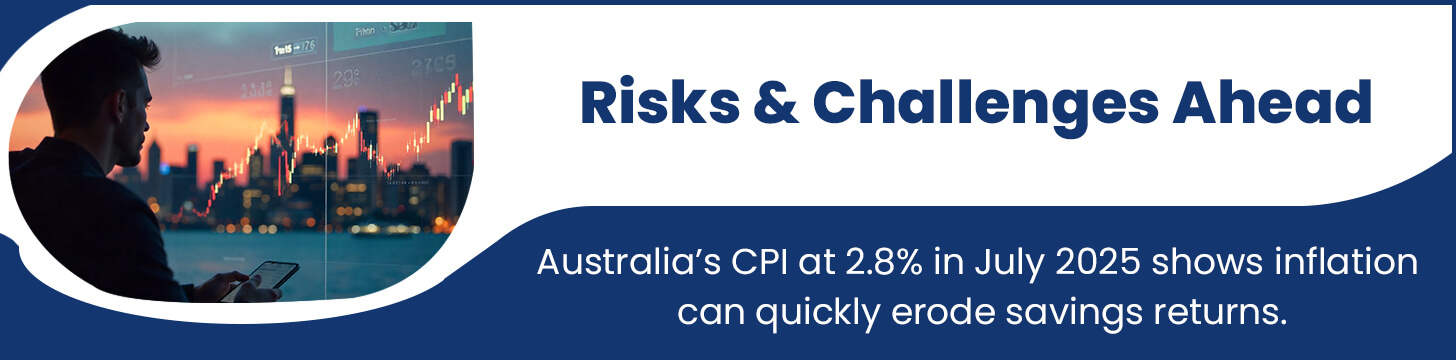
Inflation erodes returns. In July 2025, Australia’s CPI was 2.8% year-on-year, up from 1.9% in June. A 5% interest account loses 2.8% to inflation, leaving savers with a 2.2% net gain.
Global market volatility adds to the challenge. Slower Chinese growth, US interest rate changes, and European bank shifts all impact Australian funding costs. When global liquidity dries up, banks adjust domestic deposit rates.
The future is hybrid accounts that combine fixed and floating segments. Some will link to US Treasury yields or sustainable bond indexes.
This gives Australians protection from local inflation and hedging against global uncertainty.
By 2030, comparing accounts will mean comparing how they respond to global financial shocks, not just the headline rate.
Why traditional savings products are evolving to fintech disruption
Banks are modernising. Australia’s Consumer Data Right (CDR) lets customers switch accounts faster, so banks are upping their game.
Fintech challengers already offer:
- Instant comparison tools
- Gamified savings incentives
- Eco-linked bonuses
Big banks are adopting similar strategies to stay relevant. The savings account of the future won’t win customers on rate alone. It’ll be about trust, flexibility, and innovation.
By 2030, Australians may choose accounts based on digital tools, sustainability, and seamless integration into their overall financial lives — not just the percentage.
Best High-Interest Savings Accounts in Australia 2025

Choosing the “best” savings account in 2025 isn’t just about the highest rate. You need to factor in features, flexibility, transparency, and tech-enabled tools. Here are the criteria to help you pick savings options that will be competitive in 2030 and beyond.
How to pick future-proof accounts (beyond just “best rates”)
A great account in 2030 will adapt, not just advertise.
Here’s what to look for:
- Adaptive interest rates
- Look for accounts that combine a base rate with variable bonus tiers tied to liquidity or performance.
- Some Australian accounts already have tiered or conditional bonus rates.
- For example, Rabobank offers up to 5.00% p.a. for new customers, but only for an introductory period.
- Flexibility & switching
- Accounts that allow easy switching or linking to open banking will win.
- CDR (Consumer Data Right) in Australia is expanding, so users can port data and compare more easily.
- Performance triggers & rewards
- Future accounts may tie rewards to user behaviour: maintaining balance, regular deposits, or meeting sustainability goals. Some banks already gamify savings or offer eco-bonuses.
- Protection & longevity
- Make sure the provider is an authorised deposit-taking institution (ADI) covered by the Financial Claims Scheme (up to $250,000 per person).
- Also, check if bonus/intro rates are limited by balance caps or time windows.
Between 2025 and 2030, accounts that score high on flexibility, automation, and incentives will outperform those that rely solely on the rate. Savers should treat the rate as one input, not the only one.
Fees, bonus rates & digital tools
Hidden fees and unclear bonus rules devalue the account. A future-proof account must be transparent.
- Bonus conditions
- Many accounts only offer bonus rates if you deposit, don’t withdraw or make transactions. For example, ING’s “Savings Maximiser” has variable interest but conditions.
- Fees
- While many Australian accounts have no monthly fees, extra costs (statements, branch visits, transfers) can sneak in. Check the full fee schedule.
- Digital tools & transparency dashboards
- Look for apps or dashboards that show “How close am I to bonus rate?” or real-time tracking of your qualification status. The more you can see breach risks, the less you’ll lose out.
Transparency is becoming more important as savers become tech-savvy. Future accounts will require real-time alerts if you’re about to lose bonuses—a feature many banks don’t have yet.
AI-powered account comparison platforms in 2025
Imagine comparing dozens of accounts with personalized suggestions in seconds. That’s what AI brings to savings comparison tools.
- Personalized matching
- AI systems take in your income, behaviour, and goals and recommend accounts that maximise net yield. For example, AI might tell you you’d get more from a “hybrid fixed/bonus” structure given your deposit frequency.
- Dynamic rate tracking
- Some platforms already update savings rates multiple times a day. Savings.com.au compares 70+ providers and updates at least 3 times a day. AI can surface changes and flag new offers faster than static lists.
- Predictive switching alerts
- Based on historical rate moves, AI can predict when your current account’s rate will drop and alert you to switch a week early. This kind of proactivity will be essential.
- Risk filtering & reliability scoring
- AI tools will also flag accounts with volatile rates, weak bonus stability, or unclear terms. Users will have a “confidence score” on each account.
As of 2025, AI in fintech is already maturing in Australia, automating onboarding, risk assessment, and personal finance advice.
The next frontier is full-lifecycle account selection. In that world, you won’t search for “best rate”—your AI engine will route your money for you.
The Future of Savings Account Features

The next generation of savings accounts will do more than just pay interest. They will integrate data, values, rewards, and tech in ways that change how Australians save.
Below are three key feature trends that will define the “future-ready” savings accounts from 2025 to 2030.
Open banking and seamless account switching
Australia’s Consumer Data Right (CDR) creates the legal foundation for open banking. Through CDR, account holders can securely share their banking data with accredited third parties.
Open banking enables:
- One-click switching: moving money to a higher-yield account with no friction.
- Aggregate dashboards: viewing all your accounts across banks in one app.
- Smart comparison tools: automatically tailored suggestions based on your transaction history.
Already, some Australian banks and fintechs are enabling data portability and comparison tools via API integrations.
In the future, switching accounts might be as seamless as changing your streaming service. You could authorise a smart agent to shift your deposits monthly to whichever provider offers the best net yield after conditions.
Green savings: sustainability-linked financial products
Sustainability is no longer niche. More than 83% of Australians want their savings and super to be invested ethically.
Here’s how green savings are evolving:
- Sustainability-linked bonus rates: bonus interest rates tied to ESG metrics or carbon reduction targets.
- Green premium accounts: slightly lower base rate for proven funding into renewable projects.
- Impact dashboards: users see how their balance supports environmental initiatives (e.g., tree planting, clean energy).
Globally sustainable banking is growing — projected to reach US$754 billion in 2024 and US$2.6 trillion by 2030.
In Australia, banks must watch out for greenwashing and third-party verification. The future “best” savings account will be one that balances returns and real environmental impact.
Rewards beyond interest – loyalty, gamification, and tokenized incentives
As interest margins tighten, banks and fintechs will compete on user experience and rewards, not headline rates.
Gamification & Behavioral Incentives
Gamified features (badges, challenges, streaks) drive engagement. In Australia, fintech content is showing growing interest in these tools to encourage good money habits.
Markets globally confirm this: gamification is transforming digital banking by boosting loyalty and retention.
Bank apps might award points for:
- monthly deposits
- saving milestones
- referring friends
- opting into sustainable deposit options
Points can convert to cash, gift cards, or bonus interest.
Tokenized & Blockchain-linked Incentives
Tokenization allows banks to issue digital tokens as rewards. These tokens might:
- be tradable or redeemable
- carry fractional equity in green projects
- link to community programs (donations, local clean energy)
In the future, your “savings bonus tokens” might generate yield or be exchanged in decentralized finance (DeFi) contexts.
Loyalty & Tiered Benefits
Traditional loyalty models will merge with savings. Premium savers will get:
- fee waivers
- partner discounts
- priority support
- higher bonus thresholds
A loyalty score combined with AI might auto-upgrade users into better tiers, rewarding consistent saving behaviour.
Smart Strategies for Maximising Savings Returns

Just relying on a high interest rate won’t always beat inflation or opportunity cost. To make savings work harder, you need smart layering, automation, and ecosystem thinking. Here are three strategies that bridge today’s accounts with tomorrow’s wealth.
Blending savings with micro-investments and ETFs
Putting all your extra cash into a savings account might leave returns on the table. One future-proof move is hybrid allocation: allocate a portion to ultra-safe savings and another to micro investments or ETFs.
In Australia, micro-investing apps are already popular. Raiz (formerly Acorns) allows small “round-ups” from your purchases, investing into diversified ETFs.
Another example: CommSec Pocket lets you invest as little as AU$50 into themed ETFs for a $2 trade fee.
Why this works:
- Savings accounts provide liquidity and safety for your short-term buffer.
- Micro investments/ETFs offer growth for the longer term.
- Fractional shares or pooled ETFs reduce entry barriers.
By 2030, you might see banks offering hybrid accounts that automatically split deposits: 60% into savings and 40% into low-risk ETFs. The system might even adjust the split based on your risk profile or market signals.
Automating deposits with AI budgeting apps
You save more when you don’t think about it. AI budgeting and savings apps help automate consistency.
Australian apps like Frollo or WeMoney connect to your bank and categorise spending. Once set up, they can move spare cash into your savings account.
In the future, AI could go beyond budgets:
- Smart rounding: every purchase is rounded up to the nearest dollar, extra goes to savings.
- Adaptive deposits: AI predicts low-spend weeks and increases savings deposits accordingly.
- Goal-based nudges: when you fall behind on target, AI prompts micro boosts or redirects bonus funds.
Over time, automating deposits means your savings grow passively even when you get busy or distracted.
Using savings accounts as part of wealth ecosystems
Your savings account shouldn’t live in isolation. Think of it as a node in your broader wealth ecosystem: linked to investments, superannuation, credit, and wallets.
Here’s how that looks:
- Integrated dashboards: combining saving, investing, and super in one view.
- Smart capital flows: if your savings rate underperforms an internal benchmark, funds auto-move into liquid ETFs or fixed returns.
- Value stacking: loyalty perks, credit line access, or cashback for maintaining balances.
By 2030, banks or fintechs may operate money management hubs where your savings account is just one leg of a dynamic wealth engine. Your system will route idle cash to wherever it earns the best risk-adjusted return (while keeping liquidity buffers).
Risks & Challenges for Savers Beyond 2025
High-interest savings accounts offer opportunity but also come with new risks. Savers need to stay aware of structural shifts, tech vulnerabilities, and marketing traps. Below are the key challenges to watch out for in 2030.
Central bank digital currencies (CBDCs)
Many countries are exploring CBDCs (digital versions of national currencies). The RBA, like other central banks, is looking into a “Digital Australian Dollar”.
If introduced, a CBDC could change how deposits and bank balances work:
- Direct accounts with the central bank? Some argue that individuals may hold CBDC accounts directly with the central bank, bypassing traditional banks.
- Reduced bank deposits: commercial banks might see deposit outflows, reducing their ability to pay high rates.
- Programmable money: CBDC could have built-in constraints (e.g., expiration, boost certain spending) or special yield programs.
For savers, the move to CBDC means structural uncertainty. A high-interest account today may become obsolete or less competitive when digital central accounts become the new norm. Keep an eye on the regulatory developments and RBA pilots.
Cybersecurity and fraud in online savings platforms
As accounts go digital, security matters. Australian regulators are tightening up, but threats evolve.
Key risks are:
- Phishing and social engineering: attackers get you to hand over credentials.
- API exploitation: Open banking APIs can be compromised if not properly secured.
- Unauthorized switching or redirection: In weak systems, deposits can be redirected to fraudulent accounts.
To protect against these:
- Choose banks with strong multi-factor authentication and biometrics.
- Use hardware security tokens or authenticator apps.
- Monitor alerts: if a bank app says “account switched”, check immediately.
- Prefer platforms with encryption, anomaly detection, and third-party audits.
Future accounts will have on-chain proofing, zero-trust architectures, and AI anomaly detection to safeguard user funds. But until then, individual vigilance is key.
The risk of chasing unsustainable promotional rates
Many banks lure savers with high “bonus” rates — but only for a limited time or under strict conditions. Once that period ends, rates can drop sharply.
Risk factors are:
- Caps on balance eligible for bonus rates
- Conditional requirements (e.g., no withdrawals, linked spending)
- Rate cuts after teaser periods
In chasing high rates, savers may switch too often or overlook long-term stability. Always check the base rate, bonus conditions, and fallback rates before committing.
Regional & Global Trends to Watch

Savings innovations are happening fast around the world. Australia must adapt or risk being left behind. Below are three trends to watch as we head into 2030.
Savings account innovations in Asia and Europe
Asia is leading in mobile-first savings models. In many Southeast Asian markets, digital wallets are interest-bearing accounts that let you earn yield on idle funds.
For example, e-wallets in Singapore and Indonesia already offer 2-4% interest on balances, with instant access.
In Europe, “savings plus” accounts are emerging. These accounts combine traditional interest with exposure to low-risk bond baskets or green financial products.
These markets are moving faster than Australia. The lesson: savings accounts in the future will be utility, yield, and ethics — not just base interest.
How Australian banks are competing with global neobanks
Australian banks are under pressure from globally-focused neobanks and fintechs.
Some key dynamics:
- Local digital banks (e.g., Up Bank, Alex Bank) are going for mobile ease, seamless switching, and low overhead to offer better deals.
- Big banks are copying features — improved digital apps, APIs, “smart saving” tools — to keep customers.
- Regulatory shields: Australian neobanks must partner with existing ADIs or meet strict licensing, giving incumbents a structural advantage.
But Australians can already use international fintech “accounts” with better rates—though they often don’t have deposit protection in Australia. To stay competitive, Aussie banks need to lean in harder on user experience, global agility, and cross-border integration.
Will crypto savings accounts compete with high-interest deposits?
Crypto platforms already offer double-digit yields for staking, lending, or DeFi protocols. These yields can far outstrip Australian high-interest accounts — but come with volatility, counterparty risk, and regulatory uncertainty.
Still, over time, we may see hybrid “crypto-safe” deposit accounts: a portion of funds in secure, yield-generating blockchain protocols and the rest in fiat deposits. Some platforms already offer stablecoin-based savings with yields.
If Australian regulation evolves to provide clear consumer protection, crypto-linked savings could be serious competition to conventional deposits. The key will be trust, transparency, and insurance.
Conclusion – Building Future Wealth with Smarter Savings
High-interest savings accounts are still essential in Australia, but their future goes beyond rates. AI, open banking, and green finance will redefine tomorrow’s savings landscape.
Australians will expect transparency, instant switching, and personalised insights. AI engines will route deposits to higher-yield accounts automatically, while open banking will ensure frictionless movement across financial institutions.
Sustainability will be central. Green-linked savings accounts will allow individuals to align money with renewable projects, achieve both ethical impact and competitive returns without sacrificing financial growth.
Ultimately savings accounts will evolve into wealth partners, integrated with investments and superannuation. Savers should prepare now to thrive in Australia’s smarter financial future.
FAQs – The Next Decade of Savings Accounts
Will high-interest accounts stay above 5% beyond 2030?
Interest rates depend on inflation, Reserve Bank policy, and global conditions.
While occasional promotional offers may go above 5%, long-term averages will probably settle lower.
Savers should view high interest as cyclical, not permanent.
By blending savings with other safe assets, Australians can protect purchasing power while maintaining liquidity for emergencies. Flexibility, not chasing the highest rate, will be the key.
How will AI change the way we choose accounts?
Artificial intelligence will change how we choose accounts.
Instead of manually comparing rates, AI tools will analyse your financial habits, income flows, and goals.
They’ll predict rate changes, send switching alerts, and recommend accounts tailored to your lifestyle.
By 2030, many Australians may never “search” for accounts again. Instead, smart assistants will route deposits automatically into the most rewarding and secure accounts, maximising real returns with almost no manual effort.
Will “green” savings accounts be the new normal?
Green finance is growing fast. By 2030, sustainable banking could be mainstream, not niche.
Green savings accounts will fund renewable projects or climate-positive initiatives, often with bonus rates.
Australians already demand ethical finance, with surveys showing strong consumer preference for impact-driven products.
Regulators will likely require transparency to prevent greenwashing.
Savers will expect future comparisons to consider not just interest rates but environmental impact, making green accounts the new normal.
Should I use a savings account or diversify early?
Savings accounts are important for liquidity, safety, and emergencies.
But relying only on them means missing out on inflation or market opportunities. Diversification is key.
Pair savings with micro-investments, ETFs, or superannuation contributions for growth. Early diversification spreads risk and builds resilience.
By 2030, smart platforms will automate this blending, turning savings into one part of a whole of wealth strategy rather than the single foundation.
What will digital currencies do to savings?
Central Bank Digital Currencies (CBDCs) are being trialled in Australia.
If they happen, they will provide government-backed alternatives to bank deposits, possibly changing savings altogether.
CBDCs will have programmable features like instant transfers or micro interest adjustments.
They won’t replace savings accounts but will change how Australians store wealth.
Savers should keep an eye on regulatory trials because digital currencies will soon be part of every household’s financial toolkit.

Valuable Insights On Property Development & Investment Opportunities
-

Top High Interest Short Term Investment Options for 2026
High Interest Savings Accounts for Liquid Cash Buffers Cash sleeve purpose and liquidity role High…
Read More -
Best Performing Managed Funds in Australia: Expert Tips & Strategies
Top-Performing Managed Funds in Australia: What Investors Need to Know In 2026, Australian investors are…
Read More -
Best Financial Advisor Perth: How to Choose the Right Expert for Your Goals
Financial Advisor Perth Key Criteria for Choosing the Best Adviser Choosing the best financial advisor…
Read More -
How to Make Money from Property Development in Australia: A Comprehensive Guide
High-Growth Cities Offering the Best Property Development Margins Australia’s property development landscape will be shaped…
Read More -
What Are the Best Low-Risk Investments in Australia for Beginners?
Low-Risk Investing in 2026: The Beginner Snapshot For Aussie beginners seeking low-risk investments in 2026,…
Read More


Our Project Site :


Exclusive waterfront living at the Lake Narracan Resort community.

Quick Links
The information provided is general in nature and does not constitute personal financial advice. The information has been prepared without taking into account your personal objectives, financial situation or needs. Before acting on any information on this website you should consider the appropriateness of the information having regard to your own objectives, financial situation and needs. All statements made on this website are made in good faith and we believe them to be accurate and reliable however do not guarantee its currency. You should seek legal or other professional advice before acting or relying on any of the content.
Please note that past performance may not be indicative of future results. Different types of investments involve varying degrees of risk, and there can be no assurance that the future performance of any specific investment, investment strategy, or product made reference to directly or indirectly on our website, blogs , newsletters.
Our Project Site :

Find premium land developments and new estates across Australia.
Exclusive waterfront living at the Lake Narracan Resort community.

Quick Links
The information provided on this website including blogs is general in nature and does not constitute personal financial advice. The information has been prepared without taking into account your personal objectives, financial situation or needs. Before acting on any information on this website you should consider the appropriateness of the information having regard to your own objectives, financial situation and needs. All statements made on this website are made in good faith and we believe them to be accurate and reliable however do not guarantee its currency. You should seek legal or other professional advice before acting or relying on any of the content.