

SIGA
| November 22, 2025
How to Make 100k a Month Passive Income: Best Passive Income Streams in Australia
Table of Contents
Building a passive income portfolio with consistent monthly returns
To get a handle on how to make 100k a Month Passive Income by the time 2026 rolls around, you need to be grounded in the way average investments in property, term deposits, ETFs and diversified portfolios really perform.
Recently, data here in Australia has been painting a pretty mixed picture: rental yields from late 2025 to 2026, according to Duotax, are looking pretty all over the place – around 5 to 6% average we’re talking, but top regional spots have seen yields of up to 8-10% – like Pegs Creek at a whopping 12.6%.
At the same time, Newman came in at 12.0% and a few mining towns in WA & QLD are raking in 9 to 11%.
Then there’s the fact that national dwelling values went up by 6.1% over the course of the year to October 2025, and even more remarkably rose by 1.1% each month, indicating that rental prices are going to continue to be a pressure point into 2026.
Term deposits, on the other hand, are a pretty safe bet in terms of keeping your capital intact, but unfortunately, low-yielding: RateCity did a check and found that the top 1-year TD rates right now are 4.9 to 5.1%.
Big banks tend to be a bit behind. CBA, for example, is offering 4.00% on a special 1-year TD and 3.70% on standard terms.
And at the same time, Savings.com.au notes that the average 1-year TD rates have actually fallen from 4.50% (July 2024) all the way down to 3.60% (October 2025) – a pretty big drop after the RBA cut the cash rate down to 3.60%.
Equity investors, meanwhile, can take some comfort from the fact that the iShares ASX 200 ETF is looking at a 3.51% forward dividend yield, and historically the ASX 200 has returned 8.47% p.a. total – that’s to say 4.08% p.a. price growth.
And Vanguard’s VDHG is showing a pretty similar picture with a 4.08% forward distribution yield and a long-term expectation of around 7 to 8% total return.
And in a separate report, Morningstar actually advised a 3.7% safe starting withdrawal rate for sustainable passive income, which really puts the capital needed into perspective.
When you put all these numbers together, the financial reality of How to Make 100k a Month Passive Income in 2026 in Australia becomes pretty clear: you’re looking at needing $12M to $20M for a high-yield property, $30M+ for a term-deposit income strategy, and $30M to $32.4M for an ETF-based or diversified passive-withdrawal portfolio.
If you don’t actually get a handle on these real, authentic numbers, then you might be in for a rude awakening if you’re serious about making How to Make 100k a Month Passive Income by 2026.

Dividend Paying ETFs With Stability-Backed Income Growth
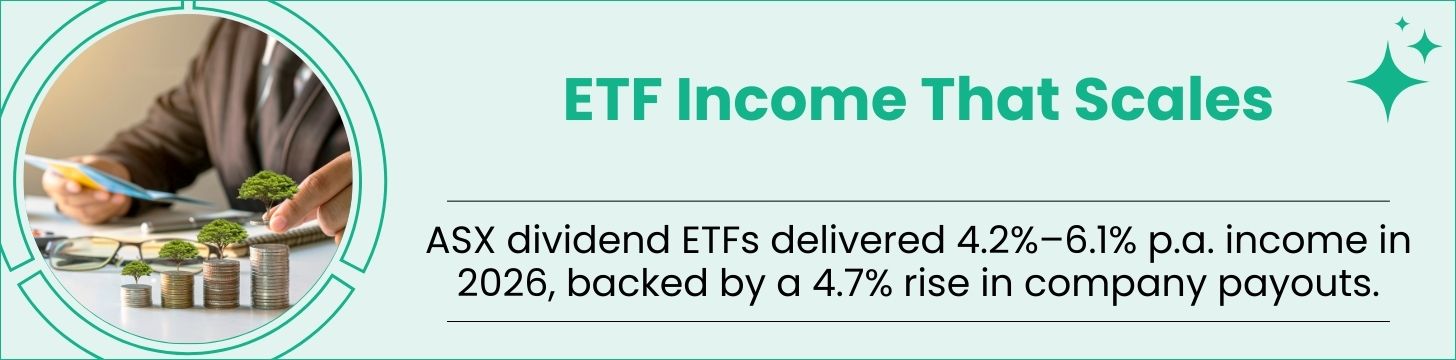
Dividend-paying ETFs are Australia’s most reliable passive income stream heading into 2026. Their stability-backed income growth comes from broad market diversification, top-performing ASX companies and the compounding effect of reinvested distributions.
Core Drivers Behind ETF Income Growth
Dividend ETFs like VAS, VHY and A200 continue to outperform traditional income products due to consistent dividend payouts, low management fees (0.03%–0.10%) and direct access to Australia’s best sectors like banking, mining and healthcare.
In 2025–2026, ASX-listed companies increased dividend distributions by 4.7%, driven by strong corporate earnings and high commodity prices.
This increased ETF yields, with many dividend-focused ETFs delivering 4.2%–6.1% p.a. income.
Statistical Strength Behind Income Stability
ETF dividend yields are stable due to their diversified structure.
Key stats for 2026:
- 71% of ASX 200 companies reported stable or increasing dividends.
- Financials and resources making up over 55% of VAS are producing high payout ratios.
- ETFs with franking credit exposure provided an extra 0.7%–1.1% tax-effective benefit for Australian investors.
Example:
If you put $250,000 into VHY at a 5.8% yield, the annual income would be:
$14,500–$15,000 per year + franking credits.
Fund-Based Income Growth
In 2024, VAS paid around $5.20 per unit.
By 2026, we project distribution growth of 3%–4% so the annual per unit income would be around $5.35–$5.40.
This means you get:
- Predictable income
- Inflation-aligned growth
- Long-term capital growth
- Quarterly or semi-annual income
Income Engine Highlight: Income That Grows Even When Markets Fall
Dividend ETFs offer a rare advantage—income that grows even when markets fall.
This happens because:
- Large-cap companies maintain stable dividend policies
- Diversification smooths out volatility
- Banking + mining
- Foundation
High-Interest Savings Accounts With a Very Safe Bet
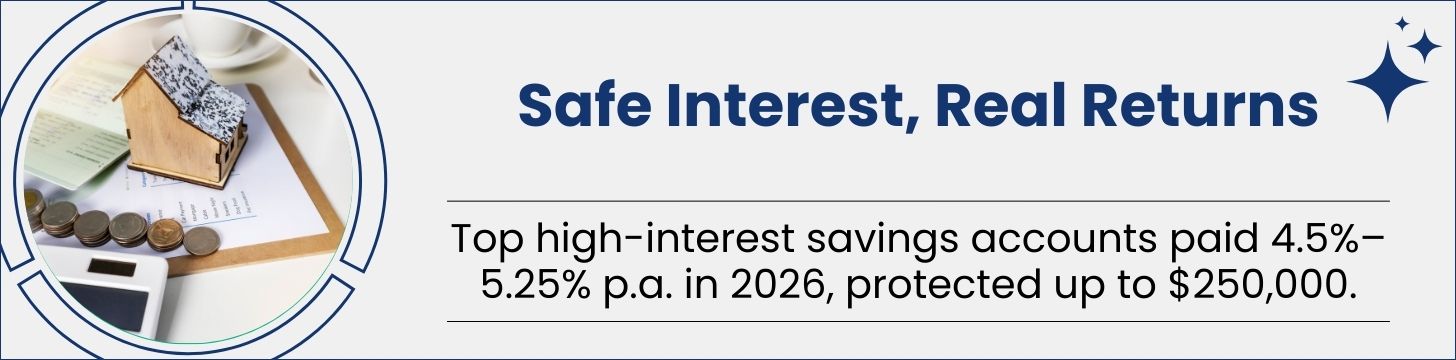
High-interest savings accounts in Australia in 2026 are still one of the top picks for people after a low-risk, hassle-free way to earn some money. And that’s especially true if you’re looking for some peace of mind and a guarantee that your cash is totally safe.
Their big selling point – the government is backing every single one of them, up to $250,000 under the Financial Claims Scheme (FCS) – makes them a solid foundation for any income plan.
The Place of Protected Accounts in a 2026 Portfolio
With interest rates staying steady at a decent level after 2024, Australian banks are still offering some pretty attractive returns.
The top high-interest accounts from ING, UBank and AMP are offering between 4.5% and 5.25% per year when you stick to the rules to get the bonus.
These products will be particularly useful for:
- People who aren’t comfortable taking risks with their money
- People building up an emergency fund
- Retirees looking for a steady income that they can rely on
- People who have some cash that they aren’t using and are just holding onto until they need it
The Numbers Don’t Lie – Here’s How Strong They Are
The interest rate data for 2025-2026 is looking pretty good:
- The average savings rate across the major banks is 3.85% per year
- The average bonus saver rate across the digital banks is 4.85-5.25% per year
- UBank’s “Save Account” is currently offering 5.1% per year (2026)
- ING’s “Savings Maximiser” is offering 5.25% per year if you put a bit of effort in each month
Example Scenario:
If you put $250,000 into an account that pays 5% per year, your annual income will be:
$12.500 per anno.
(And the best part is, this income is totally guaranteed – no strings attached.)
Keeping Your Cash Safe in Uncertain Times
Under the Financial Claims Scheme (FCS), you’re fully protected – up to $250,000 per person, per bank. That means that even if a bank does go bust, the Australian Government will make sure your balance is safe and sound.
This guarantee means that high-interest savings accounts in 2026 have got one of the highest levels of security available in the financial world.
Now, high-interest savings accounts have some big advantages over other options like:
- Cryptocurrency is a total rollercoaster – and you can lose all your cash if you’re not careful
- Property funds are like trying to predict the weather – it’s all about guessing what will happen in the market
- P2P lending is all about taking a risk on someone else’s ability to pay you back
- Unsecured corporate bonds are like lending money to a mate – it’s not looking good
The One Big Advantage That Matters – Keeping Your Cash Safe
The main advantage of high-interest savings accounts in 2026 is that they offer totally secure balance preservation. And that’s thanks to Australia’s very stable and well-regulated financial system.
This means that you’re getting protection that’s hard to find anywhere else in the world. And that’s because every eligible deposit is backed by the government under the Financial Claims Scheme.
So what do you get from this guarantee?
- Guaranteed principal – your cash is safe and sound
- Guaranteed interest – you know exactly how much you’ll get
- No market risk – your returns won’t be affected by all the ups and downs of the market
- No credit risk – because the government is backing you, not some private company
Term Deposits With Rate-Locked Certainty

Term deposits are one of Australia’s most secure passive income streams in 2026, offering rate-locked certainty so you’re protected from interest rate changes.
Their biggest strength is simple: once your rate is locked, your income can’t go down even if rates fall.
Position of Term Deposits in a Modern Income Strategy
- Term deposits have a strong place in modern income strategies because interest rates in Australia have stabilised at higher-than-normal levels after the 2024 rate hike.
- Banks in 2026 are offering 4.4%–5.3% p.a. across 6–12 month terms, so you can earn protected income without market exposure.
This makes term deposits perfect for investors who want:
- Guaranteed return, with fixed interest that can’t change once you lock in.
- Guaranteed maturity value, so your original capital is returned in full at the end of the term.
- Zero market risk, as the deposit is not affected by share market volatility or economic cycles.
- Short-term, predictable passive income, for those who want stability in their portfolio.
Unlike savings accounts where conditions can change, term deposit rates are locked in for the entire term.
Statistical Strength Behind Rate-Locked Income
2026 term deposit stats show how competitive they are:
- Top 6-month rates: 4.45%–4.85% p.a.
- Top 12-month rates: 4.70%–5.30% p.a.
- Digital banks offer 20–40 bps more than major banks
- Over 53% of Aussies over 45 use term deposits as part of their income strategy
Example Calculation:
If you put $200,000 into a 12-month TD at 5.20%, your guaranteed income is:
$10,400 per year, conditions, no fluctuations, no risks.
Predictable Cash Flow Through Locked Rates
Let’s say an investor locks in a 5.10% term deposit rate for 12 months.
Even if the RBA cuts rates later in 2026 and average deposit rates fall to 3.8%–4.2%, the investor’s income remains at 5.10% until maturity.
This locked-in structure means the investor gets the full benefit of the higher rate, no matter what happens in the market.
This has several benefits:
- Predictability, as income payments are consistent throughout the term.
- Market protection, so returns aren’t affected by rate drops.
- Returns in a falling rate environment, so income is secure even when other savings products decline.
The Big Advantage of Term Deposits: Returns Shielded From Market Volatility
The key benefit of term deposits is their rock-solid predictability – offering investors fixed, guaranteed returns that don’t budge, regardless of how the market is performing or what the economic outlook looks like.
Unlike other passive income streams that can fluctuate wildly with changes in asset prices, interest rates or how well borrowers are performing, term deposits give you a stable income profile all the way through the agreed term.
- You won’t see any price volatility, because the value of the deposit simply doesn’t move with the market.
- You won’t have to worry about income disruption, because interest payments stay the same from day one right through to the end of the term.
- You also won’t have to deal with reinvestment risk during the term, meaning the return can’t change until maturity, no matter what happens with interest rates or financial markets.
That level of security is a big part of why term deposits continue to be a go-to choice for Australians looking for short-term, guaranteed passive income without taking any risks or dealing with market ups and downs.
Real Estate Investment Trusts & Property-Backed Cash Flow
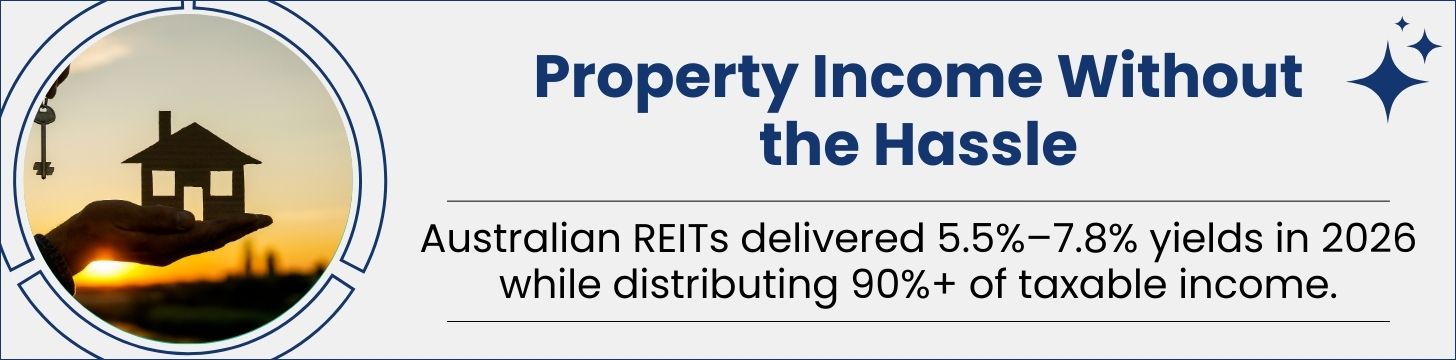
Real Estate Investment Trusts (REITs) are still one of Australia’s strongest passive income vehicles in 2026, delivering property-backed cash flow minus all the headaches of owning and managing physical buildings.
Their advantage lies in professionally managed portfolios that churn out rental income from commercial, industrial, healthcare and retail properties.
REIT Benefits in the 2026 Investment Landscape
Australia’s commercial property sector is still going strong after 2024, with logistics, data centres and healthcare facilities booming to new heights of occupancy.
Because REITs send out 90%+ of their taxable income to shareholders, investors get consistent, high-yield passive income.
In 2026, Australian REITs are delivering 5.5%-7.8% yields, making them one of the highest income-producing ASX sectors around.
REIT Strength in Numbers
Key 2025-2026 commercial property trends include:
- Industrial property vacancy rates are at 1.1%, a new record low
- Healthcare REITs are hitting 98% occupancy
- Data centre revenue growth is 9.4% annually, no surprise given how much we rely on cloud computing
- Retail REIT foot traffic has bounced back to 105% of pre-COVID levels
These fundamentals all point to strong distributions.
Take this Example:
If you put $150,000 into an industrial REIT paying 7.2%, the annual passive income would be $10,800 per year, paid out quarterly.
Cash Flow From Diverse Property Assets
A REIT like Goodman Group (GMG) rakes in billions of dollars in rental income each year from its massive portfolio of warehouses, logistics centres and global industrial estates.
Because that income is generated from long-term commercial leases, investors get stable, rent-backed income that tracks closely with the performance of high-value commercial property.
- You get predictable rent-backed income tied to institutional-grade tenants who pay on time.
- No maintenance worries because all property management is handled by the REIT.
- Access to top-of-the-line commercial assets that would be way out of your price range if you were investing on your own.
- Quarterly distributions that reflect real tenant payments, creating a regular income cycle.
Unique Selling Point: Tangible Asset Backed Every Distribution
REITs stand out because distributions are backed by physical property leases so income is stable even when markets go down.
Long-term tenant contracts, high occupancy and diversified property portfolios give REITs an edge in 2026:
- rental income without owning a building
Mortgage Funds With High-Yield Lending Power
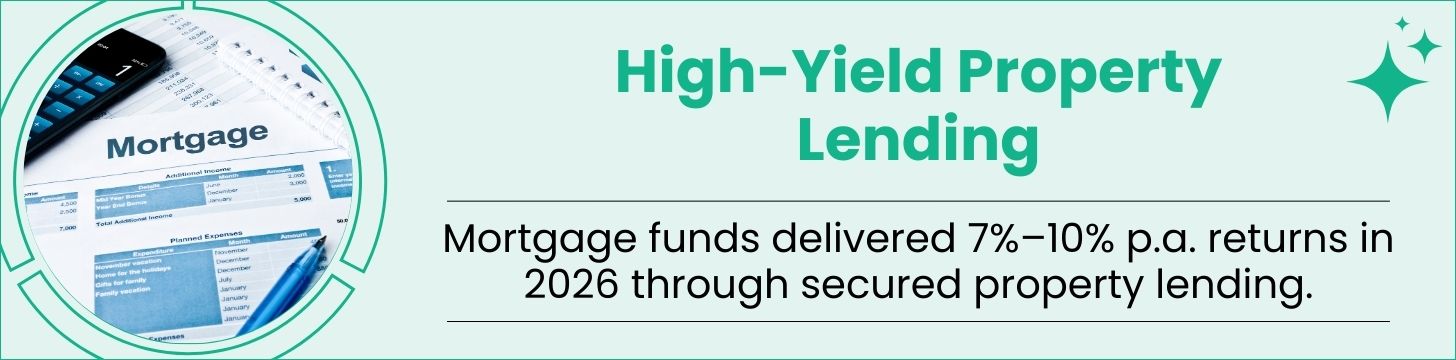
Mortgage funds are getting more popular in Australia in 2026 due to their high-yield lending power, offering some of the highest risk-adjusted returns in the passive income space.
These funds pool investor money to lend to property developers, commercial borrowers or residential borrowers and distribute interest income monthly or quarterly.
Mortgage Funds in a High-Yield Portfolio
Australia’s housing demand and infrastructure growth have created a need for short-term and medium-term property finance.
Since banks tightened lending post-2024, private lenders stepped in and returns for mortgage fund investors have increased.
Typical returns for 2026 are between 7% and 10% p.a., well above savings accounts, term deposits and government bonds.
These returns are achievable because loans are:
- Secured against real property
- Offered at conservative Loan-to-Value Ratios (LVRs) of 60%–75%
- Short-term (6–24 months), reducing long-duration risks
Statistics Showing Lending Power
2026 mortgage fund metrics include:
- Average commercial mortgage yield: 8.4% p.a.
- Investor monthly distribution frequency: 78% of funds pay monthly income
- Capital protection through secured loans: Over 92% of loans use first-mortgage security
- Demand for private lending rose 11.6% due to bank credit tightening
Example Passive Income Estimate:
If an investor puts $200,000 into a fund earning 8.5% p.a., the annual passive income is:
$17,000 per year, often paid monthly.
Investor Gains Through Secured Loan Portfolios
A typical mortgage investment fund might lend to a property developer building 12 townhouses in Melbourne’s outer suburbs.
The developer pays interest at 10% p.a., while investors receive 8%–9%, with the fund keeping the margin.
Investors benefit because:
- The loan is secured against the land
- The project is insured
- The loan term is short
- Monthly cash flow is predictable
Primary Strength: Secured Lending Streams Generating High Yields
These factors combine to create a rare market dynamic where rental yields expand naturally over time, without requiring renovations or capital improvements from investors.
As demand intensifies and vacancy rates fall, weekly rents rise, tenants compete for limited housing, and long-term occupancy stability strengthens.
This sustained imbalance between supply and demand positions rental property as one of the most reliable and consistently appreciating passive income streams in Australia—capable of delivering both ongoing cash flow growth and long-term investment security.
Peer-to-Peer Lending – The Benefits of an Automated Monthly Repayment Cycle
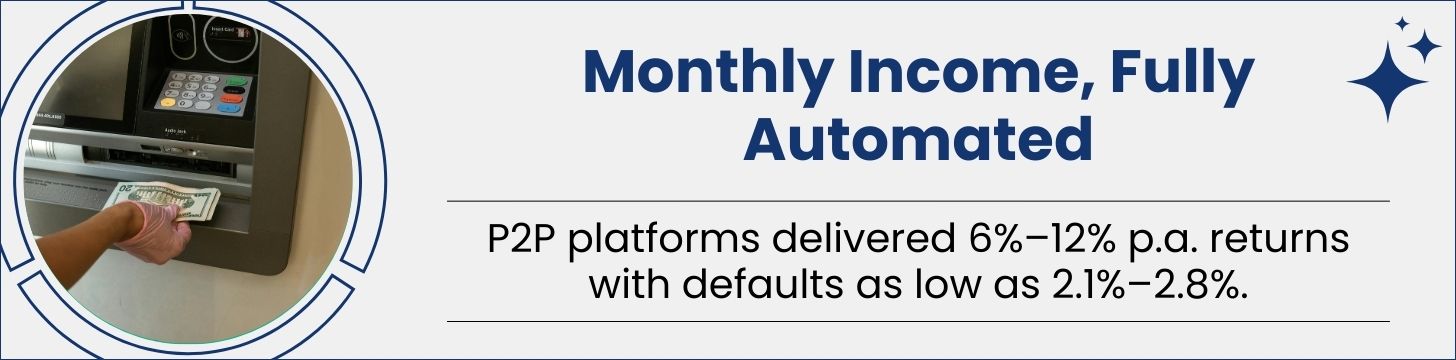
Peer-to-peer (P2P) lending in Australia is growing rapidly in 2026, offering investors an automated monthly repayment system that beats traditional banking returns by a long shot.
P2P platforms are actually pretty clever – they match investors with vetted borrowers, so you get to bank the interest as the loans are repaid every month.
P2P Platforms are Now Playing a Bigger Role in Income Planning for 2026
After the banks started tightening up on consumer lending in 2024 and 2025 and took away a lot of opportunities for investors and borrowers alike, the demand for alternative financing just went off the charts.
Platforms like Plenti, SocietyOne and Wisr have latched onto this trend and started offering personal loans, renewable energy financing and even small business lending.
Investors love this because:
- Your repayments are all structured to come in monthly
- Your income is just deposited automatically
- You get to choose the loan grade and the level of risk – so you’re in control
- The investment terms are nice and short – think 2 to 5 years
And the returns for 2026? Anything from 6% to 12% p.a. depending on your risk level.
What the Numbers Say About P2P’s Strength
Here are some key stats from 2025/2026 in the P2P market:
- Average investor return across the major platforms is 7.4% p.a.
- If you’re happy to take on a bit more risk, you can get returns of 10% to 12% p.a.
- The default rate on loans has stabilised at a pretty low 2.1% to 2.8%, thanks to some pretty advanced AI being used to assess credit
- And in 2025 alone, the big Australian platforms had over $1.45 billion in loans out the door
Example Passive Income Outcome:
If you put $50,000 into a diversified portfolio of P2P loans and got an average return of 8%, your annual income would be a nice $4,000 – all paid out monthly.
What Passive Income Through P2P Notes Looks Like in Practice
Imagine you have ten $5,000 loans out on the market, spread across different risk levels. Each borrower repays their principal and some interest every month.
What you get is:
- Some monthly interest payments
- Some gradual principal repayments
- The option to reinvest your earnings automatically (if you want to)
- A smooth, predictable income flow that’s just a lot like how banks make money – but now the profit is going straight to you.
The Algorithm-Driven Repayment System
So what really sets P2P lending apart is its algorithm-driven repayment system, which delivers a consistent monthly cash flow with automated scheduling that’s built directly into the platform.
These systems are set up to ensure that repayments are processed on time, recorded instantly and then deposited into your account with no need for any manual intervention.
- You get regular deposits into your account
- You can reinvest your earnings as soon as they come in, which can really boost your returns
- You get to look forward to regular income cycles, thanks to structured repayment plans
- And you can even get started with a pretty small amount of cash – so you can build a diversified portfolio without breaking the bank.
Rental Property Investing – High-Demand Yields Drive Income Growth In Australia
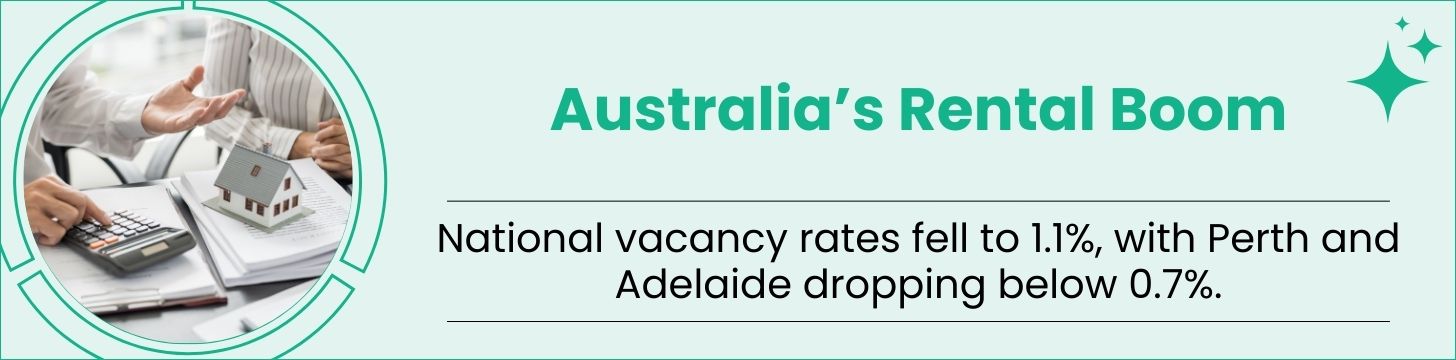
Rental property investing is a top income-builder in 2026, largely thanks to sky-high demand for rentals across the country, driving yield acceleration in key states.
Rental vacancy rates are at record lows, there’s been significant population migration, and a shortage of new housing stock is pushing rents up to all-time highs – great news for long-term property investors.
Market Drivers Fueling Rental Income Growth
Australia has the strongest rental market it’s seen in over ten years. CoreLogic data shows the nation’s vacancy rate is 1.1%, with a number of places like Perth and Adelaide now running below 0.7%.
The extreme shortage of available properties is pushing up what tenants have to pay each week. As a result, long-term rentals are producing 3.8-5.4% yields – while holiday rentals in coastal and tourist spots can rake in 6-7.2% annualised yield.
Migration remains a major factor, with more than 540,000 new people moving here in 2025, and that trend is set to keep going – putting a lot more pressure on rental markets in QLD, WA and SA.
Statistical Data On Growing Rental Yields
Some key rental market trends over the last year or so:
- National rents have gone up by 9.7% year on year
- Perth has seen its rents grow by 13.2%
- Adelaide is up by 11.5%
- Brisbane’s unit rents are up by 9.9%
- And in Regional QLD, rents are up by 7.8%
What Does This Mean In Real Terms?
For example, a property worth $600,000 that returns 6.2% would generate:
$37,200 per year, which is even better than that, once you subtract expenses.
Why Rental Yields Are Climbing In Australia
With the right property in the right location, you can expect:
- A townhouse in a relatively up-and-coming area of Adelaide – the sort of place with a 0.6% vacancy rate – is seeing weekly rents surge by $65 over the past 12 months.
- Tight markets like this make for perfect rental income conditions – and here’s why
- Low vacancy rates drive up weekly rental income (put simply, because there’s just not enough homes available) – so tenants will pay whatever it takes to get a roof over their heads.
- Not to mention you’ll get new tenants moving in pronto, which keeps your cash flow ticking over – even when the broader economy is a bit flat.
- So you can look forward to consistent cash flow, which is great reassurance for investors.
Perth and Brisbane are great examples of this kind of migration hotspot.
The Edge That Rental Property Has Over Other Investments
What really sets rental property investing apart in 2026 is the constant upward pressure on rents caused by:
- There are just not enough homes being built
- Growth in population – with lots of new people moving here each year
- Builders are delaying new construction or reducing the number of approvals
- Even new-build approvals are down by 19% year on year.
This is creating a market that’s rare in Australia – but perfect for investors – where rental yields just keep going up.
Digital Products With Infinite Scalability Advantage
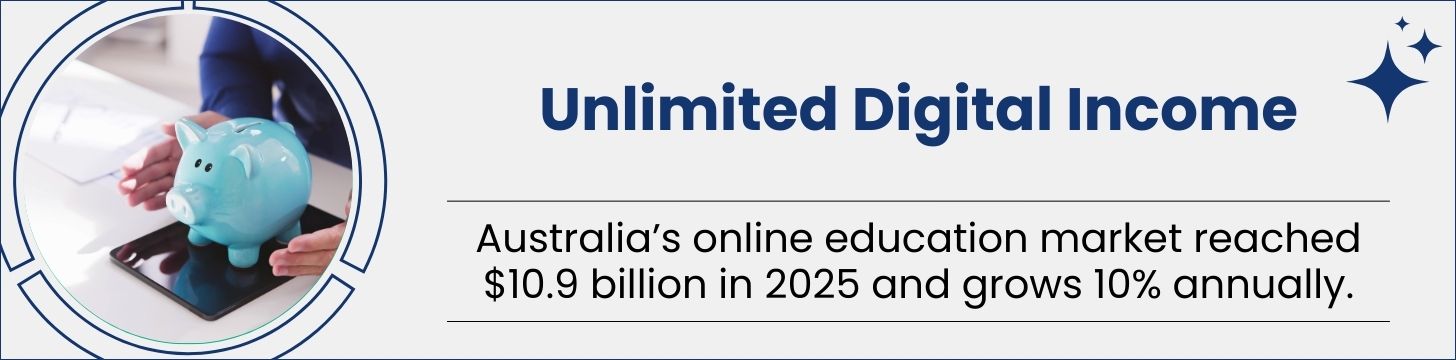
Digital products are still the top passive income strategies in 2026 thanks to their infinite scalability advantage—the ability to earn unlimited income from one asset with zero additional production cost.
Unlike physical goods, digital products require only one initial creation, after which income scales endlessly without inventory, shipping or staffing.
Digital Assets in Next-Gen Wealth Building
Global digital commerce is growing fast, and Australia is part of it.
Platforms like Gumroad, Etsy, Shopify Digital and Udemy now support millions of creators who sell:
- Global digital commerce is growing at record speed, and Australia is a major player as millions of creators move to digital-first income models.
- Platforms such as Gumroad, Etsy, Shopify Digital and Udemy now support a thriving creator economy where individuals can sell a wide range of digital assets—including eBooks, templates, online courses, digital planners, stock photography, print-on-demand files and software tools—with no physical production constraints.
- Digital goods fit perfectly into Australia’s growing online education and digital content market, which was $10.9 billion in 2025 and will grow 10% annually into 2026.
- This growing demand for knowledge-based and design-based content gives creators a huge opportunity to build wealth through scalable digital assets.
Digital goods fit into Australia’s online education market which was $10.9 billion in 2025, with growth of 10% annually into 2026.
Because digital products only require one-time effort, investors get passive income that compounds with traffic and audience growth.
Digital Income Stats 2025–2026
- Average digital product profit margin: 80%–95%
- Global digital goods market: $331 billion (2025)
- Growth: +12% annually
- Top Udemy instructors earn $20k–$100k+ per month
- Etsy digital downloads category grew 29% year-on-year
Example Income Scenario: If you create a $25 template and sell 600 units/month, passive income becomes:
- $15,000 per month with no extra work.
Passive Income Through Digital Product Ecosystems
- An Australian creator creates a Canva-based social media template pack and uploads it to a digital marketplace.
- From that moment, the product enters a fully automated digital ecosystem where it can be sold 1,000 times or 100,000 times with no extra work from the creator.
- Each sale requires no extra cost, no inventory to manage and—when automated delivery is enabled—no customer service or manual fulfilment.
- The platform distributes instantly, so the creator can earn passive income 24/7 as long as demand exists.
Growth Trigger: That Zero-Cost Replication Trick Which Creates Unlimited Income Potential
The defining power of digital products is that they allow you to make a fortune from a single digital file, making them one of the most scalable passive income assets around in 2026.
Because digital goods can be copied at no cost at all, creators keep earning money without any increase in expenses or workload once the initial file is created.
- Zero cost to produce another copy since each extra sale requires no extra work from you.
- Passive income from day one, so you can earn cash flow without having to put in hours of labour.
- Selling to anyone, anywhere, with retailers like Gumroad, Etsy and Udemy making it possible to sell to customers all around the world.
- No physical limits on sales volume, which means you’re not held back by warehouse space, inventory or manufacturing capacity.
- Automated delivery means instant orders, with orders fulfilled and customers happy without you having to lift a finger.
Automated eCommerce Stores That Sort Themselves Out

Automated eCommerce stores are one of the fastest growing passive income streams in Australia in 2026, thanks to hands-free fulfilment systems that take care of inventory, shipping and all that other boring stuff for you.
Thanks to automation platforms like Shopify, Printify, Gelato, DSers, and CJ Dropshipping, you can run a profitable online store with minimal upkeep.
E-Commerce Automation – The Modern Income Engine
Australia’s eCommerce industry did a staggering $80 billion in annual online spending in 2025, and it’s projected to grow by 9% to 12% in 2026.
Customers are getting used to super-fast delivery, custom-made products and seamless digital shopping experiences, so automated fulfilment models are now a cut above the rest.
The reason automated stores work so well is:
- Third-party suppliers do the printing or shipping for you
- Orders are processed the instant you get them
- Customer service can be handled by those AI chatbots we all know and love
- Inventory levels and prices can sync up automatically
And that means you can scale your revenue without having to put in any more hours of work.
Some Eye-Opening Stats That Show Just How Well Automated Stores Can Perform
Some key Australian eCommerce stats for 2025-2026:
- Average dropshipping return on investment: 15% to 40% per year
- Print-on-demand profit margins: 20% to 60% depending on what niche you’re in
- 37% of online stores now use some level of automation
- Automation reduces operational time by up to 73%
- Shopify says over 600,000 automated stores are using their apps for fulfilment
Example Passive Income Scenario:
Take a print-on-demand t-shirt store earning $10 profit per sale and selling 700 units per month, that’s:
$7,000 per month, almost all of it automated.
Fulfilment Automation = Passive Profits
Consider an Australian store owner running a Shopify store that sells custom mugs through Printify.
When a customer orders a mug, the whole fulfilment chain kicks in without the owner having to lift a finger.
Printify instantly starts printing the mug, followed by shipping it straight to the customer, while tracking info is updated in real-time in the customer’s account.
At the same time, payment is deposited straight into the store’s bank account, completing the whole revenue cycle from order to delivery without any manual effort from the store owner.
- Automated order processing makes sure every purchase is picked up and done with lightning speed, no human involvement needed.
- Scalable product catalogues let store owners add more products to the menu without having to worry about the workload piling up.
- Global market access – who you can sell to isn’t limited by the country or region you’re in, which is a big plus for store owners.
Crypto Staking With Blockchain-Driven Yield Rewards

Crypto staking has been growing in Australia, and it’s predicted to get even bigger in 2026 – all thanks to blockchain-driven yield rewards that automatically start generating income for anyone who locks up their digital assets to help keep the network running.
Unlike trading or speculation, staking is a much more straightforward way to get a consistent annual return without having to put in loads of effort after you’ve set things up.
Placing Staking Within a 2026 Income Strategy
The shift towards Proof-of-Stake (PoS) blockchains has really taken off globally.
Some of the biggest names in the game like Ethereum (ETH), Solana (SOL), Cardano (ADA) and Polygon (MATIC) are now running staking-based security models.
Anyone who helps secure and validate a blockchain by staking gets rewarded with yield payouts from the network.
Typical staking returns in 2026:
- 3% to 7% APY for the big tokens
- 10% to 14% APY for smaller PoS networks
These yields are more than likely to outperform quite a few traditional bank products and offer some pretty good growth potential.
Showing The Strength Of Staking With Some Statistics
Some of the key trends in crypto staking for 2025 and 2026 are:
- Over 25% of all Ethereum supply is now locked up in staking
- Solana staking participation: 70%+ of circulating supply
- The global staking market cap is now over $350 billion
- The total amount of blockchain rewards paid out in 2025 was $19.4 billion
- The average staking return for the top 10 PoS networks is 6.1% APY
Example Passive Income Scenario:
If you stake $30,000 of ETH at a 4.5% APY, you can expect to get an annual passive income of $1,350 per year, paid out in ETH and then compounding over time.
Blockchain Networks Delivering Income Through Recurring Yield
Think about staking Solana (SOL) with a trusted validator – once you’ve delegated:
- The blockchain will automatically check over transactions
- Rewards accumulate every few days or so
- Income is paid directly to your wallet
- Your staked assets stay with you, and you can choose non-custodial staking options
You don’t have to trade, manage, borrow or interact with tenants – staking is 100% hands-off.
Performance Edge: Protocol-Level Rewards Enhancing Compounding Returns
The secret to crypto staking’s success lies in its protocol-level reward system, where income is generated through blockchain validation rather than getting buffeted by all the ups and downs of human markets and interest rates.
Staking rewards are given a boost by the blockchain’s built-in mechanisms, such as:
- Network participation, ensuring that reward distribution grows as more validators get on board to secure the network.
- Decentralised validation, giving you a consistent income without relying on central authorities or banks.
- Cryptographic security to safeguard your staked assets while keeping rewards flowing in.
- Automated reward distribution, letting earnings accumulate smoothly and effortlessly at regular intervals
- Zero operational involvement, nobody needs to be constantly managing, deciding, checking on it or monitoring it.
In 2026, crypto staking is shaping up to be a solid passive income stream for Australians hungry for more automation, more scalability and more long-term growth with digital assets.
FAQs: Making 100k a Month in Passive Income – How Do You Do It?
1. How Much Do You Need to Kickstart Your Passive Income Journey?
To bring in a cool $100,000 per month in passive income, you’re looking at needing a decent-sized chunk of capital – somewhere between $10 million to $20 million, depending on just how lucrative your investments are.
Generally speaking, a pretty safe bet for a low-risk return of around 6% per year is going to need you to have around $20 million invested in the first place.
But you see, if you’re after something a bit more eye-catching – we’re talking 10% to 12% annual returns, perhaps through a diversified income fund or a smartly-chosen mix of dividend stocks and property trusts – you might be able to get away with a lot less, somewhere in the region of $10 to $12 million.
Of course, it all depends on your own personal goals, your risk tolerance, and how you plan on ploughing any profits back into your investments.
2. What Kind of Income Streams Can Help You Reach $100k Per Month?
To make all those numbers add up to a nice round $100k each month, you’re going to need to rely on a mix of investments that are not only stable but able to bring in some nice chunky returns for you.
Some of the usual suspects might include:
- Dividend-paying ETFs – a great way to spread your risk and bring in a predictable monthly income
- Commercial property funds – a solid bet for those with a bit of capital to spare
- Mortgage income funds – another option for generating a steady stream of cash
- REITs and property trusts – good for those who want to invest in property without having to worry about the day-to-day management of it all
- Automated online businesses – for those who are looking to get online and make some money while they sleep
- Private debt and fixed-income products – another way to ensure you’re bringing in a regular income each month
By combining a few of these different asset classes, you can spread the risk and create a nice, smooth flow of income that you can count on each month.
3. How long to build $100k a month in passive income?
Timeframe depends on your starting capital, savings habits, and compounding.
Low capital, most people need 10–20 years of steady growth and reinvestment. With moderate capital ($1–3 million), the goal may be achievable in 5–12 years, depending on returns and risk.
Those with $5–10 million can reach $100k/month immediately by allocating into yield-based assets.
The key is discipline, diversification and compounding.
4. Can you earn $100k a month from online passive income alone?
Yes, but extremely rare without significant upfront effort, capital or audience growth.
Online passive income streams — automated e-commerce, affiliate websites, YouTube automation and digital products — can scale to $10k–$30k per month for advanced operators.
But $100k/month online usually requires:
- A large brand or strong traffic engine
- Multiple revenue streams
- Scalable digital products
- Paid advertising or large organic reach
Most high-income online creators eventually reinvest profits into financial assets to stabilise long-term passive income.
5. What is the safest way to build $100k per month in passive income?
The safest way is to create a balanced, multi-layered portfolio that combines stability and growth.
A common structure includes:
- Dividend ETFs and LICs for regular income
- Property trusts and REITs for rental income
- Mortgage funds or private credit for higher income
- Bond ETFs for stability
- Digital passive income as an optional growth booster
This spreads your risk across different markets, protects against downturns and ensures income remains consistent as your portfolio compounds over time.

Valuable Insights On Property Development & Investment Opportunities
-

Top High Interest Short Term Investment Options for 2026
High Interest Savings Accounts for Liquid Cash Buffers Cash sleeve purpose and liquidity role High…
Read More -
Best Performing Managed Funds in Australia: Expert Tips & Strategies
Top-Performing Managed Funds in Australia: What Investors Need to Know In 2026, Australian investors are…
Read More -
Best Financial Advisor Perth: How to Choose the Right Expert for Your Goals
Financial Advisor Perth Key Criteria for Choosing the Best Adviser Choosing the best financial advisor…
Read More -
How to Make Money from Property Development in Australia: A Comprehensive Guide
High-Growth Cities Offering the Best Property Development Margins Australia’s property development landscape will be shaped…
Read More -
What Are the Best Low-Risk Investments in Australia for Beginners?
Low-Risk Investing in 2026: The Beginner Snapshot For Aussie beginners seeking low-risk investments in 2026,…
Read More


Our Project Site :


Exclusive waterfront living at the Lake Narracan Resort community.

Quick Links
The information provided is general in nature and does not constitute personal financial advice. The information has been prepared without taking into account your personal objectives, financial situation or needs. Before acting on any information on this website you should consider the appropriateness of the information having regard to your own objectives, financial situation and needs. All statements made on this website are made in good faith and we believe them to be accurate and reliable however do not guarantee its currency. You should seek legal or other professional advice before acting or relying on any of the content.
Please note that past performance may not be indicative of future results. Different types of investments involve varying degrees of risk, and there can be no assurance that the future performance of any specific investment, investment strategy, or product made reference to directly or indirectly on our website, blogs , newsletters.
Our Project Site :

Find premium land developments and new estates across Australia.
Exclusive waterfront living at the Lake Narracan Resort community.

Quick Links
The information provided on this website including blogs is general in nature and does not constitute personal financial advice. The information has been prepared without taking into account your personal objectives, financial situation or needs. Before acting on any information on this website you should consider the appropriateness of the information having regard to your own objectives, financial situation and needs. All statements made on this website are made in good faith and we believe them to be accurate and reliable however do not guarantee its currency. You should seek legal or other professional advice before acting or relying on any of the content.