

Table of Contents
Long-Term Performance Benchmarks for High Returns
In 2026, Australia starts off strong on the statistics front when it comes to investing for high returns. Long term, the numbers are pretty clear: Aussie shares have been delivering around 9.8% a year for the past 30 years and A-REITs have averaged 9.3% – that’s no surprise considering them the top performers for return-driven portfolios.
Property is also data-driven. KPMG is forecasting a national house price growth of +3.3% for 2025 and over +6.0% in 2026, thanks to a persistent gap in supply and demand.
Just to put that in perspective, the country is expecting around 562,000 new households between 2023 and 2026 but only around 467,000 new homes being built – that’s a shortfall of about 95,000 homes. And with rental inflation projected to stay between 3-4% that’s great for property investors.
When it comes to income assets, 2026 is shaping up to be a much better year than past cycles.
As of last November, the 10-year Australian government bond was sitting at a yield of around 4.5% – Housing Australia’s 10-year borrowing cost was even higher at just under 5%. That’s a higher return on income than before the pandemic.
Alternative credit is still one of the biggest high-yield opportunities. P2P platforms are offering 6-12% a year and globally, the market is expected to blow past $176.5 billion in 2025 and eventually hit $698.3 billion by 2032 (CAGR of 21.7%).
Thematic investing on a global level also looks pretty promising, thanks to IMF forecasts of 3.2% global GDP growth in 2025 and 3.1% in 2026.

Global Index Funds For Long-Term Wealth Growth

Diversification Across Multiple Markets For Stability
Global index funds offer the perfect foundation for what’s going to work in Investment Ideas for High Returns (2026), since they spread your money across thousands of companies all around the globe – meaning no over-reliance on any one sector or country.
This built-in diversification helps smooth out the ups and downs of global growth cycles.
They give you exposure to the US, Europe, Japan, Australia and emerging markets all at once.
And that means you get protection against currency swings, geopolitical shocks or even sector-specific downturns.
Some examples of funds that do this include:
- S&P 500 ETFs – nice and simple to understand
- MSCI World ETFs – cover a huge range of global markets
- FTSE All-World ETFs – includes exposure to the whole world
- ASX 200 ETFs – gives you a feel for the Australian market
These funds cover entire economies, rather than just betting on individual winners.
The Decade-Long Evidence Supporting Long-Term Growth
Global index funds have a proven track record of outperforming most actively managed funds across long periods of time.
We know this because of how they’ve performed over the decades.
The S&P 500 has historically delivered around 11% annual returns, even when you adjust for inflation.
And MSCI World has averaged over 10% returns, thanks to growth from global tech, healthcare and consumer sectors.
That consistency makes them central to Investment Ideas for High Returns (2026).
Power Of Compounding To Drive Portfolio Growth
What’s key to global index funds is the kind of compounding that happens when you get steady, moderate returns over time.
This is how it works:
- When you reinvest the dividends, you’re buying more shares and so accelerating your long-term growth.
- Low fees mean you get to keep more of the growth, which then gets to compound even faster.
- By spreading your risk across all those global markets, you get to keep more of the growth, and the returns stay more stable and consistent over time.
- And remember, markets have a natural tendency to go up over the long term – so even a moderate 8% or 10% return can multiply your wealth by a lot over the years.
Let’s look at a 10-year example of this compounding in action:
- 8% → You end up with about $21,589
- 10% → You’d be at around $25,937
- 11% → You’d be at around $28,531
Those small differences in returns can really add up.
Economic Trends Driving 2026
In 2026, the global markets are likely to be driven by the usual suspects – AI, cloud, consumer tech, healthcare innovation and energy transitions.
And global index funds automatically give you exposure to these trends.
So when the tech sector rallies – they’ll catch the ride.
When energy surges – they’ll be on the up.
When financials recover – they’ll benefit too.
This automatic exposure makes global index funds a core part of what you need for Investment Ideas for High Returns (2026).
Tech Funds Gaining Momentum from AI Boom

Innovation Areas Propelling Fast-Paced Advances
Technology equity funds continue to top the list for investment ideas with high returns potential in 2026, thanks to the explosive growth of AI, automated systems, and innovative semiconductors.
These tech companies have the ability to scale incredibly fast with minimal physical overhead, which in turn enables rapid revenue growth.
As AI platforms, data centers, robotics, cybersecurity, and cloud services continue to expand in 2026, it creates a solid foundation for long-term valuations to rise.
Long-Term Data Confirming Strong Tech Trends
For over a decade, tech has consistently outperformed the global market. Major indices show no signs of slowing down as we enter 2026.
Some telling numbers that illustrate long-term performance include:
- US tech averages are delivering between 25 & 28% annual returns in strong years
- International funds focused on tech have been delivering around 14-15% yearly gains in recent years
What all this adds up to is why tech remains at the very heart of our investment ideas for high returns in 2026.
AI-Driven Forces Propelling Market Gains
The AI Acceleration Catalyst is the single biggest growth driver of tech equity funds. By 2026, AI will have become an integral part of every industry.
Key factors to consider here are:
- AI adoption is rising fast globally
- The semiconductor shortage is partly driven by increased demand for data center needs
- AI infrastructure investment is on the rise
- Automation in various sectors (like transport, finance, and retail) is gaining traction
- More companies are turning to AI to cut costs
All of these forces are pushing up earnings & supporting long-term compound growth.
Leading Tech Players That’ll Shape 2026 Growth
Companies like NVIDIA, AMD, Microsoft, Broadcom, and Google remain the leaders in the AI infrastructure space.
Cloud-AI providers are expanding into new markets
Cybersecurity is booming as more systems & data become digital.
You can gain exposure to these market leaders with ease by investing in a tech ETF.
This is why tech funds remain a top pick for our investment ideas with high returns potential in 2026 – they’re able to tap into the kind of exponential growth cycles that others can only dream of matching.
Emerging Markets With Strong Rebound Prowess

Growth-Focused Economies to Watch in 2026
Emerging market funds keep popping up as one of the top investment ideas for high returns (2026) because developing economies are growing at a much faster clip than the US, Europe, or Australia. And that’s not changing anytime soon. These are the regions to watch: India, China, Vietnam, Indonesia, Brazil, and Mexico.
These places are doing great because:
- They’ve got some of the fastest-growing populations in the world, and that’s driving up long-term economic output. Young people are consuming and working in bigger numbers than ever before.
- As people move from the countryside to the city, you see a surge in demand for infrastructure and a boost to productivity. And that’s attracting all sorts of global companies looking to tap into these new markets.
- Manufacturing is expanding, which means they’re increasing their export capacity and getting more global companies to set up shop.
- The whole digital sector is taking off – fintech, e-commerce, automation, cloud-based industries – and that’s driving up GDP growth.
- And to top it all off, foreign capital is flowing in as global investors put money into these high-growth sectors and development projects.
With young populations and a rising middle class, you’re looking at multi-decade growth trends.
Recovery Waves Are Driving Emerging Markets Higher
Emerging markets have a history of bouncing back big-time after a downturn. And 2026 is no exception. Here’s what’s looking promising:
- China is finally starting to see some real growth again after a few tough years.
- India is still going strong with that 6-8%+ GDP growth.
- Vietnam and Indonesia are seeing a sudden acceleration in growth due to some supply-chain shifts.
- Brazil is benefiting from all the right commodities and cost advantages.
And it’s not just these countries – emerging market-heavy global funds tend to do really well during rebound years, often clocking double-digit average returns.
The Rebound Momentum Cycle Explained
So what’s behind this rebound momentum cycle? It’s pretty simple:
- Policy stimulus helps kickstart the economy and supports stronger market performance.
- Exports pick up and companies start seeing stronger earnings, which drags up the equity market.
- Currency stabilises and volatility goes down, making it a lot easier for foreign investors to put money in.
- And as investors start to get more confident, you see a lot more capital flowing in, driving up asset prices and supporting steady market returns.
- Finally, you get all these undervalued equity prices that are just begging to be picked up, and when they are, you get higher future gains as valuations normalise.
It’s a recipe that can really deliver some rapid and outsized returns compared to developed markets.
Regional Developments to Watch
India is still leading the charge with that consumption-driven growth.
China is making a big bet on manufacturing, EVs, and AI.
Vietnam is winning out as global tech companies look to diversify their supply chains.
Indonesia is getting a lot of attention due to rising commodity demand and the resulting foreign capital inflows.
These economies are all poised for some really strong growth, making emerging market funds a smart part of your investment strategy for high returns (2026).
Small-Cap Funds With Fast Growth Momentum

Agile Companies Growing Rapidly in 2026
Small-cap and mid-cap funds are a high-opportunity area within Investment Ideas for High Returns (2026) because smaller companies grow faster than big companies.
Their revenue base is smaller so they can scale quickly when demand increases.
In 2026 small caps are benefiting from:
- new technology adoption
- AI enabled business efficiency
- rising domestic consumer spending
- innovation in manufacturing, retail and clean energy
These are strong growth drivers in the small-cap space.
Long-Term Premiums Rewarding Investors
Decades of research still supports the small-cap premium.
Historical data shows:
- small caps outperform large caps by 2-3% per annum over long periods
- strong recovery cycles produce 15-30% per annum returns
- small cap rallies often lead the market during early economic expansions
So they are perfect for Investment Ideas for High Returns (2026) when markets transition from uncertainty to growth.
Early-Stage Dynamics Driving Expansion
Small-cap companies thrive because they are in earlier stages of development.
This creates unique advantages:
- faster revenue doubling cycles
- quicker innovation than big companies
- ability to pivot to new markets
- strong potential for acquisition by bigger companies
Once small caps get market traction earnings accelerate and valuations rise.
This Early-Stage Expansion Advantage often produces multi-year returns.
Sector Specific Signals Supporting Outperformance
In 2026 sectors like renewable energy, specialty manufacturing, software-as-a-service (SaaS), battery technology and biotech are performing well from small and mid-sized players.
Indices like the Russell 2000, MSCI Emerging Small Cap Index and ASX Small Ordinaries often outperform large-cap counterparts during recovery phases.
As central banks ease interest rates in 2026 small caps get easier access to credit which supports their expansion plans.
So small-cap funds are a key component of Investment Ideas for High Returns (2026).
REITs for Stable Income and Property Growth

Income + Growth in 2026 Property Cycle
REITs are part of Investment Ideas for High Returns (2026) because they combine income stability with long term property growth.
Even as global interest rates stabilise in 2026, demand for logistics, industrial, healthcare and residential property is rising.
REITs benefit from this demand through rent collection and property value growth.
Multi Decade Strength Boosts Investor Confidence
REITs have historically performed well.
Over 20+ years global REITs have averaged 10-12% p.a. returns, outperforming many other income assets.
In 2026 the strongest sectors are:
- industrial REITs (driven by e-commerce and logistics growth)
- healthcare REITs (driven by ageing populations)
- data center REITs (benefiting from AI and cloud expansion)
These sectors have strong rental demand.
Rent Powered Systems for Consistent Income
The unique feature of REITs is the Rent Driven Income Engine.
This works because:
- tenants pay long term recurring rent
- leases often have annual rent increases
- properties generate monthly or quarterly cash flow
- diversification across property types reduces vacancy risk
Dividend yields are 3-6% and act as an income buffer.
Property Sector Trends Driving 2026 Demand
Industrial REITs are fully occupied due to global online deliveries.
Healthcare REITs are expanding as medical facilities and aged care demand grows.
Data center REITs are growing as AI, cloud and 5G infrastructure scales globally.
These trends are why REITs are part of Investment Ideas for High Returns (2026) — income and long term growth.
Corporate Bond Funds With Yield Cushion Mechanism
Medium-Risk Bonds for Steady Growth in 2026
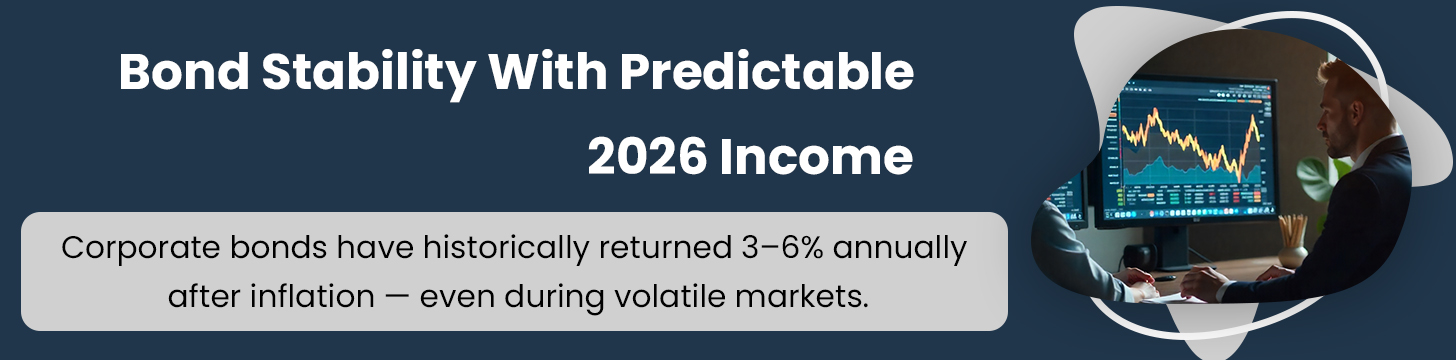
Corporate bond funds are the balance between safety and growth in Investment Ideas for High Returns (2026).
As interest rates cool and stabilize in 2026, corporate bonds become more attractive with improving credit conditions and steady yield spreads.
They offer higher yields than government bonds with less volatility than equities.
Historical Proof of Credit Strength
Historically, corporate bond funds have returned 3-6% per annum after inflation, depending on credit quality.
This is better than cash, term deposits and low-yield fixed income assets.
During recovery periods, narrowing credit spreads push bond prices higher, adding capital gains to coupon income.
Yield Cushion Features Reduces Volatility
The unique feature of corporate bonds is the Yield Cushion Mechanism.
This works because you get interest payments even if market prices fluctuate.
Key benefits:
- monthly or quarterly coupon income
- reduced downside volatility
- predictable cash flow
- stabilizer during equity drawdowns
This makes corporate bond funds ideal for reducing risk without sacrificing returns.
Credit Market Conditions for 2026 Stability
In times of equity correction, corporate bond funds often produce stable or mildly positive returns due to the income component.
For example, when market volatility rose in previous cycles, investment grade bond funds still returned 3-4% per annum thanks to coupon payments.
As 2026 markets grow moderately and corporate profitability improves, corporate bonds benefit from lower default risk and stable interest rate environment.
This makes them a stabilizer in Investment Ideas for High Returns (2026).
Growth Multi-Asset Funds With Balanced Performance

Multi-Layer Diversification Reduces Risk in 2026
Growth multi-asset funds are at the heart of Investment Ideas for High Returns (2026) because they combine equities, bonds, property, infrastructure, alternatives and cash into one managed portfolio.
This multi-layer diversification smoothes returns across different market cycles.
When equities go up, growth assets perform.
When markets soften, defensive assets absorb the volatility.
This is why multi-asset funds are ideal for investors who want above average returns without excessive risk.
Stable Track Records Back Up Consistent Outcomes
Global pension and superannuation data shows the power of diversified growth portfolios.
Balanced and growth funds have returned ~6.5%–7% p.a. long term after fees.
In good years they can return 10%–12% as we’ve seen in previous cycles.
Their stability over decades is why they are a key part of Investment Ideas for High Returns (2026).
Blended-Return Engines Deliver Reliability
The unique advantage of these funds is the Risk-Balanced Return Engine.
This mechanism adjusts asset weights to maximise returns while controlling volatility.
Key components include:
- automatic portfolio rebalancing
- reduced drawdowns in market shocks
- exposure to global equity growth
- defensive allocation through bonds and alternatives
- long term compounding
This engine keeps performance steady while still allowing upside.
Asset-Mix Strategies Work in 2026
Growth multi-asset funds capture this through exposure to global equities and income assets at the same time.
In volatile periods defensive allocations – corporate bonds and real assets – help cushion the decline.
This blended approach produces smoother growth than a pure equity portfolio.
That’s why growth multi-asset funds are one of the most reliable parts of Investment Ideas for High Returns (2026).
Gold and Commodities for Inflation Protection
Inflation-Responsive Assets for 2026 Portfolios
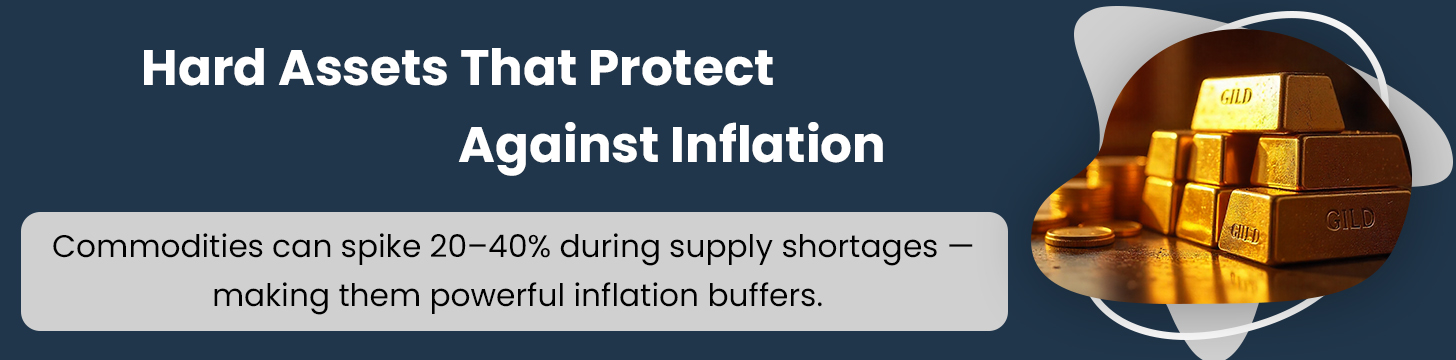
Gold and commodities are in Investment Ideas for High Returns (2026) because they do well when inflation rises or currency moves.
In 2026, global commodity markets are supply constrained, energy transitioning and geopolitically tense.
Gold is a store of value.
Commodities grow during demand spikes.
Together they stabilise the portfolio during economic uncertainty.
Crisis-Era Patterns of Resilience
Gold’s long term real return may be moderate but its crisis performance is exceptional.
Examples based on history:
- Gold goes up during inflationary cycles
- Commodities can spike 20-40% during supply shortages or global booms
- Precious metals perform well when central banks change monetary policy
These patterns show the defensive nature of commodities and metals.
Metal Based Shields of Value
The unique feature is the Inflation-Shielded Metal Buffer.
This buffer protects purchasing power during price rises.
Key benefits:
- gold is negatively correlated to equities
- commodity price sensitivity to global demand
- hedging during currency depreciation
- resilience during geopolitical shocks
Allocate 5-10% to metals and commodities to stabilise returns.
Commodity Specific Drivers for 2026
In 2026 demand for copper, lithium and rare earths will increase due to EV manufacturing and renewable infrastructure growth.
Energy markets are volatile so oil and gas will be priced.
Gold benefits from moderate inflation and central bank accumulation.
These conditions make gold and commodities part of Investment Ideas for High Returns (2026) — protection and selective growth.
Cryptocurrencies – Using an Exponential Volatility Engine
The High-Risk, High-Reward World of Digital Assets
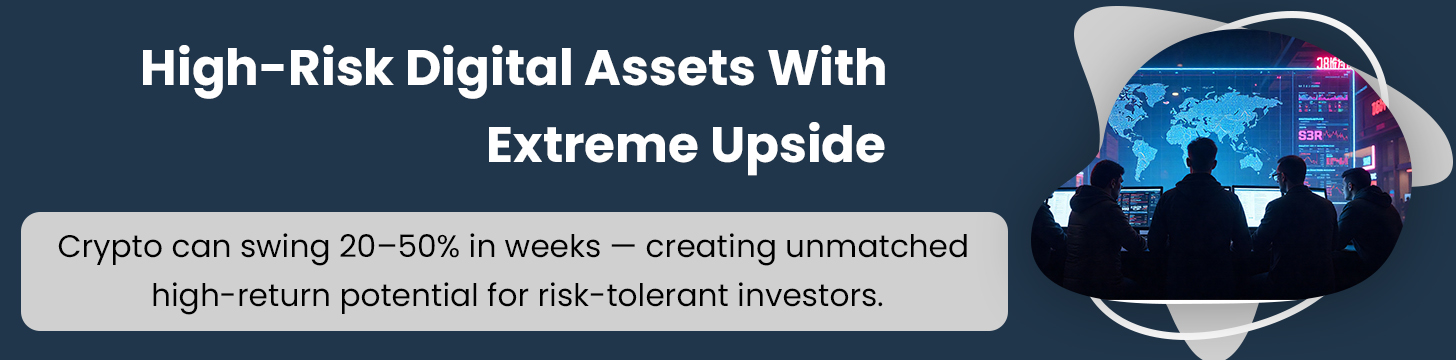
Cryptocurrencies are attracting investors who are looking for high returns & are not afraid to take on some financial risk – as per Investment Ideas for High Returns (2026).
Their potential for growth is still unmatched due to the way technology is being adopted, network effects kicking in, and the way supply is limited.
But to be fair, the crypto markets are fantastically volatile.
We’re talking 20% – 50% price swings in just a few weeks – that kind of thing.
This volatility creates both enormous opportunities for rapid accumulation and also some significant downsides to watch out for.
Cycle-Driven Surges Cause the Big Upswings
The long-term performance of cryptos has helped cement its reputation as a way to make some big returns.
Bitcoin’s cycles – which stretch out over several years – regularly outperform traditional markets.
Take a look at these historical examples:
- multi-hundred percent bull runs have been a thing in the past
- deep corrections followed by fast recoveries – we’ve seen that too
- strong post-halving rallies – as prices bounce back after a halving event
- rapid adoption-driven surges – when new users come in, that can drive prices up in no time
These patterns help explain why crypto remains such a speculative – but very powerful – addition to any high-return strategy you might have.
Volatility Engines Drive Up Price Movements
The real thing that sets things in motion is the Exponential Volatility Engine.
And it’s powered by:
- that limited supply (e.g. only 21 million Bitcoins will ever exist) leads to scarcity, which means even a small increase in demand can trigger a pretty big price movement
- the global flow of capital coming in and out of the market causes short-term volatility to spike
- when large institutions come in and start buying up big blocks of crypto, it can drive prices up pretty fast
- technological upgrades boost confidence and utility – the more useful and trustworthy a crypto becomes, the more people will take an interest in it and that can drive price activity up in no time
- as a network grows, more people and transactions get added to the mix – that can increase momentum and accelerate price swings
- speculative cycles just fuel things – they can drive prices up or down in a pretty rapid way
Small changes in demand can lead to big price reactions – and that’s what accelerates both the gains and the losses.
Blockchain-Based Advances Fuel The Momentum Going Into 2026
In 2026, crypto adoption just keeps on going through:
- the expansion of blockchain payment systems
- improvements in regulatory frameworks
- the development of more institutional investment products
- increasing usage in Web3, gaming, and DeFi
- post-halving momentum in Bitcoin – it’s a pretty big event
These trends do support the ongoing long-term relevance of crypto – but let’s be clear – risk remains high.
Anyway, for 2026, crypto should probably be kept as a small but controlled allocation, given the extreme volatility involved.
Skills & Business Ventures With Lifetime Income Multiplier

Human Capital at the Center of 2026 Wealth Growth
Skills and business ventures are one of the top Investment Ideas for High Returns (2026) because they generate income that compounds for decades.
In 2026, AI adoption, digital transformation and remote work expansion creates massive opportunities for individuals who upskill.
Human capital grows regardless of market cycles.
This is a long-term asset.
Earnings Patterns Increasing Lifetime Value
Labour and economic studies show that people who add high-demand skills experience 30%–200% lifetime income growth depending on profession.
Examples of skill-linked earning boosts:
- AI and data analytics roles pay 40%–70% more
- cybersecurity and cloud specialists earn premium income
- skilled freelancers scale from $25/hour to $80–$150/hour with experience
These numbers outperform many financial assets over long periods.
Income-Multiplier Effects Strengthening Progression
The unique characteristic is the Lifetime Income Multiplier.
This happens when skill investments increase:
- Salary potential increases as higher-value skills qualify you for better roles and stronger compensation packages.
- Freelance rates rise because specialized expertise allows you to charge premium pricing for your work.
- Business income grows as improved skills enhance operations, marketing and overall profitability.
- Passive digital product revenue scales upward when advanced skills help you create assets that earn continuously.
- Consulting opportunities expand as your knowledge positions you as a higher-value advisor in your industry.
Every skill upgrade compounds on top of previous income growth.
Innovation-Led Opportunities Expanding Personal Growth
A person who learns AI automation can design business systems that scale without additional labor.
A marketer who adopts 2026 digital tools can build agencies or sell digital assets.
A software developer can transition into higher-paying cloud and cybersecurity roles.
Business ventures — especially online — have unlimited scalability.
These characteristics make skills and personal ventures one of the most resilient components of Investment Ideas for High Returns (2026).
High Return Investments – FAQs
1. What investments will give the highest returns in 2026?
High returns in 2026 are in sectors that are growing fast.
Technology and AI investments are still strong as automation, data analytics and digital transformation is happening across every industry.
Renewable energy assets are attractive as demand for clean power is rising and long term government backed initiatives.
Private credit and alternative lending products give higher yields as more businesses are looking for non-bank funding.
Property development and strategic real estate investments can give strong capital gains in high growth areas.
These areas give strong upside when matched with the right investment timeframe and risk appetite.
2. Are high return investments risky?
Yes—higher returns always come with higher risk.
These investments can go up and down with market movements, industry cycles, interest rate changes and broader economic conditions.
But risk can be managed by diversification, selecting assets with strong fundamentals and having a structured investment plan.
Investors who know their financial goals and risk tolerance are better placed to take advantage of high growth opportunities.
3. How much cash do I need to kick off investing in high-return investments?
You can start small if you like, or go big – its really up to the kind of investment you choose.
Equity investments and ETFs will let you get started with a pretty low outlay making them a good fit for beginners who are just getting started.
Higher-yield investments like private credit, development projects, or structured income options though will usually require a bit more cash upfront.
Some platforms will also let you invest tiny amounts, so you can build up your portfolio gradually over time.
But the most important thing is to make sure your budget matches your goals, timeline and comfort level with market ups and downs.
4. How long should I stay invested if I want to see some real returns ?
Most high-return investments take time to start delivering decent results.
Equity and growth-focused investments usually need a couple of years to 5 to ride out the market highs and lows.
Developing property projects normally take 24 to 48 months to finish and show a return.
Private credit or fixed-term investments might run for 1 to 3 years, depending on what you pick.
But the key is to stick with it for the long haul – that way you’ll get the benefit of steady returns and not get hammered by short-term volatility.
5. Can I score high returns without being too reckless with my cash?
The answer is yes – but its worth noting that the returns are probably going to be a bit more modest.
Balanced investments such as dividend funds, government bonds and solid fixed-income products are good if you want a stable income that wont keep you up at night.
These are perfect for investors who just want steady results without the worries of wild market swings.
Putting a mix of high-growth investments with lower-risk income producers together in one portfolio is a great way to create a balance that will grow steadily and stay safe.
This is a good way to get decent returns in the long term while keeping risk at a sensible level.

Valuable Insights On Property Development & Investment Opportunities
-

Top High Interest Short Term Investment Options for 2026
High Interest Savings Accounts for Liquid Cash Buffers Cash sleeve purpose and liquidity role High…
Read More -
Best Performing Managed Funds in Australia: Expert Tips & Strategies
Top-Performing Managed Funds in Australia: What Investors Need to Know In 2026, Australian investors are…
Read More -
Best Financial Advisor Perth: How to Choose the Right Expert for Your Goals
Financial Advisor Perth Key Criteria for Choosing the Best Adviser Choosing the best financial advisor…
Read More -
How to Make Money from Property Development in Australia: A Comprehensive Guide
High-Growth Cities Offering the Best Property Development Margins Australia’s property development landscape will be shaped…
Read More -
What Are the Best Low-Risk Investments in Australia for Beginners?
Low-Risk Investing in 2026: The Beginner Snapshot For Aussie beginners seeking low-risk investments in 2026,…
Read More


Our Project Site :


Exclusive waterfront living at the Lake Narracan Resort community.

Quick Links
The information provided is general in nature and does not constitute personal financial advice. The information has been prepared without taking into account your personal objectives, financial situation or needs. Before acting on any information on this website you should consider the appropriateness of the information having regard to your own objectives, financial situation and needs. All statements made on this website are made in good faith and we believe them to be accurate and reliable however do not guarantee its currency. You should seek legal or other professional advice before acting or relying on any of the content.
Please note that past performance may not be indicative of future results. Different types of investments involve varying degrees of risk, and there can be no assurance that the future performance of any specific investment, investment strategy, or product made reference to directly or indirectly on our website, blogs , newsletters.
Our Project Site :

Find premium land developments and new estates across Australia.
Exclusive waterfront living at the Lake Narracan Resort community.

Quick Links
The information provided on this website including blogs is general in nature and does not constitute personal financial advice. The information has been prepared without taking into account your personal objectives, financial situation or needs. Before acting on any information on this website you should consider the appropriateness of the information having regard to your own objectives, financial situation and needs. All statements made on this website are made in good faith and we believe them to be accurate and reliable however do not guarantee its currency. You should seek legal or other professional advice before acting or relying on any of the content.