
SIGA
| November 21, 2025
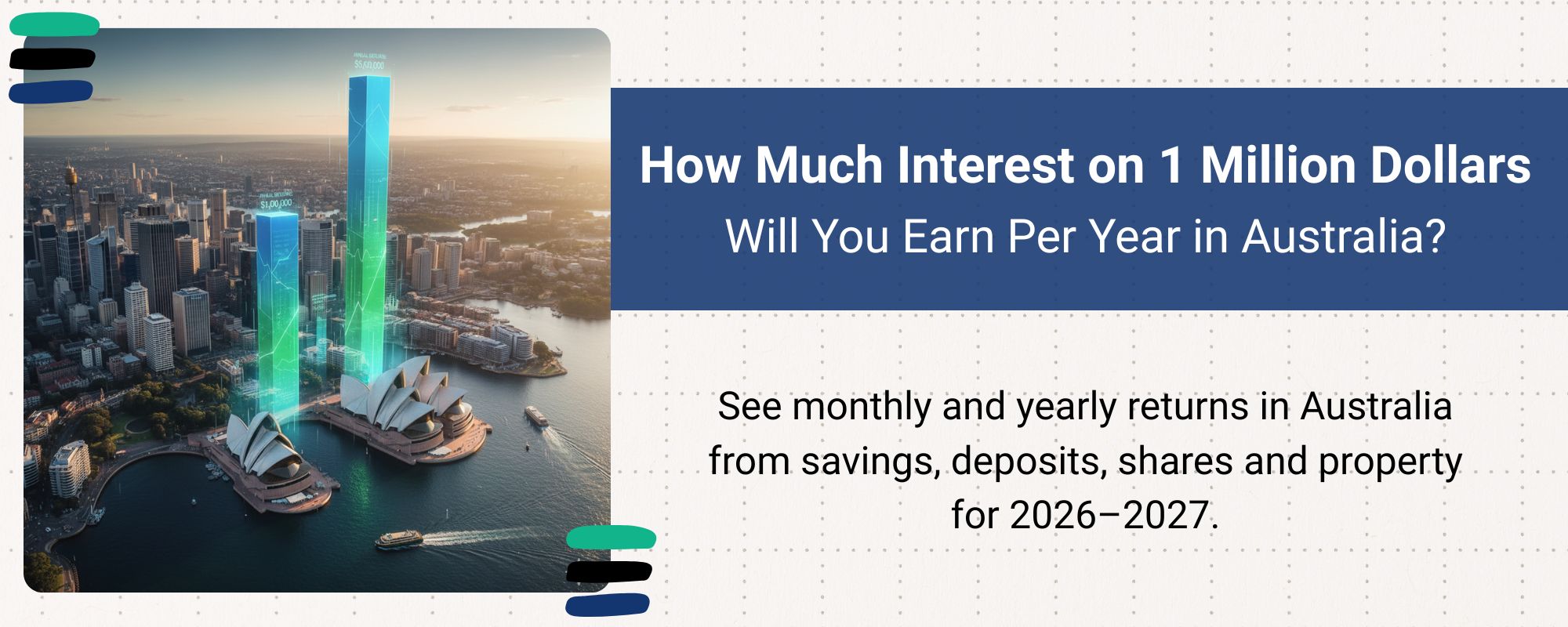
How Much Interest on 1 Million Dollars Will You Earn Per Year in Australia?
Table of Contents
Monthly and Annual Income Breakdown for 1 Million Dollars
In Australia right now, the amount of interest you can earn on 1 million dollars definitely depends on where you put your money.
You can get a pretty decent return from a high-interest savings account – around 4.75% to 5.10% per annum – which works out to $45,000 to $51,000 a year, or $3750 to $4250 a month. And it’s not a bad alignment with the current RBA cash rate of 3.60%.
Term deposits offer a slightly less exciting option – 3.7% to 4.4% a year – but at least it’s low risk and fixed, so you know exactly what you’re getting. You’d be looking at around $37,000 to $44,000 a year.
If you’re looking for better long term performance, you might want to consider the ASX 200 – over 10 years it’s returned around 9.56% per annum, which on $1 million works out to roughly $95,600 per year although you do have to put up with market volatility.
Property on the other hand is still going strong – values are rising at around 6.1% a year at the moment and over 30 years the average growth rate has been around 6.8%.
So on top of that, you could expect to see a value increase of around $68,000 a year – plus 3 to 4% rental yields which is another $30,4000 to $40,000.
Looking ahead to 2026, it seems like savings and deposit rates are going to stay pretty steady at around 4 to 5% a year, which will keep you earning safe interest of between $37,000 to $51,000 a year on $1 million.

2026 Interest Rate Outlook with Stability Insight
A. The 2026 Interest Rate Environment
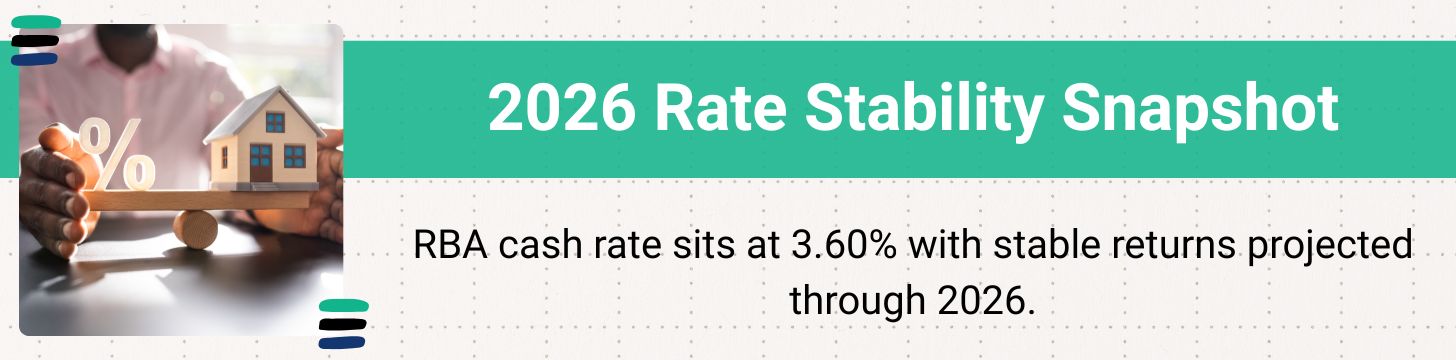
Australia’s income in 2026 is all about the stability of the cash rate. As of late 2025, the RBA cash rate is 3.60% and is expected to remain in a band for most of 2026.
This stability is key because it impacts:
- Deposit rates
- Bond yields
- Mortgage offsets
- Corporate borrowing
- Property yields
When the base (cash rate) is predictable you can calculate how much interest on 1 million dollars you will earn with much more accuracy.
B. 2026 Yield Bands for Low Risk Investors
Current data suggests low risk returns for 2026 will be 3.5% to 4.5% p.a.
This means:
- $35,000-$45,000 per year on $1,000,000 in low risk assets
- A stable range for retirees, SMSF investors and income focused households
These figures are based on bank savings rates, government bond yields and term deposit comparisons for 2026.
C. 2026 Rate Scenario
If you put $1,000,000 in conservative products at:
- 3.5% → $35,000 per year
- 4.0% → $40,000 per year
- 4.5% → $45,000 per year
Even at the lowest rate the yield is predictable and backed by the national monetary policy.
D. The Protective Power of Rate Planning
Stable rates help you:
- Avoid income drops
- Plan cashflow for 12-24 months
- Choose products with confidence
- Build blended portfolios knowing the base rate won’t collapse
That’s why understanding the 2026 rate environment is the foundation of how much interest on 1 million dollars will be earned per year in Australia.
High Interest Savings with Liquidity Advantage
A. High Interest Savings in 2026
High interest savings accounts are for investors who want to earn income and have funds immediately available.
Unlike term deposits, these accounts are fully liquid, meaning the entire balance can be withdrawn at any time without penalty.
This is perfect for investors who may want to switch to better yields or lock in new opportunities as 2026 unfolds.
In Australia, banks are competing fiercely for deposits, and savings rates rise whenever monetary conditions allow. This benefits investors with large balances like $1,000,000.
B. 2026 Savings Product Yield Expectations
Comparison data leading into 2026 shows:
- Standard high interest savings accounts: 4.25%–4.75% p.a.
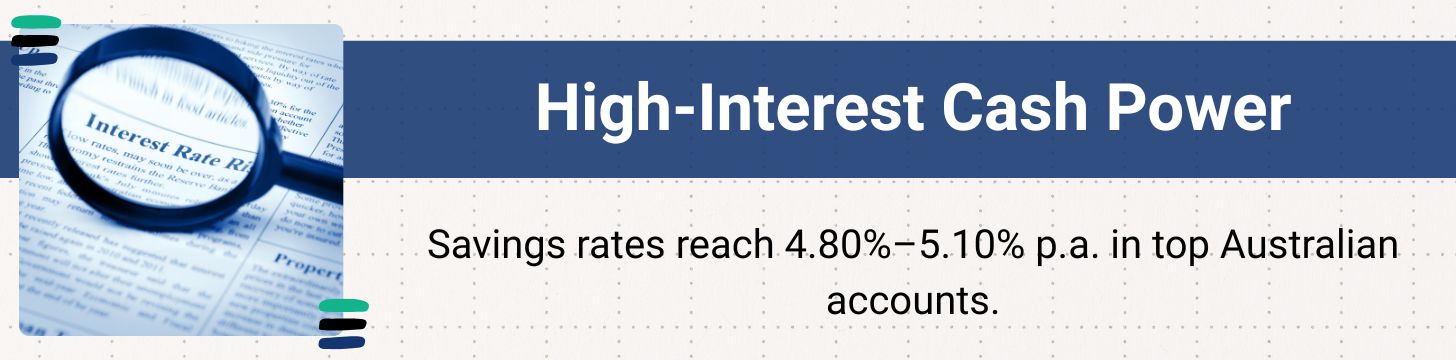
- Bonus-rate and introductory accounts: 4.80%–5.10% p.a.
These are the top performing low-risk income streams.
So how much interest is 1 million dollars?
- At 4.5% p.a. → $45,000 per year
- At 5.0% p.a. → $50,000 per year
Even the lower end beats traditional transaction savings accounts by a long shot.
C. Practical Example of Liquidity First Strategies
An investor has $1,000,000 in a 4.5% savings account. They earn $45,000 per year but also have the ability to:
- Switch funds to a term deposit if rates rise
- Deploy money into property, shares or private credit quickly
- Keep a large emergency or opportunity buffer
This flexibility is not possible with fixed term deposits or long duration bonds.
D. Instant Access is a Stronger Financial Foundation
Liquidity is a competitive advantage because 2026 will be a year of change.
Having $1,000,000 in an account that earns solid interest and is fully accessible means you can:
- Grab high yield offers
- Respond to RBA rate changes
- Hedge against volatility
- Have a cash buffer
This is why savings accounts are the second step in determining how much interest on 1 million dollars you can earn in Australia.
Building a Term Deposit Ladder Adding Locking In Security

A. Term Deposits – A Stable Income Fix for 2026 Portfolios
Term deposits are your go-to for some predictability, offering fixed returns that’ll stick with you. And rightly so in 2026, given the likely plateau or slight dip in interest rates as inflation trends unfold.
That means locking in those higher rates today won’t just give you peace of mind – it’ll also shield you if the broader market takes a turn for the worse. Plus, term deposits kill off daily market shenanigans – your earnings are set in stone from day one.
B. Projected Deposit Rates From Australian Banks in 2026
It looks like the big four banks are still offering competitive fixed-term rates come 2026:
- 1-2 year terms: around 4% – 4.25% p.a.
- 3-5 year terms: 4.2% – 4.4% p.a.
Which is consistent with that steady cash-rate environment RBA’s setting – 3.6%
Using these figures, here’s how that would look for a $1 million investment:
- At 4% p.a. you’re looking at around $40,000 a year
- At 4.4% p.a. you’ll pocket around $44,000 a year
Term deposits offer that sort of predictability, making them the perfect place for conservative investors to park their cash.
C. The Real-World Effect of Building a Multi-Tier Deposit Ladder
Rather than just ploughing a $1 million into a single 5-year term, you can split it into staggered maturities in a ladder structure like this:
- $200,000 at 6 months
- $200,000 at 12 months
- $200,000 at 24 months
- $200,000 at 36 months
- $200,000 at 60 months
This way:
- Every year a chunk of your money comes good
- You get to capture those higher rates when the cycle moves in your favour
- And avoid being locked out of better deals when they come along
D. Strength of Long-Term Rate Protection in Shifting Markets
A ladder really helps reduce the risk of reinvestment – you know, the danger of all your funds maturing when rates are low. It also means your exposure is spread across multiple interest environments, so you get:
- A nice steady income each year
- A bit more flexibility
- And all that guaranteed yearly cashflow
So it’s little wonder term deposits become an essential part of your 2026 interest on $1 million dollar plans in Australia – with minimal risk to boot.
Government and Corporate Bonds for Market Resilience
A. Bonds as a Stabiliser in 2026 Allocations
Government and investment-grade corporate bonds are a stabiliser when markets move.
In 2026 Australia will have moderate inflation and a steady RBA cash rate so bonds are essential for income certainty.
Bonds protect you because their returns are less volatile than shares, less restrictive than term deposits and more stable than property income during market corrections.
This makes bonds a natural “defensive anchor” in any income strategy.
B. 2026 Bond Yield Projections
Heading into 2026 bond yields in Australia look like this:
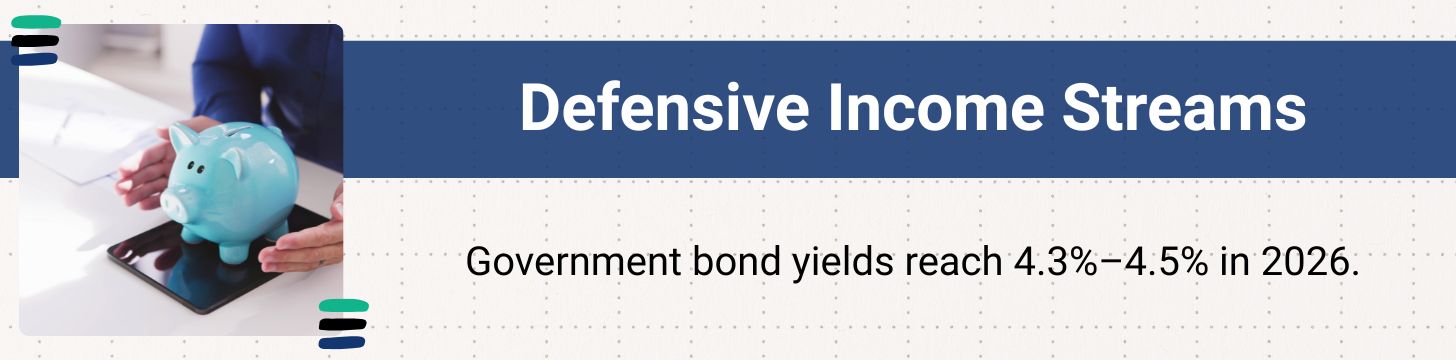
- Australian 10-year government bonds: 4.3%–4.5%
- Investment-grade corporate bonds: 4.2%–4.6%
- Short-duration bond ETFs: 3.8%–4.2%
Using these numbers, how much interest on 1 million dollars becomes:
- At 4.2% → $42,000 per year
- At 4.5% → $45,000 per year
These are good yields for risk-averse investors who want predictable cashflow without locking funds away for years.
C. Example of a Balanced Bond Allocation
Allocate $300,000 of your $1,000,000 into a bond portfolio:
- $100k in government bonds at 4.4%
- $100k in corporate bonds at 4.2%
- $100k in short-duration bonds at 4.0%
This gives you a blended yield of around 4.2% or $12,600 per year from the bond component.
Meanwhile your capital is relatively stable during equity downturns.
D. The Shield of Bond Diversification
The key benefit of bonds is they stabilise a portfolio when other asset classes move.
Bonds offer:
- Lower volatility than shares
- Higher certainty than property income
- Faster liquidity than term deposits
- Regular annual distributions
When equities fall or property yields slow, bond income remains consistent.
This is why bonds are essential to calculate how much interest on 1 million dollars you can earn safely in Australia in 2026.
Dividend Shares for Growth Infused Income
A. The Growing Role of Dividend Shares for 2026 Income Goals
Australian dividend paying shares are one of the most reliable ways to get income and long term portfolio growth.
In 2026 ASX listed companies will have stable corporate earnings, strong bank profitability and resilient mining sector activity.
Unlike cash and bonds dividend shares offer two benefits:
- Income via dividends
- Capital growth as share prices rise
This dual engine makes dividend shares a powerful component when calculating how much interest on 1 million dollars an investor can earn per year.
B. Expected Dividend Yields Across 2026 Sectors
Historical and forward earnings projections show:
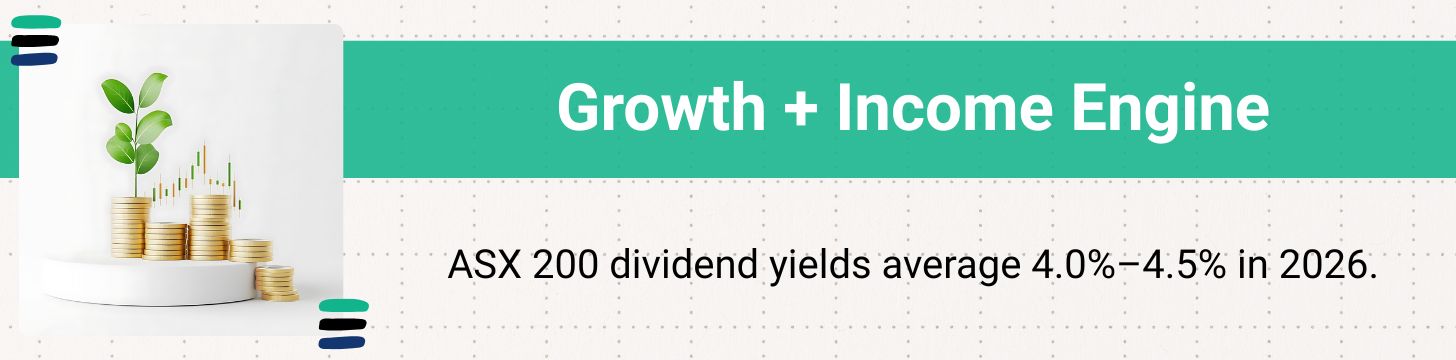
- ASX 200 average dividend yield is around 4.0%–4.5%
- Fully franked yields can produce a gross yield of 5.0%–5.5% when franking credits are included
- Leading income stocks (banks, energy, utilities) often yield 5%+
Based on these numbers income from $1,000,000 becomes:
- At 4.5% yield → $45,000 per year
- At 5.0% gross yield → $50,000 per year
These returns beat most bank products and add long term upside.
C. Illustrated Dividend Focused Portfolio
A diversified dividend income portfolio may look like:
- 30% major banks (4.5%–6% yields)
- 25% mining & resources (3%–5% yields)
- 20% essential services/utilities (4%–5% yields)
- 25% industrial shares (3.5%–4.5% yields)
If the portfolio averages 4.8% the investor earns $48,000 per year plus any capital growth.
This structure gives both income and growth.
D. The Dual Benefit of Growth Supported Income in 2026
Dividend shares will outperform in 2026 because:
- Earnings grow with inflation
- Australian companies perform well
- Tax efficient income through franking credits
- Rising dividends in good years
Even modest capital growth (3% per annum) turns a 5% income yield into an 8% return.That’s why.
Boosting Your Rentals: How REITs and Property Income Funds can give you a Yield

The Rental Income Boom: Why Property Funds are the way to go in 2026
Property income funds and REITs (Real Estate Investment Trusts) give you a direct link to Australia’s rental markets – no property ownership needed!
Australia’s doing pretty well in 2026, with a strong rental demand thanks to a growing population, people moving from other states, and not enough houses to go around.
All of this is good news for REITs. They get a consistent flow of cash from rental income which gets paid out to you, making your investment a good bet for people looking for a reliable income.
Projected Rental Returns and Yields in 2026
Australian REITs and property funds tend to produce:
- A yield of around 5-6% for top-notch commercial property
- 6-6.5% for property trusts that have a bit of everything
- 4.5-5.5% for ASX listed REITs – depends what they’ve got in their portfolio
We know this because of the rising rents and stable property values in the industrial, office and retail sectors.
If you pick the middle of this range, you could get:
- 5% yield – $50,000 a year
- 6% yield – $60,000 a year
Which puts REITs ahead of term deposits and bonds in terms of raw income.
Balancing it Out: A Sample REIT Allocation for 2026
You could spread a $1 million investment across:
- $300k on industrial REITs (warehousing etc)
- $200k on retail REITs (shopping centres)
- $300k on diversified property trusts
- $200k on unlisted commercial property funds
And if these produce an average 5.7% yield, you’d get an annual income of $57,000 – way ahead of more conservative investments.
Rental Income Streams as a Strong Investment Bet
REITs outperform on income because rental contracts just naturally rise with inflation. And as rents go up, so do the distributions you get.
They also offer:
- A lower entry point than buying property
- Automatic diversification across lots of buildings
- Professionals take care of tenants and leases
- Good liquidity for listed REITs
It’s all this that means property funds are the key to working out how much interest on a million dollars you can hope to make in Australia in 2026.
Private Credit and Mortgage Funds for High Yield Performance

A. The Rise of Private Credit in 2026 Markets
Private credit, mortgage funds and alternative lending platforms have grown rapidly in Australia as banks tighten traditional lending rules.
This demand for faster, more flexible funding creates higher-yield opportunities for investors willing to take on a bit of risk.
In 2026, developers, SMEs and asset-backed borrowers are paying premium interest rates because private lenders are filling the gap that banks can’t. This means investors can earn much higher yields than standard savings or term deposits.
B. Expected Yields for Private Debt and Mortgage Funds
Private credit funds in Australia offer:
- 7.0%–8.0% p.a. for senior secured mortgages
- 8.0%–9.5% p.a. for diversified private credit portfolios
- 10%+ for high-risk mezzanine or unsecured loans (not for conservative investors)
Based on this range, how much interest on 1 million dollars becomes:
- At 7% p.a. → $70,000 per year
- At 8.5% p.a. → $85,000 per year
- At 9% p.a. → $90,000 per year
Much higher than banks, bonds and many property income vehicles.
C. Sample Allocation Structure with Secured Credit Vehicles
Investor puts $300,000 into a secured property-backed mortgage fund that pays 8% p.a.
Annual income becomes:
- $24,000 from this alone
- Backed by first or second registered mortgages
- Diversified borrowers and strict lending criteria
Combined with other yield-focused strategies, private credit can lift the whole portfolio’s income.
D. The Performance Advantage of High-Yield Structures
Private credit’s main advantage is the yield premium—you earn more because borrowers value speed, flexibility and simplicity.
Plus:
- Monthly or quarterly distributions
- Lower volatility than equities
- Asset-backed protection when secured by property
- Strong demand from sectors that need short-term capital
So private credit is one of the best tools to increase how much interest on 1 million dollars you can earn in 2026 if you manage risk wisely.
Blended Portfolio with Balance Optimisation

A. The Competitive Edge of Multi-Asset Blending
A blended portfolio stops you relying on one income source. In 2026 Australia’s financial landscape is moderate inflation, stable interest rates and high competition for income generating assets.
Because each asset type behaves differently, diversification is the best way to stabilise long term returns.
This structure allows you to work out how much interest on 1 million you can earn over multiple market cycles.
Blended portfolios reduce risk and smooth income because correlations between asset classes change during economic changes.
B. Statistical Breakdown of a Balanced 2026 Model Portfolio
A balanced income focused portfolio using the earlier recommended mix might look like:
- 30% high interest savings @ 4.5%
- 30% bonds/term deposits @ 4.2%
- 25% dividend paying shares @ 4.5% yield
- 15% REITs/property funds @ 5.5% yield
Using these numbers the math becomes:
| Asset Type | Allocation | Yield | Annual Income |
| High-interest savings | $300,000 | 4.5% | $13,500 |
| Bonds/term deposits | $300,000 | 4.2% | $12,600 |
| Dividend shares | $250,000 | 4.5% | $11,250 |
| Property income funds | $150,000 | 5.5% | $8,250 |
Total Annual Income = $45,600
This model provides income stability even if one asset underperforms.
C. Case Study Showing Risk Reduction Through Allocation Balance
If equities fall 10% only 25% of the portfolio is impacted directly.
The other 75% cash, bonds and property keeps generating steady income.
Conversely if REIT yields soften, strong dividend payouts or bond interest stabilises overall income.
This “offsetting effect” is the reason blended portfolios protect you.
D. Long Term Strength of Optimised Portfolio Design
The unique benefit of this step is predictability.
You get:
- Stable cashflow during volatility
- Protection against interest rate drops
- Multiple yield drivers
- Higher long term return efficiency
This structure allows you to work out how much interest on 1 million you will earn in Australia across different 2026 scenarios.
Using Tax Structures and Inflation Controls To Keep More of Your Wealth in 2026

A. The Tax-Savvy Way to Manage Your 2026 Income
What you bring home is a whole lot different to what you actually take away.
In 2026, Australia’s tax system still treats interest, dividends and property income as separate beasts – which is a big deal because the tax structure you pick can make a real difference to your net returns.
Getting your head around tax brackets, franking credits, super rules and corporate set-ups is crucial if you want to squeeze every last cent out of the interest on 1 million dollars you can keep each year.
This bit is super important because even shaving off 1% in tax on a $1M portfolio can mean an extra $10,000+ stuffed into your pocket annually.
B. Key Tax Parameters and Inflation Metrics To Keep in Mind for 2026
Here are the tax things you should keep an eye on in 2026:
- Your personal income tax: It’s a nasty bit of news but interest and unfranked dividends will cost you up to 45% (plus medicare).
- Superannuation (in the accumulation phase): You’ll only pay 15% tax on earnings.
- Superannuation (pension phase): Good news – you won’t pay any tax on earnings (as long as you’re within the transfer balance cap rules).
- Franking credits: These can wipe out your tax bill or even give you a refund depending on what your tax bracket is.
- Offset accounts: These give you real tax-free returns equal to your mortgage rate – often around 5%
As you can see, the post-tax income from the interest on 1 million dollars depends pretty heavily on the structure you choose.
C. Model Scenario Takes a Closer Look at Net Returns on $1,000,000 at a 5% Yield
Scenario Comparison – The Difference a Good Structure Makes
| Structure Type | Gross Income | Tax Rate | Net Income |
| Personal name (37% tax bracket) | $50,000 | 37% | $31,500 |
| Superannuation (15% tax) | $50,000 | 15% | $42,500 |
| Pension phase (0% tax) | $50,000 | 0% | $50,000 |
| Mortgage offset (tax-free) | $50,000 | 0% | $50,000 |
This table shows just how much one structure can make a difference – an extra $18,500 a year in net income without doing a thing.
D. Smart Tax Planning and Inflation Controls Can Save That You Money
Tax structures and inflation control mechanisms help you keep more of what you earn.
So what are the benefits of all this? Well:
- Inflation chews up real returns unless you’ve got income that’s higher than CPI
- Tax minimisation lets compound interest work its magic
- Super set-ups protect your wealth long-term
- Offsets provide those lovely risk-free, tax-free returns
It’s no wonder wealth preservation is not a “nice to have” – it’s a core requirement if you want to work out how much interest on 1 million dollars will actually end up in your pocket in Australia during 2026.
Review and Stress Test Yearly with a Forward Adaptive Strategy

A. Annual Investment Reviews
Financial markets move fast and income focused investors need to adapt every 12 months or sooner if rates change.
In 2026 the RBA may change rates based on inflation, wage growth and economic trends.
Because each asset class reacts differently, not reviewing your portfolio increases the risk of underperformance.
This step ensures your projected income is aligned with real economic conditions and protects the long term accuracy of how much interest on 1 million dollars you expect to earn each year.
B. Stress Test Scenarios for 2026 Conditions
To fully understand the resilience of your income strategy investors should run four yield simulations:
- 3.5% yield → $35,000 per year
- 4.5% yield → $45,000 per year
- 6.0% yield → $60,000 per year
- 8.0% yield → $80,000 per year
These ranges cover low, moderate, strong and high income environments.
Running multiple scenarios highlights sensitivity—how much your yearly income may increase or decrease based on market conditions.
C. Illustrative Stress Test Example Showing Portfolio Protection
Imagine you need 6% yield ($60,000 per year).
If market conditions weaken and yields fall to 4% income drops to $40,000—a $20,000 reduction.
By stress testing you can see if your lifestyle, budget or investment commitments can absorb such a change.
This allows investors to:
- Reallocate to higher stability products
- Increase exposure to defensive assets
- Build cash reserves
- Adjust risk levels ahead of time
D. The Structural Advantage of a Forward Adaptive Planning Model
A forward adaptive model ensures your income survives economic shocks.
It allows you to:
- Change asset allocation based on RBA policy
- Increase defensive investments if volatility rises
- Switch to growth assets when conditions improve
- Have predictable yearly income
This dynamic approach means you always know the true, up to date answer to how much interest on 1 million dollars you can expect to earn in Australia even when conditions change fast.
FAQs: How Much Interest on 1 Million Dollars
1. How much interest do I stand to earn on 1 million dollars in a run-of-the-mill savings account?
Most major banks around 2025-6 offer interest rates ranging between 1.5 percent and 3.5 percent on their high-interest savings accounts – but you know what they say, high-interest doesn’t always mean high returns does it?
At a rate of 1.5 percent, 1 million dollars would bring in a measly 15,000 dollars a year.
At 3.5 percent, you’d be looking at 35,000 dollars per year.
Savings accounts are a no-brainer in terms of low risk, but the reward is hardly anything to write home about – especially when you factor in inflation.
To be honest, for long-term wealth creation, interest alone is usually not going to be enough to keep up with the cost of living.
2. How much interest will my 1 million dollars earn in a term deposit?
Term deposit rates in Australia for 2026 are forecasted to be anywhere between 4.1 percent and 5.3 percent depending on the bank and how long you’re willing to lock your cash away for.
At 4.1 percent, a million dollar term deposit would bring in 41,000 dollars per year.
And at 5.3 percent, that rises to a healthy 53,000 dollars per year.
Now, term deposits do offer a few things going for them: guaranteed returns, fixed timelines and government protection up to 250k per institution – but there is a catch: your money’s essentially locked in for the duration, reducing your flexibility.
This option is geared towards investors who want predictable income without all the ups and downs that come with other investments.
3. How much interest can I expect to earn on 1 million dollars with bonds or fixed-income funds?
Government and corporate bond yields in 2026 are projected to be between 3.8 percent and 6.2 percent depending on the quality of the bond and how long it’s got left to run.
A balanced bond portfolio averaging a 5 percent yield would bring in 50,000 dollars a year on a 1 million dollar investment.
High-yield corporate bonds can bring in much more – although come with the higher risk attached to higher-yield investments.
Bonds are a good option for investors looking for a steady income stream and consistent cash flow – they’re also a good choice for those that want to reduce their exposure to volatility.
4. What if I were to invest 1 million dollars in dividend-paying shares?
Australian share portfolios in 2026 are expected to yield between 4 percent and 6 percent in dividends depending on the sector.
At 5 percent – a pretty reasonable rate of return – you’d be raking in 50,000 dollars per year just from the dividends alone. And that’s before you even factor in capital growth – historically this has added another 6 or 7 percent annually – which means the total return potential could be an impressive 11-14 percent – or 110,000 to 140,000 dollars per year.
Of course, dividends aren’t guaranteed, and the share market can be volatile in the short-term – so this option is best suited for long-term investors who are looking for a combination of growth and income.
5. What is the highest interest I can earn on 1 million dollars with managed or private investments?
If you’re looking to push the boundaries with some more exotic investments, then private credit funds, property-backed lending and syndicate investments often pay out 8-12 percent returns in a year in Australia.
At 10 percent, 1 million dollars would bring in a very attractive 100,000 dollars per year.
Some structured investments even offer monthly payouts, fixed terms and asset-backed security – making them an attractive option for those looking for strong passive income.
Returns above 12 percent do exist, but they often come with a higher risk attached – or require you to be involved in complex lending structures or property development cycles.
Before you dive in though, make sure to assess the security type, borrower history and legal documentation of any high-yield investment you’re considering.

Valuable Insights On Property Development & Investment Opportunities
-

Top High Interest Short Term Investment Options for 2026
High Interest Savings Accounts for Liquid Cash Buffers Cash sleeve purpose and liquidity role High…
Read More -
Best Performing Managed Funds in Australia: Expert Tips & Strategies
Top-Performing Managed Funds in Australia: What Investors Need to Know In 2026, Australian investors are…
Read More -
Best Financial Advisor Perth: How to Choose the Right Expert for Your Goals
Financial Advisor Perth Key Criteria for Choosing the Best Adviser Choosing the best financial advisor…
Read More -
How to Make Money from Property Development in Australia: A Comprehensive Guide
High-Growth Cities Offering the Best Property Development Margins Australia’s property development landscape will be shaped…
Read More -
What Are the Best Low-Risk Investments in Australia for Beginners?
Low-Risk Investing in 2026: The Beginner Snapshot For Aussie beginners seeking low-risk investments in 2026,…
Read More


Our Project Site :


Exclusive waterfront living at the Lake Narracan Resort community.

Quick Links
The information provided is general in nature and does not constitute personal financial advice. The information has been prepared without taking into account your personal objectives, financial situation or needs. Before acting on any information on this website you should consider the appropriateness of the information having regard to your own objectives, financial situation and needs. All statements made on this website are made in good faith and we believe them to be accurate and reliable however do not guarantee its currency. You should seek legal or other professional advice before acting or relying on any of the content.
Please note that past performance may not be indicative of future results. Different types of investments involve varying degrees of risk, and there can be no assurance that the future performance of any specific investment, investment strategy, or product made reference to directly or indirectly on our website, blogs , newsletters.
Our Project Site :

Find premium land developments and new estates across Australia.
Exclusive waterfront living at the Lake Narracan Resort community.

Quick Links
The information provided on this website including blogs is general in nature and does not constitute personal financial advice. The information has been prepared without taking into account your personal objectives, financial situation or needs. Before acting on any information on this website you should consider the appropriateness of the information having regard to your own objectives, financial situation and needs. All statements made on this website are made in good faith and we believe them to be accurate and reliable however do not guarantee its currency. You should seek legal or other professional advice before acting or relying on any of the content.