


SIGA
| December 5, 2025
Best Way to Invest $50,000 in Australia: Safe & High-Return Strategies for 2026
Table of Contents
How Inflation Impacts Your $50,000 Investment
Investing $50,000 in Australia next year will be all about finding that perfect balance between making some money and playing it safe, considering the state of the economy is a bit of a mixed bag.
The OECD is calling for GDP growth of 2.2% in 2026 – up from just 1.8% this year – and inflation is looking like it’ll average out at 2.3%.
That means if you want to actually make your money grow in real terms, you’re going to need to aim for something way better than 3% a year.
The Reserve Bank cash rate is sitting pretty at 3.60% (as of November 2025), but with inflation running at 3.8% annual CPI and 3.3% trimmed mean, you’re going to be hard pressed to find a risk free return that beats 4-4.5%.
Top term deposits are looking a bit more promising, yielding 4.2 to 4.4% – which is good for about $2,200 per year on a $50,000 investment.
And of course 10 year government bonds are offering 4.55 – 4.56%, but let’s be real, those aren’t exactly the most exciting investments.
If you’re after some growth, though, Australian shares are generally looking pretty good – long term they’ve risen somewhere between 9.8 and 10.7% – and the ASX 200 has been up 13.0% over the last three years.
Property yields are a bit lower at 5.04% but some units in Darwin are doing okay at 7.8%.
Household investment has been doing all right, too – it’s up to $56.0 billion, which is a nice chunk of change, and the total wealth of Aussies has grown 2.7% over the last year.
In 2026, investing $50,000 is all about finding a way to balance safe returns with a bit of growth – whether that’s through cash, bonds, a diversified share portfolio, some property, or even just making a super contribution to shoot for something a bit better.

High Interest Savings & Offset Accounts For Liquidity and a Peace of Mind
Having Some Liquidity in Reserve – A Safety Net
High interest savings and offset accounts are still one of the safest places to stash that $50,000 invested by 2026.
Liquidity – being able to get your hands on your cash when you need it – plays a huge part in keeping your financial ship afloat in times of uncertainty.
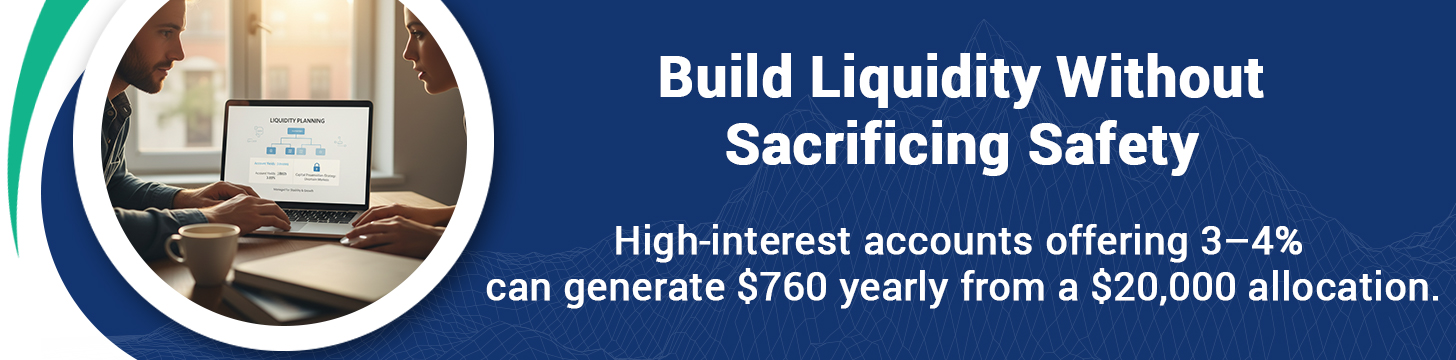
With the RBA cash rate still sitting at 3.6% and banks still offering 3-4% on their high interest savings products (which come with a string or two attached), you’re going to see a decent return, even if it’s not going to set the world on fire.
Government Protection for Your Deposits
Accounts like these are covered by the Financial Claims Scheme, which means up to $250,000 of your money is fully protected if the bank does go down.
And that’s a pretty big safety net right there – the thought of losing your savings is already a major risk factor, and having this guarantee eliminates that fear.
Keeping Cash on Hand for Life’s Curveballs
Having part of your capital easily accessible lets you:
- Grab opportunities when they come up in shares or property
- Cover the odd emergency without having to dip into your other investments
- Smooth out the cash flow when the markets start getting a bit hairy
For example,
| Allocation Strategy | Amount | Benefit |
| Emergency buffer | $10,000 | Immediate access |
| Short-term liquidity fund | $10,000 | Available for market dips |
| Remaining investment pool | $30,000 | Used for higher-return assets |
This 40% liquidity model you can have stability plus still be able to grow your wealth.
2026 Market Outcomes for Your Savings
If you stick your $20,000 in a high interest account and it earns 3.8% per year (which is what you’d get with a typical bonus rate), here’s what you can look forward to:
- Your $20,000 will earn you $760 per year in interest
- You won’t have to pay a cent in account fees
- Your capital remains 100% secure, with zero risk of losing a single dollar
And when compared to the wild fluctuations of the markets (think shares dropping 10-15% in a correction, for example), having a high interest savings account really helps to steady the ship.
Stabilising Your Investment Strategy
- When home loan rates go up, an offset account becomes a lot more valuable, saving you heaps on interest
- The ASX is forecasting some short-term volatility, which makes the case for having a liquidity buffer even more compelling
- Savings accounts are a foundational layer in any investment plan – they’re the anchor that lets you safely invest in riskier assets.
Put simply, the fact that you can access your money when you need it is a big deal and why high interest savings or offset accounts should be a must-have for your $50,000 investment plan.
Getting Reliable Returns with Term Deposits

Making Sense of the Market
In a time of constant interest-rate shifts and rising inflation, term deposits offer a decent return that you can actually rely on.
With some Australian banks now offering as much as 4.45% p.a on certain terms (as of late 2025), term deposits are turning out to be a low-risk and stable way to lock in returns for 2026.
Keeping Your Money Safe
It’s no secret that shares and property can be super shaky. Term deposits on the other hand, are like a safe harbour.
They give you:
- A fixed return, meaning you can be sure your initial investment is going to grow steadily with no risk to your principal.
- No price volatility, so their value doesn’t fluctuate with the market like shares or property.
- Clear maturity timelines, so you can plan your finances with some certainty and know exactly when your cash will be available.
- Many are backed by the government up to $250,000, giving you an added layer of security and peace of mind for your investment.
That’s why they’re ideal for the part of your $50,000 that you want to completely shield from market ups and downs.
Making the Most of Your Money
One way to get the most out of your term deposits is by ‘laddering’, where you split your cash across different maturity dates.
Here’s an example ladder:
| Maturity Term | Amount | Benefit |
| 3 months | $12,500 | Quick reinvestment at new rates |
| 6 months | $12,500 | Balances liquidity + yield |
| 9 months | $12,500 | Longer stability |
| 12 months | $12,500 | Highest rate potential |
The idea is that portions of your money will be maturing regularly, and if interest rates rise, you can reinvest at the higher rate. And if they fall, you still have some of your cash locked away at the higher rate.
Your Money Could Grow
- Let’s say you invest in a term deposit with an average rate of 4.20%.
- On a $50,000 investment, you could expect to earn around $2,100 per year.
- The best part is that your principal is fully protected, so you won’t lose any of your money. And with no management fees or ongoing involvement needed, it’s a super simple way to earn interest.
- In fact, compared to bonds, term deposits eliminate valuation risk entirely – they’re not going to fluctuate with interest rate expectations like bonds do.
Creating a Solid Foundation
Term deposits have one key advantage over other investments – fixed-rate stability, which gives you a level of security that’s hard to match.
Compared to bond funds, which are sensitive to rate changes, equities (which can be volatile in the short term) or property (which requires a lot of capital and carries leverage risk), term deposits stand out for their reliability.
For short-term investors (1–3 years), you’d be hard-pressed to find any products that match this level of predictability.
Term deposits are essential for creating a safe, stable foundation in your 2026 investment strategy.
Government and Corporate Bond Funds for a Stable Income Stream
A Defensive Allocation for Real Stability
Government and investment-grade bond funds remain a core defensive asset class for Australians investing $50,000 in 2026.
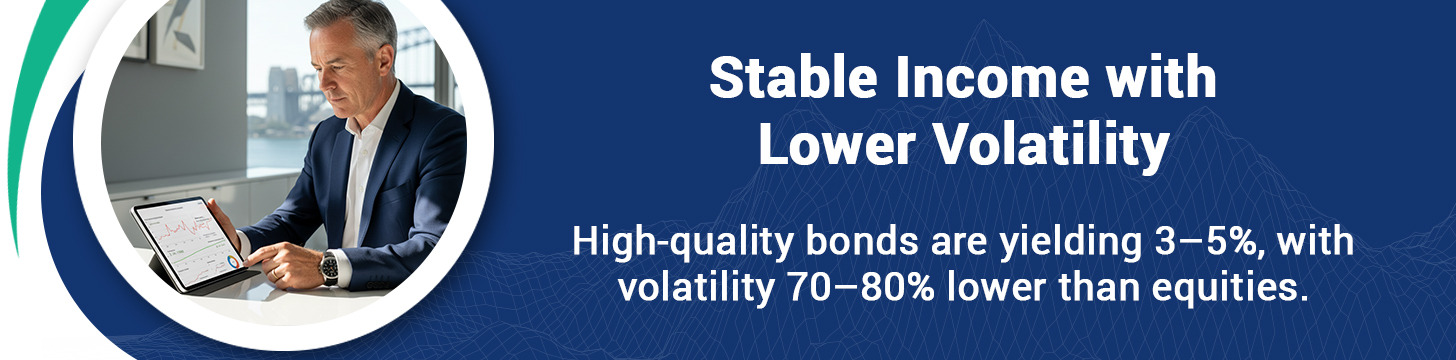
When the RBA cash rate sits at 3.60% (as of Nov 2025), high-quality Australian fixed-income ETFs and managed funds have bond yields that are normalising, sitting in the 3–5% range.
Over the past decade, that put bonds in a pretty unique position – they now offer better returns than the super-low interest rate years of 2015–2021, all while still keeping volatility low.
Getting a Predictable Yield-to-Maturity
The one thing that really stands out about this investment strategy is that you get a predictable yield-to-maturity (YTM). That means you’ve got a clear idea of what to expect for long-term returns – assuming you hold onto the bonds until maturity.
This makes it a lot easier to model:
- A predictable yield-to-maturity means you can anticipate your annual income, giving you a clear picture of what consistent earnings you can expect each year from your investment.
- It also provides long-term return certainty, which means you can plan and forecast your financial goals with real confidence.
- Plus, because this approach has a lower sensitivity to short-term price fluctuations, you’re less affected by those temporary market ups and downs and can focus on the bond’s performance over its full term.
For example, if a fund reports a YTM of 4.2%, you can confidently expect an annualised return in that range over the coming years, assuming credit conditions stay stable.
Reducing Volatility with Quality Bonds
Bonds are different beasts to shares and property. They often rise when equities fall, which can help to stabilise your portfolio.
Key benefits:
- Bonds are lower volatility, which means they offer a more stable investment compared to shares and property.
- They also deliver a steady, reliable stream of income in the form of interest payments.
- Many bonds come with government or high-grade corporate backing, which adds an extra layer of security and reduces the risk of default.
- And in downturns, bonds can play a defensive role, often performing better when equity markets collapse, helping to protect the overall value of your portfolio.
Historical data shows that diversified government bond portfolios typically experience a whopping 70-80% less volatility than equities over 10-year periods.
That greatly reduces portfolio drawdowns when markets correct.
Example Portfolio Allocation with $50,000
A defensive allocation might look something like this:
| Asset Type | Amount | Purpose |
| Government bond ETF | $8,000 | Capital protection |
| Investment-grade corporate bond ETF | $7,000 | Higher yield |
| Fixed-income managed fund | $5,000 | Professional management |
You have $20,000 allocated to bonds as the stability anchor.
Anchoring Your Portfolio’s Performance
- Bond yields are still elevated relative to the past decade.
- They help counter the volatility of the ASX and global equity markets.
- And they improve your long-term risk-adjusted returns.
In short, yield-to-maturity predictability is what makes bond funds such an essential, stabilising component of your 2026 investment strategy.
Aussie Share Funds for Long-Term Gains and Dividends
The Fundamentals of Long Term Wealth Creation
Broad Australian share market ETFs – the ones tracking the ASX 200 or ASX 300 – aren’t going out of style just yet : they still make up the bulk of long-term wealth creation for Aussies.
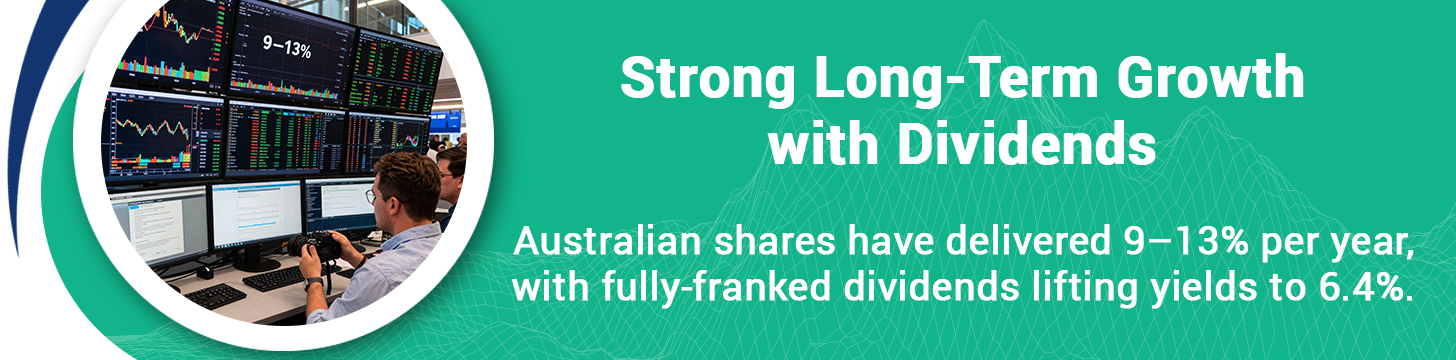
And it’s no wonder: the Australian share market has a pretty decent track record of delivering an average return of around 9-13% per year, depending on the time frame. Not bad for a country that’s got some of the world’s top dividend payers.
This performance is thanks to the big sectors like:
- Banking – reliably generating a steady stream of cash
- Mining – where the Aussie companies are the big players in the global game
- Healthcare – always in demand and churning out strong earnings
- Industrials – a mix of the businesses that drive the economy forward
These sectors have got some really solid, stable earnings and they pay out some pretty generous dividends. And that’s why Australia is up there with the best of the world’s dividend-paying markets.
The Magic of Franking Credits
One thing that really stands out about investing in broad Australian ETFs is the franking credit bonus.
Franking credits can give you a bit of a tax break – especially if you’re paying less in taxes, so you get to keep even more of your money.
Take this example: if a company pays out a 4.5% dividend – fully franked, your effective yield jumps to around 6.4% once the credits are added in. That’s a nice little surprise.
And it’s one of the reasons why Australian ETFs are more tax-efficient than many of their international rivals.
Spreading the Risk with a Broad ETF – the Easy Way to Invest
A broad ETF covers 200-300 companies, so you’re not relying on just one or two hot stocks to do well.
Here are a few key benefits:
- With a broad ETF, you can sleep easy knowing your investment risk is spread right across the market.
- They come with automatic rebalancing – so your portfolio stays aligned with the market index without needing to constantly tweak it.
- They’re usually pretty affordable, with fees ranging from 0.03% to 0.10% – making them a cost-effective way to invest in a broad range of companies.
- And they’re a solid bet for long-term growth – just the kind of thing you want when the market is getting a bit wild.
Portfolio Strategies to Get You Started
So, where do you start?
| Investment | Amount | Reason |
| ASX 200 ETF | $15,000 | Core growth engine |
| ASX 300 ETF | $5,000 | Broader diversification |
One of the most balanced strategies might be to put 20,000 into broad Australian equities – that forms the backbone of your portfolio.
Aussie Equities are Still a Good Call
- Our banks and miners are still churning out a lot of cash – which means they can keep paying those nice dividends.
- The franking credits are a real game-changer – and that means you get to keep even more of your money.
- And despite all the global uncertainty, market forecasts are still showing Australia is on track for some steady growth.
So in short – broad Australian ETFs are still one of the best long-term wealth builders out there.
Global Share ETFs for International Sector Exposure

Spreading the Risk with Global Market Exposure
Global share ETFs give Aussie investors access to industries and sectors the ASX just can’t compete with.
While our local market’s pretty well dominated by banks and miners, global markets offer a much wider range of options, including:
- Tech
- Healthcare
- Renewable energy
- Industrials
- Consumer products and innovation
And over the long haul, major global indices like the MSCI World and S&P 500 have consistently delivered results on a par with, if not better than, the ASX – we’re talking 10-12% p.a. returns depending on the timeframe.
This global exposure reduces concentration risk, making your long-term returns more stable.
Spreading Your Bets Across Countries and Sectors
The real value of this investment option is the international sector diversification it brings to the table.
Global ETFs hold tens of thousands of companies across dozens of countries, giving you access to high-growth sectors that aren’t really available here in Australia.
Take a look at some key examples:
- US Tech: Apple, Microsoft, NVIDIA, Alphabet
- Global Healthcare: Johnson & Johnson, UnitedHealth Group
- Consumer leaders: Amazon, LVMH, Costco
- The future of tech – AI & Semiconductors: Taiwan Semiconductor, ASML
These sectors have driven a huge chunk of global market returns over the past decade – for instance, US technology alone has accounted for over 30% of S&P 500 performance in many recent years.
Spreading the risk, and the reward
Global diversification reduces portfolio volatility because international markets don’t always move in the same way as the ASX.
So what are the benefits?
- Global diversification helps you avoid concentration risk by spreading your investments across multiple countries and sectors, rather than relying solely on the ASX.
- It gives you exposure to multiple economic cycles, so you can benefit from growth in regions at different stages of development.
- By investing internationally, you get access to different interest-rate environments, which can boost returns and reduce sensitivity to domestic monetary policy changes.
- A globally diversified portfolio is more resilient in the face of domestic downturns, helping to protect your investments when the local market’s having a tough time.
Studies show that adding 20-40% global equities can increase long-term returns while lowering overall portfolio risk.
Our Allocation Framework Portfolio
| Investment Type | Amount | Purpose |
| Global (MSCI World) ETF | $10,000 | Broad global exposure |
| S&P 500 ETF | $5,000 | High-growth tech-driven index |
Total: $15,000 allocated to global markets.
Positioning for Growth in 2026
- The world’s innovation leaders aren’t in Australia.
- Global ETFs outperform most actively managed funds on cost and diversification.
- Exposure to AI, cloud computing, pharmaceuticals, and automation – the kind of things that drive long-term capital growth.
So in short, international sector diversification gives your $50,000 portfolio a shot at global innovation, and a chance to accelerate your long-term wealth creation.
Diversified or Balanced ETF Taking the Hard Work Out of Long-Term Investing
Proven Multi-Asset Solution for Investors Looking for Long-Term Growth
Diversified ETFs are designed to make your life easier – they combine a range of asset classes – Australian shares, global shares, bonds and sometimes property – all in one neatly managed portfolio. No need to spend time messing around with individual holdings.
They are perfect for investors who want to build wealth over the long term without any of the day-to-day hassle of managing their own investments.
Typically, diversified ETFs can be grouped into categories like:
- Conservative (asset allocation of 20-40% shares)
- Balanced (asset allocation of 40-60% shares)
- Growth (asset allocation of 70-85% shares)
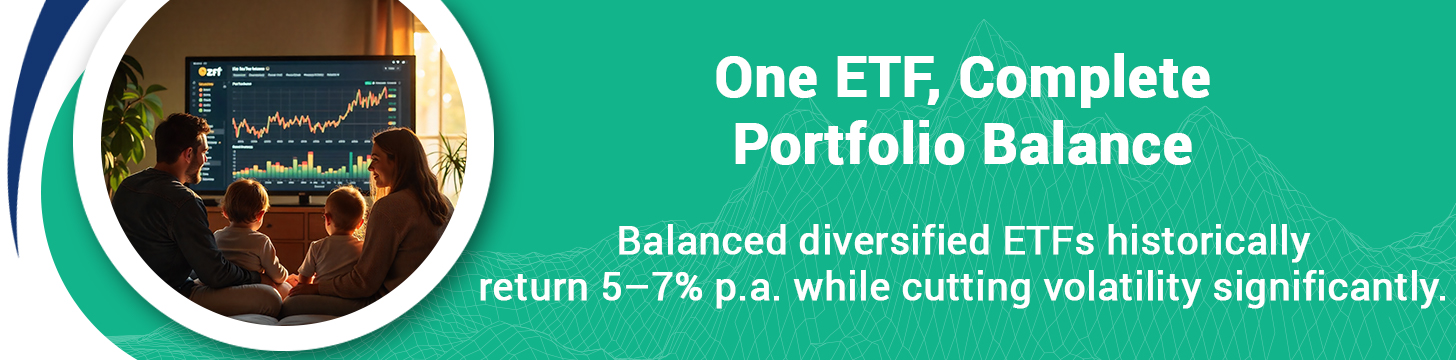
Looking at the numbers, a balanced 60/40 split typically returns around 5-7% per annum over the long term, which is also lower volatility than investing purely in the stock market.
These types of returns are backed up by research all over the world on how to create a portfolio that balances risk and reward.
Automatic Rebalancing: A Key to Smoother Investment Returns
But what really sets diversified ETFs apart is the automatic rebalancing control that comes with them.
As the values of each asset class goes up or down, the ETF automatically adjusts the allocations to get back to the target level.
This means you get:
- Growth assets that don’t get over-heated in bull markets
- Defensive assets that have the right balance to protect you from downturns
- A long-term strategy that really delivers consistent results
- No emotional decisions, just pure data-driven investment decisions
Here’s an example of how it works:
If the global equities component of your portfolio suddenly shoots up from 30% to 38%, the ETF automatically reduces the weighting of global equities and puts the money into bonds or Australian shares instead.
It’s this disciplined approach that has been shown to outperform individual investors time and time again – because it takes the emotional decisions out of the equation.
Getting Diversified Exposure the Low-Cost Way
Diversified ETFs take the hassle out of investing – you get access to a wide range of assets all in one portfolio, with fees typically set between 0.20% and 0.30% per annum.
And the benefits don’t stop there:
- You get a single product with global diversification – so you can invest in a wide range of assets without having to buy each one individually
- There’s no need to time the market – the ETF automatically tracks a basket of assets, so you can relax and let it do the work
- Many ETFs come with built-in risk control, spreading your investments across different sectors and regions to reduce risk
- Fees are low, typically between 0.20% and 0.30% per annum – making them a much cheaper option than actively managed multi-asset funds
- You get access to a wide range of industries and markets worldwide – all through a single investment.
Structuring a Long-Term Portfolio
| ETF Type | Amount | Purpose |
| Balanced diversified ETF | $30,000 | Core long-term holding |
| Growth diversified ETF | $5,000 | Higher-growth satellite allocation |
Investment amount: Total $35,000 – this is your long-term “engine room” for your portfolio.
Diversified ETFs Are The Smart Choice for 2026 Market Conditions
- Markets are still pretty unpredictable, so automatic rebalancing is more valuable than ever
- Bond yields are stable, which helps support defensive allocations
- Diversified ETFs outperform individual investors who try to time the market – so it’s a much safer bet to let the ETF do the work for you
In short, automated rebalancing is what makes diversified ETFs one of the most effective and low-maintenance strategies for building long-term wealth in 2026.
Super Contributions – The Ultimate Compounding Machine for Long-Term Wealth
Superannuation As A Tax-Efficient Investment Powerhouse
Investing your hard-earned cash into super remains one of the best ways to build long-term wealth in Australia.
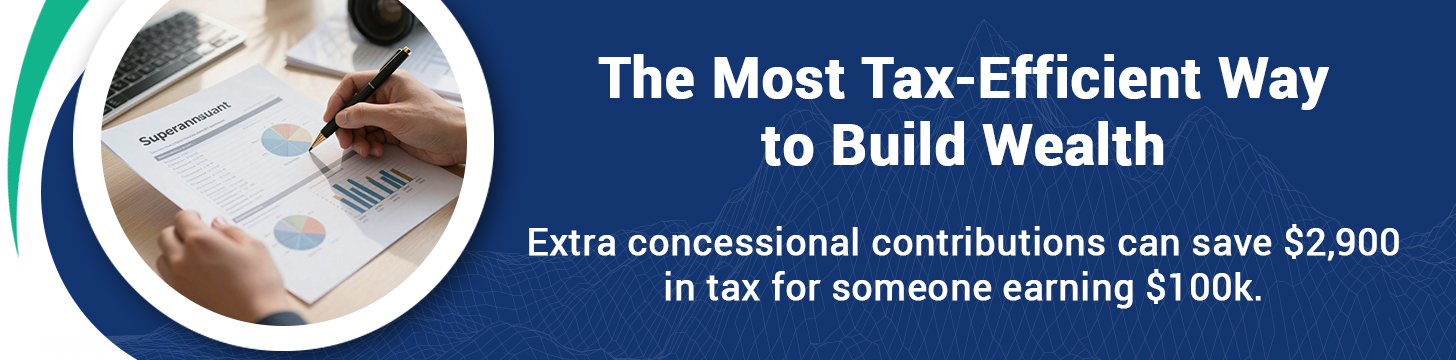
When you add in extra pre-tax (concessional) super contributions, you get to take advantage of a 15% tax rate inside the super system – a rate that’s significantly lower than the marginal tax rates of up to 45% + Medicare levy you’d pay outside of super.
This tax advantage alone can really boost your long-term returns, especially if you’re consistent with your investments.
Here’s an example:
Someone on a $100,000 salary who adds in an extra $10,000 into super at tax time saves themselves a whopping $2,900 in tax (32.5% marginal tax rate vs the 15% super rate).
And that’s not all – this tax saving compounds over time, meaning it can make a huge difference to your retirement prospects.
Getting The Most Out Of Your Investment
So what makes super such a great investment option? It’s the long-term tax efficiency that really sets it apart.
Super offers:
- A low tax rate of just 15% on earnings
- And 0% tax on earnings in the pension phase once you’ve reached preservation age
- The compounding benefits of tax savings over 20-30 years are huge
If your super fund is earning 7% a year (which is a pretty typical growth option return over the long term), keeping more of the earnings after tax really does accelerate wealth creation.
For example:
A $20,000 contribution growing at 7% over 20 years becomes around $77,000 – far higher than you’d get from investing after tax outside of super at higher tax rates.
Diversification – The Key To Stabilising Returns
Most super funds invest across a range of assets like global shares, bonds, property, infrastructure and alternatives.
This diversification really does help to smooth out long-term returns.
Here are some historical performance figures for major Australian super funds:
- Growth options: 7-9% a year over 10+ year periods
- Balanced options: 5-7% a year
- Conservative options: 3-5% a year
These returns often outstrip those of individual investors who try to manage their own portfolios, thanks to the scale, expertise and diversification of super funds.
Breaking Down Contributions Into $50,000
| Super Contribution Type | Amount | Benefit |
| Extra concessional contributions | $15,000 | Tax savings + long-term compounding |
| Personal non-concessional | $5,000 | After-tax top-up |
Total: $20,000 directed into super.
Super Contributions Are Still A Smart Move In 2026
- Rising volatility in the sharemarket makes the long-term, tax-efficient power of compounding all the more appealing.
- Super funds continue to outperform average retail investors thanks to their diversified global exposure.
- Tax savings alone can boost returns much more effectively than trying to time the market.
In short, long-term tax efficiency makes extra super contributions one of the most powerful and stable investment strategies for your $50,000 in 2026.
Residential Property & Leverage Potential – a Wealth Driver

Growth in the Property Market
Residential property has been a steady as you go growth asset in Australia over the years.
Over 30 years, the overall value of property in the country has gone up by around 6.4 – 7% per annum. excluding what you make from renting it out.
Recent data tells us:
- In the last 12 months, the value of homes across the country has gone up by 6.1%.
- Cities like Perth, Brisbane, and Adelaide are seeing 8-12% annual growth.
- Forecasters are predicting 6-10% national price growth by 2026, assuming things stay as they are.
This stability means property can be a pretty powerful tool for building wealth, as long as you are willing and able to use some leverage to make the most of your investment.
Leverage – Amplifying Your Investment
The thing that really makes this investment stand out is the potential for growth through leverage.
With $50,000 you can put down a deposit and borrow the rest – which gets you access to a lot more than you could buy with that amount on its own.
Think about it like this:
- Put down $50,000
- Borrow $400,000 to buy a $450,000 property
If the value of that property goes up by 7% in a year, you have gained a total of $31,500 – and you only put up $50,000 of your own cash to start with.
That’s a 63% return on your initial investment – before you even factor in the costs of owning a property.
None of the other major investment types can match that kind of growth potential.
Getting Started with Property Funds
If buying a property of your own isn’t an option, property funds or A-REIT ETFs let you get a piece of the real estate market without needing a huge amount of money to start.
The benefits are:
- A much lower entry point than buying a property to live in
- You can sell your shares relatively quickly if needed – a lot more easily than selling a physical property
- You get to spread your investment across various types of property – industrial, commercial, retail and more
A-REITs often pay out dividends of around 4-6% per year.
Choices for Your Investment
| Option | Amount | Purpose |
| Property deposit | $50,000 | Long-term leveraged purchase |
| OR: A-REIT ETF | $10,000 | High-yield income alternative |
| OR: Unlisted property fund | $15,000 | Medium-risk, stable yield |
This set-up means you have the option to choose between buying a property to live in and property-based financial products.
The Market Conditions That Are Supporting Growth
- There is still a strong demand for housing in the major cities, but not enough homes are being built to keep up with that demand
- Migration levels are still pretty high, so there is a good chance that property prices will keep going up
- Interest rates are stabilising at a moderate level, which makes investing with a mortgage a bit easier to predict.
In short, it’s leverage-driven growth that makes residential property and property funds one of the best options for making your $50,000 go further as a long-term wealth builder by 2026.
High-Dividend Shares & ETFs for a Steady Income Stream
An Income-Focused Portfolio Strategy That Actually Works
Australia has got to be one of the best places in the world to find dividend-paying shares.
This is mainly because the country’s got a strong presence of profitable sectors like:
- Banking – the gold standard of stable returns
- Mining – a market that’s on the up
- Telecommunications – steady as you go
- Utilities – the reliable workhorses of the stock market
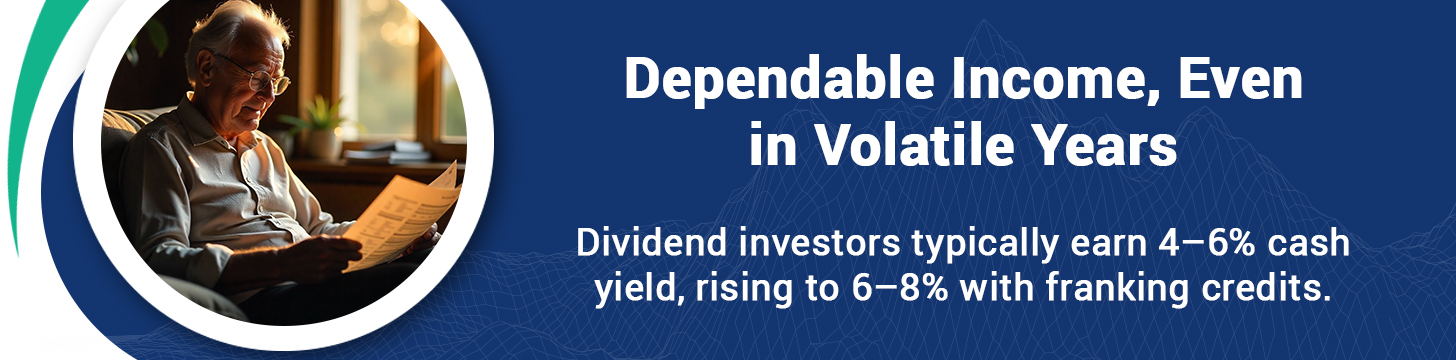
Historically, high-dividend investors in Australia can expect an annual cash yield of 4-6% – excluding those all-important franking credits.
With franking credits taken into account, the grossed-up yield can be as high as 6-8%, making high-dividend strategies the go-to for anyone looking for stable income.
And that’s particularly useful in volatile years when capital growth is all over the place, but income remains rock solid.
Getting a Stable Dividend Cashflow
What sets this investment approach apart is its predictable income stream.
Unlike those high-growth stocks that rely on share prices going up, up, up, dividend shares give you a steady stream of earnings that get handed over to investors.
The benefits include:
- Knowing exactly when to expect your quarterly or semi-annual dividend payments
- Less volatility compared to growth companies
- Tax-efficient income thanks to franking credits
- And an added layer of resilience during market downturns
Take bank stocks like Commonwealth Bank or Westpac for example – they’re often able to maintain their dividends even when the market is going haywire, helping to smooth out investor returns.
Lessons from the Past Decade
Over the last decade, high-dividend ETFs – like those tracking the ASX Dividend Leaders Index – have delivered:
- 4-6% annual yield
- Total returns that compare favourably to broad market ETFs over the long term
- Strong defensive performance during downturns
And here’s the thing – even when the ASX took a 10-15% hit, dividend-focused portfolios usually fell less because of their strong balance sheets and stable cash flows.
A Structured Allocation Plan
| Investment Type | Amount | Purpose |
| High-dividend ETF | $10,000 | Regular income generation |
| Blue-chip dividend stocks | $5,000 | Long-term, stable yield |
Total investment: $15,000, dedicated to income-focused investing.
Positioning Yourself for a Reliable Income
- Growing demand for income-producing assets as more and more people get older
- Aussie companies keeping strong payout ratios, especially in banking and mining
- High interest rates making it the perfect time to look for reliable, low-volatility income sources
To wrap it all up, income-stream stability makes high-dividend shares and dividend ETFs a great addition to your growth strategy within your $50,000 investment plan for 2026.
High-Growth Opportunities in ETFs, Small Caps & Private Credit

Growth-Focused Investments – A Key to Outpacing the Market
Sector ETFs, small-cap stocks and listed private credit funds are the real game-changers when it comes to growing your wealth. They can make a real difference to your overall performance, even when you just add them in small amounts.
These investments behave differently than the broad-market ETFs, giving you a way to get in on emerging industries, early stage companies or high-yield credit markets that the bigger players often miss.
We’ve seen time and time again that small-cap and thematic sectors can outperform the broad indices when the markets are on the up, even if they do take a bigger hit when things get tough.
For instance, global tech and AI sector ETFs have been delivering double-digit returns over the last decade, way outpacing the broad market average in the good years.
Unleash the Full Potential of Emerging Sectors
This investment option has some unique characteristics that make it a high-growth powerhouse.
That means the possibility of getting far higher returns than your traditional investments, especially if you’re focusing on:
- Technology & AI – where the tech giants keep getting bigger
- Semiconductors – the brains behind the machines
- Robotics and automation – getting more and more efficient all the time
- Renewable energy – a cleaner, greener future is just around the corner
- Biotechnology – the breakthroughs just keep coming
- Small-cap innovators – where the next big thing is often born
- Private credit funds offering a 6-10% yield – pure gold dust!
Because these sectors tend to expand rapidly when the growth cycle is in full swing, even a small allocation can give your long-term portfolio a huge boost.
Take this example:
A $5,000 bet on a global tech ETF growing at 12% per annum for 10 years turns into ~$15,500, tripling your money and leaving most broad ETFs in the dust.
Adding a Dash of Risk-Controlled Exposure
While the potential for high returns is real, there’s still a lot of volatility to factor in.
Sector ETFs and small caps can fall 2-3 times harder than the broad market when things start going south, that’s why you should use them as “satellites”, not your main event.
Here’s what you get from this approach:
- Targeted exposure to innovation
- The chance to outperform the broad market
- A strong long-term potential in sectors where the tech is really moving the needle
Allocation Framework for High-Growth Fun
| Investment Type | Amount | Purpose |
| Global tech or AI ETF | $3,000 | Growth acceleration |
| Australian small-cap ETF | $2,000 | Local innovation exposure |
| Private credit fund | $2,500 | High-yield income |
Total: $7,500 (15% of your portfolio) for all those satellite growth opportunities.
Leveraging the Trend towards Innovation
- AI, cloud computing and biotech are expanding fast, and the next decade is going to be just as exciting.
- Higher yields in private credit due to interest rates staying low for a while.
- More and more investors are looking for portfolios that are driven by innovation.
The bottom line is that sector ETFs, small caps and private credit are the perfect additions to your 2026 investment strategy when you use them in small, controlled amounts.
FAQs: Safest Way to Invest $50,000 in Australia
1. What’s the deal with the safest places to stash $50,000 in Australia?
The safest bets usually tend to be government bonds, high-interest savings accounts and term deposits.
They’re designed to keep your capital safe even when the market gets all wobbly.
Government bonds are backed by the Aussie government, making them one of the most rock-solid investment options out there.
High-interest savings accounts currently offer pretty steady returns with hardly any risk, while term deposits will lock in a fixed rate for the whole duration.
If you’re going for safety and stability, these options will give you a good slow and steady growth without exposing your $50,000 to too much uncertainty.
2. Can i get some passive income out of $50,000 in Australia?
You sure can.
You can get passive income coming in from investments like ETFs, REITs, dividend shares and monthly interest bonds.
ETFs give you a nice broad exposure to the big Aussie and global players, with the added bonus of regular dividend payments over time.
REITs let you get in on the rental action without having to worry about buying and selling actual property – perfect for anyone who wants to just sit back and collect the cash.
Monthly interest bonds just pay out a regular, predictable stream of cash each month, which is ideal for anyone who wants a steady, no-stress income.
With the right investments, your $50,000 can be churning out a nice long-term passive income.
3. Is investing $50,000 in ETFs a good move for 2026?
Yes, ETFs are still one of the top picks for Aussie investors in 2026 – and for good reason.
With an instant diversification option, you can spread your $50,000 across dozens or hundreds of companies with a simple click.
That means you get all the benefits of risk reduction – without having to worry about choosing which individual stocks to pick.
And the best part? ETFs come with low fees, great liquidity and a proven track record of delivering solid returns.
If you’re after a hassle-free way to grow your $50,000 over the long term, then ETFs are definitely worth considering.
4. Is investing in property the way to go with my $50,000?
Property can definitely be a great long-term investment, but buying a house usually requires way more than $50,000 upfront.
BUT – there are some clever ways to get in on the property action without breaking the bank.
You could look at REITs, or maybe even try investing in property via a platform that lets you buy small shares of individual properties for a fraction of the cost.
This is a great way to spread your $50,000 across multiple properties, and get some property-based returns without the hassle of dealing with tenants and maintenance.
5. What’s the best way to invest $50,000 in Australia, anyway?
A good balanced strategy is about spreading your money across different asset types to reduce risk and boost returns.
It’s all about finding a mix that works for you – so your $50,000 isn’t all in one basket.
We’re talking growth assets, income-producing assets, and low-risk defensive investments all in one neat portfolio.
This might mean putting some of your $50,000 into ETFs for growth, a bit into REITs for property income, a chunk into bonds for stability, and a bit into high-interest cash for liquidity.
By spreading your bets across different types of investments you can protect your portfolio from market ups and downs, while still aiming for long-term growth.
And at the end of the day, this approach will help your $50,000 work for you – no matter what the market is doing.

Valuable Insights On Property Development & Investment Opportunities
-

Top High Interest Short Term Investment Options for 2026
High Interest Savings Accounts for Liquid Cash Buffers Cash sleeve purpose and liquidity role High…
Read More -
Best Performing Managed Funds in Australia: Expert Tips & Strategies
Top-Performing Managed Funds in Australia: What Investors Need to Know In 2026, Australian investors are…
Read More -
Best Financial Advisor Perth: How to Choose the Right Expert for Your Goals
Financial Advisor Perth Key Criteria for Choosing the Best Adviser Choosing the best financial advisor…
Read More -
How to Make Money from Property Development in Australia: A Comprehensive Guide
High-Growth Cities Offering the Best Property Development Margins Australia’s property development landscape will be shaped…
Read More -
What Are the Best Low-Risk Investments in Australia for Beginners?
Low-Risk Investing in 2026: The Beginner Snapshot For Aussie beginners seeking low-risk investments in 2026,…
Read More


Our Project Site :


Exclusive waterfront living at the Lake Narracan Resort community.

Quick Links
The information provided is general in nature and does not constitute personal financial advice. The information has been prepared without taking into account your personal objectives, financial situation or needs. Before acting on any information on this website you should consider the appropriateness of the information having regard to your own objectives, financial situation and needs. All statements made on this website are made in good faith and we believe them to be accurate and reliable however do not guarantee its currency. You should seek legal or other professional advice before acting or relying on any of the content.
Please note that past performance may not be indicative of future results. Different types of investments involve varying degrees of risk, and there can be no assurance that the future performance of any specific investment, investment strategy, or product made reference to directly or indirectly on our website, blogs , newsletters.
Our Project Site :

Find premium land developments and new estates across Australia.
Exclusive waterfront living at the Lake Narracan Resort community.

Quick Links
The information provided on this website including blogs is general in nature and does not constitute personal financial advice. The information has been prepared without taking into account your personal objectives, financial situation or needs. Before acting on any information on this website you should consider the appropriateness of the information having regard to your own objectives, financial situation and needs. All statements made on this website are made in good faith and we believe them to be accurate and reliable however do not guarantee its currency. You should seek legal or other professional advice before acting or relying on any of the content.