


Table of Contents
Melbourne at the Edge of Change
The best suburbs to invest in Melbourne are changing fast in 2025. Melbourne’s population is expected to grow by 1.6 million by 2035 (Victoria in Future 2023).
Growth corridors saw 11.2% growth in property values in 2024, with western and northern suburbs the biggest winners. 2025 is the turning point for Melbourne property investment.
Why 2025 is a New Era for Melbourne Investors
- Big projects, such as the Suburban Rail Loop and Melbourne Airport Rail Link, will boost accessibility and long-term demand.
- Melbourne’s rental vacancy rate dropped to 1.1% in late 2024 (SQM Research), creating pressure for new supply.
- Investors are targeting growth corridors where new jobs and infrastructure meet, driving higher yields.
Tech, Migration, and Infrastructure Driving Decisions
Investors are using AI-powered platforms to predict suburb-level returns. These tools assess rental yield, affordability, and capital growth with real-time data.
- Net overseas migration added 518,000 arrivals nationally in 2023–24 (ABS), with Melbourne getting the biggest share.
- Smart precincts and renewable developments are driving demand in areas that prioritise sustainability.
- Digital first mortgages and open banking reforms are speeding up approval times, making property investment faster and more competitive.
Setting the Stage for Future-Proof Suburbs
By 2030, Melbourne suburbs will be judged on resilience, connectivity, and technology:
- Climate resilience – avoiding flood zones and heat risk.
- Transport connectivity – benefiting from metro, rail and road expansion.
- Tech readiness – access to 5G, smart energy, and digital services.
These are the suburbs where Melbourne property investors in 2025 will get long-term gains.
Programs like the Growth Areas Infrastructure Contribution (GAIC) and the Growing Suburbs Fund are helping fund infrastructure in rapidly growing LGAs.

Top 10 Suburbs to Invest in Melbourne 2025
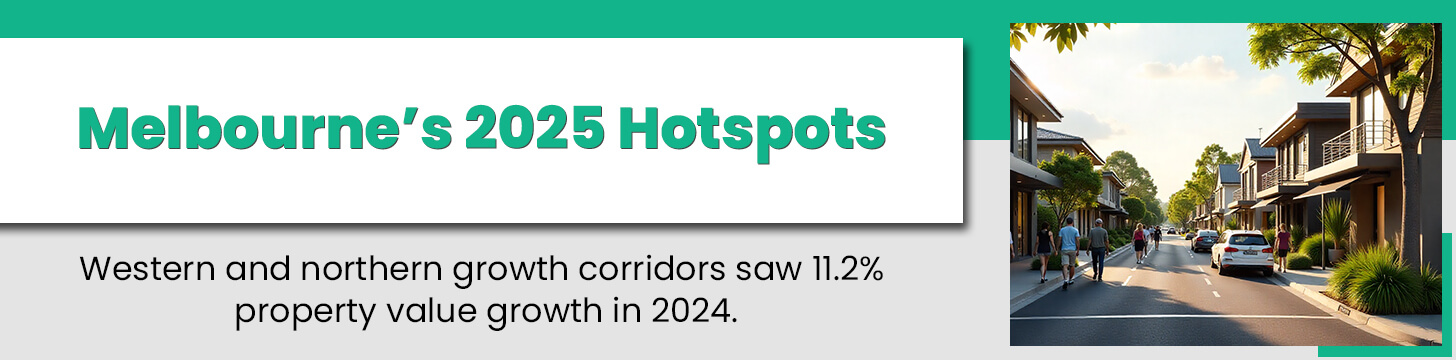
The best suburbs to invest in Melbourne 2025 aren’t just about today’s prices. They’re about affordability, infrastructure, and lifestyle with strong long-term potential.
Sunshine – Affordable with Major Upgrades
Sunshine is transforming from a forgotten suburb to a future hot spot thanks to major infrastructure projects and growing affordability for families and renters.
Stats:
- Median house price: $690,000 (Domain, 2024)
- Rental yield: 3.8%
- Melbourne Airport Rail Link completion: 2029
Why Invest:
Sunshine’s transformation is driven by the Melbourne Airport Rail Link, which will make it one of Melbourne’s most connected suburbs. Affordable housing and low vacancy rates mean long-term investor demand.
Footscray – Gentrification and Rental Demand
Footscray is Melbourne’s inner-west powerhouse, with cultural diversity, student demand, and gentrification making it a hot spot for both renters and long-term investors.
Stats:
- Unit price growth: +6.8% in 2024 (PropTrack)
- Vacancy rate: <1.5%
- Close to Victoria University and the CBD
Why Invest:
Footscray’s appeal is strong rental demand, university presence, and renewal projects. By 2030, it will be one of Melbourne’s best-performing western suburbs.
Werribee – Western Growth Corridor
Werribee is one of Melbourne’s fastest growing western suburbs, with affordability, family demand, and infrastructure upgrades making it a hot property investment spot.
Stats:
- Median house price: $650,000
- Vacancy rate: 1.3%
- Werribee Employment Precinct → thousands of jobs
Why Invest:
Werribee has affordability and rental appeal. The Employment Precinct will deliver jobs, schools, and health facilities, which will strengthen long-term growth.
Cranbourne – Southeast Expansion Hub
Cranbourne is the heart of Melbourne’s southeast expansion, with growing population demand, affordable housing, and new infrastructure projects that boost rental yield and capital growth.
Stats:
- Median house price: $670,000 (REIV, 2024)
- Located in Casey, Victoria’s fastest-growing LGA
- Rental yield: 3.6%
Why Invest:
Cranbourne’s affordability and location in Victoria’s biggest growth corridor make it attractive. Health centres and town hubs will increase demand over the next 10 years.
Preston – Inner-City Renewal
Preston is being redeveloped through urban renewal, attracting professionals and families who want lifestyle, culture, and quick CBD access while securing long-term property value.
Stats:
- Median house price growth: +7.2% in 2024
- Level Crossing Removal is improving accessibility
- Strong café and lifestyle scene
Why Invest:
Preston’s renewal projects are creating long-term appeal. Transport improvements and lifestyle culture mean it’s a sought-after inner-city suburb for investors.
Doncaster – Premium with Education Demand
Doncaster is a premium suburb with strong family demand, elite schools, and premium retail, making it a high-value long-term property investment.
Stats:
- Median house price: $1.5M (Domain, 2024)
- Strong demand for elite schools
- Major retail: Westfield Doncaster upgrades
Why Invest:
Families drive Doncaster’s property stability. Education demand and lifestyle amenities mean ongoing buyer competition. Yields are modest, but capital value is strong.
Brunswick – High-Yield Lifestyle Suburb
Brunswick is one of Melbourne’s cultural hotspots, attracting young professionals and students, with high yields and lifestyle appeal that keeps investors interested.
Stats:
- Rental yield: 4.3% for units
- Strong demand from professionals and students
- Cultural hub
Why Invest:
Brunswick has lifestyle and investment strength. Yields outperform the Melbourne average, making it one of the most reliable suburbs for ongoing returns.
Coburg – Affordable Alternative
Coburg is emerging as an affordable inner north alternative, with new transport upgrades, community appeal, and strong growth making it a future property investment winner.
Stats:
- Median house price growth: +8% in 2024
- Linked to Metro Tunnel Project
- Family-friendly community
Why Invest:
Coburg benefits from being close to Brunswick but at a lower price. Future transport links will make it more accessible, boosting demand and long-term investor returns.
Tarneit – Entry Level Growth Suburb
Tarneit has affordable entry points for investors, with migration-driven population growth, transport upgrades, and consistent demand from first-home buyers and renters.
Key Stats:
- Median house price: $640,000 (REIV, 2024)
- Population growth is among the fastest in Victoria
- Tarneit Station upgrades are improving commuting
Why Invest:
Tarneit is a classic growth suburb. Affordable homes and a fast-expanding community make it a reliable choice for long-term investment security.
Thornbury – Lifestyle and Rental Strength
Thornbury balances lifestyle, rental demand, and strong property growth, for families and professionals who want community living close to Melbourne’s CBD.
Key Stats:
- Median house price growth: +7.5% in 2024
- Vacancy rate: 1.4%
- Proximity to CBD with café culture
Why Invest:
Thornbury’s lifestyle and rental demand mean stability. It attracts professionals and families seeking culture and connectivity, so it’s a suburb poised for growth.
Melbourne’s Property Market is Future-Ready

Melbourne is gearing up for its next property cycle. Growth, technology, and climate planning are shaping how suburbs become future-ready investment zones.
How AI and Big Data Will Change Suburb Selection
AI-powered property tools are changing suburb selection by giving investors data-driven predictions on capital growth, rental demand, and affordability trends across Melbourne.
Over 60% of younger Australian buyers are using digital-first property platforms.
These tools now analyse suburb-level data, including climate risks, population movement, and affordability. AI models can predict capital growth patterns up to a decade in advance.
Suburbs like Footscray and Cranbourne are being identified as growth-ready due to affordability and population growth.
Climate Resilient Development in Melbourne’s Growth Corridors
Climate change is forcing developers to design resilient communities, with green spaces, energy-efficient housing, and sustainable planning at the heart of Melbourne’s growth corridors.
The CSIRO says 40% more extreme heat days by 2050, while flood-prone suburbs face rising insurance costs.
Developers in Tarneit, Werribee, and Cranbourne are already building climate-adaptive designs with renewable energy, stormwater planning, and heat-mitigation features. These will be key to long-term property values.
What’s Driving Future Property Growth in Melbourne

Melbourne’s future property growth is being driven by technology, migration flows, and sustainability trends. These will determine which suburbs will deliver the best long-term returns by 2030.
Smart City Developments and 5G Infrastructure
Digital connectivity is just as important as physical infrastructure. Suburbs with 5G, smart energy grids, and digital services are attracting renters and investors.
- 5G now covers 85% of Melbourne’s metro area (ACMA, 2024), so homes and businesses can have faster digital connectivity.
- Smart city precincts like Docklands and Fishermans Bend have energy-efficient lighting, IoT-enabled transport systems, and renewable energy grids.
- Suburbs like Brunswick and Preston are already benefiting, with professionals and start-ups moving in who want reliable digital infrastructure for remote work.
Future Insight:
By 2030, suburbs with strong digital infrastructure will have higher rental yields and faster capital growth as tenants and buyers prioritise tech-ready living.
Migration Patterns and International Student Housing Trends
Population growth is the biggest driver of housing demand in Melbourne. Migrants and students are reshaping the rental market in both affordable and central suburbs.
- 518,000 net overseas migrants in 2023–24 (ABS), with Melbourne getting the biggest share.
- Affordable suburbs like Sunshine, Werribee, and Tarneit are where new migrant families are looking for housing.
- International students are back to pre-pandemic numbers of 250,000+ per annum and driving demand for apartments in Carlton, Footscray, and Brunswick.
- Rental vacancies across the city are under 1.5%, so yields are going up.
Future Insight:
By 2030, suburbs near universities, employment hubs, and transport corridors will be investor favourites supported by migration and education demand.
Green Spaces, Sustainability and Liveability Index 2030
Melbourne’s liveability is one of its greatest assets, and it’s all about the balance of green spaces, sustainability, and modern planning.
- Mercer Global Liveability Index 2024 ranked Melbourne the 10th most liveable city in the world.
- Suburbs like Coburg, Doncaster, and Thornbury are in demand because of parks, cycle paths, and walkable neighbourhoods.
- Developers in growth areas are building solar-ready homes, recycled water systems, and climate-adaptive estates to future-proof communities.
- Buyers are looking beyond affordability, prioritising sustainability, lifestyle, and eco-friendly design.
Future Insight:
By 2030, suburbs that combine affordability with sustainability will outperform, delivering strong growth and resilience to environmental risks.
Melbourne vs Sydney & Brisbane Investment Hotspots

Melbourne is competing with Sydney and Brisbane for investor attention. Each city has its own drivers, but Melbourne’s affordability and growth, and planning set it apart.
Why Melbourne’s Growth Outpaces Other Capital Cities
Melbourne has been the population growth leader for years, and its affordability advantage gives it an edge over Sydney.
- Melbourne’s population will reach 6.3 million by 2035, surpassing Sydney (Victoria in Future 2023).* Median house price in Melbourne: $935,000 (CoreLogic, 2024), compared to Sydney’s $1.35 million.
- Melbourne’s western and northern growth corridors have large-scale land releases; Sydney no longer does.
By 2030, Melbourne will be a more scalable city for property growth due to affordability and ongoing infrastructure investment in new corridors.
Lessons from Sydney’s Past Booms
Sydney’s history shows the risks of sharp booms followed by affordability crises. Investors can learn from this when targeting Melbourne’s suburbs.
Future Insight:
- Sydney’s property grew 75% between 2012–2017, but growth slowed after affordability peaked (CoreLogic).
- Rental yields in Sydney are lower, 2.7% for houses compared to Melbourne’s 3.2%.
- Suburbs like Parramatta and Blacktown show how infrastructure can spark growth but also how overheating can lead to long-term affordability issues.
- Investors in Melbourne’s outer suburbs, Tarneit, Cranbourne, and Werribee, can learn from Sydney’s mistakes.
Brisbane’s 2032 Olympics vs. Melbourne’s Long-Term Stability
| Factor | Brisbane – 2032 Olympics Impact | Melbourne – Long-Term Stability |
| Growth Driver | Olympics-driven hype and infrastructure upgrades in precincts like Woolloongabba. | Ongoing demand from population growth, infrastructure projects, and migration. |
| Property Growth | Prices up 32% since 2021 (PropTrack, 2024), largely speculation-led. | Steady 11.2% annual growth in 2024 (CoreLogic), supported by long-term fundamentals. |
| Economy | Smaller economy: contributes 9% of Australia’s GDP (ABS). | Larger, diversified economy: contributes 25% of national GDP. |
| Infrastructure | Olympic-focused projects (stadiums, transport near event hubs). | Mega projects like Suburban Rail Loop, Metro Tunnel, Airport Rail Link that reshape the entire city. |
| Rental Market | Short-term boost in demand near event zones; risks of post-Olympics oversupply. | Ongoing rental crisis with vacancy at 1.1%, driving sustained yields. |
| Investor Risk | Growth may slow after the Olympics, with reduced demand post-2032. | Stable growth trajectory driven by affordability, migration, and global liveability rankings. |
Brisbane’s Olympics provide a short-term boost, but Melbourne offers sustained, future-ready stability. By 2035, Melbourne’s diversified economy and large-scale planning will outperform event-driven markets.
Future-Proof Property Investment Strategies

Melbourne investors in 2025 need to think beyond location and affordability. Technology, ownership models, and digital finance are changing how property wealth will be built.
AI-Powered Property Forecasting Tools for Investors
Artificial intelligence is changing property investing by giving investors suburb-level insights into growth potential and rental demand. Instead of relying only on history, AI models project future market conditions with precision.
- CoreLogic and PropTrack already use AI to provide growth forecasts up to 10 years ahead.
- Over 60% of buyers under 40 in Australia now depend on digital-first property platforms (CoreLogic, 2024).
- Data inputs include migration flows, rental stress, climate risks, affordability trends, and demographic shifts. These tools allow investors to compare suburbs in real time. For example, AI may highlight Sunshine or Tarneit for affordability and growth potential, while flagging lifestyle suburbs such as Preston or Brunswick for stable rental demand.
By blending big data with predictive modelling, AI reduces uncertainty and helps investors choose suburbs aligned with long-term growth.
Investors using AI will not only identify Melbourne’s current hotspots but also anticipate future ones before the wider market catches on, ensuring they stay ahead of competition.
Fractional Ownership and Tokenized Real Estate in 2025
Fractional ownership and tokenization are making property more accessible for Australians priced out of the traditional housing market. These models let people invest with smaller amounts while still gaining exposure to high-value areas.
- Platforms like BrickX already allow shares in Australian property from as little as $100.
- Global reports suggest tokenized property will be a $16 billion industry by 2030 (PwC).
- Younger investors, locked out of premium suburbs, see fractional ownership as a pathway into Melbourne’s real estate market.
This opens up suburbs like Doncaster and Thornbury, where median house prices are over $1.5 million. Instead of saving for years, investors can buy partial ownership, spread their risk across multiple locations.
Tokenization, built on blockchain, also means transparency and easier trading; property behaves more like shares or ETFs.
Fractional ownership won’t replace traditional buying, but it will democratise access. In Melbourne’s competitive market, it could be the difference between missing out and building wealth.
Financing Smart Investments: Digital Mortgages & Open Banking
Securing finance is one of the biggest hurdles for property investors. In 2025, digital mortgages and open banking reforms will change how quickly Australians can get loans.
- Digital mortgage approvals can now be done in hours, not weeks, with automated verification.
- The Australian market for digital mortgages is expected to be over $100 billion by 2030 (Deloitte).
- Open banking lets lenders access borrower data instantly, customised interest rates, and faster decisions.
Fintech lenders like Athena and Nano are already offering paperless mortgages, perfect for investors who need speed in auctions.
For example, suburbs like Footscray or Preston, where demand is high and stock is low, reward investors who can get finance fast.
Faster loan approvals also reduce the risk of missing out on growth suburbs. Open banking means better deals for borrowers and lower barriers for entry-level investors.
As Melbourne’s market tightens, investors who use these tools will be better equipped to act fast and get properties in the city’s best suburbs.
Risks and Challenges for Melbourne Investors Beyond 2025

Even though Melbourne is future-proof, investors face risks that could impact property values. Affordability, climate change, and changes in rental demand must be considered.
Affordability Crisis and Government Regulations
Melbourne’s affordability gap is growing. While outer suburbs have entry-level prices, the city as a whole is getting harder to get into, so the government will intervene.
- Melbourne’s median house price was $935,000 in 2024 (CoreLogic).
- The price-to-income ratio is over 9:1, one of the highest in the world.
- Government schemes like the First Home Buyer Guarantee and shared equity models are expanding.
- Rental price growth was 12% year on year in 2024, according to SQM Research. For investors, this means more competition from government-backed buyers and potential restrictions on lending or negative gearing in future reforms.
Outer ring suburbs like Tarneit and Cranbourne are affordable, but pressure is building in premium areas like Doncaster and Thornbury.
Affordability is a double-edged sword: while it increases demand in cheaper suburbs, it also means political backlash and new regulations that could impact investor returns.
Climate Change Risks: Flood Zones & Heat Mapping
Climate change is a property risk investors can’t ignore. Suburbs exposed to floods, fires, or heat zones are seeing rising costs and falling demand.
- Insurance premiums in flood-prone Melbourne suburbs have risen 25% since 2020 (Insurance Council of Australia).
- CSIRO projects a 40% increase in extreme heat days by 2050.
- Suburbs near waterways like Maribyrnong and Werribee are at long-term flood risk.
- Growth corridors in the west and southeast are already being reviewed for heat mapping and resilience planning.
These risks increase holding costs and reduce buyer appeal in vulnerable areas. Investors need to factor in not just growth potential but environmental resilience.
Developers are starting to deliver climate-adaptive estates with solar, water recycling, and cooling designs, but investors choosing the wrong suburb could see value eroded.
Shifts in Rental Demand Due to Remote Work Trends
Remote and hybrid work patterns are changing how renters choose suburbs. Accessibility is no longer just about CBD proximity – lifestyle and flexibility now drive demand.
- By 2024, 43% of Australians will be working remotely at least part-time (ABS).
- Suburbs further from the CBD, like Werribee and Cranbourne, are seeing rental demand rise as families seek affordability and space.
- Lifestyle suburbs like Brunswick, Thornbury, and Preston are still attractive due to cafes, parks, and culture, not just work access.
- Vacancy rates are lowest in suburbs with strong lifestyle appeal, often below 1.5%.
For investors, this means CBD apartments may not recover as quickly as suburban rentals. Instead, demand is shifting to outer-ring growth areas and lifestyle suburbs.
Melbourne’s rental market is diversifying, and investors who adapt to this shift will benefit. Those focusing only on inner city properties may see yields stagnate.
Conclusion – Where Future Wealth Will Be Built
Melbourne’s property market is changing fast. Population growth, transport upgrades and technology are reshaping suburb demand, creating future-proof investment opportunities for smart property buyers.
Affordable suburbs like Sunshine, Tarneit, and Cranbourne are emerging growth corridors. Lifestyle-focused areas like Brunswick, Preston, and Thornbury will continue to attract steady rental demand from professionals, families, and long-term residents.
Investors have affordability pressures, climate risks, and shifting rental demand. Using AI forecasting, digital mortgages, and fractional ownership will give you an edge in the Melbourne market.
By 203,0 Melbourne will be Australia’s biggest city. Investors who choose suburbs with connectivity, sustainability, and liveability will build long-term wealth and market resilience.

Valuable Insights On Property Development & Investment Opportunities
-

Top High Interest Short Term Investment Options for 2026
High Interest Savings Accounts for Liquid Cash Buffers Cash sleeve purpose and liquidity role High…
Read More -
Best Performing Managed Funds in Australia: Expert Tips & Strategies
Top-Performing Managed Funds in Australia: What Investors Need to Know In 2026, Australian investors are…
Read More -
Best Financial Advisor Perth: How to Choose the Right Expert for Your Goals
Financial Advisor Perth Key Criteria for Choosing the Best Adviser Choosing the best financial advisor…
Read More -
How to Make Money from Property Development in Australia: A Comprehensive Guide
High-Growth Cities Offering the Best Property Development Margins Australia’s property development landscape will be shaped…
Read More -
What Are the Best Low-Risk Investments in Australia for Beginners?
Low-Risk Investing in 2026: The Beginner Snapshot For Aussie beginners seeking low-risk investments in 2026,…
Read More


Our Project Site :


Exclusive waterfront living at the Lake Narracan Resort community.

Quick Links
The information provided is general in nature and does not constitute personal financial advice. The information has been prepared without taking into account your personal objectives, financial situation or needs. Before acting on any information on this website you should consider the appropriateness of the information having regard to your own objectives, financial situation and needs. All statements made on this website are made in good faith and we believe them to be accurate and reliable however do not guarantee its currency. You should seek legal or other professional advice before acting or relying on any of the content.
Please note that past performance may not be indicative of future results. Different types of investments involve varying degrees of risk, and there can be no assurance that the future performance of any specific investment, investment strategy, or product made reference to directly or indirectly on our website, blogs , newsletters.
Our Project Site :

Find premium land developments and new estates across Australia.
Exclusive waterfront living at the Lake Narracan Resort community.

Quick Links
The information provided on this website including blogs is general in nature and does not constitute personal financial advice. The information has been prepared without taking into account your personal objectives, financial situation or needs. Before acting on any information on this website you should consider the appropriateness of the information having regard to your own objectives, financial situation and needs. All statements made on this website are made in good faith and we believe them to be accurate and reliable however do not guarantee its currency. You should seek legal or other professional advice before acting or relying on any of the content.