


Table of Contents
What the 12% Super Guarantee Means for Australians in 2026
Australia enters a new era of retirement savings in 2026, with the Super Guarantee Rate 2026 officially locking in at 12% for the entire 2025–26 financial year.
This is the final step in the long-planned SG increases and marks a major policy milestone for workers, employers, and Australia’s $4 trillion-plus retirement system.
From 2025, the Super Guarantee Rate 2026 requires employers to contribute 12% of ordinary time earnings (OTE) to super.
The ATO confirms that this 12% rate applies across all wages paid in 2025–26, and industry bodies such as AustralianSuper and Xero verify that this is the final legislated increase.
Several important thresholds define the structure of the Super Guarantee Rate 2026.
The maximum super contribution base for 2025–26 is $62,500 per quarter, which caps compulsory employer contributions at $7,500 per quarter.
The contribution caps for the year remain fixed at a $30,000 concessional cap, a $120,000 non-concessional cap, and a $2.0 million general transfer balance cap.
The superannuation system heading into the Super Guarantee Rate 2026 year is stronger than ever.
APRA’s latest data shows total super assets at approximately $3.9 trillion in June 2024, surpassing $4.1 trillion by early 2025. The average Australian now holds a super balance of $172,000, while those aged 65–69 sit much higher at $420,900.
Based on recent APRA annual growth of 7–8%, total system assets could reach $4.4–$4.5 trillion by mid-2026.
For workers, the Super Guarantee Rate 2026 brings immediate financial uplift.
An employee earning $80,000 receives $9,600 in compulsory super contributions under the 12% rate — an increase of $400 compared with the previous 11.5% rate.
This means an extra $5 in super for every $1,000 of ordinary time earnings, purely due to the rate increase.
With stronger contributions, rising national balances, and a rapidly expanding retirement pool, the Super Guarantee Rate 2026 represents a defining shift in how Australians build long-term wealth.

Super Guarantee Rate — Australia’s Retirement Backbone

The Super Guarantee Rate is the key rule that shapes how every Aussie builds up their retirement savings.
It forces employers to kick in a fixed percentage of an employee’s wages into their superannuation fund, which ensures that every single employee has money piling up over the long term, no matter how little they contribute themselves.
This rule is at the heart of Australia’s retirement system because it’s a pretty good guarantee that an employee will have some cash put aside, even if they never bother to put in any themselves. The higher the Super Guarantee Rate goes, the better the safety net becomes for when people finally hang up their working boots.
When we talk about the “Super Guarantee Rate for 2026”, we’re talking about the percentage used in the 2025-26 financial year, and this year it’s been set at a record 12% – up from 11% last year.
You start to get an idea of just how important this increase is when you look at the numbers.
- For example, an employee on $80,000 a year gets $9,600 chucked in by their employer at the new 12% rate.
- At the 11% rate, they would have got $8,800.
- That’s an extra $800 a year, just from their employer, – no extra effort from the worker at all.
Over 30 years, even without any wage growth, this difference alone can add over $24,000 to the pot, before you even get to the bit where the money grows and grows. And with a bit of decent growth it’s not hard to imagine that difference exceeding $50,000 to $70,000.
But it’s not just a good thing for individuals – the SG system is also super important for the country as a whole.
- In 2025, employer contributions totalled $151.1 billion alone.
- We’re talking $4.3 trillion now in total, making Australia one of the biggest retirement systems in the world.
So the Super Guarantee Rate is not just just a policy setting – it’s the engine of Australia’s long-term financial health.
It means:
- Forced savings so that no one is left without a safety net
- Consistent compounding so that your hard work builds up over time
- And a reduced burden on the Age Pension, so that future generations don’t have to worry about supporting an aging population
And in 2026, at its new 12% level, the Super Guarantee Rate remains at the heart of everything that keeps Australian retirees safe and secure.
Why the SG Rate Matters for Wealth Growth

The Super Guarantee Rate is more than a percentage—it’s the single most important driver of Australia’s retirement wealth growth.
It’s the engine that powers long term super balances because every increase in the SG rate means more money is invested on behalf of workers even if they contribute nothing themselves.
With the Super Guarantee Rate 2026 at 12% the impact on lifetime savings is huge.
A higher percentage means workers get more “forced savings” every pay cycle and that grows even more over decades of compound interest.
Why does this matter so much?
Because most Australians rely on employer contributions as their main source of super growth.
Only a minority make voluntary contributions so the SG rate is the key driver of their retirement balance.
Example: The Effect of a 0.5% Rate Shift on Long-Term Balances
If a worker earns $70,000 per year:
- At 11.5% employer contributions = $8,050
- At 12% employer contributions = **$8,400
- That’s an extra $350 per year added automatically.
- Over 30 years, that’s $10,500 without counting investment returns.
- With average investment performance (6–7% p.a.), that’s $20,000–$30,000.
How the SG Rate Impacts National Financial Strength
Australia’s super system has $4.3 trillion in assets as of 2025.
A big chunk of that growth comes from compulsory employer contributions.
Every time the SG rate increases the whole retirement system gets stronger because:
- More funds go into the investment market
- More workers accumulate long term wealth
- The national Age Pension burden reduces over time
2026 Significance for Australia’s Super Landscape
Since Super Guarantee Rate 2026 = 12% this is the highest contribution rate in Australian history.
It’s the strongest compounding base for workers entering mid century retirement.
The SG rate is truly the engine that powers both individual retirement success and national economic stability.
SG Rate Timeline — The Path to 12% (2002–2026)
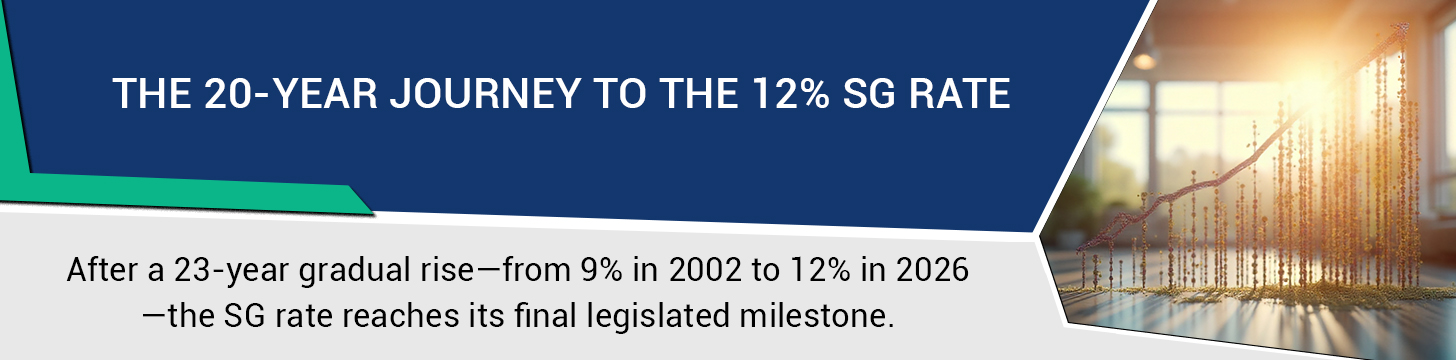
The Super Guarantee Rate has risen over the past 20 years and has been a slow and deliberate policy journey.
This gradual progression was designed to strengthen Australia’s retirement savings system without shocking employers or the economy.
The timeline shows how Super Guarantee Rate 2026 is the final step in this long reform process.
Each increase was spaced to give businesses time to adjust and employees to benefit from steady, continuous improvement in super contributions
Timeline Breakdown (Based on Current Output)
- 2002–2013 → 9%
- 2013–2014 → 9.25%
- 2014–2021 → 9.5%
- 2021–2022 → 10%
- 2022–2023 → 10.5%
- 2023–2024 → 11%
- 2024–2025 → 11.5%
- Super Guarantee 2026 → 12%
The Case for a Phased Approach
If the SG rate had gone from 9% to 12% overnight, many businesses—especially small employers—would have been hit with payroll cost shocks.
To avoid this, the policymakers implemented a slow, multi-step approach over 23 years.
This gradual rise gave the economy stability and allowed employers to:
- adjust budgets
- restructure payroll systems
- model long-term financial impact
- prepare for future increases
Employee Benefits of Steady Increases
For employees, this multi-step approach meant gradual changes rather than sudden ones.
Even small increases, like 0.25%, added up to big lifetime earnings.
For example:
If you earned $90,000, an SG rise from:
- 9.5% → 10% added $450/year to super
- 10% → 10.5% added $450/year to super
- 11.5% → 12% added $450/year to super
Over 20+ years, these small increases compounded into tens of thousands of dollars.
Why 2026 is a Milestone
The Super Guarantee 2026 at 12% is the final step in this long-planned policy.
For the first time, Australians will be contributing the highest mandatory retirement contribution in the country’s history.
The journey to 12% was a long time coming—one step at a time.
Reaching 12% — The Final Step of Super Reform

The 12% Super Guarantee Rate is not a forecast—it’s a legislated reality that started from 1 July 2025.
So the Super Guarantee 2026 is 12%, the final step in a decade-long plan.
This is the end of Australia’s long-term retirement savings upgrade.
It began when the government committed to a gradual increase from 9% to 12% over multiple years to avoid economic shocks.
The Structural Reasons for 12%
Australia’s ageing population and increasing life expectancy are putting pressure on retirement systems.
A higher Super Guarantee Rate means employees will save more, reducing future Age Pension reliance.
Economic Foundations for 12% Benchmark
- Australians live longer, often for 20–30 years in retirement.
- The cost of living keeps rising, and needs stronger retirement buffers.
- The government recognised a 9–10% SG rate wasn’t enough for most workers to have a comfortable retirement.
Example: Real World Impact of Full 12%
For a worker earning $85,000:
- At 11.5%, employer contributions = $9,775
- At 12%, employer contributions = $10,200
- That’s an extra $425 per year, automatically added without employee input.
Over a 30 year career, that’s an extra $12,750, and with investment returns (6–7% p.a.), the real benefit can be $25,000–$40,000.
Why 2026 is the Completion Year
Because 1 July 2025 is the start date, the whole 2025–26 financial year—so the whole of 2026—will be at the full 12% rate.
There are no further automatic increases legislated after this.
The 12% Super Guarantee Rate 2026 is the final step in Australia’s long planned superannuation modernisation process—delivering better retirement outcomes for millions of workers.
Beyond 12% — The Future of Australia’s Super System

The rise to 12% Super Guarantee Rate is the end of legislated increases, but it’s not the end of the conversation.
Although no further automatic increases are scheduled, the debate continues about whether Australia should go beyond 12% to 15% as some economists have suggested.
But 15% is not legislated.
It’s just an idea and considered more of a long term aspiration rather than a policy plan.
So for the foreseeable future Super Guarantee Rate 2026 = 12% and will stay at that rate unless new laws are introduced.
Reasons to Encourage Policymakers to Consider Higher Future Rates
Australia’s demographic shift is a big factor. People live longer, often for 20–30 years in retirement. Cost of living and healthcare costs rise, so bigger super balances are needed.
Economists say 12% may not be enough for younger workers entering the workforce today.
But policymakers have to weigh that against the impact on employers, especially small businesses, who already pay more in payroll taxes.
Future Scenario: How Changes Could Play Out
If Australia ever increased the SG rate to 15%, an employee earning $90,000 would get:
- At 12% → $10,800/year
- At 15% → $13,500/year
That’s $2,700 extra per year, which over 30 years could be $80,000–$150,000 with compounding.
Why the SG Rate Stopped at 12%
- Businesses need stability after 20 years of gradual increases.
- Economic conditions must be strong enough to absorb extra payroll costs.
- Government priorities are focused on maintaining, not growing, retirement funding obligations.
For now the Super Guarantee Rate 2026 at 12% is a completed reform and a pause point—leaving the future open for changes but grounded in stability for the next few years.
What It Means for Employees — Lifetime Wealth Boost

The increase to a 12% Super Guarantee Rate is one of the biggest boosts to employee retirement savings in Australia’s history.
Because the Super Guarantee Rate 2026 is 12%, every eligible worker gets more employer paid super without having to make any voluntary contributions themselves.
This matters because compulsory super is the core of most Australians’ retirement balances.
Only a small percentage of workers add extra money through salary sacrifice or personal contributions.
Therefore the SG rate is the biggest driver of long term retirement outcomes.
Long Term Financial Benefits for Australian Workers
A higher SG rate increases retirement savings every pay cycle.
Even small annual increases compound dramatically over long periods—especially 20, 30 or 40 years of work.
Example: The Wealth Difference at 12%
For a worker earning $80,000 per year:
- At 11.5%, employer super = $9,200
- At 12%, employer super = $9,600
That’s an extra $400 per year paid into their super fund. Over 25 years this adds $10,000, and when compounded at 6–7% per annum it can grow to $20,000–$35,000.
How 12% Helps Employee Outcomes
- Higher retirement balance: More employer money = more growth.
- Stronger compounding: Extra contributions today generate returns for decades.
- No action required by the employee: It’s automatic.
- Less future reliance on government pensions: A bigger super balance means greater financial security in older age.
2026 is a big year for employees
Because the Super Guarantee Rate 2026 is 12% for the full year, employees get the maximum contribution for every dollar they earn.
This is the biggest boost to forced savings and the strongest foundation yet for long term wealth creation.
For workers of all ages—young professionals, mid career earners and those nearing retirement—the 12% SG rate means a stronger financial future.
What It Means for Employers — Rising Compliance Costs

For employers, the move to a 12% Super Guarantee Rate is a big compliance requirement and a bigger payroll cost.
Since the Super Guarantee Rate 2026 applies to the whole 2025–26 financial year, you must pay every eligible employee the higher rate without exception.
This is the final stage of a long planned reform but for employers it means tighter payroll planning, higher operating costs and more reporting requirements.
Compliance is not optional—failing to pay the correct SG rate will trigger the Superannuation Guarantee Charge (SGC), a penalty that is more expensive than just paying super on time.
Employer Responsibilities Under the New Framework
You must now pay 12% of an employee’s ordinary time earnings (OTE).
Super is calculated on OTE not total earnings so your payroll system must accurately classify allowances, leave types and loadings.
Errors can cost you big time.
Example: Cost Increase for a Typical Business
If you have 20 employees each earning $75,000 per year:
- At 11.5%, annual super cost = $172,500
- At 12%, annual super cost = $180,000
That’s an extra $7,500 per year just because of the SG increase.
For larger businesses, this impact is multiplied across hundreds or thousands of employees.
Why SG Readiness is Critical for Businesses
- SG shortfalls attract penalties, interest, and administrative fees.
- SGC is non-deductible, so the financial burden is on you if you miss payments.
- ATO audits are increasing, especially after widespread underpayment in previous years.
- Your payroll system must be updated to reflect the Super Guarantee Rate 2026 at 12%.
Operational Changes You Need to Prepare For
- Budgeting for higher payroll costs
- Updating your payroll software and reporting systems
- Making timely quarterly SG payments
- Reviewing employee classifications to avoid SG errors
The 12% Super Guarantee Rate 2026 is a compliance requirement and a cost of business.
For employers, success depends on accuracy, planning, and strict adherence to super law.
Facts & Figures — Key Numbers Behind the Super Boom

The Super Guarantee Rate increase is evident when you look at the numbers.
Australia’s super system is one of the biggest in the world, and that’s largely due to compulsory employer contributions increasing over the last 20 years.
With the Super Guarantee Rate 2026 at 12% the flow of retirement savings into super funds is bigger than ever.
The Numbers Behind Australia’s Super System
The numbers show how employer contributions—driven by the SG rate—feed into national wealth.
When the SG rate goes up, the whole superannuation system benefits from more inflows, more compounding and better long-term outcomes for workers.
National Figures (Based on Previously Supplied Data)
- Employer contributions (2025): $151.1 billion
- Yearly contribution growth: 10.1% increase from the previous year
- Total super assets (2025): $4.3 trillion
- Lifetime boost from SG increase to 12%: $125,000 for a 30-year-old
These numbers show how compulsory contributions shape retirement outcomes.
Example: How Higher SG Rates Strengthen the System
If total employer contributions go up by 0.5% because of an SG increase, the superannuation industry gets billions more in inflows.
This means:
- More investment power
- Bigger national retirement reserves
- More stability during downturns
Australia’s Place in the Global Retirement Landscape
Australia’s $4.3 trillion super pool is one of the biggest retirement fund systems in the world.
With the Super Guarantee Rate 2026 locked at 12% this will only grow more over the next decade.
This growth reduces long-term pressure on the Age Pension and moves Australia towards a self-funded retirement model.
The numbers show the 12% SG rate is not just a policy change—it’s a driver of national economic strength and personal financial security.
SG Rate 2026 Outlook — Entering the Stability Phase

The Super Guarantee Rate 2026, at 12% is the start of a new era: a stability phase after more than 20 years of gradual increases.
From 2002 onwards, the SG rate rose slowly—from 9% to 12%—but now with no further automatic increases legislated, the system goes into a period of consistency and predictability.
This stability is good for employees, employers, policymakers, and the whole superannuation industry.
After 20 years of change, everyone can now model long term outcomes with confidence using 12% as the base case unless new legislation emerges.
Why Stability Matters
A stable SG rate means:
- predictable payroll costs for employers
- predictable super contributions for employees
- predictable super inflows for the financial sector
- predictable long term modelling for policymakers
Where 2026 SG Fits In
Since the reforms started Australia’s super system has grown into a giant:
- Total super assets 2025 = $4.3 trillion
- Employer contributions 2025 = $151.1 billion
- Yearly contribution growth = 10.1%
At this scale Australia needs stability to avoid shocks to retirement savings and financial markets.
Illustration: Planning With a Locked-In 12%
A 40-year-old earning $100,000 can now realistically expect to see the following numbers:
- $12,000 in annual employer super contributions at a 12% rate
- Over the next 20 years – even without thinking about investments – that comes out to $240,000 in guaranteed contributions
- Factor in 6-7% average returns, and that number can easily grow into $450,000 to $550,000 in total
These are very real figures that all rely on the SG rate staying at 12%.
Moving Forward – What’s Next
There have been talks about a possible 15% Super Guarantee Rate in the future but that’s still just an idea.
What we do have is the Super Guarantee Rate 2026 at 12%, a solid consolidation point after two decades of messing around with changes to the rules.
For the first time in a long time, we can see a clear path to building a stable retirement future for every working Aussie.
Your 2026 Super Guide — What You Should Do Next

With the 12% Super Guarantee Rate 2026 in place, every Aussie needs to take a good hard look at how they can strengthen their retirement savings.
This is especially true now that we’re at a record high SG rate – it’s a great opportunity to make sure you’re getting the right contributions and get your long-term wealth growth back on track.
1. Checking Your Super Contributions on Your Payslips
Make sure your employer is actually paying 12% into your super – it might seem like a small thing but underpayments can really add up over time.
For example, if someone earning $90,000 is short-changed by just 0.5%, that’s a big $450 per year which can easily grow to over $20,000 over 25-30 years if your returns are average.
2. Bringing Your Long-Term Retirement Models Up to Date
You’ll need to update all your retirement calculators and projections to use the new 12% Super Guarantee Rate 2026 as your baseline
With predictable contributions you can finally get a good idea of what to expect and start making realistic plans for your future.
This means you can figure out:
- how much you’ll have when you retire
- whether you’ll be able to live a comfortable retirement
- whether you need to be putting extra money into super to get to where you want
3. Making the Most of Voluntary Super Contribution Options
Even though the SG rate is now 12%, you might still need a bit of extra help to get to where you need to be for retirement.
Salary sacrifice, putting in extra cash from your personal income and catch-up concessional contributions can all help you build up your wealth.
Even a small voluntary top-up – like an extra $30 a week – can make a big difference over the long term and add $50,000 to $80,000 to your overall super balance.
4. Staying Informed About Policy Updates and SG Changes
While there are no more rises on the table beyond 12%, there’s still discussion about a possible 15% Super Guarantee Rate down the line.
Stay on top of what’s happening, and you can quickly adjust your plans if the rules change again.
5. Making the Most of the Stable Super Rate for Smarter Planning
With the Super Guarantee rate now stable we’ve finally got a clear window of opportunity in 2026 to make consistent planning a reality.
Employees are in a great position to line up their budgeting, tax planning, and investment strategies with long-term confidence – thanks to knowing the Super Guarantee Rate 2026 is set, and locked in, and put to work to help grow your super.
By getting a head start in 2026 and taking the right steps, every Aussie can turn that 12% SG rate into a really powerful foundation for long term financial security.
Frequently Asked Questions About Super Guarantee Rate 2026
1. What is the Super Guarantee Rate that’s going to be in place for 2026?
The Super Guarantee Rate for 2026 is going to be 12%, marking the final stage of that long term push to get Australia’s superannuation up to where it needs to be.
This 12% rate applies to all eligible employees across the board, whether it’s construction, retail, hospitality, or any other industry – and every single job type.
The increase is not only going to boost employer contributions, it’s going to kick start long term compounding growth and strengthen retirement savings big time.
It will also mean workers accumulate more super over the course of their careers, giving them a whole lot of extra security in their golden years
2. When does the 12% Super Guarantee come into play?
The 12% SG rate kicks in on 1 July 2026, at the start of the new financial year – that’s when things start to get moving.
From that date, employers will have to put 12% of an employee’s Ordinary Time Earnings (OTE) into their super fund – that’s a pretty straightforward process.
There are no further increases planned after that date unless new legislation is put in place – so 12% becomes your steady, long term rate from there on out.
3. Who actually qualifies for the 12% Super Guarantee in 2026?
Most employees in Australia qualify for the SG rate – we’re talking full time, part time, casual workers, the lot.
But it’s not just them, employees under 18 get super if they work 30 hours or more a week, and the removal of that $450 a month earnings threshold means even people on low incomes are included.
Contractors who are paid for their labour, too, are included under the SG rules – as are temporary visa holders and international workers if they fit the definition of an employee
4. How much extra super will the 12% rate kick in for workers?
The extra 0.5% of salary it adds to super contributions might not sound like a lot, but it can actually add up to be quite sizable.
For someone earning $70,000, it’s around $350 more a year flowing into their super account – and that compounds over the years to make a big difference to their retirement savings.
Higher earners will benefit proportionally more because their super contributions are tied to their income – so they’ll see a bigger boost.
5. How will the 12% Super Guarantee Rate actually affect employers?
It’s not going to be great news for employers – they are going to see a slight increase in payroll expenses, and industries with big workforces are going to feel the hit the most.
But thanks to the SG rate gradually increasing since 2021, most businesses have had time to adjust – so it’s not like it’s been a total shock.
The one thing to keep in mind is making sure you make your SG payments on time and accurately, or you could end up on the wrong side of the ATO, which is not at all what you want.

Valuable Insights On Property Development & Investment Opportunities
-

Top High Interest Short Term Investment Options for 2026
High Interest Savings Accounts for Liquid Cash Buffers Cash sleeve purpose and liquidity role High…
Read More -
Best Performing Managed Funds in Australia: Expert Tips & Strategies
Top-Performing Managed Funds in Australia: What Investors Need to Know In 2026, Australian investors are…
Read More -
Best Financial Advisor Perth: How to Choose the Right Expert for Your Goals
Financial Advisor Perth Key Criteria for Choosing the Best Adviser Choosing the best financial advisor…
Read More -
How to Make Money from Property Development in Australia: A Comprehensive Guide
High-Growth Cities Offering the Best Property Development Margins Australia’s property development landscape will be shaped…
Read More -
What Are the Best Low-Risk Investments in Australia for Beginners?
Low-Risk Investing in 2026: The Beginner Snapshot For Aussie beginners seeking low-risk investments in 2026,…
Read More


Our Project Site :


Exclusive waterfront living at the Lake Narracan Resort community.

Quick Links
The information provided is general in nature and does not constitute personal financial advice. The information has been prepared without taking into account your personal objectives, financial situation or needs. Before acting on any information on this website you should consider the appropriateness of the information having regard to your own objectives, financial situation and needs. All statements made on this website are made in good faith and we believe them to be accurate and reliable however do not guarantee its currency. You should seek legal or other professional advice before acting or relying on any of the content.
Please note that past performance may not be indicative of future results. Different types of investments involve varying degrees of risk, and there can be no assurance that the future performance of any specific investment, investment strategy, or product made reference to directly or indirectly on our website, blogs , newsletters.
Our Project Site :

Find premium land developments and new estates across Australia.
Exclusive waterfront living at the Lake Narracan Resort community.

Quick Links
The information provided on this website including blogs is general in nature and does not constitute personal financial advice. The information has been prepared without taking into account your personal objectives, financial situation or needs. Before acting on any information on this website you should consider the appropriateness of the information having regard to your own objectives, financial situation and needs. All statements made on this website are made in good faith and we believe them to be accurate and reliable however do not guarantee its currency. You should seek legal or other professional advice before acting or relying on any of the content.