


SIGA
| April 18, 2024
Exploring the Optimal Passive Income Streams in Australia: 7 Options to Consider
Table of Contents
Passive income serves as an aspirational beacon for countless Australians striving for financial freedom and security. The allure lies in its promise of earning without the perpetual demands of time and effort. However, discerning the most lucrative passive income avenues necessitates a thorough examination of various factors. Here, we delve into several compelling passive income strategies tailored to the dynamic Australian market landscape.
Commercial Real Estate Investment

Delving into commercial real estate stands as a formidable option for cultivating passive income Down Under. Unlike their residential counterparts, commercial properties boast higher rental yields and prolonged lease agreements. Prime locales in major urban hubs like Sydney, Melbourne, and Brisbane offer consistent rental revenues and the potential for enduring capital appreciation. Furthermore, commercial properties often entail lower upkeep costs, with tenants assuming responsibility for maintenance and repairs.
Nevertheless, plunging into commercial real estate demands substantial capital outlay and entails inherent risks. Fluctuations in market dynamics, economic downturns, and tenant vacancies can profoundly impact cash flow and profitability. Therefore, meticulous due diligence, market analysis, and consultations with financial experts are imperative before embarking on commercial property investments.
The expected returns from commercial real estate investments in Australia can vary depending on factors such as location, property type, and market conditions. On average, commercial properties in prime locations can deliver annual yields ranging from 6% to 10%, with the potential for higher returns in certain sectors or regions. Additionally, capital appreciation over time can further enhance overall investment returns, making commercial real estate an attractive option for passive income seekers.
- Goodman Group (ASX: GMG) – Goodman Group is one of Australia’s leading integrated commercial and industrial property groups, specializing in the development, ownership, and management of logistics and business parks.
- Scentre Group (ASX: SCG) – Scentre Group is the owner and operator of Westfield shopping centers in Australia and New Zealand, with a portfolio of retail properties that attract millions of shoppers annually.
- Dexus (ASX: DXS) – Dexus is a diversified real estate investment trust (REIT) with a focus on office and industrial properties across Australia’s major cities, known for its strong track record of delivering consistent returns to investors.
- Vicinity Centres (ASX: VCX) – Vicinity Centres is one of Australia’s largest owners and operators of retail properties, managing a portfolio of shopping centers located in prime metropolitan and regional areas.
Residential Real Estate Investment
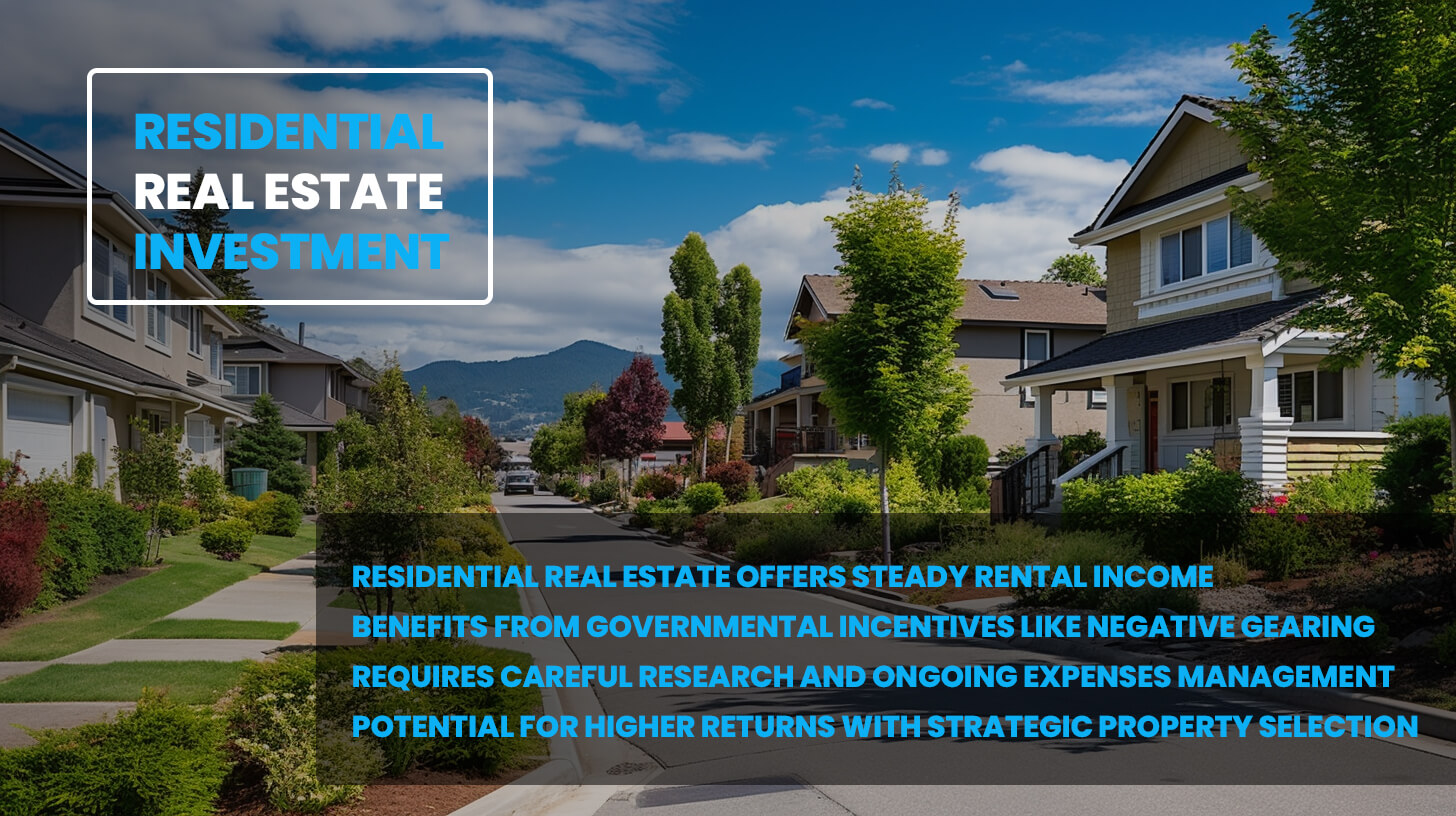
Residential real estate endures as a favored avenue for passive income seekers across Australia. Fueled by a burgeoning population and robust rental demand, residential properties offer a steady influx of rental income and prospects for long-term capital growth. Moreover, governmental incentives such as negative gearing and depreciation benefits augment investment returns for property enthusiasts.
Nonetheless, venturing into residential real estate mandates meticulous research and consideration of various factors, including location, property type, and rental demand dynamics. Investors must also account for ongoing expenses such as maintenance, property management fees, and insurance premiums. Despite these challenges, residential real estate investment holds the promise of furnishing a dependable source of passive income for those adept at navigating the intricacies of the property realm.
The expected returns from residential real estate investments in Australia can vary depending on factors such as location, property condition, and rental market trends. On average, residential properties typically yield rental returns ranging from 3% to 5% annually. However, with careful property selection and strategic management, investors can achieve higher yields, especially in high-demand areas or through value-add strategies such as renovations or development projects.
- Mirvac Group (ASX: MGR) – Mirvac Group is a diversified property group with a focus on residential, commercial, and retail developments across Australia. Known for its innovative design and sustainability initiatives, Mirvac has established itself as a leading player in the residential real estate market.
- Stockland (ASX: SGP) – Stockland is one of Australia’s largest diversified property developers and managers, with a significant presence in residential communities, retirement living, and commercial properties. The company’s focus on master-planned communities and sustainable development practices has earned it recognition in the industry.
- Lendlease Group (ASX: LLC) – Lendlease Group is a global property and infrastructure company with a strong presence in residential development and urban regeneration projects in Australia. Renowned for its iconic developments and commitment to creating vibrant, sustainable communities, Lendlease is a prominent player in the residential real estate sector.
Dividends from Share Investing (i.e., on the ASX)

Participation in the Australian Securities Exchange (ASX) presents investors with a conduit for accruing passive income through dividends from share investments. Dividend-paying stocks emerge as particularly alluring for income-oriented investors seeking consistent cash inflows. Numerous established Australian companies, colloquially referred to as blue-chip stocks, boast a track record of disbursing steady dividends to shareholders.
Investing in dividend stocks proffers the dual benefit of potential capital appreciation alongside recurrent dividend earnings. However, prudent diversification across diverse sectors and industries is crucial to mitigating risk and fortifying portfolio stability. Additionally, conducting comprehensive research and analysis is imperative for identifying companies with robust fundamentals and sustainable dividend policies.
The expected returns from dividend-paying stocks on the ASX can vary depending on factors such as company performance, dividend yield, and market conditions. Historically, dividend stocks have delivered average annual yields ranging from 3% to 6%, providing investors with a reliable source of passive income. Moreover, dividend reinvestment plans (DRIPs) allow investors to compound their returns over time by reinvesting dividends back into additional shares, further enhancing long-term wealth accumulation.
- Commonwealth Bank of Australia (ASX: CBA) – Commonwealth Bank is one of Australia’s largest financial institutions, renowned for its stability and consistent dividend payouts. As a leading player in the banking sector, Commonwealth Bank has a strong track record of delivering shareholder value through dividends and capital appreciation.
- Telstra Corporation Limited (ASX: TLS) – Telstra is Australia’s leading telecommunications company, providing a range of services including mobile, fixed-line, and broadband. With a solid market presence and dependable cash flows, Telstra is known for its reliable dividend payments to investors.
- BHP Group Limited (ASX: BHP) – BHP is a global resources company engaged in the exploration, production, and marketing of commodities such as iron ore, copper, and petroleum. Despite fluctuations in commodity prices, BHP has maintained a consistent dividend policy, making it a preferred choice for income-oriented investors.
- Wesfarmers Limited (ASX: WES) – Wesfarmers is a diversified conglomerate with interests in retail, chemicals, energy, and industrial operations. With a portfolio of well-known brands such as Bunnings Warehouse and Coles, Wesfarmers has a stable earnings base that supports regular dividend payments to shareholders.
A Side Business or Freelance Operation

For individuals imbued with entrepreneurial zeal, launching a side business or engaging in freelancing presents a fertile avenue for passive income generation in Australia. Whether it entails e-commerce endeavors, consultancy services, or creative pursuits, leveraging one’s skills and expertise to foster independent income streams affords flexibility and autonomy. The advent of online platforms and digital marketplaces further amplifies opportunities for reaching a global clientele and scaling business endeavors.
However, nurturing a thriving side business or freelance enterprise demands unwavering dedication, perseverance, and strategic acumen. Identifying lucrative market niches, crafting a viable business model, and investing in branding and marketing endeavors are indispensable for attracting clientele and fostering sustained growth. While passive income may not materialize instantaneously, cultivating a resilient business framework can pave the way for enduring financial stability and personal fulfillment.
The expected returns from a side business or freelance operation can vary significantly depending on factors such as industry, niche market demand, and business model. While some entrepreneurs may achieve modest supplementary income in the initial stages, successful ventures have the potential to generate substantial passive income streams over time. By consistently delivering value to clients and optimizing operational efficiency, entrepreneurs can maximize profitability and long-term sustainability.
- Freelancer.com – Freelancer.com is a global freelancing platform that connects businesses with freelance professionals across various industries, including writing, design, programming, and marketing. Freelancers can bid on projects and collaborate with clients remotely, making it an ideal platform for Australian freelancers seeking diverse income opportunities.
- Etsy – Etsy is an e-commerce marketplace specializing in handmade, vintage, and unique goods. Australian artisans and creatives can showcase their products to a global audience, leveraging Etsy’s platform to generate passive income from sales while pursuing their passion for crafting.
- Airtasker – Airtasker is an online marketplace that enables users to outsource tasks and find local services, ranging from home maintenance to event planning. Australian freelancers can offer their skills and services on Airtasker, earning passive income by completing tasks for individuals and businesses in their local community.
- Upwork – Upwork is a leading global freelancing platform that connects businesses with freelance professionals in fields such as programming, graphic design, and digital marketing. Australian freelancers can leverage Upwork’s platform to access a wide range of projects and clients, facilitating the growth of their freelance businesses.
Royalties (from Copyrighted Music, Books, etc.)

Creative virtuosos in Australia can harvest passive income through royalties derived from copyrighted works such as music compositions, literary masterpieces, and artistic creations. Licensing intellectual property to third-party entities or distributing content via digital platforms facilitates the monetization of creative endeavors sans perpetual exertion. Royalty arrangements typically entail receiving a predetermined percentage of sales proceeds or usage fees for copyrighted works.
Nevertheless, accruing royalties necessitates substantial upfront investment in crafting high-caliber content and securing copyright protection. Furthermore, navigating the labyrinthine terrain of copyright laws and licensing agreements mandates adept legal counsel to safeguard intellectual property rights and ensure equitable remuneration. Despite these challenges, royalties furnish a passive income stream that celebrates and rewards ingenuity and innovation.
The expected returns from royalties in Australia can vary widely depending on the popularity and commercial success of the copyrighted works. Royalty rates typically range from 5% to 25% of gross sales or usage fees, with potential for higher earnings for blockbuster hits or best-selling creations. Additionally, with the advent of digital distribution platforms and streaming services, creators can reach global audiences and maximize their royalty earnings.
- Sia – The Australian singer-songwriter has achieved international acclaim for her chart-topping hits and distinctive vocal style. With a catalog of copyrighted music spanning multiple albums and collaborations, Sia continues to earn royalties from streaming platforms, radio airplay, and licensing deals.
- Tim Winton – Renowned for his evocative storytelling and vivid portrayals of the Australian landscape, Tim Winton is a prolific author whose novels have garnered critical acclaim and commercial success. Through royalties from book sales, film adaptations, and audiobook downloads, Winton enjoys a steady income stream from his literary creations.
- John Butler – As a celebrated musician and songwriter, John Butler has captivated audiences worldwide with his soulful guitar playing and socially conscious lyrics. With a repertoire of copyrighted music that resonates with fans across generations, Butler earns royalties from album sales, concert performances, and synchronization licenses for film and television.
- Shaun Tan – Award-winning illustrator and author Shaun Tan has enchanted readers of all ages with his whimsical illustrations and poignant narratives. Through royalties from book sales, merchandise licensing, and adaptations of his works into animated films, Tan continues to inspire audiences and generate passive income from his creative endeavors.
Bond and Fixed Interest Investments

Venturing into bonds and fixed interest securities furnishes investors with a stable reservoir of passive income in the Australian milieu. Government bonds, corporate bonds, and fixed interest funds proffer regular interest payments and serve as bulwarks against market vicissitudes during periods of economic turbulence or equity market volatility.
Nonetheless, bond investments entail inherent perils such as interest rate fluctuations, credit risks, and inflationary pressures. Hence, undertaking a meticulous assessment of risk tolerance, investment objectives, and time horizon is imperative before allocating capital to fixed income securities. Diversification across disparate bond issuers and maturity spectrums is paramount for risk mitigation and bolstering portfolio resilience.
The expected returns from bond and fixed interest investments in Australia vary depending on factors such as bond type, issuer credit quality, and prevailing interest rates. Government bonds, considered low-risk assets, typically offer yields ranging from 1% to 3%, reflecting the prevailing interest rate environment and bond maturity. Corporate bonds, on the other hand, may offer higher yields ranging from 3% to 6%, commensurate with issuer credit risk and bond duration. Fixed interest funds, comprising a mix of bonds and other fixed income securities, may yield returns ranging from 2% to 5%, depending on fund composition and management strategy.
- Australian Government Bonds – Issued by the Australian government, these bonds are considered low-risk investments and offer fixed interest payments semi-annually until maturity. With varying maturities ranging from short-term Treasury Notes to long-term Treasury Bonds, Australian Government Bonds provide investors with a range of options to match their income needs and risk preferences.
- Corporate Bonds – Issued by corporations to raise capital, corporate bonds offer higher yields than government bonds but carry greater credit risk. Investors can choose from a diverse range of corporate bonds issued by Australian companies across industries such as banking, telecommunications, and utilities, with yields reflecting issuer creditworthiness and market demand.
- Fixed Interest Funds – Managed by professional fund managers, fixed interest funds invest in a diversified portfolio of bonds and other fixed income securities. These funds provide investors with exposure to a range of bond issuers and maturities, offering potential for income generation and capital preservation. Notable fixed interest funds in Australia include those offered by Vanguard, BlackRock, and AustralianSuper.
Managed Funds and ETFs (Exchange Traded Funds)

Managed funds and exchange-traded funds (ETFs) offer investors a streamlined and diversified pathway to passive income generation in the Australian investment landscape. These investment vehicles amalgamate capital from myriad investors and apportion funds across an expansive gamut of asset classes, spanning equities, bonds, and real estate investment trusts (REITs). While managed funds are steered by professional fund managers, ETFs typically track a specific market index.
Partaking in managed funds and ETFs endows investors with instantaneous diversification, professional oversight, and liquidity perks. Regular disbursals of dividends, interest, or rental income proffer a dependable wellspring of passive income. Nevertheless, conducting a comprehensive evaluation of management fees, performance track record, and underlying asset allocation is indispensable before venturing into managed funds or ETFs. Furthermore, vigilantly monitoring and rebalancing the investment portfolio is essential to align with investment objectives and risk appetite.
The expected returns from managed funds and ETFs in Australia vary depending on factors such as fund composition, investment strategy, and market performance. On average, managed funds and ETFs may yield annual returns ranging from 5% to 10%, depending on asset allocation and market conditions. Dividends from equity holdings, interest from bond investments, and rental income from property holdings contribute to the overall passive income generated by these investment vehicles.
- Vanguard Australian Shares Index ETF (ASX: VAS) – This ETF tracks the performance of the S&P/ASX 300 Index, providing investors with exposure to a diversified portfolio of Australian equities across various sectors. With a low management fee and broad market coverage, Vanguard Australian Shares Index ETF offers investors a cost-effective way to access the Australian stock market.
- BetaShares Australian High Interest Cash ETF (ASX: AAA) – Designed for investors seeking stable income with minimal risk, this ETF invests in a portfolio of high-quality, short-term fixed income securities, offering competitive yields compared to traditional cash accounts. BetaShares Australian High Interest Cash ETF provides investors with liquidity and capital preservation while generating passive income through interest payments.
- Magellan Global Fund – Managed by Magellan Asset Management, this global equity fund invests in a concentrated portfolio of high-quality companies with sustainable competitive advantages and long-term growth potential. With a focus on capital preservation and wealth creation, Magellan Global Fund offers investors exposure to global markets and potential for capital appreciation alongside dividend income.
The Bottom Line
In summation, the optimal passive income stream in Australia hinges upon individual predilections, risk tolerance levels, and investment aspirations. Whether it entails real estate ventures, stock market forays, or entrepreneurial odysseys, diversifying income streams and adopting a long-term perspective emerge as linchpins for attaining financial prosperity and security. By meticulously scrutinizing opportunities and harnessing available resources, Australians can cultivate sustainable passive income conduits that underpin their pursuit of financial autonomy and lifestyle aspirations.

Valuable Insights On Property Development & Investment Opportunities
-

Top High Interest Short Term Investment Options for 2026
High Interest Savings Accounts for Liquid Cash Buffers Cash sleeve purpose and liquidity role High…
Read More -
Best Performing Managed Funds in Australia: Expert Tips & Strategies
Top-Performing Managed Funds in Australia: What Investors Need to Know In 2026, Australian investors are…
Read More -
Best Financial Advisor Perth: How to Choose the Right Expert for Your Goals
Financial Advisor Perth Key Criteria for Choosing the Best Adviser Choosing the best financial advisor…
Read More -
How to Make Money from Property Development in Australia: A Comprehensive Guide
High-Growth Cities Offering the Best Property Development Margins Australia’s property development landscape will be shaped…
Read More -
What Are the Best Low-Risk Investments in Australia for Beginners?
Low-Risk Investing in 2026: The Beginner Snapshot For Aussie beginners seeking low-risk investments in 2026,…
Read More


Our Project Site :


Exclusive waterfront living at the Lake Narracan Resort community.

Quick Links
The information provided is general in nature and does not constitute personal financial advice. The information has been prepared without taking into account your personal objectives, financial situation or needs. Before acting on any information on this website you should consider the appropriateness of the information having regard to your own objectives, financial situation and needs. All statements made on this website are made in good faith and we believe them to be accurate and reliable however do not guarantee its currency. You should seek legal or other professional advice before acting or relying on any of the content.
Please note that past performance may not be indicative of future results. Different types of investments involve varying degrees of risk, and there can be no assurance that the future performance of any specific investment, investment strategy, or product made reference to directly or indirectly on our website, blogs , newsletters.
Our Project Site :

Find premium land developments and new estates across Australia.
Exclusive waterfront living at the Lake Narracan Resort community.

Quick Links
The information provided on this website including blogs is general in nature and does not constitute personal financial advice. The information has been prepared without taking into account your personal objectives, financial situation or needs. Before acting on any information on this website you should consider the appropriateness of the information having regard to your own objectives, financial situation and needs. All statements made on this website are made in good faith and we believe them to be accurate and reliable however do not guarantee its currency. You should seek legal or other professional advice before acting or relying on any of the content.