


Table of Contents
From Active Work to Scalable Passive Income Ideas
Passive income isn’t just a fleeting side hustle thing anymore; it’s turned into a rather messy, multi-layered web tied up with how the global economy is looking, making money online, and the weird new ways people work.
In 2025, roughly 27% of U.S. adults were still juggling side hustles – and on average, they pulled down around US$885 a month (although median earners were probably only scraping by on US$200).
Among those side hustlers, 25% managed to rake in more than US$500 a month, and 14% got to US$1,000 a month – which is still probably not a lot, but hey. Common side hustles included things like selling online (15%), freelancing/business services (14%), or just delivering food, tutoring, fixing people’s houses, and walking their dogs.
But the real deal is that there are massive global markets just taking off across the board.
The gig economy – freelance work, temp labour, and contractors – was worth a whoppin’ US$3.7 trillion in 2023, showing just how valuable it’s become to have access to on-demand labour worldwide.
As for making money, the amount that creators are spending on advertising in the U.S. in the creator-economy has gone through the roof – up from US$13.9 billion in 2021 to US$29.5 billion in 2024, and forecast to hit US$37 billion by 2025.
Meanwhile, the social commerce market – where shopping meets social media – is due to boom from a modest US$992.4 billion in 2022 right up to a whopping US$2.9 trillion by 2026.
All put together, these numbers make a pretty good argument for why 2026’s going to favour people who build assets – digital content, automated stores, creator pipelines, affiliate and subscription systems – rather than just trading in their time for cash.
If you get your side hustle right, it’s not just about earning some extra hundred bucks – you can tap straight into some massive multi-trillion-dollar global flows.

Building Cash Flow Foundations for Everyday Stability
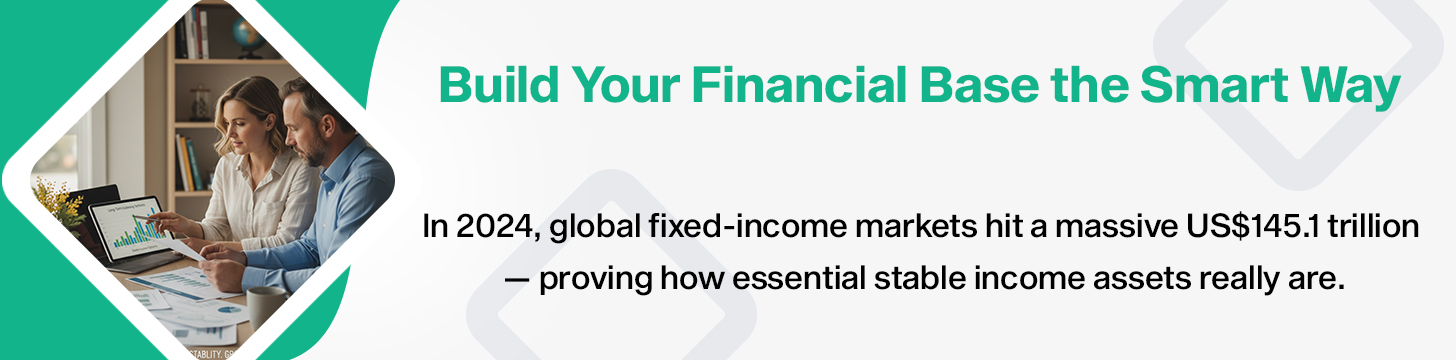
The first part of this process is building stability before thinking about bigger ambitions by focusing on low-risk, easy-to-understand income options that protect your emergency funds and leave room for new opportunities.
Brief explanation:
You start by using safer and simpler tools to keep your money in an accessible and predictable state.
That’s why options like high-interest savings accounts, term deposits, money market funds, treasury bills, and bonds with staggered maturity dates are so important at this stage – they create a secure base before you move into more complex or high-risk passive income strategies.
Getting a stability mindset
Even if these tools don’t give you high returns, they reduce the risk while you get used to the idea of passive income.
Globally, fixed income is a huge part of conservatively investing.
For example, by 2024, the total value of global fixed income markets had reached about US$145.1 trillion, showing just how big a role these instruments play in looking after your capital and generating income
Another estimate puts the value of the global bond market at around US$141.34 trillion in 2024, and it’s expected to keep growing to 2030.
Building income the easy way
If you want to get consistent monthly interest with a minimum of hassle:
- You can just keep a cash buffer in a high-interest account
- Then put the rest of your money into a layered mix of short and medium-term deposits or bonds
In the US for example, standard big bank savings accounts are pretty poor, while the best high-yield accounts have recently been offering around ~4% to 5%, but the national average is even lower.
The outcomes you can rely on
This bit of the process lets you build a safer base, clearer plans, and the patience to go after the higher-yield assets later because having stable early income means you can avoid unnecessary stress, make better decisions, and build growth-focused streams at your own pace without putting yourself at too much risk
The Long-Term Income Game of Dividend Compounding
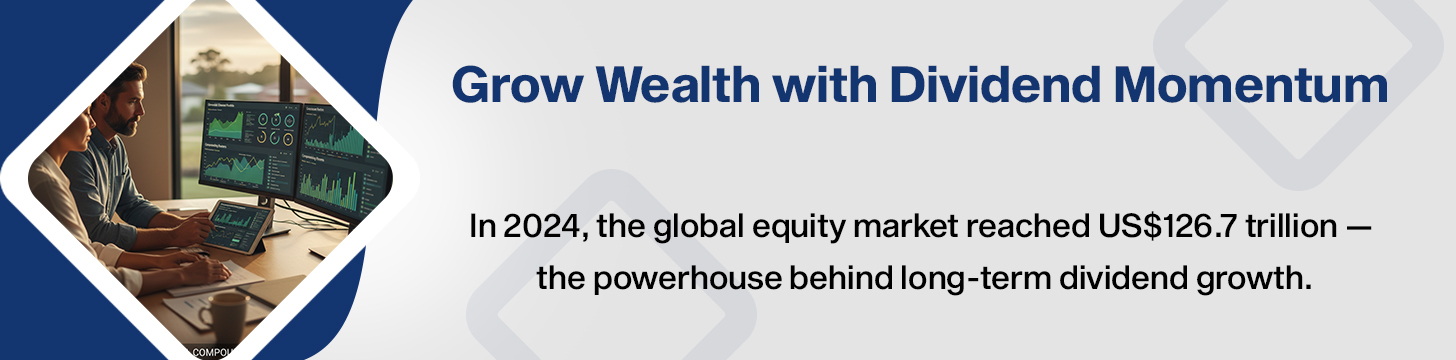
The Big Promise
- Dividend strategies can create a snowball effect of long-run payout momentum, using income-generating assets like dividend stocks, dividend ETFs, index funds that dish out dividends, REIT ETFs, and preferred shares that pay you over time.
- And the best part is you get regular payouts and the potential for your investments to grow, which means if you reinvest those dividend cheques, the compounding effect really starts to kick in – it’s a great next step after you’ve built a solid foundation.
How Long-Term Dividend Income Works
Dividends can:
- Roll in regularly
- Get automatically locked back into your investments
- Be a key part of your long-term wealth plan
But importantly, all this sits on top of a massive and ever-growing pool of equity investments.
In 2024, the value of the global equity market was a staggering US$126.7 trillion – and that’s just the total amount of money being generated in terms of shareholder returns.
The Power of Dividend ETFs
- a lot of investors like dividend ETFs because they spread the risk across many different companies, avoid the pitfalls of putting all your eggs in one basket, make it a lot easier to reinvest, and just make the whole thing easier to manage long term, which makes your income steadier and portfolio management a lot less stressful
By September of 2025, the total value of all ETFs was reportedly around US$18.81 trillion – and this is because more and more people are using ETFs to get exposure to a lot of different investments, including income strategies.
A Simple Dividend Income Setup
- A basic steady-growth setup might combine one broad-market dividend ETF with one REIT ETF for property-linked income, and a small slice of high-quality individual dividend stocks.
- This mix gives you a good balance of diversification and income focus, spreads out the risk across different sectors, and adds in some extra income from property-backed investments, while still giving you the chance to boost your return without over-exposing your portfolio.
The Right Sequence
Because of course dividends can be a bit patchy in downturns.
Having your Cash Flow Foundations in place first means you can stay the course and not sell out in a panic when the market gets a bit wobbly.
Property-Backed Income for Predictable Income Streams

The scope of this property-backed strategy
This step is all about using income from physical property – long-term rentals, short-term vacation lets, commercial leases and more – to create a safer, more predictable income flow.
Because property income is tied to real life demand for space, this approach leans a lot less on market sentiment and more on people needing places to live and work, which gives you a more stable income base.
And you get to choose from all sorts of income formats to suit your risk level and how much effort you want to put in.
What makes property a more predictable income stream?
Compared to digital or market-linked income streams, property has a few key advantages:
- A clearer link between the value of the asset and how much money it makes.
- More stable demand if you’re in a well-established location.
- More income formats to choose from, depending on how much risk you’re happy to take on.
REITs – those big players that trade on the stock exchange – show just how high the income from real estate can be. In the US alone, listed REITs had an equity market capitalization of over $1.4 trillion and paid out nearly $112.5 billion in dividends in 2024.
Globally, there were 1,021 listed REITs with a combined equity market capitalisation of roughly $2 trillion at the end of 2024, and that’s pretty compelling proof that real estate income is a real thing.
Short-term rentals: the good and the ugly
Short-term rentals may well give you a higher income, but they also bring their own set of problems – including city-by-city regulation risks.
A recent report put the global vacation rentals market at $174.84B in 2024 and $195.45B in 2025.
A practical example of a low-to-moderate risk mix
A good starting point might be:
- One long-term rental to provide a stable income base.
- A bit of a rent-by-room strategy to boost your cash flow.
- A small allocation to a property syndicate for some added diversification.
The main point in a single sentence
Property works its best when you treat it like a:
- cash-flow machine first and foremost.
- A growth engine is only second.
Alternative Lending with A Safety Net For Your Returns
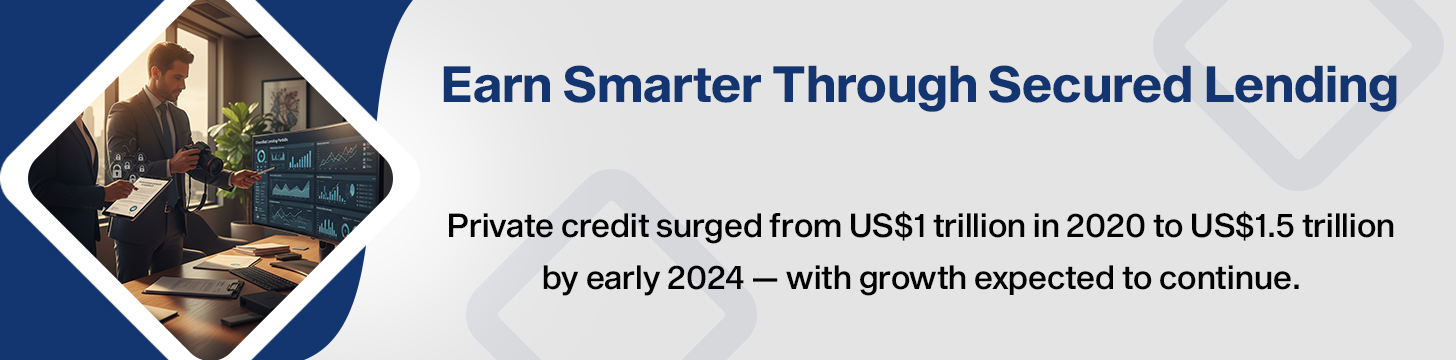
What this step is all about
This step is all about finding a balance between getting a decent return on your money and minimizing the risk of losing it. We’re talking about using interest-based income options like peer-to-peer lending, small business loans, invoice financing, real-estate debt funds and other forms of asset-backed lending.
Because returns from these types of investments come from interest rather than rent or selling a product, they can add some extra diversification to your passive income stream. But to make this work, you need to spread the risk, focus on sound underwriting and avoid getting tempted by unusually high returns – the ones that sound too good to be true.
Growth in the Market – What’s driving it
There’s a pretty compelling institutional story behind this category.
Private credit has grown from around US$1 trillion back in 2020 to a whopping US$1.5 trillion at the start of 2024. Some estimates are even suggesting it will reach US$2.6 trillion by 2029.
Meanwhile, Blackrock thinks this is a US$2.1 trillion market that’s only going to get even bigger over the next few years. All of which explains why retail and high net worth investors are getting more and more interested.
Taming the Beast – The Guardrails Mindset
By ‘guardrails’, we mean making sure that your passive income isn’t completely risk-free. Don’t worry – you’re not on your own here! By designing some clear structures – like diversifying your investments, setting limits and regular checks to make sure everything is on track – you can make sure that any returns you do get are safe and controlled.
So, how do you use these guardrails?
- Don’t put all your eggs in one basket – keep your allocations to smaller loans.
- Whenever possible, go for the secured or asset-backed options.
- Be wary of promised yields that are just a bit too high.
- Don’t be afraid to spread your loans across multiple types.
A safer way to start
One safer approach could be to start with a small allocation to P2P lending, spread across a lot of different borrowers. Then, you could add in a bit of a higher quality small business loan platform that’s known for its good underwriting. And finally, a small slice of real estate debt funds which link back to the security of some actual property.
How does this fit in with the earlier steps
This step should come after property or dividend investing, because the risk is less visible daily with lending. Defaults seem like a rarity until suddenly you have a whole bunch of losses on your hands. If you have a solid income stream already in place, that can help take some of the pressure off and stop you from chasing every high yield that comes along.
The Bottom Line
Alternative lending can be a great way to add variety to your portfolio, as long as you do it the right way. That means diversifying your lending, going for secured or asset-backed options and keeping your allocations to a conservative level.
When you do it like that, you can reduce the impact of defaults, add some stability with options that are collateral-backed and protect your overall financial base – all while still getting some decent interest-driven returns.
Create-Once Digital Products That Can Keep On Earning
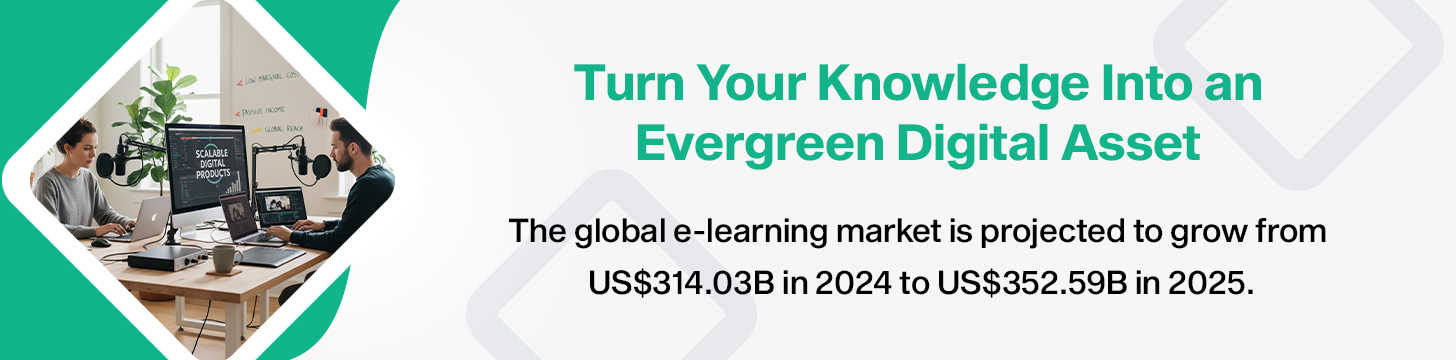
What we mean by “create-once”
This stage is all about creating digital products that can scale by turning your expertise into evergreen goodies like online courses, recorded workshop packages, downloadable templates, e-books, and niche toolkits that you can build once and sell multiple times over.
The fact that these are digital assets that need zero ongoing effort to ship means they can keep raking in the dough over the long term, especially if you structure them to solve a clear problem and position them to sell again and again to different customer needs.
What’s driving the demand for growth
The demand for digital knowledge products is here to stay – it’s not just hype.
The global e-learning market is looking pretty healthy, set to grow from about US$314.03 billion in 2024 to US$352.59 billion in 2025.
That’s a pretty clear signal that there are a lot of buyers out there looking for digital knowledge products.
And don’t forget, the broader digital goods markets are expanding fast too. One major estimate puts the sector at a whopping US$124.32 billion in 2025, with a nose-diving projection to US$416.21 billion by 2030.
That’s the ecosystem your products are going to be living in.
How each product fits a smart ladder
A simple way to structure your offers is:
- Templates make a great entry product – quick, easy wins
- E-books are a great way to build trusting relationships
- Toolkits are about delivering done-for-you value
- Recorded workshops are a premium learning experience
- Courses are all about complete transformation
That way, you can create a funnel that keeps on delivering without needing to put in constant live delivery.
Some common use cases
You can put this step to use by creating simple, high-use digital assets like a website audit template, pricing calculator, step-by-step SEO guide, recorded workshop package, or a checklist-based course for business services, SOP packs, hiring templates, and onboarding toolkits for operations/HR.
These examples work because they solve repeated problems with reusable resources – making them easy to package, easy to deliver, and super valuable to buyers who want faster outcomes without having to start from scratch.
Where this step fits in the sequence
This step is ideal for after you’ve put in the groundwork because creating digital products needs all the research, packaging, and distribution you can get – so income may take a little while to build, but once demand and visibility take off, you’ll be laughing.
By first securing a stable financial foundation, you’ll have the time and breathing room to create quality assets and let sales grow steadily – rather than expecting immediate returns.
The bottom line
This step is perfect for people who want:
- Big scalability
- Low marginal costs
- Strong long-term brand value
So, create products that can keep on earning while you’re sleeping!
Evergreen Content That Keeps on Giving
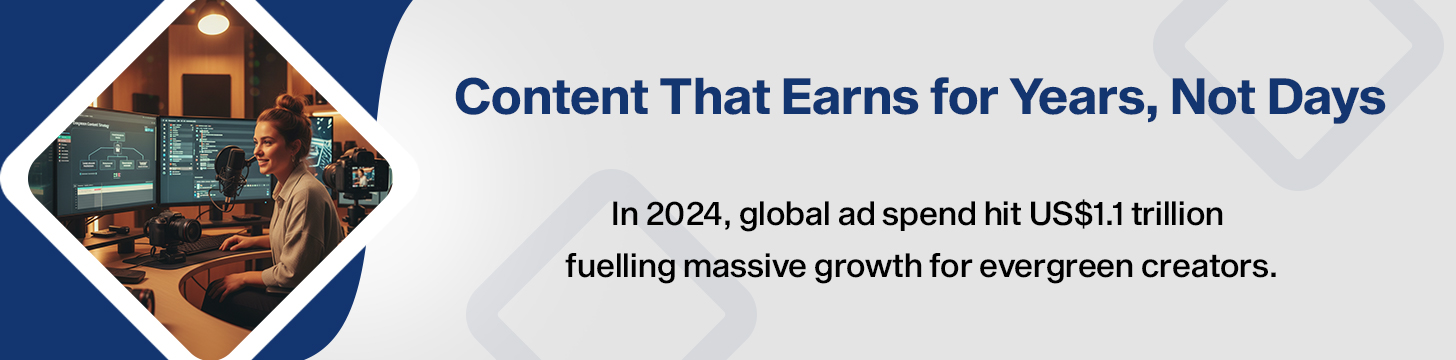
Building an Evergreen Cash Machine
Building an evergreen audience flywheel uses a bunch of different content types – affiliate blogs, YouTube videos that’ll still be popular next year, podcasts that are still getting listened to, and paid newsletters – to create passive income that grows over time.
Plus, niche comparison sites that make money from long-tail keywords. It’s like building a business that keeps on earning even when you’re not putting in the time.
The Long-Tail Advantage
- This kind of content stays useful for ages – months, even years. So you don’t have to keep churning out new stuff every single day. Your income is earned because people keep finding your old stuff over time.
- And it’s this ‘build once, earn many’ approach that fits perfectly with what’s happening in the wider ad and platform world.
In 2024, we saw $1.1 trillion being spent on ads globally, a 7.3% increase on the year before. Yeah, that’s a big pool of money.
Why Affiliate-And-Search Works
Blogs and comparison sites are powerful for a few reasons:
- They’re in front of people when they’re actually looking to buy something
- They rank for search terms that mean people really want to find what you’re selling
- They get paid based on sales, not just views. Which is way more attractive to people who care about actually making money
In 2024, the affiliate marketing market was valued at $18.5 billion and it’s only going to keep growing.
YouTube, Podcasts, and Newsletters: The Back-Catalog Engine
This group of channels has the potential to create a real snowball effect. Because old content is still earning money.
The trick is to find topics that are still relevant, and then reuse and repurpose that content in different formats like “best of” lists or solution-focused videos.
The creator economy was worth around $212 billion in 2024 and it’s expected to keep growing for years to come.
A Simple Evergreen Stack
- A basic evergreen stack could be one blog on a specific topic, one YouTube channel repurposing the same content, one curated newsletter, and one comparison page. All these channels link to each other to create a web that helps you rank for buyer-intent searches and keeps driving traffic to your stuff, even when you’re not working on it.
- Because each format reinforces the others, you end up with a machine that generates income for years to come with minimal extra effort.
The Big Reminder
This step is perfect for creators who want to generate a really passive income, with minimal extra work, and also create a valuable asset that can be sold later on.
Just remember that evergreen content isn’t a get-rich-quick thing – it’s more like building a long-term, compoundable asset that will keep on earning for years to come.
Licensing Your IP for Ongoing Royalties

What counts as IP you can license
This section sticks to those five ideas from before:
- Stock photos
- Stock videos
- Music licensing
- Fonts or icon packs
- App or software licensing
The real unique selling point here is the fact that you can get paid over and over again. You’re not just selling your time, you’re selling off the rights to your work.
Putting passive potential into practice
Licensing works when people continue to use your content without requiring additional work on your part.
That means:
- A truly exceptional photo series can continue to sell for years.
- One clean font family can earn you money every time a project uses it.
- One music track can keep raking in cash through syncs and live performances.
This is why licensing is a perfect next step for content and digital products. You already know how to create something that people value. Now you just need to package up its useful capability.
Market momentum suggests there’s a big demand
The wider market for licensing visual assets is still huge. Some experts think the global stock images and videos market is worth around US$5.2 billion by 2023, and that’s forecast to grow to US$9.3 billion by 2032.
Others estimate that the stock photography market is worth around US$5.09 billion in 2025, and that it’s supposed to reach US$7.27 billion by 2030.
This suggests that even with all the AI disruption going on, brands still need good, reliable, safe media that they can license.
One big sign of the consolidation and competition in this space was the Getty Images and Shutterstock merger in 2025, valued at around US$3.7 billion. This is just a sign of the pressure and the opportunities that exist in the licensing world.
How each idea can be approached in practice
To make this actually workable:
- Stock photos:
Focus on business, lifestyle, healthcare, and local authenticity. It’s gonna be super helpful to have some real-world examples there. - Stock videos:
Make these short clips that would be perfect for ads, UI, explainers, and social media reels. - Music licensing:
Create some music tracks that can help creators or brands set the mood. The music licensing services market is around US$5.8 billion in 2024, and they think it will keep growing. - Fonts/icons:
Build some clean, easy-to-read font families, and give them different commercial license tiers. - Apps/software:
Make some small tools that people can license for a year, or based on how many seats they have.
A simple example of how to get started
A realistic place to start:
- 50-100 photos of a specific niche.
- 20 short stock video clips.
- 1 music pack that’s just a few tracks.
- 1 icon pack.
Get these all uploaded and make sure they’re properly labelled. Do this about every quarter to keep things fresh.
The main takeaway from all this
This is a great step if you’re looking for:
- Stuff that can be used loads of times
- Royalties that just keep coming in
- A creative library that can keep on giving
In the 50 Passive Income Ideas framework, this is where your creativity turns into a kind of asset class.
Getting a Simple Extra Income from Renting Out Your Assets
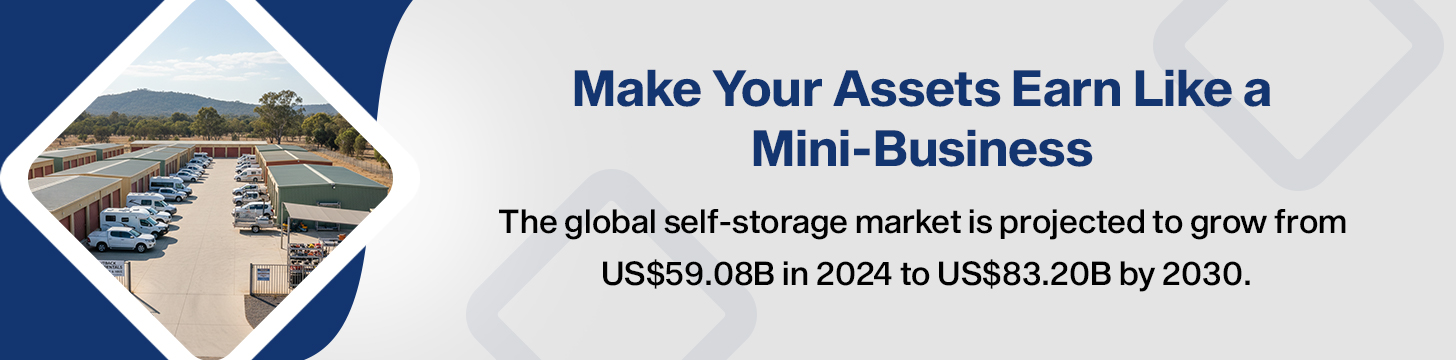
What This Step Is All About
This step is all about making your existing assets work harder for you by turning existing value into a reliable income stream through things like leasing out vehicles, renting out storage, caravans, or RVs in areas where that’s allowed, and equipment or event gear.
Why This Step is a No Brainer
The great thing about asset rentals is that you don’t need to have a huge audience – you just need people to want to use your assets, for them to be available, and to have a system that works, with clear prices, a schedule, and some basic rules to keep things running smoothly.
Market Trends Show the Opportunity is Growing
Even on a global level, people are turning to renting assets instead of buying them.
For example, the global self-storage market was valued at US$59.08 billion in 2024 and is projected to reach about US$83.20 billion by 2030, showing that people are realising the value of space-as-a-service.
On the equipment side, the global construction equipment rental market was about US$204.06 billion in 2024 and is forecast to rise to US$280.13 billion by 2030, which just goes to show how people are shifting towards renting rather than owning.
And then there’s the leisure travel sector, where the RV rental market is currently valued at around US$2.72 billion and is projected to reach US$3.62 billion by 2030, driven by demand for road trips and easier access.
Making Each Idea Easier to Manage
To make things easier on yourself:
- Vehicle leasing: Try for longer-term leases to cut down on the hassle of having to deal with turnover.
- Equipment rental: Focus on things that are durable, in high demand, and don’t require a lot of maintenance.
- Storage space: Automate as much as possible, including access and billing.
- Caravan/RV rental: Use standardised check-in and check-out procedures and maintenance schedules to save time.
- Event gear rental: Make things easier for yourself by bundling items together to increase the value of each booking.
A Realistic Scenario
A good starting point might be to offer a small storage space and some high-demand equipment, and to lease out a vehicle for a longer period of time – that way you only have to set up the system once, and then just repeat the process.
This works because longer hire periods and clear processes keep daily management to a minimum, and having a few reliable assets spreads the risk and creates a steadier, simpler cash flow.
The Main Point Here
This is one of the most practical parts of the 50 Passive Income Ideas framework, turning idle assets into a reliable income stream with fewer moving parts than most digital models.
Systemised Micro-Businesses That Run Like Clockwork
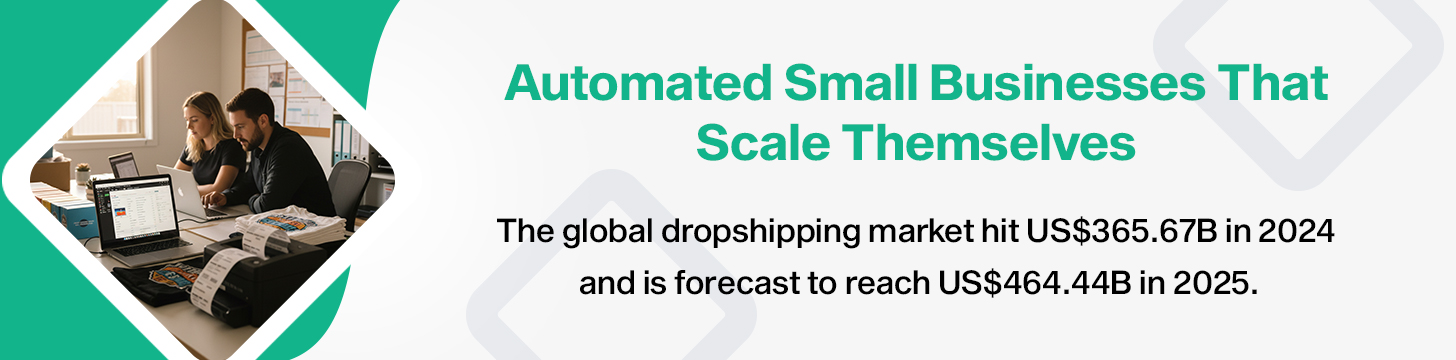
What this step is all about
This step is all about creating a steady income stream through print-on-demand, dropshipping, Amazon KDP, digital subscriptions, and simple SaaS/no-code tools – all of which are process-first and reward consistency and clarity.
Because these models thrive on being consistent and running like clockwork, the more you standardise product selection, creation, fulfillment, and customer support, the more stable and scalable your income becomes with less day-to-day hassle.
How does this differ from content income?
Unlike content income, which is all about attracting and holding onto people’s attention, this step is all about getting systems in place, churning out content, and executing consistently.
Success here is all about turning systems into repeatable revenue streams without relying on viral wins or audience spikes.
Print-on-demand: the ultimate low-risk business
Print-on-demand is a game-changer because it lets you launch designs fast, test niches cheaply, and scale winners without ever having to worry about inventory or warehousing – and that’s a huge reduction in risk. It also lets you turn your creativity into flexible income streams.
The global print-on-demand market was estimated to be a whopping US$8.93 billion in 2024, and is expected to hit US$10.78 billion in 2025 – not bad for a market that’s just getting started.
POD niche angles to get you started
A niche store focused on:
- campsite humour tees for people who love to poke fun at themselves
- off-road lifestyle mugs for anyone who loves their 4×4
- caravan family stickers for families who love to travel
can earn a steady income if you design your products with clear buyer intent in mind.
Dropshipping: the secret to semi-passive income
Dropshipping can be semi-passive if you treat it like a real business – which means you need to have some discipline and guardrails in place to make it work.
The global dropshipping market was estimated to be around US$365.67 billion in 2024, and is expected to reach US$464.44 billion in 2025.
Guardrails that’ll help you succeed:
- Keep a close eye on supplier performance with strict scorecards
- Have a clear refund handling policy in place
- automate order routing for efficiency
- Set realistic shipping promises to keep your customers happy
Amazon KDP: a low-maintenance way to earn passive income
Amazon KDP is a great way to earn passive income through micro-assets – which are essentially small books that you publish on Amazon. The key is to publish small, targeted books, and to optimise them for keywords and covers.
Niche themes that tend to do well:
- Habit trackers for people who want to get their life together
- Travel planners for anyone who loves to explore new places
- Simple industry logbooks for people who need to keep track of their work
Consistency and keyword precision are key to making this work.
Subscriptions: the secret to predictable recurring income
Subscription communities work when they deliver value – and that means delivering clarity, tools, updates, and accountability. When you do this well, you can build a steady stream of recurring income.
The global subscription economy was estimated to be around US$492.34 billion in 2024, and is expected to reach US$555.92 billion in 2025.
Simple SaaS / no-code: creating tools that solve real problems
Micro-tools tend to do well when they solve narrow problems and can be sold easily, which is exactly what no-code platforms are built for. The market for no-code platforms is expected to grow from US$28.11B in 2024 to US$35.61B in 2025 globally.
The Lowdown
- This step is perfect for people who love building systems, writing documentation, and using automation to create repeatable income streams.
- Because success here is all about having clear processes and scalable workflows in place, you’ll do best if you enjoy turning tasks into checklists, standardising execution, and letting tools handle routine work so your business can run smoothly with minimal daily effort.
Higher-Risk Streams with a Touch of Balance
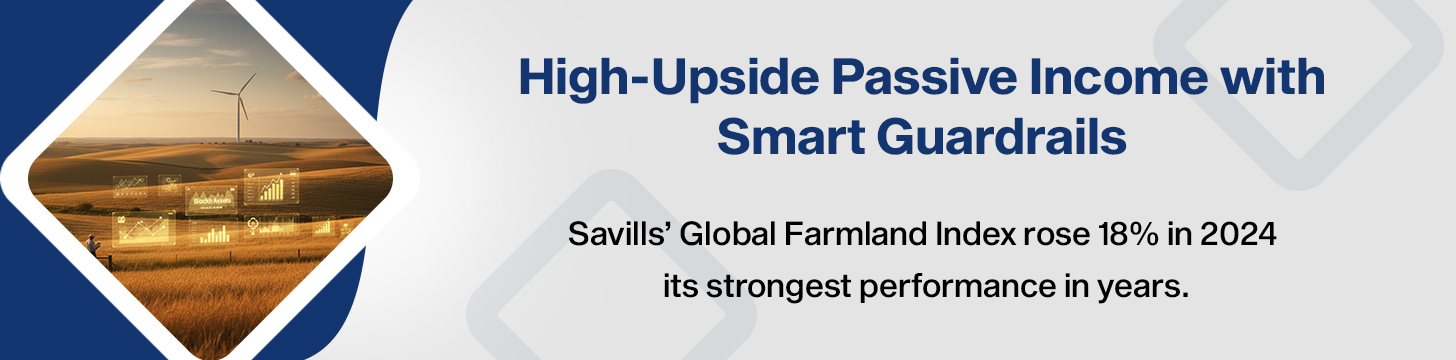
What This Step Entails
This step doesn’t stray from the original five ideas – those being:
- Royalties from patent and innovation deals
- Tucking away cash in dividend-style private investments (though not super common)
- Farmland or agricultural funds
- Domain names you can lease-to-own
- Crypto staking (just don’t do it unless you fully get the risks)
The twist here is that these ideas carry more upside, but with some control over how much of your money’s at risk, they won’t make up your core income, but they are there to complement what you’ve got and let you go after some extra return without blowing the whole thing.
Adding Last, Safety First
This step comes last because these ideas can rake in some great returns, but there’s a lot more uncertainty and, if you get it wrong, you could end up losing more than you would have if you’d stuck to the safer options earlier on.
Farmland: A Real-Asset Hedge Against the Odds
Farmland can serve as:
- Inflation insurance
- A long-term bet on food security and steady demand
- A tool to diversify your investments
Savills’ Global Farmland Index rose about 18% in 2024 – its strongest year since 2021.
This is all good news for investors, but don’t forget that:
- Weather
- Commodity prices
- Policy changes could all impact your returns.
Angel-Style Deals: Rare Income, Often Growth
There are those rare “angel” deals that do bring in a steady income.
But the truth is, most early-stage investing is about building capital value, not churning out quarterly dividends.
To put this into perspective, global startup funding reached about $314 billion in 2024, not far from last year, and showing there’s still plenty of momentum with AI being a major driver.
Think of this sort of investing as:
- High potential for growth
- Low certainty of returns
- Long, unpredictable timelines
Domain Names: Curated Digital Real Estate
Lease-to-own domain names are like curated digital real estate when you focus on short, snappy names with a strong fit for a particular industry and clear demand from end-users.
This isn’t a high-volume game – it’s all about finding the right assets to hold onto for steady, low-maintenance income.
Crypto Staking: A Double-Edged Opportunity
Staking can earn you returns, but it also carries:
- Risk of token price volatility
- Risk of the platform itself going wrong
- Shifting regulatory winds
There’s evidence that mainstream adoption is taking off – for instance, Bank of America will start allowing advisors to recommend crypto ETPs from January 5, 2026, signifying that institutions are more at ease with crypto as the regulatory landscape shifts.
FAQ
1. What are the best passive income ideas for beginners?
The best options for starters are super simple, hardly any risk, and pretty easy to keep going.
You don’t need to be an expert to get started, but you do need to keep at it with some consistency.
Good places to start are with high-interest savings accounts, term deposits, dividend ETFs, government bonds, or even renting out a spare room on the side.
If you want to sell stuff, digital templates or print-on-demand can be great too.
The smartest thing to do is pick one idea first, build a small success, and then start scaling up gradually, because a simple plan you can stick to will usually outdo a complicated one that you get bored with halfway through.
2. How much money do I need to start earning passive income?
To be honest, you can start with almost nothing if you go for skill-based options that take up your time and effort first, like writing an ebook, creating a small online course, selling stock photos, or building a niche blog.
If you want to invest, you can start small and grow it over time with consistent contributions. What matters most is getting started early, building some habits, and being consistent enough to let growth and reinvestment do their thing.
3. Which passive income ideas are the safest?
The safest options are usually those that give you stable returns and are pretty low-risk.
People who like predictability over fast growth tend to go for savings accounts, term deposits, or government bonds.
High-quality dividend ETFs can be a good pick, too if you choose wisely. Real estate can be pretty safe in areas that are in demand and have good fundamentals.
Here it’s worth thinking about your timeline, because if you’re after short-term goals, then you want options that are rock-solid stable, but for long-term goals, you can balance safety with growth.
4. How long does it take to build meaningful passive income?
Building meaningful passive income doesn’t happen overnight – it takes time.
Investment-based income often grows gradually, and digital assets or content-based income may take a while to get going at first but can scale up faster once you get some momentum going.
A realistic path would be early months of learning and setup, seeing some modest results in the first year, and stronger compounding or consistent monthly income over 1 to 3 years. Reinvesting your earnings and improving how things work can speed up progress a lot.
5. Can I create multiple passive income streams at once?
Yes, you can, but it’s usually better to build one at a time rather than trying to do everything at once.
Start with one, get that stabilized, and then get into a rhythm of maintenance before adding another source of income.
For example, dividends go well with digital products, or rental income can be paired with another low-maintenance asset.
Passive income still needs some occasional monitoring and tweaking, so the goal is to reduce effort over time, not eliminate it from day one.

Valuable Insights On Property Development & Investment Opportunities
-

Top High Interest Short Term Investment Options for 2026
High Interest Savings Accounts for Liquid Cash Buffers Cash sleeve purpose and liquidity role High…
Read More -
Best Performing Managed Funds in Australia: Expert Tips & Strategies
Top-Performing Managed Funds in Australia: What Investors Need to Know In 2026, Australian investors are…
Read More -
Best Financial Advisor Perth: How to Choose the Right Expert for Your Goals
Financial Advisor Perth Key Criteria for Choosing the Best Adviser Choosing the best financial advisor…
Read More -
How to Make Money from Property Development in Australia: A Comprehensive Guide
High-Growth Cities Offering the Best Property Development Margins Australia’s property development landscape will be shaped…
Read More -
What Are the Best Low-Risk Investments in Australia for Beginners?
Low-Risk Investing in 2026: The Beginner Snapshot For Aussie beginners seeking low-risk investments in 2026,…
Read More


Our Project Site :


Exclusive waterfront living at the Lake Narracan Resort community.

Quick Links
The information provided is general in nature and does not constitute personal financial advice. The information has been prepared without taking into account your personal objectives, financial situation or needs. Before acting on any information on this website you should consider the appropriateness of the information having regard to your own objectives, financial situation and needs. All statements made on this website are made in good faith and we believe them to be accurate and reliable however do not guarantee its currency. You should seek legal or other professional advice before acting or relying on any of the content.
Please note that past performance may not be indicative of future results. Different types of investments involve varying degrees of risk, and there can be no assurance that the future performance of any specific investment, investment strategy, or product made reference to directly or indirectly on our website, blogs , newsletters.
Our Project Site :

Find premium land developments and new estates across Australia.
Exclusive waterfront living at the Lake Narracan Resort community.

Quick Links
The information provided on this website including blogs is general in nature and does not constitute personal financial advice. The information has been prepared without taking into account your personal objectives, financial situation or needs. Before acting on any information on this website you should consider the appropriateness of the information having regard to your own objectives, financial situation and needs. All statements made on this website are made in good faith and we believe them to be accurate and reliable however do not guarantee its currency. You should seek legal or other professional advice before acting or relying on any of the content.