


Table of Contents
How Low Are Australia’s Interest Rates Expected to Fall in 2026?
Australia’s interest rate landscape in 2026 is expected to mark a crucial turning point for both homeowners and investors.
After years of tightening, the experts are expecting an easing cycle — but the forecasts vary wildly depending on inflation and global conditions.
According to Westpac Economics, the cash rate will fall to 2.85% by 2026, with two 25-basis-point cuts early in the year. That’s one of the lowest rates since 2022 and means the RBA will be more accommodative.
Commonwealth Bank (CBA) expects rates to stay at 3.60% for the whole of 2026, as they think inflation will be above target for longer and the RBA won’t have room to cut.
NAB is expecting the first rate cut in May 2026, to 3.35%. ANZ is similar, with a March 2026 cut to 3.35%. Both think inflation will fall enough for the RBA to ease without causing financial instability.
A Reuters economists’ poll is a bit more dovish — the cash rate could be 3.10% by the end of March 2026 and flat for the rest of the year as the economy stabilises.
In summary, the 2026 interest rate forecasts in Australia range from 2.85% to 3.60% depending on how quickly inflation comes back and global growth recovers. Most banks and research houses think the RBA will be cautious — only cutting when inflation is back in the 2–3% target band.
2026 is going to be a big year for interest rate policy in Australia, impacting mortgage rates, investment yields and overall economic confidence.

Interest Rates Australia 2026 — The Turning Point for Borrowers
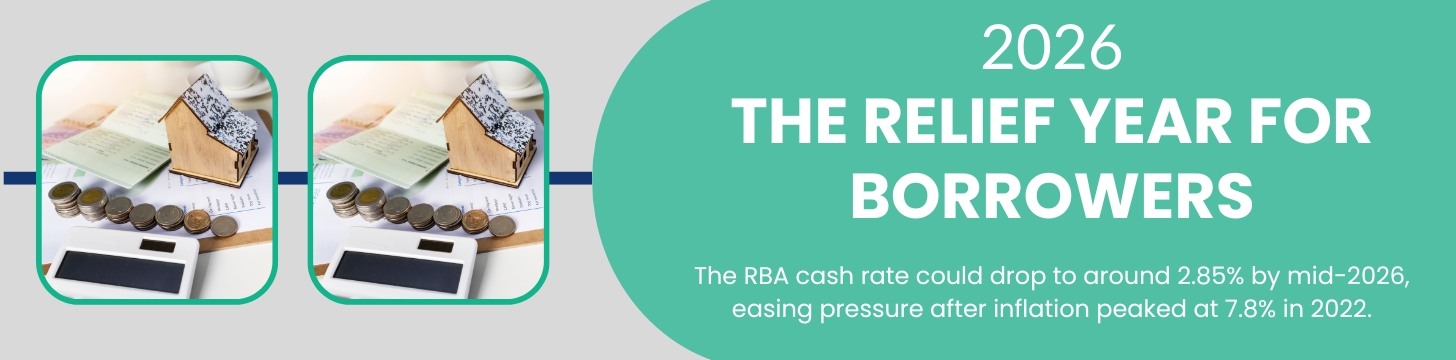
As of late 2025, the cash rate in Australia — the rate for all lending — is around 3.60%.This is a multi-decade high compared to pre-pandemic levels when rates fell to a record low of 0.10% in 2020.
The rates have been tightening since 2022 to control inflation which peaked at 7.8% and has since eased to 3.2% by Q4 2025.
Westpac and CBA economists think the RBA could cut rates four times in 2026 and get the cash rate to ~2.85% by mid-year — a level that will be a big turning point for credit markets and households.
Why Lower Interest Rates Australia Matter
When interest rates Australia fall, the impact is felt across:
- Home loans → lower monthly repayments
- Business lending → more access to capital
- Consumer credit → more discretionary spending
For example:
- A $600,000 home loan at 6.2% interest (average rate in 2025) costs around $3,685/month.
- A 0.75% reduction in interest rates in Australia would reduce repayments by about $270/month, which is over $3,200/year for the borrower.
The Effect of Lower Interest Rates on Borrowers and Property Confidence
Lower interest rates in Australia give a boost to buyer confidence, especially among first-home buyers & investors who’ve been priced out over the last few years when interest rates were going up.
Easing loan serviceability comes as good news for Regional markets like Perth, Adelaide and Brisbane – cities where the rental yields are a pretty healthy 5%, making them a lot more attractive for investors who are looking to get back in when rates do ease.
So by 2026 it could be looking like a year of readjustment, where falling interest rates in Australia give people some financial breathing room and kick-start some sustainable property investment again across the whole country.
How Cooling Inflation and Economic Fine-Tuning Are Driving Interest Rates in Australia

Inflation in Australia basically dictates interest rates.
When prices start going up too fast, the Reserve Bank of Australia (RBA) puts the brakes on by raising rates to slow things down and cut back on borrowing.
The other way around, when inflation eases up, the RBA can then reduce the interest rates to help get the economy moving.
Inflation peaked at 7.8% back in December 2022 but has since come back down to more manageable levels – to 3.2% by the end of 2025 according to the Australian Bureau of Statistics (ABS).
That’s largely due to falling energy costs, supply chains starting to stabilise, and wage growth slowing up a bit.
With inflation now pretty close to the RBA’s 2-3% target band, you can see why the case for loosening monetary policy is getting stronger in 2026.
Finding the Right Balance on Growth & Employment
Its been softening a bit – GDP growth is expected to stay around 1.8% in early 2026 – well down on the 10-year average of 2.6%.
Unemployment is looking like it might rise a bit from 4.1% to 4.8%, showing a slightly cooling labour market.
Those conditions really aren’t helping households sustain spending when borrowing costs are so high.
So the RBA may end up lowering interest rates to get growth & employment back in balance, and prevent things slowing down even further.
Data Snapshot: Economic Drivers of Lower Interest Rates Australia
| Key Indicator (2025–2026) | Trend | Impact on Interest Rates Australia |
| Inflation | ↓ from 7.8% → 3.2% | Allows easing |
| GDP Growth | ↓ 2.6% → 1.8% | Supports cuts |
| Unemployment | ↑ 4.1% → 4.8% | Encourages stimulus |
| Wage Growth | Stable at ~3.5% | Keeps inflation anchored |
Example: Borrower Outlook for 2026
A household pulling in $120,000 in 2026 may well end up facing $8,000 less in annual interest payments if interest rates drop by a whole 0.75%.
This savings will then get ploughed straight back into the economy through the way people spend their money, helping give a lift to the retail and construction sectors.
So – it looks like Australia’s interest rates are now guided by a delicate balancing act — keeping a lid on inflation without stomping on economic momentum.
The RBA will have their work cut out in 2026 – to cut rates just enough to keep the recovery going, but not so much that we get another run of inflation.
The Keystones to Cheaper Borrowing Power Through Lower Interest Rates
When interest rates in Australia come down, that’s a big deal for people looking to get a mortgage.
As the RBA cash rate drops, the banks and lenders inevitably follow by slashing their variable and fixed loan rates.
This change is real, tangible relief for homeowners, investors and businesses carrying debt.
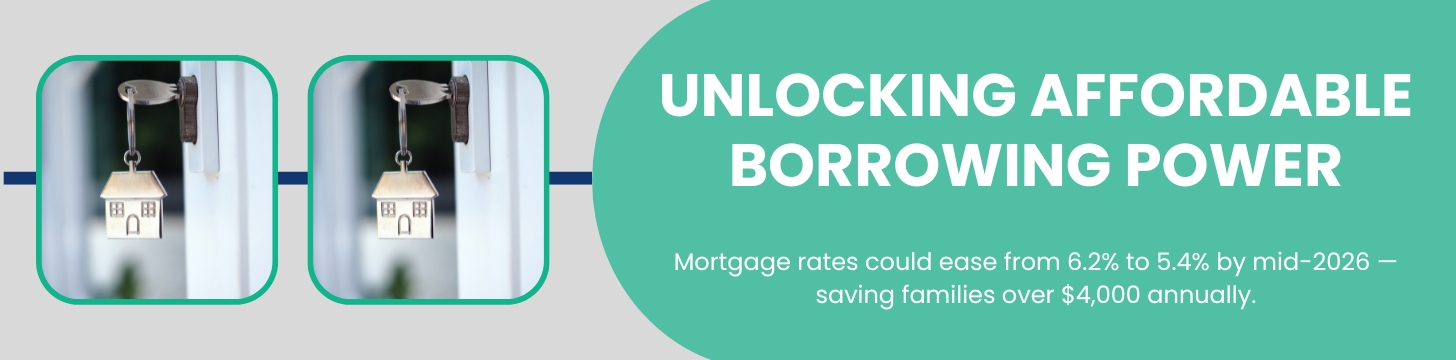
Come the end of 2025, the average standard variable mortgage rate is about 6.2% according to the RBA’s Lending Indicators
According to the forecast models, by mid 2026, the average rate could ease down to around 5.4%, assuming the cash-rate drops to 2.85%.
This potential drop out works out to a saving of around $340 a month on a $700,000 mortgage – or over $4,000 a year in after tax income.
The Borrowing Power Bonus
Lower interest rates in Australia do more than just lower repayments – they also give people a lot more borrowing power.
When lenders assess how much a person can borrow, they use serviceability assessments which factor in the interest rate plus a bit of a buffer (usually 3% these days).
So, if rates drop from 6.2% to 5.4%, a typical household’s borrowing limit could increase by 8-10%
Example:
| Household Income | Rate | Max Borrowing Power |
| $120,000 p.a. | 6.2% | $720,000 |
| $120,000 p.a. | 5.4% | $790,000 |
That extra $70,000 in borrowing capacity can be the difference between buying a unit and a house, or getting into a better neighbourhood.
Why This Stirs Up Property Demand
As borrowing becomes cheaper, buyer demand usually gets a boost – particularly among first-home buyers and investors looking to get a bit more bang for their buck.
This in turn can drive property prices up, especially in markets like Perth, Brisbane and Adelaide where affordability is still a bit higher than the rest of the country.
So – falling interest rates in Australia don’t just make a world of difference for people with debt – they also unleash a whole lot of demand out there in the property market, which in turn reinforces the link between monetary easing and market confidence.
The Trigger for Rising Property Investment Sentiment as Interest Rates Ease in Australia
The movement of interest rates in Australia is one of the few things that can really get property investors excited.
When rates fall, the market takes it as a sign that the economy is stable and people can afford to buy again – which in turn gets investors off the fence and back into the market.
As borrowing costs come down, investor confidence usually bounces back. This confidence is driven by two factors:
- Better cash flow thanks to lower mortgage repayments.
- Greater potential for asset valuation increases thanks to property prices responding well to cheaper financing.
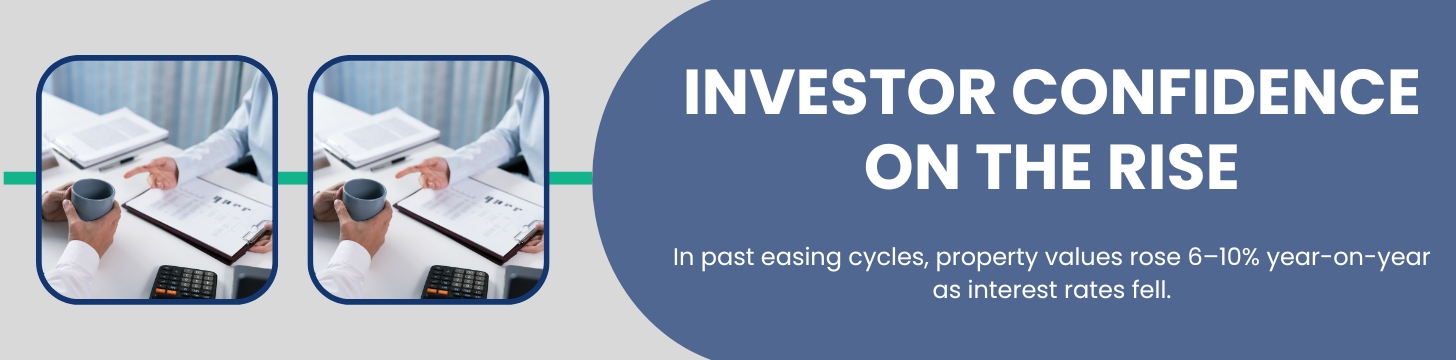
In our previous easing cycles (2015-2016 and 2019-2020), property values in major cities rose by anywhere between 6-10% year on year, directly thanks to the cuts in interest rates in Australia.
The Financial Math Behind the Mood Swing
Investors in property usually operate on a bit of a tightrope – with their investments balanced on the fine line of potentially drastic rate changes.
For instance, a 1% drop in lending rates can boost rental yield margins by as much as 15-20% in many cases where the investment is a $500,000 loan.
The RBA is expected to bring rates down to around 2.85% by the middle of 2026 – which could see average investment loan rates fall to 5.5%, down from 6.4% late last year.
As a result, you can expect to see stronger net rental returns, which in turn is going to fuel investor enthusiasm for expansion or refinancing.
Cases in Point: Where Investor Enthusiasm is on the Rise
Places such as Perth, Adelaide, and Brisbane are basically starting to sizzle with investor interest, driven by:
- Rental yields that are 5% or higher.
- Vacancy rates that are below 1%.
- Total population growth driven by people moving in from elsewhere in Australia.
When you pair those with lower interest rates in Australia, you get a “double-positive effect” – where making a property investment is both more affordable and could also be more profitable.
Rounding Out
In the end, falling interest rates in Australia are more than just a cost-saver – they also get the juices flowing, encouraging investors to get back into the market or to scale up.
That change in mood will often signal the start of a rise in property prices, making the sentiment effect one of the first indicators that the next big investment wave is on the way.
Why Drops in Interest Rates Don’t Always Mean Automatic Property Price Growth in Australia

Lots of people assume that when interest rates in Australia fall, property prices automatically go up.
While there can often be a connection between the two, the relationship isn’t set in stone – because interest rates are only one of several factors that influence the property market at any given time.
In 2020, for instance, record-low rates of 0.10% certainly did kick things into high gear.
However, by the time 2023-2025 rolled around, even when the cash rate had risen to 4.35%, house prices still managed to stay pretty resilient – and that’s because the market’s response is ultimately dependent on a range of other factors – not just interest rates in Australia.
The Laws of Supply and Demand Still Rule the Roost
Falling interest rates in Australia make borrowing cheaper, but growth still ultimately depends on the availability of housing and how the population is trending.
Some examples include:
- Sydney and Melbourne are facing limited land supply and construction costs that are through the roof, which is boxing in new housing development.
- Perth and Adelaide, on the other hand, are in a much better position due to affordability and the fact that there’s strong demand for rentals.
Even with lower interest rates in Australia, if there’s too much oversupply or a drop in migration, expect price growth to stall.
Table: Market Dynamics (2026 Forecast)
| City | Vacancy Rate | Projected Price Growth (2026) | Key Limiter |
| Sydney | 1.5% | 2–3% | High prices, limited supply |
| Melbourne | 2.0% | 1–2% | Construction slowdown |
| Perth | 0.7% | 6–7% | Low supply, strong demand |
| Brisbane | 0.9% | 5–6% | Migration growth |
Other Things That Could Hold Growth Back
Even if interest rates in Australia do fall, growth may be derailed by:
- Flat wage growth (projected to be only 3.5% in 2026).
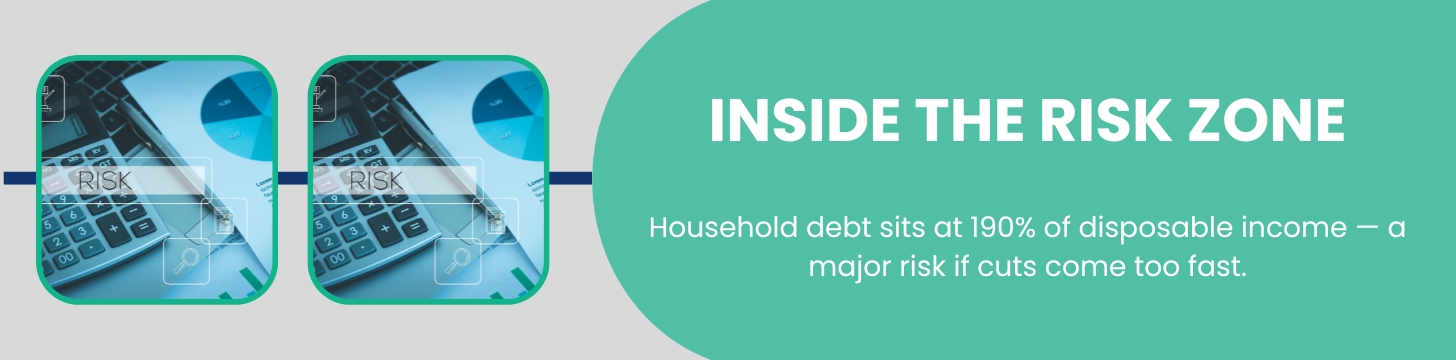
- High household debt of over 190% of disposable income.
- Regulatory restrictions on lending to investors.
Conditional, Not Guaranteed Growth
Lower interest rates in Australia are one of the things that can help nudge things in the right direction, but they’re no guarantee.
For property growth to really sustain itself, Australia needs balanced fundamentals – a stable economy, strong demand, and just the right amount of supply.
Without those in place, even the sharpest cuts to interest rates in Australia will probably just give us a temporary mood boost, rather than long-term price growth.
Australia’s 2026 Scenario — Finding the Sweet Spot for Growth Momentum in Interest Rates

By mid-2026, economists expect the RBA to have lowered the cash rate to around 2.85% from 3.60% in late 2025.
This is a measured easing cycle, not a stimulus. It’s about balance – supporting borrowers without reigniting inflationary pressures.
Inflation is expected to be around 2.8% and GDP growth near 1.9%, so this is the “sweet spot” – where interest rates in Australia are low enough to stimulate demand but stable enough to keep economic discipline.
Property Market Response to the Sweet Spot
At this rate range, the average mortgage rate could drop to 5.3–5.5% according to Westpac’s housing forecasts.
This will mean:
- More affordability for first-home buyers.
- More cash flow for investors.
- More refinancing for existing borrowers.
National property values are expected to grow 4–5% in 2026 as demand comes from local and interstate buyers.
Cities like Perth and Brisbane where yields are above 5% will outperform as lower interest rates in Australia boost returns.
Statistical Overview: 2025 vs 2026
| Metric | 2025 | 2026 (Projected) | Impact |
| Cash Rate | 3.60% | 2.85% | Cheaper borrowing |
| National Price Growth | 2.4% | 4.8% | Stronger demand |
| Average Mortgage Rate | 6.2% | 5.4% | +0.8% affordability gain |
| Investor Loan Growth | 3.1% | 5.6% | Confidence returns |
Balanced Momentum
2026 could be the perfect equilibrium where lower interest rates Australia fires up the property market without blowing the bubble.
It’s the balance of relief and restraint – enough to boost investment sentiment and affordability but not enough to overheat.
If this sweet spot eventuates, 2026 will be the year Australia’s property market got back to healthy growth.
The Risk Zone Ahead — Economic and Regulatory Headwinds Impacting Australia’s Interest Rates
While many are looking for relief from interest rates in Australia, a sudden or deep rate cut can also be a red flag – not a reward.
If the RBA cuts rates because the economy is slowing rapidly, the outcome may be:
- Weak consumer spending
- Rising unemployment
- Falling business confidence
The current projections show GDP growth dropping to 1.8% in early 2026 and unemployment rising to 4.8–5.0%.
In that case, lower interest rates in Australia are a symptom of slowdown, not a sign of prosperity.
Macro Risks That Could Halt or Reverse Rate Cuts
Even if the RBA eases gradually, several factors could intervene:
- Sticky inflation: If energy or rental prices rise again, cuts will pause.
- Global shocks: US or Chinese rate decisions will pressure Australian bond yields.
- Currency depreciation: A weaker AUD (below 0.62 USD) will increase import costs and re-ignite inflation.
In those scenarios interest rates in Australia may stay higher for longer than expected, putting pressure on borrowers who are already stretched by record household debt – 190% of disposable income according to RBA data.
Regulatory and Lending Headwinds
Property investors may also face tighter credit or tax changes. For example:
- APRA could increase loan serviceability buffers above 3%.
- State governments could introduce foreign investor surcharges or cap negative gearing.
These will offset the benefits of lower interest rates in Australia for leveraged investors.
Navigating the Risk Zone
2026 will be a mixed phase — where lower interest rates Australia meets economic fragility and regulatory caution.
Investors must remember that lower rates don’t always mean growth; sometimes they mean uncertainty that requires prudence and liquidity buffers.
The Strategic Investor’s Advantage in Australia’s 2026 Interest Rates Cycle

Lower interest rates in Australia trigger emotional buying frenzies but the best investors see them as a signal, not a shortcut.
When rates drop the window to get capital at good rates opens briefly — and disciplined investors act before the market does.
Instead of rushing into speculative purchases they plan for:
- Debt consolidation to lock in lower costs.
- Portfolio diversification into higher yielding suburbs or asset types.
- Timing acquisitions just before market momentum peaks.
This forward thinking approach means lower interest rates Australia becomes a tool for long term wealth creation not just short term gain.
Practical Strategies for 2026
With the cash rate expected to fall to ~2.85% by mid 2026 investors have:
- Fix and hold: lock in 3 year rates at ~5.3% before the bounce.
- Target high rental regions: e.g. Perth (average yields above 5.1%) or Adelaide (around 4.8%).
- Release equity: use capital growth to refinance and re-invest in multiple smaller assets.
These strategies turn lower interest rates in Australia into multipliers of leverage and liquidity — essential in a low rate environment.
Comparative Advantage Snapshot
| Strategy | Benefit | Risk Level |
| Fixed Loan Re-Lock | Protects against rate reversals | Low |
| Regional Yield Plays | Higher returns via affordability | Moderate |
| Refinance & Reinvest | Portfolio scaling potential | High |
The Strategic Edge
Strategic investors win because they see the shift in interest rates in Australia before it happens.
They look at macro trends, stress test cash flows and use data — not headlines — to time the market.
In 2026 those who treat lower interest rates in Australia as an advantage not a market signal will be the true winners of the next property cycle.
The Conditional Property Boom Hypothesis Linked to Australia’s Interest Rates

A property boom in 2026 depends on how interest rates Australia interacts with the broader economy.
Lower rates can boost affordability and investment but do not guarantee a boom unless other conditions align — stable inflation, limited supply and population growth.
History supports this conditional pattern.
Between 2015 and 2017 when interest rates in Australia fell from 2.5% to 1.5% national home prices rose 18%.
But in 2019–2020, despite a rate of 0.75%, growth stalled in several markets due to weak wages and tighter lending.
This proves one key fact: Interest rates Australia create opportunity — fundamentals convert it into growth.
Conditions for a Real Property Boom
For a real upswing to happen in 2026, these must exist:
- Inflation stability: CPI must be between 2–3% to keep buyer confidence.
- Housing undersupply: National vacancy rates below 1% will keep pushing rents up.
- Migration recovery: Over 450,000 net arrivals per annum will boost demand, especially in Perth and Brisbane.
- Wage support: Sustained wage growth above 3.5% will not see borrowing capacity outpaced by prices.
Table: Key Growth Triggers vs Restraints (2026 Outlook)
| Driver | Effect on Property | Status |
| Lower Interest Rates | Increases borrowing power | Positive |
| Supply Shortage | Pushes up rents & prices | Positive |
| Weak Wage Growth | Limits affordability | Negative |
| Regulatory Pressure | Slows investor lending | Negative |
The Conditional Boom Hypothesis
If interest rates in Australia go to around 2.85% and everything else stays the same, a measured property boom could happen — in affordable, high-yield markets.
But if inflation re- accelerates or lending standards tighten, the upswing will be contained.
So the 2026 boom is conditional, not just on cheaper credit but on economic harmony that allows confidence, not speculation, to drive growth.
The 2026 Watchlist — What Every Investor Should Monitor in Australia’s Interest Rates

In a 2026 market in motion, successful investors will be watching the interest rates in Australia and its flow-on effects on lending, inflation and property trends.
Small changes in policy can shift entire investment strategies. A 0.25% rate move can change average mortgage repayments by hundreds of dollars a month and national property sentiment.
So watching the right economic indicators allows investors to anticipate — not react — to changes in interest rates Australia direction.
Key Indicators to Watch
Investors should be looking at a mix of macro and housing specific metrics:
- Inflation Rate (CPI): The RBA’s 2–3% target is the key threshold. If inflation goes below 2.5%, rate cuts will continue.
- RBA Board Statements: Each meeting reveals the tone and guidance on future policy. A dovish tone means easing.
- Employment Data: Unemployment above 5% means lower interest rates in Australia to boost demand.
- AUD Value: A falling currency can delay rate cuts due to import inflation risks.
- Housing Indicators: Vacancy rates, building approvals and rent growth will show if demand can absorb lower borrowing costs.
Example Table: Core Indicators for 2026
| Indicator | Healthy Range | Impact on Interest Rates Australia |
| CPI Inflation | 2.0–3.0% | Encourages stable or lower rates |
| Unemployment | <5.0% | Supports moderate cuts |
| GDP Growth | 1.8–2.5% | Reflects balanced demand |
| Vacancy Rate | <1.0% | Signals property tightness |
The 2026 Investor’s Edge
Investors who follow and understand these will have the edge.
The future of interest rates Australia is not about individual events but about the interaction between inflation, employment and property supply.
Those who time their entry with these signals — adjusting loan structures, entry points and asset classes — will get the most value as the 2026 property and credit cycle unfolds.
In short, smart investors will not treat interest rates in Australia as a number but as a barometer of opportunity and risk.
FAQs
1. What is Australia’s current cash rate and what can we expect for 2026?
As things currently stand, Australia’s cash rate is around 3.6% to 3.85%, following a pretty aggressive period of rate hikes designed to tackle inflation.
However analysts predict that by 2026 we’ll see interest rates going down as the economy starts to stabilise and inflation eases off a bit.
Most forecasts think the rate could end up slipping down to between 2.6% and 2.9% by mid-to-late 2026.
This means borrowers can look forward to more manageable loan repayments, while savers are likely to earn lower returns on their deposits.
It all points to a scenario where 2026 will see the start of a bit of an easing cycle for the economy – helping people and small businesses to get a bit more financial breathing room.
2. Why do people think interest rates will drop in 2026?
Well basically it’s because inflation is finally coming down.
After years of elevated prices and tight monetary policy, inflation is expected to move closer to the Reserve Bank of Australia’s 2–3% target band.
As inflation eases the pressure on interest rates to stay high starts to ease too, which will likely prompt the RBA to start cutting.
Also economic growth is expected to slow right down, with people spending a bit less and businesses investing less too.
A softer labour market and households demanding less will make the case for lower interest rates even stronger – to give the economy a bit of a nudge in the right direction.
3. What could stop interest rate cuts from happening in 2026?
Even though it looks like 2026 is going to be a bit of a rate-cut friendly year, there are a few risks that could put the brakes on rate reductions.
If inflation stays stubbornly high the RBA may decide to hold rates steady for a bit longer.
There’s also the risk that labour shortages and rising wages could keep driving inflation up, which would stop rate cuts dead in their tracks.
And then there’s also the risk of external shocks like higher oil prices, renewed supply chain disruptions, or global tensions – all of which could create pressure on prices.
So while rate cuts are looking likely they are very much dependent on how the economy shapes up and how stable things stay on a global level throughout 2026.
4. How will lower interest rates affect borrowers and savers in 2026?
For borrowers lower interest rates generally mean:
- Cheaper mortgage repayments
- Cheaper business and personal loans
- Easier access to credit
This can be a big help, by taking a bit of the pressure off and making people a bit more confident about buying or investing in property or a business.
But for savers the effect will be the opposite:
- Lower interest rates on deposits
- Less income from your savings account, or fixed deposits
- A chance to think a bit differently about investments like bonds, or managed funds
So all in all 2026 is looking like a bit of a borrower-friendly year, but savers will need to get creative to keep earning a good return.
5. How can Australians plan for the interest rate changes in 2026?
The thing to keep in mind is to get on top of your finances early.
If you have a variable mortgage then you’ll want to keep an eye on RBA announcements and start thinking about how you’d handle some changes to your repayments.
If you have a fixed-rate loan you’ll want to know when your current rate ends and start thinking about what you can do if interest rates change.
Savers should start shopping around for high-interest accounts and maybe think about diversifying your investments a bit, to offset the loss of interest on your savings.
Also it’s a good idea to set a flexible budget so you’re ready for any ups or downs.Finally, making a habit of staying on top of the latest economic news and using some tools to help you make sense of the market will make all the difference in making smart financial decisions in 2026.

Valuable Insights On Property Development & Investment Opportunities
-

Top High Interest Short Term Investment Options for 2026
High Interest Savings Accounts for Liquid Cash Buffers Cash sleeve purpose and liquidity role High…
Read More -
Best Performing Managed Funds in Australia: Expert Tips & Strategies
Top-Performing Managed Funds in Australia: What Investors Need to Know In 2026, Australian investors are…
Read More -
Best Financial Advisor Perth: How to Choose the Right Expert for Your Goals
Financial Advisor Perth Key Criteria for Choosing the Best Adviser Choosing the best financial advisor…
Read More -
How to Make Money from Property Development in Australia: A Comprehensive Guide
High-Growth Cities Offering the Best Property Development Margins Australia’s property development landscape will be shaped…
Read More -
What Are the Best Low-Risk Investments in Australia for Beginners?
Low-Risk Investing in 2026: The Beginner Snapshot For Aussie beginners seeking low-risk investments in 2026,…
Read More


Our Project Site :


Exclusive waterfront living at the Lake Narracan Resort community.

Quick Links
The information provided is general in nature and does not constitute personal financial advice. The information has been prepared without taking into account your personal objectives, financial situation or needs. Before acting on any information on this website you should consider the appropriateness of the information having regard to your own objectives, financial situation and needs. All statements made on this website are made in good faith and we believe them to be accurate and reliable however do not guarantee its currency. You should seek legal or other professional advice before acting or relying on any of the content.
Please note that past performance may not be indicative of future results. Different types of investments involve varying degrees of risk, and there can be no assurance that the future performance of any specific investment, investment strategy, or product made reference to directly or indirectly on our website, blogs , newsletters.
Our Project Site :

Find premium land developments and new estates across Australia.
Exclusive waterfront living at the Lake Narracan Resort community.

Quick Links
The information provided on this website including blogs is general in nature and does not constitute personal financial advice. The information has been prepared without taking into account your personal objectives, financial situation or needs. Before acting on any information on this website you should consider the appropriateness of the information having regard to your own objectives, financial situation and needs. All statements made on this website are made in good faith and we believe them to be accurate and reliable however do not guarantee its currency. You should seek legal or other professional advice before acting or relying on any of the content.