


SIGA
| November 6, 2025
How to Invest in Commercial Property for 2026 in Australia: 10 Key Steps for Smart Investors
Table of Contents
Key Market Indicators Every Commercial Property Investor Should Watch
As Australia enters 2026 , commercial property investors will be navigating a changing landscape – where resilient sectors, cautious capital markets, and selective opportunities are really grabbing the headlines these days.
With the Reserve Bank of Australia holding the cash rate steady at 3.60% as of 2025, that means debt is still relatively pricey, and investors need to think about how their investment would stack up if interest rates stayed at that level when assessing whether a potential income stream is actually stable.
Across the major markets, CBD office vacancy has climbed to around 14–15% in H1 2025, one of the highest levels in decades. This highlights the bifurcation between premium, ESG-compliant office stock and struggling secondary assets.
On the other hand, the industrial and logistics sector is still flying high, with an East Coast vacancy rate of about 3.2%. Sure, rent growth has slowed a bit, but this asset class is still delivering steady cashflow and long leases that are attracting in all the big institutional investors.
Retail properties too are starting to show renewed confidence – with retail sales up 3.6% year on year and there just isn’t a lot of investable stock around, which should keep capital values stable.
Notably, capital values even rose by around 0.9% in Q3 2025 – the first quarterly uptick since 2022 – and that in itself might be a signal that the market is finally turning a corner.
Heading into 2026, success in commercial property investment will depend on rigorous underwriting, targeting WALEs above five years, maintaining strong tenant covenants, and favouring industrial and daily-needs retail while remaining cautious on secondary offices.

Getting Your Investment Strategy Right – Clarity of Purpose is Your Best Friend

Before we even start diving into the commercial property market, getting a clear idea of what you want out of this investment is just about the most important thing you can do.
In 2026, Australia’s property landscape is just so varied – from small strata offices in suburban hubs right up to multi-million dollar industrial estates in growth corridors. And if you don’t have a clear goal, even the best asset can underperform.
So, investors need to take some time to decide what they’re actually trying to achieve:
- Predictable income: Look for properties with long-term leases and rock-solid tenants.
- Capital growth: Focus on areas with major infrastructure development going on and limited supply of properties.
- Balanced returns: Mix and match by investing in a broad range of assets (like industrial + medical suites).
According to CoreLogic (Q2 2025), industrial assets averaged a yield of 6.1%, while office properties returned 5.2% and retail 5.7%.
And these numbers just go to show the importance of getting your goals aligned – income-focused investors may prefer industrial or logistics properties, while those chasing capital growth might look at outskirts of the city where rezoning is possible.
Practical Scenario
Someone investing for passive income might buy a $1.5 million warehouse in Melbourne’s west with a 10-year lease to a logistics company at $90,000 a year rent. That works out at a 6% net yield – which should give them a nice predictable income, no matter what the market does.
On the other hand, someone speculatively buying a vacant block near an emerging business park, hoping to see zoning changes increase the property’s value over five years – that’s a higher risk, and higher potential reward.
When you’re defining your goal, ask yourself:
- What level of risk am I prepared to take on if interest rates jump up?
- How long am I willing to hold on for before I start seeing some returns?
- Do I prefer reliable monthly income or long-term wealth build-up?
Strategic Lesson
A clear investment objective makes you intentional not reactive.
In 2026’s market clarity is your competitive advantage — every decision from funding to location will align to measurable outcomes.
Study the 2026 Market Landscape – Understanding Trends Builds Advantage
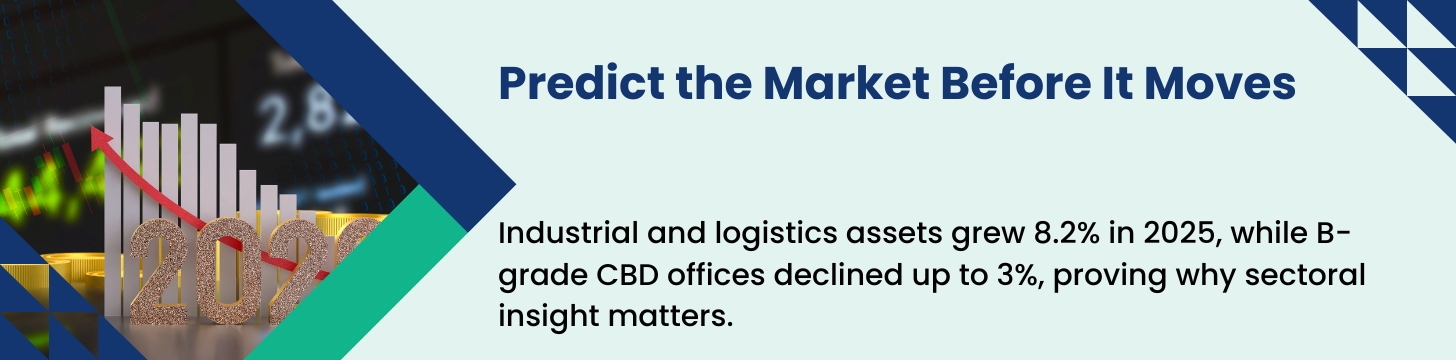
To invest in commercial property you must know where the market is going — not where it has been.
Australia’s 2026 commercial property outlook is influenced by changing economic conditions, sectoral divergence and investor sentiment driven by the Reserve Bank’s monetary policy.
Interest rates are one of the key drivers. After the RBA stabilised the cash rate at 3.60% in 2025, analysts are predicting rate cuts by mid 2026 as inflation cools to 2-3%.
Lower borrowing costs may reignite demand for income producing commercial assets, particularly industrial and logistics properties that showed their resilience during the tight credit period.
According to JLL and CoreLogic’s 2025 data, the commercial market displayed clear sectoral trends:
| Sector | Average Yield (2025) | Annual Growth | Outlook for 2026 |
| Industrial & Logistics | 6.0–6.5% | +8.2% | Strong – Driven by e-commerce & storage demand |
| Retail | 5.5–6.0% | +3.4% | Moderate – Neighbourhood retail outperforming CBD |
| Office | 5.0–5.5% | +1.8% | Mixed – Flight to quality, hybrid work continues |
These figures show a clear investor shift toward stable, essential-service assets.
Data Snapshot
A logistics hub in Western Sydney near the Aerotropolis recorded 9.1% growth in 2025, while B-grade CBD offices fell 2-3%.
This shows the importance of sectoral awareness — following the macro trends means your capital goes into growth areas not stagnant ones.
When looking at the 2026 market:
- Look at infrastructure investment pipelines (Inland Rail, Western Harbour Tunnel, etc.).
- Review population and employment growth areas from ABS data.
- Track tenant demand in emerging sectors like data centres and medical facilities.
- Check vacancy rates — national industrial vacancy was under 1.2% in late 2025, a record low.
Investor Reflection
Knowing the data gives you an edge.
By 2026, informed investors will be targeting low-vacancy, high-growth corridors and positioning themselves ahead of reactive buyers chasing last year’s trends.
Structure Your Investment – Build Before You Buy

Before you buy any commercial property the structure of your investment determines how profitable, flexible and tax effective your portfolio will be.
A well structured foundation protects your assets, optimises tax outcomes and simplifies management as your portfolio grows.
In Australia, commercial property can be owned through various structures:
| Structure Type | Key Features | Best Suited For | Tax Considerations |
| Individual Ownership | Simple setup, full control | Small investors | Income taxed at marginal rate (up to 45%) |
| Company | Limited liability, formal governance | Medium businesses | Flat 30% corporate tax rate |
| Trust (Unit/Discretionary) | Asset protection, income flexibility | Family investors | Tax passes through to beneficiaries |
| SMSF (Self-Managed Super Fund) | Long-term wealth building | Retirement-focused investors | Concessional tax rate (15%) but strict rules |
Applied Illustration
An investor buying a $1.2 million retail property through a trust can really spread the tax hit around to family members and pay less in tax.
Meanwhile an investor using a Self-Managed Super Fund (SMSF) to buy the same property gets some long-term tax breaks but then they have to deal with lower borrowing limits and some restrictions on what kind of assets they can own.
Financing is a big deal. Unlike residential loans,commercial loans have a few key differences:
- Lower Loan-to-Value Ratios (LVRs) – typically 60–70%.
- Shorter loan terms – typically 3-5 years.
- More hoops to jump through with high documentation requirements, such as lease agreements and rent rolls.
According to an ANZ Commercial Insights report, the average LVR went down from 74% in 2022 to 66% in 2025 because banks are becoming more cautious with lending.
This means investors will need to have some serious cash stashed away and some solid financials for when they try to get a loan in 2026.
Key Structuring Insight
Picking the right way to own and finance a property affects just about everything about your investment – from getting that loan approved in the first place and having some protection in place for your assets, to how things work out when you try to sell and what you’ll be paying in tax.
If you get it wrong you can end up eating into your returns because of too much tax or because you’re exposing yourself to some big financial risks.
Quick Wrap-Up
Before you start building a property portfolio you need to get your ownership plans sorted.
Get in the right team – an accountant, lawyer, and mortgage broker – early on.
If you get the structure right your investment will be able to grow faster, keep your wealth safe and you’ll be in a good position to take advantage of any opportunities that come up in 2026 and beyond.
Choose the Right Asset Class & Location – Match Your Vision to the Market

Working out which asset class and location is going to work best for you is one of the most important things you do when building a commercial property portfolio.
Right now, Australia’s commercial property market is all over the place – some areas are performing fine while others are really struggling.
Getting this right means your investment will be on track to meet your financial goals and that you’ll be in a good position to ride any changes that come down the track in the next few years.
Asset class selection starts with understanding the unique characteristics of each sector:
| Asset Class | Typical Yield (2025) | Key Drivers | 2026 Outlook |
| Industrial / Logistics | 6.0–6.5% | E-commerce, manufacturing, supply-chain expansion | Strong – Vacancy below 1.5% |
| Retail (Neighbourhood / Service-based) | 5.5–6.0% | Population growth, daily needs retail | Moderate – Local retail remains resilient |
| Office (A-grade / B-grade) | 5.0–5.5% | Employment trends, hybrid work adoption | Mixed – Flight to quality continues |
| Medical / Childcare / Aged Care | 5.0–5.8% | Demographic growth, essential services | High potential – Defensive sector |
Field Example
Someone who is after stable cash flow might look at a logistics warehouse up in Brisbane’s north where the vacancy rate was only 1.3% in 2025.
On the other hand, if you’re after growth you might be looking at medical suites in areas like Melbourne’s West or Sydney’s South-West where demand is really taking off because people need healthcare.
When you are choosing a location, take a close look at:
- What’s coming down the track in terms of big infrastructure projects – things like Melbourne’s Suburban Rail Loop or Brisbane’s Olympic 2032 upgrades can have a real impact on property values.
- Economic activity hubs – areas with ports, industrial estates or business parks tend to do a lot better than areas that don’t.
- Population and job growth – ABS numbers show regional centres like Geelong, Sunshine Coast and Newcastle are growing at a rate of 1.6% per annum.
Competitive Advantage
Where you invest in really important – it determines how much demand there is for the property, how stable the tenants are and how much the property is likely to be worth in the long term.
If you pick a property in the right location with the right tenant mix you can expect to get an extra 2–3% per annum on top of the market average in terms of total returns.
Investor Takeaway
The people who are most likely to succeed in the commercial property market are those who are able to match their vision for their investment with the actual market reality – where they invest in the right location, with the right asset class and at the right time.
In 2026, try to focus on areas with strong growth, good infrastructure and solid fundamentals – that way you’ll be in a good position to make some money and ride out any ups and downs that come along the way.
Do Your Due Diligence – Details Are Profit

In commercial property investment profit is made in the purchase, not the sale — and that profit is all down to how well you do your due diligence.
Unlike residential property where emotional appeal rules, commercial assets are income-generating businesses.
A small mistake in lease terms, tenant quality or building compliance can cost thousands a year.
Due diligence has three key pillars:
- Tenant & Lease Analysis
- Check the tenant’s financials — national brands and government tenants are more secure.
- Check lease term (WALE – Weighted Average Lease Expiry). A longer WALE means stable income and less vacancy risk.
- Confirm rent increases (CPI or fixed annual increases).
- Identify outgoing expenses — in a “triple net lease” the tenant pays insurance, rates and maintenance, improving net yield.
- Example:
- A property leased to Australia Post on a 10 year term with 3% annual increases can yield 6.3% net, while a similar property with a local tenant on a short term lease might drop to 5.2% due to risk loading.
- Property Condition & Compliance
- Inspect for structural issues, asbestos or fire safety compliance.
- Check zoning and permitted use under local council rules.
- Review environmental risks (e.g. contamination or flooding).
- According to the NSW Valuer General (2025), over 18% of commercial property disputes involved undisclosed building compliance issues — so don’t skimp on your checks.
3. Financial & Market Verification
- Compare yields to similar sales in the area.
- Review historical vacancy rates — a region with vacancy above 6% will struggle to find tenants.
- Model multiple scenarios: base, optimistic and conservative rent assumptions.
Actionable Insight
Detailed due diligence turns uncertainty into certainty.
By checking every lease clause, every detail and every number investors protect their returns.
In 2026’s competitive market data-driven diligence is not optional — it’s your best defence against loss and the path to sustainable profit.
Negotiate Like a Pro – The Deal Is in the Details
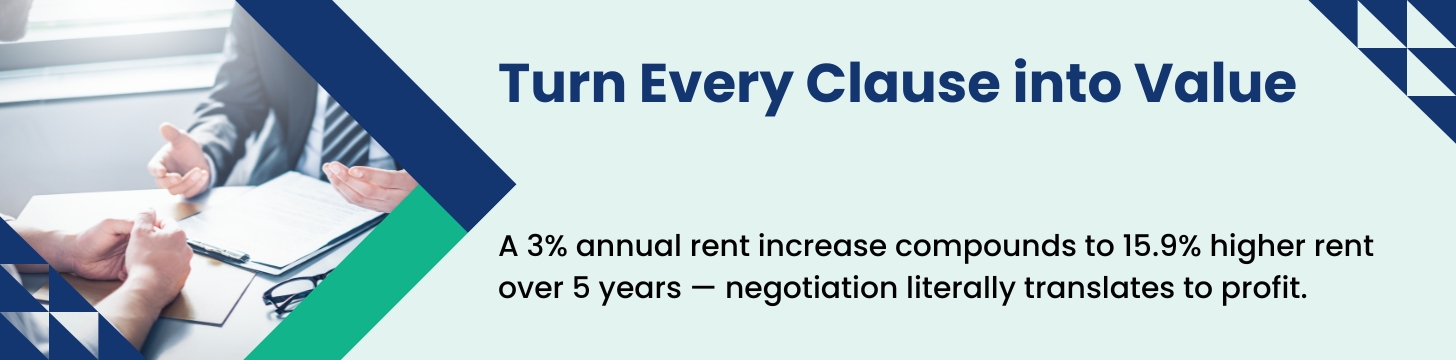
Once you’ve found the right property and done your due diligence, your next task is to negotiate strategically.
In commercial real estate every clause in the contract can impact your future returns — from lease structure to rent increases.
Professional negotiation is not just about price; it’s about protecting your cash flow and maximising long term value.
A well negotiated deal considers four key factors:
- Purchase Price vs Yield Alignment
- Target a yield that reflects market benchmarks and tenant risk.
- For example in 2025 industrial properties averaged 6.1% yields and office assets 5.3% (CoreLogic Commercial Index).
- Paying above market yield for a short term lease is a warning sign; negotiate the price to offset the risk.
- Example:
- A Sydney warehouse priced at $1.8 million with $108,000 annual rent yields 6%. If the tenant has only 2 years left on the lease you could negotiate a $50,000 discount to balance the vacancy risk.
- A Sydney warehouse priced at $1.8 million with $108,000 annual rent yields 6%. If the tenant has only 2 years left on the lease you could negotiate a $50,000 discount to balance the vacancy risk.
- Lease Terms and Escalations
- Rent reviews should be CPI indexed or fixed (3-4% per annum).
- Negotiate outgoings so the tenant pays as many as possible (insurance, maintenance, rates).
- Get options to renew — this will add value and tenant stability.
- Triple net leases can add 0.5% to the yield.
- Settlement and Incentives
- Negotiate good settlement terms, especially if finance is pending.
- Ask for vendor rent guarantees if property has recent vacancy history.
- In some cases, vendors offer fit-out contributions or rent-free periods to attract tenants — use these in negotiations.
Investor’s Mindset
One clause can add thousands to your return each year. For example, a 3% annual rent increase compounds to a 15.9% higher rent over 5 years — big increase in property value.
Essential Summary
In 2026 with yields stabilising and competition increasing, negotiation skills separate smart investors from average buyers.
Every percentage point, every lease clause and every incentive counts.
The deal isn’t done when the contract is signed — it’s won when every detail serves your long term investment strategy.
Appoint Expert Property Management – Consistency Creates Compounding Value

Owning a commercial property is just the beginning — managing it professionally is what turns a good asset into a great long term investment.
In 2026 with vacancy rates tightening in industrial but fluctuating in office and retail, a good property manager is crucial for consistent income, tenant satisfaction and asset performance.
Why Professional Oversight Creates Stability
Commercial leases are complex. They involve multiple stakeholders, variable rent structures and detailed legal obligations.
A professional manager ensures rent is collected on time, outgoings are reconciled correctly and lease renewals are negotiated proactively — no unexpected income gaps.
According to a Knight Frank 2025 survey, properties with experienced management teams recorded:
- 12-15% higher tenant retention rates
- 10% faster re-leasing periods
- Up to 0.4% higher average yields compared to self managed properties
These stats show that consistent management adds up to more total return over time.
Core Duties of a Commercial Manager
- Lease administration: Tracking rent reviews, renewals and escalations.
- Maintenance oversight: Scheduling repairs and inspections to protect asset value.
- Tenant relations: Addressing issues promptly to maintain occupancy stability.
- Expense control: Monitoring outgoings to ensure accurate tenant reimbursements.
- Reporting: Providing quarterly income and performance summaries.
Practical Example from the Field
A Brisbane investor had a $2 million industrial warehouse and outsourced management to a specialist in 2025.
The manager got a rent increase from $115,000 to $120,000 p.a. (4.3% increase) and reduced maintenance expenses by 8%.
This lifted net yield from 5.7% to 6.1% without the owner doing anything.
Relevance in the 2026 Market Cycle
As technology advances, top end firms now use AI driven property management systems to predict maintenance schedules and tenant churn, making it even more efficient.
Investors who use professional, tech enabled management get not only smoother operations but compounding capital value over time.
Final Reflection
Consistent, expert management turns a property from just a source of passive income into a growing, high value asset.
In commercial real estate, stability is key to making a profit and a top-notch management team is the key to both.
Get A Clear Picture Of Your Cash Flow & Tax Position – Numbers Tell The Real Story

In commercial property investing, it’s the numbers that count.
Before signing a contract, investors need to put together a detailed cash flow model that forecasts income and expenses, as well as financing costs and tax outcomes.
This will give you a clear idea of whether the property can generate sustainable returns and stay on track even when interest rates or vacancy periods change.
Importance of Forecast Modelling
Unlike residential property, commercial assets often have rent structures, expenses and maintenance costs that can make a big difference to your bottom line.
A strong model lets you test different scenarios and get ready for any changes in the market.
According to ANZ Property Insights (2025), 37% of new commercial investors underestimated operational expenses by at least 10%, reducing their effective yield.
This just goes to show how important it is to build accurate, data-driven projections.
Key Building Blocks of a Cash Flow Plan
- Gross income: That includes base rent, car park rent, and signage rent and all that.
- Outgoings: These include things like insurance, maintenance, land tax and council rates.
- Loan repayments: That means principal and interest obligations over time.
- Vacancy allowance: Make sure to budget at least 3–6 months for potential downtime.
- Tax and depreciation: Make sure you factor in ATO-approved depreciation schedules for buildings and fixtures (Division 43 & 40).
Illustrative Case Study
For example, a Perth investor bought an industrial property for $1.5 million with an annual rent of $90,000 and annual expenses of $10,000.
Their loan was 70% LVR at 6.0% interest, with an annual debt service of $63,000, leaving a net cash flow of $17,000 before tax, which works out to an effective 1.1% cash yield.
Depreciation of $25,000 wiped out their taxable income, improving their after-tax returns.
Tax Optimisation Perspective
Choosing the right structure (e.g., a trust or SMSF) can cut tax from 30% to as low as 15%.
Using depreciation schedules and offsetting expenses means you get to keep more of your cash.
Financial Wrap-Up
Your spreadsheet is your best tool for managing risk.
By running multiple financial scenarios, you ensure that every dollar you invest is guided by facts, precision and a focus on making a profit – not just assumptions.
Keep A Close Eye On Your Asset – Adapt To Stay Ahead

You don’t just “set and forget” a commercial property – owning one needs regular review of performance, ongoing analysis and proactive optimisation.
The most successful investors in 2026 are the ones who treat their properties like businesses, constantly checking their performance against financial and market benchmarks.
Regular reviews keep your asset profitable, competitive and in line with broader economic trends.
Why Periodic Reviews Safeguard Value
The Australian commercial property market is constantly changing.
According to CBRE’s 2025 Investor Sentiment Report, properties that underwent active management reviews every 6–12 months achieved average value growth of 9.4%, compared to just 5.7% for passively held assets.
That shows that regular performance tracking really can lead to higher returns over time.
Metrics That Define Asset Health
- Occupancy & Vacancy: Make sure your vacancy rate stays below 5% so you’re getting that steady income stream.
- Rent Review Management: Don’t forget to check for CPI-linked or fixed rent increases every year.
- Operating Costs: Compare what you’re spending on day-to-day stuff to industry benchmarks – overspending will cut into your net yield.
- Tenant Retention: Building long-term relationships with good tenants is key. Losing a major tenant can mean 6-12 months of lost rent.
- Market Comparison: Keep an eye on how your property stacks up against nearby assets in terms of yield and value to see if you’re competing fairly.
Example of Real-World Adaptation
In 2025, a Melbourne investor who owned a medical suite took a closer look at their asset and decided to make some changes.
They sorted out energy-efficient lighting and gave the facade a fresh coat of paint, and as a result reduced their outgoings by 8% and landed a new healthcare tenant at 7% higher rent.
The property’s valuation shot up from $1.4M to $1.55M within 12 months – shows you, it’s the small changes that can add up.
Maintaining a Competitive Edge
By 2026, tenants are going to be a lot more interested in ESG (Environmental, Social, Governance) stuff and buildings that are more sustainable.
Things like solar panels and efficient HVAC systems aren’t just good for cutting costs, but they’ll also boost your property’s appeal and valuation, which according to the JLL Green Property Index 2025 can be by 3-5%.
Investor Summary Insight
Regularly checking the numbers, making improvements, and adapting to what tenants and the market are looking for, is the key to turning your property ownership into a money-maker.
By analysing data, working to be more efficient, and thinking ahead to tenant and market trends, you’ll make sure your commercial properties stay strong, profitable and ready for whatever comes next in 2026 and beyond.
Thinking ahead is key for every savvy investor

A smart commercial investment strategy doesn’t end when you buy a property – it’s when you’ve got a solid exit plan that you really start getting the most out of your cash.
Knowing when and how to sell, refinance, or expand is what determines where your wealth goes from here.
In 2026, with Australia’s property market starting to stabilise after rate hikes, the investors who plan ahead will have the room to either lock in their gains or put their money to work for future growth.
Strategic Importance of Exit Planning
Commercial property cycles usually last 7-10 years, thanks to interest rates, growth, and supply.
According to Colliers 2025 Commercial Outlook, if you make a plan for when and how to exit you’ll be 18-22% ahead of the ones who don’t.
A solid exit plan lets you cash in during the good times, not when things are going south.
Main Exit & Expansion Scenarios
| Strategy | Description | When to Apply |
| Sale (Capital Realisation) | Sell the asset when yields compress or tenant demand peaks | When market cap rates fall or value exceeds target IRR |
| Refinancing | Use equity gains to secure new funding for additional properties | When interest rates decline or valuation rises |
| Portfolio Expansion | Reinvest profits into diversified asset types or regions | During stable market conditions |
| Holding for Income | Retain property for long-term cash flow and depreciation benefits | When asset has strong lease covenants |
Applied Investor Example
An investor laid out $2 million for a logistics property in 2020 at a 6.5% return. By 2026, the yield drops to 5.8% and the property’s value suddenly jumps to $2.25 million, pocketing the investor a tidy $250,000 capital gain.
Refinancing 70% of that new value frees up a tidy little $150,000 in equity, enough to fund another smaller commercial purchase without having to sell the original asset.
Forward-Looking Takeaway
When putting together your investment plan, don’t forget about the things that’ll eat into your profits, like CGT obligations, stamp duty costs and market timing.
Keeping an eye on the right economic indicators – like RBA rate movements, employment figures and yield spreads – will help you spot the best time to sell.
You know what sets the good investors apart? They always have an exit plan built into their entries. By 2026, those who treat every purchase as part of a bigger portfolio plan – with clear growth and liquidity targets – will be the ones standing out from the crowd.
Whether you decide to sell, refinance or expand, having the right vision will turn property ownership into a very real path to lasting wealth creation.
Frequently Asked Questions
1. How Do I Start Investing in Commercial Property in Australia in 2026?
Starting out on your commercial property investment journey in 2026 all begins with getting clear about what you’re hoping to achieve – is it rental income, capital growth or a bit of both?
Next, you need to figure out your budget and borrowing capacity – commercial loans usually need a 30-40% deposit, whereas residential loans can often get by with much less.
You’ll need to pick your property type carefully – offices, warehouses, retail or medical suites all carry different levels of risk and return.
Don’t be afraid to get some professional advice – a good buyer’s agent, property lawyer and financial advisor can help with the structure, the tax side of things and any other important legal bits you might need to consider.
Before you even think about laying out the cash, do your due diligence – review the tenant quality, lease durations, demand in the area and vacancy rates.
In 2026, there are a few areas that are expected to see a lot of interest from investors – like Western Sydney, Melbourne’s industrial belts and Perth’s logistics precincts.
2. How Much Money Do I Need to Invest in Commercial Property in 2026?
The cost of entry is going to depend on where you are and what kind of property you’re after. Smaller industrial or medical units can be had for as little as $300,000 to $600,000, while a prime retail or office space could easily set you back $2 million or more.
You’ll typically need:
- A deposit of 30-40% of the purchase price
- Stamp duty – that’s going to be around 4-6%
- Legal and valuation fees – you’re looking at $5,000 to $10,000
- Inspection and setup costs – another $1,000 to $2,000
Commercial loans tend to have shorter terms – 5-15 years – and slightly higher interest rates, but the rental yields can be anything between 6 and 8% – that’s a lot better cash flow than most residential investments.
The combination of having to put up a lot of cash upfront and strong long-term income makes it an attractive option for more experienced investors in 2026.
3. Is Commercial Property a Good Investment in Australia for 2026?
Yes, and not surprisingly, commercial property is still shaping up to be one of the most resilient asset classes as we head into 2026.
Vacancy rates are getting tighter and yields are on the rise – and it’s the industrial and logistics sector that’s really leading the charge, thanks to the ongoing growth of e-commerce.
Commercial property has a lot going for it – including:
- Leases that can run for 3 to 10 years, which is great for income stability.
- Tenants who pick up most of the outgoings – which helps to keep costs down for us owners.
- And annual rent increases that are linked to inflation – anywhere between 3 to 5% as things have been going.
Of course, some of the office markets are starting to stabilise, but it’s the industrial, medical and regional retail sectors that are predicted to keep delivering solid returns through 2026 and beyond.
4. What are the Main Risks of Commercial Property Investment in 2026?
One of the biggest risks is undoubtedly vacancy – it can take longer to re-lease a commercial space than it does a residential one.
Other things to watch out for include:
- Higher interest rates – which can make repayments a lot more expensive.
- Economic downturns which can cut business demand.
- High maintenance costs on older properties – not to mention sector specific risks, like over-supply in certain office areas.
But there are ways to mitigate these risks – by focusing on:
- Good long term tenants with solid financials.
- High growth areas like logistics corridors and suburban business hubs
- And buildings that are adaptable to multiple tenants.
With a bit of smart due diligence and some diversification, commercial property can deliver strong, risk adjusted returns.
5. What are the Best Locations to Invest in Commercial Property in 2026?
In 2026, the best investment locations are ones that combine population growth, infrastructure spending, and low vacancy rates.
Some of the top areas to look at are:
- Western Sydney (NSW) – especially around the Badgerys Creek Airport, where industrial demand is looking strong.
- Perth & Kwinana (WA) – the growth zones for energy and logistics are really starting to take off.
- Brisbane North & Sunshine Coast (QLD) – retail and medical are expanding rapidly in these areas.
- Melbourne West (VIC) – it’s a major warehouse development corridor.
- Adelaide Fringe (SA) – if you’re looking for some affordable offices and small industry space.
Regional cities like Geelong, Newcastle and Townsville are also starting to get more traction – largely due to improved connectivity and lifestyle migration.If you get your location right – based on who the tenants are and what the yields are then you should be able to capitalise on the opportunities through 2026-2030.

Valuable Insights On Property Development & Investment Opportunities
-

Top High Interest Short Term Investment Options for 2026
High Interest Savings Accounts for Liquid Cash Buffers Cash sleeve purpose and liquidity role High…
Read More -
Best Performing Managed Funds in Australia: Expert Tips & Strategies
Top-Performing Managed Funds in Australia: What Investors Need to Know In 2026, Australian investors are…
Read More -
Best Financial Advisor Perth: How to Choose the Right Expert for Your Goals
Financial Advisor Perth Key Criteria for Choosing the Best Adviser Choosing the best financial advisor…
Read More -
How to Make Money from Property Development in Australia: A Comprehensive Guide
High-Growth Cities Offering the Best Property Development Margins Australia’s property development landscape will be shaped…
Read More -
What Are the Best Low-Risk Investments in Australia for Beginners?
Low-Risk Investing in 2026: The Beginner Snapshot For Aussie beginners seeking low-risk investments in 2026,…
Read More


Our Project Site :


Exclusive waterfront living at the Lake Narracan Resort community.

Quick Links
The information provided is general in nature and does not constitute personal financial advice. The information has been prepared without taking into account your personal objectives, financial situation or needs. Before acting on any information on this website you should consider the appropriateness of the information having regard to your own objectives, financial situation and needs. All statements made on this website are made in good faith and we believe them to be accurate and reliable however do not guarantee its currency. You should seek legal or other professional advice before acting or relying on any of the content.
Please note that past performance may not be indicative of future results. Different types of investments involve varying degrees of risk, and there can be no assurance that the future performance of any specific investment, investment strategy, or product made reference to directly or indirectly on our website, blogs , newsletters.
Our Project Site :

Find premium land developments and new estates across Australia.
Exclusive waterfront living at the Lake Narracan Resort community.

Quick Links
The information provided on this website including blogs is general in nature and does not constitute personal financial advice. The information has been prepared without taking into account your personal objectives, financial situation or needs. Before acting on any information on this website you should consider the appropriateness of the information having regard to your own objectives, financial situation and needs. All statements made on this website are made in good faith and we believe them to be accurate and reliable however do not guarantee its currency. You should seek legal or other professional advice before acting or relying on any of the content.