

Table of Contents
Balanced 60/40 Portfolios to Invest for Retirement
Investing $500,000 for retirement in 2026 – setting yourself up for a comfortable retirement – requires a clear understanding of how things are likely to pan out in the year ahead.
The major Australian banks are tipping that the cash rate will sit somewhere between 3.10% and 3.35% in 2026, which means high-interest savings accounts and term deposits are going to be around 3.1% – 3.5%.
If you’re relying on cash returns alone, you can expect to earn somewhere between $15,500 and $16,750 per year on a $500,000 investment.
Investing in fixed income is looking like a pretty good bet too, with global research forecasting that bond yields will rise to about 4.2% in 2026, and some managers are expecting total bond returns of 4%–5% when you factor in income and capital gains.
That works out to $21,000–$25,000 in expected annual returns, giving retirees a pretty stable income source with a lot less volatility.
For growth-oriented investors, multiple capital market assumption studies – including J.P. Morgan’s 2026 LTCMA – are forecasting a 5.7% – 6.4% long-term annual return on a global 60/40 portfolio, giving you $28,500–$32,000 every year on a $500,000 investment.
More sophisticated models like “60/40+”, which include real assets and alternatives, are projected to earn around 6.9% annually – or roughly $34,500 a year.
There’s sustainable withdrawal research, which suggests a 4.0%–4.7% rule, which would give you $20,000–$23,500 in the first year when drawing from an investment portfolio.
What all these 2026 figures tell us is that for retirees, the choices are clear: cash is your safety net, bonds are stable, balanced portfolios are for growth, alternatives boost return potential, and annuities offer that extra bit of certainty.
It’s all about getting the mix right – and that depends on your income needs, how much risk you can handle, how long you’ve got to wait for returns, and whether you’re after a guaranteed income stream or something a bit more flexible.

Setting Your Clear Retirement Income Goal
Defining the Income Target That Works for You
When figuring out what to do with 500k for your retirement, the first step is to turn that lump sum into a realistic yearly income goal that’s based on some actual numbers.
Having a clear target gives your investments a direction in life, stops you from overspending, and makes sure your money will last as long as you do.
The Importance of a Withdrawal Rate That Won’t Leave You Struggling
Two rules of thumb that many people use when planning for retirement are:
The 4% Rule
- Take out 4% in the first year
- It’s been shown to last about 30 years in the past, and that’s been pretty consistent across different market ups and downs
Updated Safe Withdrawal Rate for 2025: 3.7%
- A bit more conservative
- Takes into account lower returns going forward
- Designed for people with 20-50% of their portfolio invested in stocks (and backed up by some decent research)
Using These Rules to Plan for a 500k Portfolio
Using these two rates lets us see what kind of income you should get from 500k:
Using these two rates:
| Withdrawal Method | Rate | Annual Income (500k) | Why It Matters |
| Classic Method | 4% | $20,000/year | Works well for average-return environments |
| Modern Conservative | 3.7% | $18,500/year | Safer in low-growth or volatile markets |
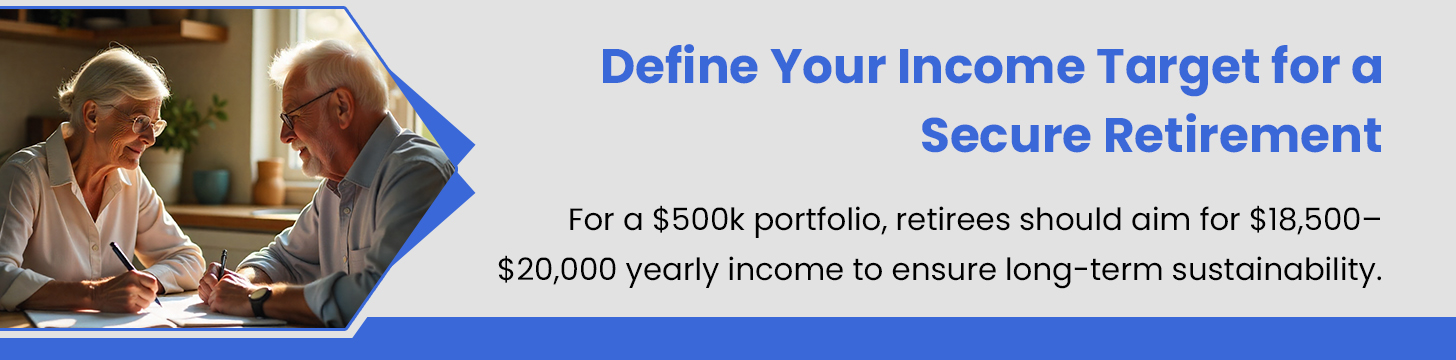
So, your income goal from 500k should probably be somewhere between $18,500 and $20,000 per year.
Protecting Your Spending Power With a Precise Plan
A clear income target is essential because:
- It keeps you from dipping into your retirement savings too early – which is probably the most common reason folks blow through their retirement funds.
- It keeps you from overspending in good times.
- And it gives you a clear rule of thumb to follow when the market is down – you know exactly how much can still be safely withdrawn.
This is especially important when figuring out how to invest 500k for retirement (2025-2055) because it turns out early market losses can have a pretty big impact.
A Real-World Example
If you withdraw 6% instead of 4%, you’re basically doubling the risk of running out of money within 20 years. On the other hand, if you stick to 3.7-4%, you’re a lot more likely to be able to keep your money going for 25-30 years or more.
Having a clear plan isn’t a nice-to-have – it’s actually a must-have if you want to make the most of your money and keep your long-term financial future on track.
Using these two rates:
| Withdrawal Method | Rate | Annual Income (500k) | Why It Matters |
| Classic Method | 4% | $20,000/year | Works well for average-return environments |
| Modern Conservative | 3.7% | $18,500/year | Safer in low-growth or volatile markets |
So your income goal from 500k should be between $18,500–$20,000 per year.
Protecting Long-Term Spending Power With Accuracy
A precise income target is crucial because:
- It prevents early depletion (the most common retirement failure).
- It prevents you from overspending in bull markets.
- It gives you a clear benchmark when the market falls — you know what can still be withdrawn safely.
This is especially important when designing How to Invest 500k for Retirement (2025–2055) because early market losses have a bigger impact.
Example Case Study
If a retiree withdraws 6% instead of 4%, the risk of running out of money in 20 years doubles.
But at 3.7–4%, the probability of the portfolio lasting 25–30+ years improves significantly.
Accurate planning isn’t optional — it’s the foundation of maximizing interest and passive income while protecting your long-term financial future.
Align Investments with Your Risk Tolerance

Time Horizon as the Foundation of Asset Allocation
Your risk level should match the number of years your 500k must last, especially for How to Invest 500k for Retirement in 2030, 2035, and beyond.
The research you got earlier showed that portfolios with 20–50% equities had better safe withdrawal rates than ultra-conservative or ultra-aggressive portfolios.
This range balances growth and stability.
Short, Mid, and Long Retirement Durations
If retiring in 0–5 years
- If you are retiring in 0–5 years, you should reduce volatility exposure to protect your portfolio from sudden drops.
- At this stage, it’s important to hold more bonds, cash, and high-yield savings because these assets provide stability and predictable income.
- This approach helps you protect against early market drops, which are the biggest risk to long-term portfolio survival.
- So the ideal structure is a target equity allocation of 20–35% to have enough stability without sacrificing all growth potential.
If retiring in 5–15 years
- If you are retiring in 5–15 years, you should keep a balanced mix of income and growth assets to support mid-term goals.
- Your core investments should be bonds + dividend equities + index funds to have both stability and future growth.
- For this timeline, a target equity allocation of 40–50% is a good balance between risk management and growth opportunities.
If retiring in 15+ years
- If you are retiring in 15+ years, you can take more equity exposure since you have a longer time horizon to ride out market volatility.
- In this stage, growth matters more than short-term volatility, so equities are key to long-term wealth creation.
- For this timeframe, the recommended structure is a target equity allocation of 50–60% to compound and still have some stability through bonds and income assets.
Data Points That Shape the Way We Allocate Our Money
- Back in 2025, research showed that having a balanced portfolio had a clear edge when it came to sustainable withdrawal rates, and that’s compared to portfolios that were 100% equity.
- With a 100% equity portfolio, you’re often in for a pretty rough ride early on, with the market experiencing some pretty big declines, which then makes it that much harder to avoid running out of money.
- And a 100% bond portfolio? Unfortunately, it just can’t keep up with inflation long-term.
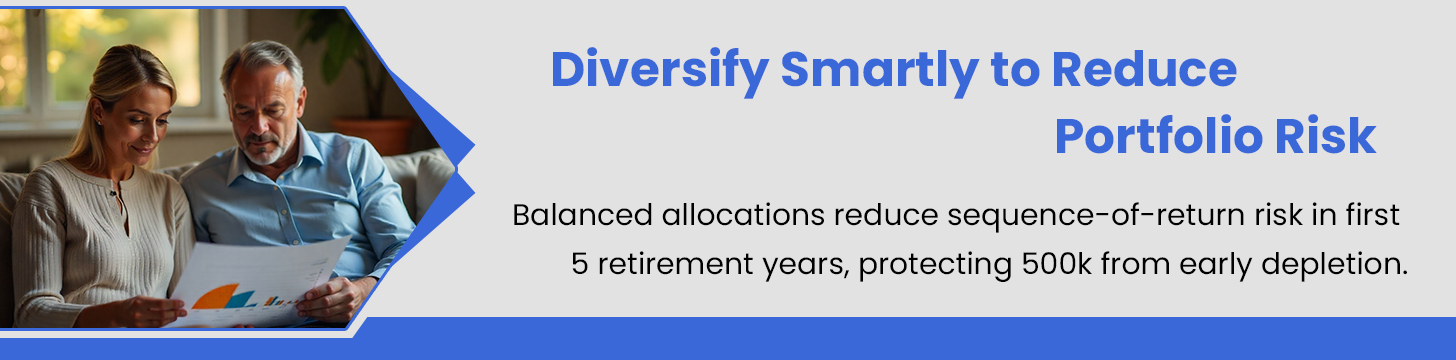
Balanced allocations do so much better because they help reduce the sequence-of-return risk, especially in those first 5 years of retirement, when it can make all the difference.
What Happens When Two 500k Retirement Plans Go Head-to-Head
Retiree A:
80% of their portfolio was in equities – then the market fell by a whopping 25%
- Their portfolio value plummeted to 375k
- A 4% withdrawal in that situation would translate to $15,000 – a major strain on their finances
Retiree B:
On the other hand, Retiree B had a balanced portfolio with 45% in equities – the market fell by 25% but it only affected the equities
- Overall, their portfolio drop was only around 11%, which is much more manageable
- Not only that, but their withdrawal remained sustainable, too
And that’s why understanding how to match your risk to your retirement timeline is so crucial when it comes to How to Invest 500k for Retirement (2025-2055).
Creating a High-Liquidity Safety Buffer
What’s the Point of Maintaining Immediate-Access Funds?
A liquidity buffer is your first line of defense, and it’s meant to protect you when the market takes a tumble. This bucket of cash holds 1-3 years’ worth of living expenses, all invested in low-risk instruments.
It’s a core part of the How to Invest 500k for Retirement strategy because it stops you from having to sell your investments at a loss when you’re in a tight spot.
Top Vehicles for Liquid Reserves – We’re Talking the Best
The Top Picks for Liquid Reserves
High-Yield Savings Accounts – They’re a Safe Bet
- You can get pretty good rates with high-yield savings accounts – global rates were at 4.0-4.2% APY in 2025, which is a world apart from what you’d get in a standard savings account.
- In fact, standard savings accounts were only earning 0.3-0.4% APY last year, so you can see that high-yield savings accounts are a much better bet.
- And if you’re looking internationally, India’s savings accounts have been offering some pretty decent rates too – 2.5-8% per annum in some cases. That’s always going to give you options, depending on which bank you go with and what kind of balance you’re looking to manage.
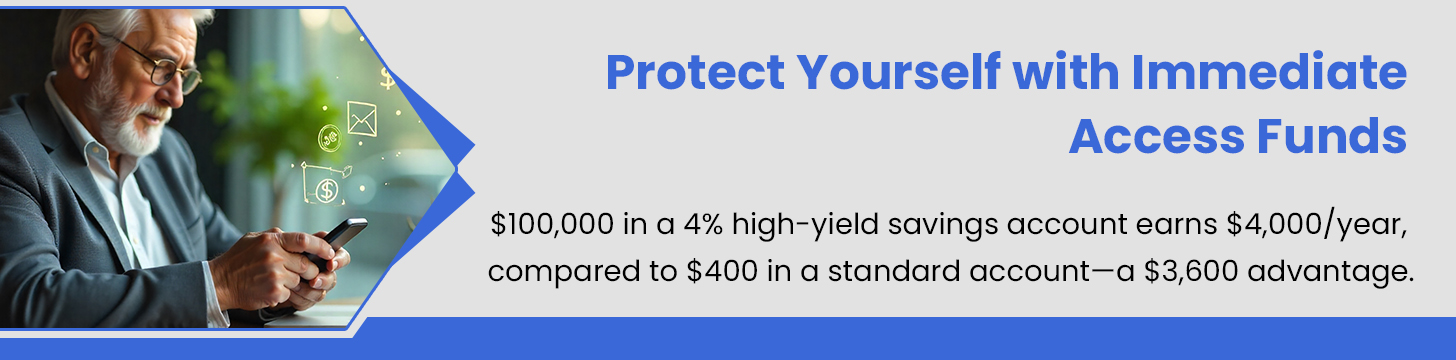
- Just imagine the difference that makes if you’re putting away a decent chunk of cash. $100,000 at 4% APY is going to earn you $4,000 a year, while $100,000 at 0.4% APY will only earn you $400. That’s a $3,600 yearly difference with no increased risk.
Money Market Funds – The Low-Risk Option
- Money market funds are another safe choice when it comes to liquid reserves because they usually return around 4-5%, which is a pretty decent return on your money.
- They’re also very low-risk, so they’re a great choice for anyone who needs to keep their capital safe.
- And the best part is, you can get in and out of money market funds pretty quickly, which is great if you need to make some big purchases or cover some big expenses.
Short-Term Bond Funds – The Middle Ground
- Short-term bond funds are a great choice for liquid reserves because they usually return around 3.5-4.8%, which is a pretty stable return.
- They’re also very stable in terms of price movement, so you don’t have to worry about your capital shrinking away when the market gets volatile.
- And they’re also a great source of regular income, which makes them super useful for covering ongoing expenses while keeping your overall portfolio stable.
Risk Shielding Through Short-Term Stability
- Having 1–3 years of expenses in safe assets means you don’t sell stocks in a downturn because your immediate income needs are covered without relying on volatile equity markets.
- It means you have income even when dividends fall because your essential spending is supported by stable savings, money market funds, or short-term bonds instead of relying on market-driven payouts.
- It allows you to refill this bucket when markets recover, so you can replenish your short-term reserves during strong performance years instead of withdrawing during market stress.
- It reduces the sequence of return risk because you’re not forced to withdraw from declining assets during the earliest and most sensitive years of retirement.
- This buffer alone can add 5–10 years to your portfolio’s longevity in bad market conditions because it protects your long-term investments from premature depletion and gives them time to recover.
Use Bonds for Steady, Low-Volatility Income
The Strategic Role of Fixed Income
The bond part of your portfolio generates steady, predictable income, which is critical for retirees who need a stable cash flow.
In How to Invest 500k for Retirement, bonds are your income backbone, complementing dividends and protecting against stock market volatility.
Current Bond Yields (2024–2025 Data)
These yields provide a foundation for retirement income planning.
Optimal Bond Mix for a 500k Portfolio
Government Bonds
- Safest option
- Best during recessions
- Provides deflation protection
Investment Grade Corporate Bonds
- Higher yield than government bonds
- Moderate risk
- Suitable for retirees looking for income
Short Term & Intermediate Bond Funds
- Lower volatility
- Stable periodic payouts
Sample Fixed Income Allocation
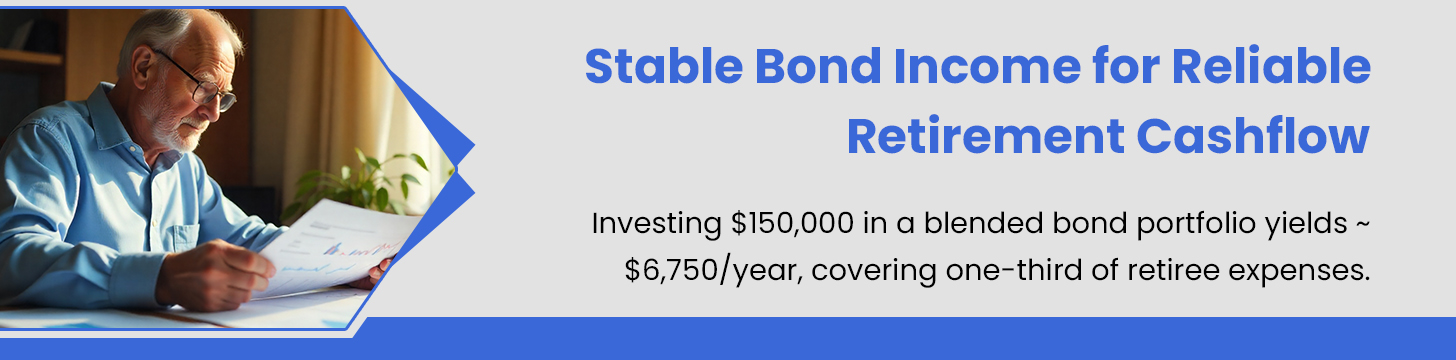
Investing $150,000 of your 500k in a blended bond portfolio:
- Average yield: ~4.5%
- Annual income: $6,750This alone covers one-third of a retiree’s expenses ($18.5k–$20k).
Longevity Benefits of Stable Yield Instruments
- They stabilize returns in down markets
- They reduce the need to sell equities
- They provide predictable interest
- They complement high-yield savings and dividends
Investors who had 40%+ bonds historically had safer withdrawal rates and lower portfolio volatility.
Stress Test
During a downturn:
- Equities may fall 20–30%
- Good bonds may fall 0–3% (or even rise)
- Bond income remains constant
This protects your retirement withdrawals and adds years to your 500k.
Cashflow with Dividend Shares
Role of Dividend Shares in Retirement Income
Dividend shares serve a dual purpose in How to Invest 500k for Retirement:
- They give passive income.
- They can give dividend growth, so your income grows faster than inflation.
Unlike bonds which pay fixed interest, dividend income can grow over time, so your money goes further in a 20–30 year retirement.
Trends Across Global Payout Markets
The earlier data showed a strong dividend landscape:
- Global dividends in 2024 were $1.75 trillion, a 6.6% year-on-year increase.
- Equity income ETFs yield 3–4%.
Sector yields in early 2025:
- Energy: 4.75%
- Real Estate: 3.7%
- Utilities: 3.3%
Dividend-focused funds had $23.7 billion in inflows in the first half of 2025.
These numbers show strong global demand for dividend-paying assets, so they should be in your retirement portfolio.
Ideal Dividend Share Allocation for 500k
A well-structured portion of your retirement portfolio might include:
- Global Dividend ETFs
- High Quality Domestic Dividend Stocks
- Real Estate Income Funds (REITs)
- Low-cost Equity Income Index Funds
Target $150,000 (as per the original model) for dividend-focused investments.
Expected Income from a $150k Dividend Segment
| Component | Yield | Annual Income | Notes |
| Dividend ETFs | 3.5% | $5,250 | Broad diversification |
| Sector Yield Mix | 3.3–4.7% | $5,000–$7,000 | Depends on the weighting |
| REIT Inclusion | ~4% | Adds an extra $2,000 | Optional layer |
This creates a $5,250+/year income stream with room for annual growth.
Compounding Power of Rising Dividend Streams
Dividend-paying companies have a history of boosting payouts by 5 to 8% every year – and that’s good news for retirees who want to:
- Keep ahead of the rising cost of living
- Don’t have to keep dipping into their savings
- Grow their income even when the market isn’t doing too well
- Weather the storms that come with inflation
For a retiree whose dividends increase by 6% a year, their income will effectively double in around 12 years – all without having to put in another dollar.
The Dividend Payoff
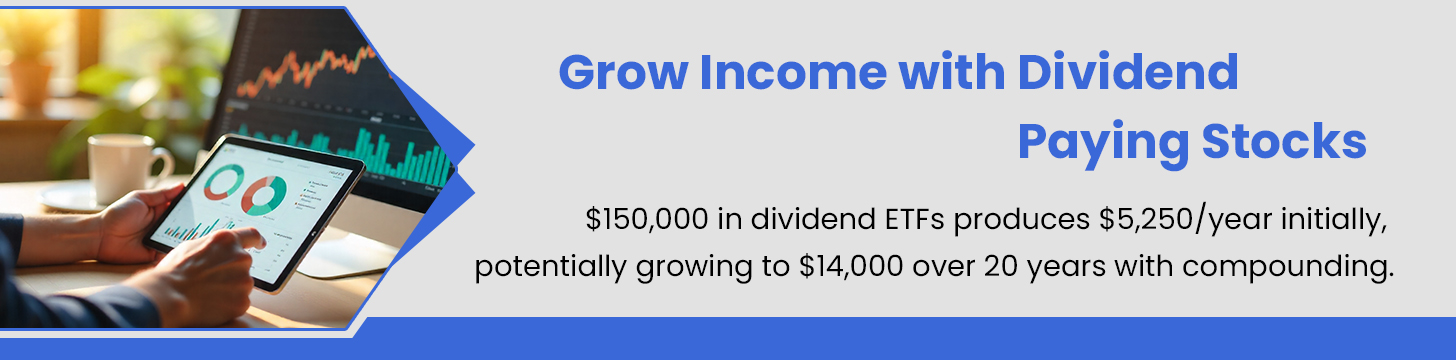
If you put $150k into a dividend ETF:
- You’ll be earning $5,250 a year in the first year
- 10 years later, with a 5.5% annual dividend lift, that will be bumping up to $9,000+
- And by year 20, you’re looking at $14,000+
This turns your dividend section into a really powerful cashflow engine, because this income will keep growing and help support you over the long haul.
Building Wealth with Broad Market Index Funds
Growth Assets as the Key to Long-Term Success
Even if you’ve built a solid foundation of income streams (bonds, dividends, savings), your retirement portfolio still needs to grow to keep up with inflation and avoid running out of money over 20, 30 years.
That’s where broad equity index funds come in – they’re a vital part of How to Invest 500k for Retirement.
Growth shares don’t give you stable income like bonds or dividends, but what they do offer is much more valuable:
- Capital gains
- Protection against inflation
- The potential for higher returns
- Growth to help you make future withdrawals
If you don’t have a growth engine, your purchasing power will be eroding – even if your interest and dividends stay steady.
Lessons from Past Market Upswings
We can’t promise past results will happen again, but looking at historical numbers does give us some useful insights:
- Global stock markets usually return 6 to 7% a year over the long haul.
- Even through really tough decades, diversified index funds tend to bounce back a lot better than individual shares.
The general rule is that equity markets will outperform bonds and cash over 10 to 20 year periods.
For example:
| Asset Type | Long-Term Average Return | Volatility | Role |
| Global Equities | 6–7% | High | Growth engine |
| Government Bonds | 2–4% | Low | Stability & income |
| Cash/MMFs | 0.5–4% | Very low | Liquidity |
This is why Step 6 is critical — even after building income layers, you still need long-term compounding.
Market Index Allocation for 500k Plans
Based on the earlier strategy:
- $150,000 to global and domestic index funds.
- Purpose: not income, but growth.
Common choices:
- Global equity index ETFs
- Domestic market index funds
- Low-cost broad market trackers (S&P 500, global all-cap, etc.)
Growth Towards Sustainable Withdrawals
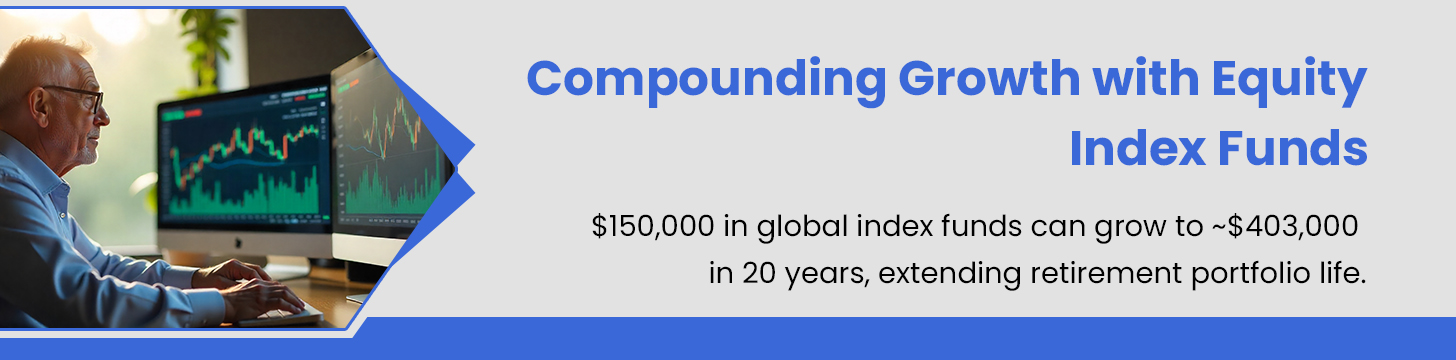
If the $150k equity sleeve grows at long-term historical average (6–7%), it will be:
- ~$268,000 after 12 years
- ~$403,000 after 20 years
This extra value:
- Extends portfolio life
- Supports withdrawals even if income assets slow
- Offsets inflation over long retirement
- Reduces pressure on bonds and dividends
A retiree relying only on income sources will stagnate. A retiree with income + growth will have balanced, inflation-proof financial strength.
Equity-Driven Scenario
During high inflation periods, dividend growth slows, and bond yields don’t keep up. But broad index funds bounce back quickly during market upswings and replenish portfolio value.
This means the overall How to Invest 500k for Retirement structure remains dynamic, adaptable, and long-lasting
Add Property or REITs for Inflation Protection
Real Estate’s Place in Retirement Portfolios
Real estate adds a separate inflation-protected income stream to How to Invest 500k for Retirement.
Unlike equities or bonds, property values and rental income go up with inflation, making real estate a great complement to your dividend and bond layers.
This is optional, but valuable for retirees who want:
- Income diversification
- Partial inflation hedging
- Tangible asset exposure
- Steady rental-derived returns via REITs or property funds
Even a small allocation can make a big difference.
Direct Ownership vs Listed Property Options
Direct Rental Property
- Typical net yields (after expenses): 3–5%
- Highly dependent on location, vacancy rates, and maintenance
- Hands-on management required
- Income is stable, but costs can be unpredictable
REITs (Real Estate Investment Trusts)
- Typical yields: 3–5% globally
- Completely passive
- Trade like stocks, offer liquidity
- Exposes you to residential, commercial, industrial, and global property markets
These fit with the dividend-focused strategies earlier.
Recommended Allocation Within a 500k Structure
Based on earlier output, a simple way to add real estate is:
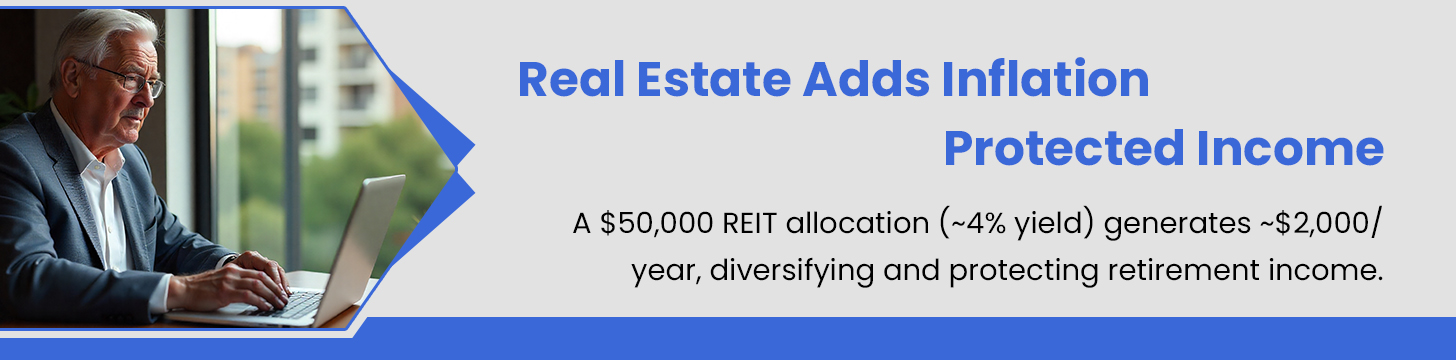
- $50,000 to diversified REIT ETFs
- Typical yield: ~4%
- Annual income generated: ~$2,000
Even 10% allocation adds significant diversification without over-exposing the portfolio to real estate.
Strengthen Income Through Inflation-Linked Assets
Real estate is a powerful supporting layer because:
- Rental income goes up over time, with inflation
- REITs distribute 90%+ of taxable income, so steady cash flow
- Property exposure reduces equity exposure during down markets
- REITs bounce back strongly after rate cuts or economic recoveries
For example:
| Asset | Typical Yield | Inflation Sensitivity | Liquidity |
| REITs | ~4% | High | High |
| Bonds | 3.7–6.5% | Low–Medium | High |
| Dividends | 3–4% | Medium | High |
Real estate provides a different source of cash flow, improving portfolio resilience.
Using Real Estate to Insulate Your Portfolio from Inflation
Imagine inflation suddenly shoots up to 5%:
- Bond income might flat-line
- Dividend growth could stall
- But rental income (and REIT payouts) might actually increase, offsetting rising costs and providing a safeguard for your How to Invest 500k for Retirement strategy
This is why real estate can serve as a valuable inflation hedge.
Build a 3-Bucket System for a Secure Retirement Income

Why You Need a Layered Withdrawal System
Building a portfolio with income layers (cash, bonds, dividends, REITs, equities) isn’t enough – retirees also need a reliable, defensive withdrawal plan to protect themselves from running out of money – especially in the early years when markets can be particularly volatile
A haphazard withdrawal approach is a surefire way to put your retirement at risk – which makes a clear and structured withdrawal system essential
And out of all the options, the 3-Bucket Withdrawal System is the most tried-and-tested way to do this.
Bucket One: Your Emergency Fund (1-3 Years)
This first bucket is all about covering your immediate expenses, so you can keep living the life you want – regardless of what’s happening in the markets.
What Should Go in Bucket 1?
- High-yield savings (around 4.0-4.2% APY is a good target)
- Money market funds
- Short-term government bond funds – the idea is to keep this bucket liquid and easily accessible
How Much You Should Hold
If you need $20,000 per year to live comfortably, then consider setting aside:
- $20,000 as a bare minimum (1-year cushion)
- $40,000 (2-year cushion) – this will give you some breathing room
- $60,000 (3-year cushion) – This is ideal for protecting yourself from market downturns.
Bucket Two: Your Mid-Term Income Pool (3-10 Years)
This bucket is where you put your income-generating assets, which will provide a steady stream of returns with minimal volatility.
What Goes in Bucket 2?
- Government bonds (around 3.7% yield is a reasonable target)
- Corporate bonds (around 4.8-5% yield)
- REITs (3-5% yield)
- Dividend ETFs (3-4% yield)
This bucket will gradually refill Bucket 1 when markets are doing well.
Bucket Three: Your Long-Range Growth Engine (10+ Years)
Your growth engine sits in this bucket, driving your future wealth expansion.
What Goes in Bucket 3?
- Global equity index funds
- Domestic index funds
- Growth equities – these assets should be left alone during market downturns to prevent losses from compounding.
How to Handle Markets That Are Either Booming or Dipping
When Markets Are Strong:
- Withdraw from Bucket 3 (your equities)
- Use the proceeds to refill Bucket 1
- Keep your long-term growth path intact
When Markets Are Weak:
- Don’t be tempted to sell your equities
- Instead, withdraw from Bucket 1
- Let Bucket 3 recover – by leaving it untouched, you’ll avoid locking in losses and getting caught in the sequence-of-return risk trap.
And to give you a better idea of just how well this system works, let’s consider a scenario where equities fall by 25%
- Bucket 3 remains untouched
- Bucket 1 covers you for 1-3 years
- Bucket 2 keeps generating bond and dividend income
- Your overall portfolio stays intact – no permanent damage done
This significantly increases the chances that your 500k will last you 25-30+ years in retirement
Reducing Volatility with a Smart Allocation
The Key to a Durable Retirement Portfolio
Risk management is not something you can afford to do without in How to Invest 500k for Retirement – it’s the thing that makes all the difference:
- Will your portfolio survive 20-30 years with ease
- Will your withdrawals stay stable and predictable
- Will downturns knock your plan off track
- Will you end up having to bail out your portfolio during a crisis
Most retirees don’t fail because they got poor returns – they fail because they didn’t handle the early years right – specifically, the really volatile ones.
And that’s why Step 9 builds on what we’ve covered already: a solid combination of diversification, regular rebalancing, and some protection from the order of returns.
Spreading Your Money Across Different Types of Assets
1.How to Diversify Your Portfolio
Diversification means your income isn’t tied to just one thing:
- Corporate Bonds – a solid 3.7-6.5% each year
- Dividend-paying Stocks – steady 3-4% income with some growth on the side
- Real Estate Investment Trusts (REITs) – around 4% and it keeps pace with inflation
- High-yielding Savings Accounts – 4% cash on tap
- Equities – your long-term growth engine, delivering 6-7%
Each of these assets acts differently under different economic conditions.
For instance, when the stock market takes a 25% hit, high-quality bonds can potentially lose just 0-3% or even go up a bit, saving your portfolio from taking a huge hit.
2. Sector Diversification
Avoid concentration in one industry. Dividend yields vary across sectors:
| Sector | Typical Yield | Stability |
| Energy | 4.75% | Volatile |
| Utilities | 3.3% | Defensive |
| Real Estate | 3.7% | Inflation-linked |
| Financials | 3–5% | Rate-sensitive |
A blend of sectors can prevent a total income collapse during industry-specific downturns.
3. Geographic Diversification
The fact is, global markets don’t all fall at the same time, so you can reduce drawdowns and make your long-term growth prospects a lot better by adding some U.S., Europe & Asia exposure.
Balancing Market Sectors for a More Even Ride
Getting Exposure Across the World, Not Just One Region
We said all this before: you should try to get your portfolio back on track every 6-12 months – not sooner, not later.
Rebalancing:
- locks in some gains when the market is running hot
- stops you from taking on too much risk when things seem good
- automatically buys some of the assets that are undervalued
- lets you make rational decisions, rather than emotional ones
An Example to Put It All in Perspective
If equities suddenly surge from 40% of your portfolio to 55%:
- you sell 15% of your equities
- you use that money to buy some bonds or restock Bucket 1
- you reduce the risk of future volatility
- You keep your portfolio aligned with your retirement goals
Managing the Risk of Sequence in Withdrawals
This is what happens when you get a string of bad returns at the very beginning of your retirement, and suddenly you’re forced to sell off at losses.
The strategy you set up earlier (3 buckets + diversification) is actually designed to protect you against this.
A Real-Life Example of How to Manage Risk
A retiree with $500,000 and a 20,000 dollar withdrawal rate sees their portfolio drop 25% in value.
Without any risk management:
- the market drops 25%
- your portfolio now stands at $375,000
- that 20,000 dollar withdrawal is now 5.3% of the portfolio – a bit high if you ask me.
With the risk management strategy:
- The market still drops 25%
- You take withdrawals from Bucket 1
- You leave the equities untouched
- So the portfolio recovers a bit faster
Just by managing your risk, you can actually add 10+ years to how long your retirement savings will last.
Take a Close Look at Your Portfolio Every Year
The Function of Annual Portfolio Checkups
The fact is, a retirement plan isn’t a “set and forget” affair, because the financial world is constantly changing, and your strategy needs to evolve with it.
Markets go up, markets go down, and the value of your investments changes with them, so it’s essential to keep checking that your allocations still match up to your retirement goals.
Interest rates can change, too, which affects bond yields and savings returns, so you need to keep an eye on where your money is parked and make some adjustments as needed.
The same goes for dividend payouts and inflation – you need to keep track of these changes so you can understand whether your income stream is growing, stable, or weakening.
To keep ‘How to Invest 500k for Retirement’ working for you for 20 or 30 years or more, you need to carry out structured annual reviews that take into account your income, risk, withdrawals, and performance.
Assessing Withdrawal Sustainability Every Year
Why This is Important
You already know that the safe withdrawal zone is 3.7 to 4% of your portfolio – but you may need to adjust this number if the markets deliver some unusually good returns, or if dividend payouts rise, or interest rates go up, or inflation surges, or your expenses change.
An Example to Illustrate the Point
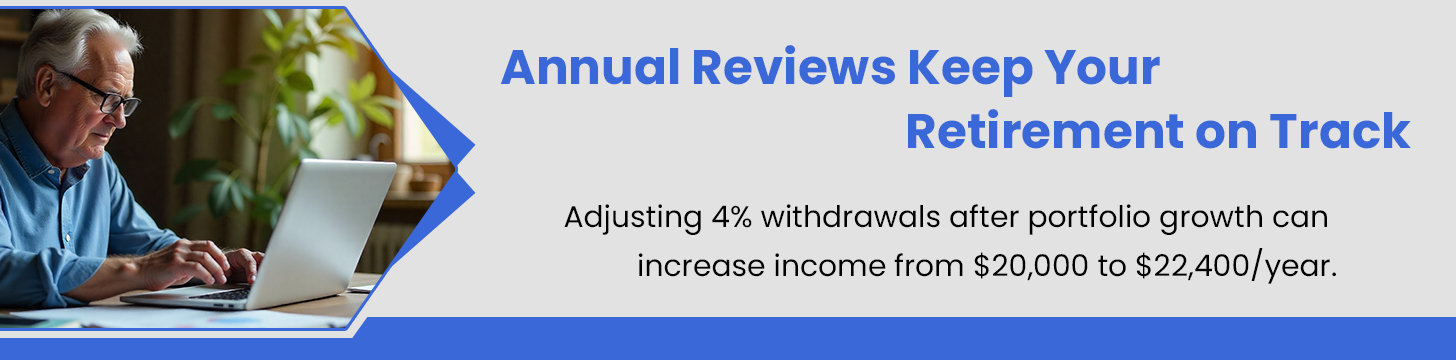
Let’s say your portfolio grows from $500,000 to $560,000, and a 4% withdrawal now becomes:
- $20,000 a year before
- $22,400 a year now
And the reverse is also true – if the markets drop, you may need to pull back on withdrawals to keep your retirement savings intact.
Getting Back to Target Weights
The Case for Annual or Bi-Annual Rebalancing
Why You Need to Get Back to Target Weights
- Rebalancing back to target weights is a must because it keeps your investments aligned with your actual retirement goals and risk tolerance, rather than just drifting along and ending up in a higher risk place than you’re comfortable with.
- Let’s say your equity allocation suddenly jumps from 40% of your portfolio to 55% – you’ll need to cut that back by selling off some of those gains, so you don’t get too aggressive with your retirement plan.
- Once you’ve sold off the extra equity, you plow that cash back into fixed income or other low-risk investments, which then gives you a more stable income stream.
- All of this means that your overall portfolio won’t be as sensitive to market ups and downs, so even when the markets are booming, you can still rest easy knowing you’ve got a solid strategy in place.
- And the best part is, this keeps your risk profile stable even as the market is changing, so you can always trust that your retirement plan is going to deliver what you need.
Tweaking Your Income Strategy as Markets Shift
Some Real-Life Examples:
- If bond yields start rising then you should probably shift some of your money into higher-yielding bonds to get a bit more interest income
- If dividend stocks are growing fast, you might as well let your equities run a bit to take advantage of those higher payouts
- If inflation starts spiking, then REITs or other inflation-proof investments might be the way to go
- If recession fears start rising, then you should probably build up a bigger cash cushion to help you weather the storm
- If your expenses start going up, then it’s time to rethink your withdrawal rate to make sure you’re not taking on too much risk.
These small adjustments will keep your long-term strategy on track.
Keeping an Eye on Your Spending and Income Growth
Dividends tend to grow at a healthy 5-8% a year in many places. Bond interest will change with interest rate cycles. REIT income often rises in inflationary times.
Compare:
| Category | Typical Growth | Impact |
| Dividends | 5–8% | Rising income over time |
| REITs | 2–4% | Tracks inflation trends |
| Bonds | 0–2% | Stable but slow growth |
Your annual review keeps your income in line with real world cost increases.
Annual Updates That Prolong Portfolio Life
Reviewing your plan every year helps you:
Reviewing your plan every year helps you not overspend in bull markets because regular reviews remind you to stay disciplined with withdrawals even when investments are up.
It helps you not lose permanent capital in bear markets because an annual check-in allows you to adjust withdrawals or move allocations before losses compound.
It helps you keep income stable and predictable because annual updates allow you to fine-tune income sources like dividends, bonds, and cash reserves based on their latest performance.
FAQs
1. What is the safest way to invest $500,000 for retirement?
The safest way is to build a low-risk, diversified income portfolio that protects your capital while giving you predictable yearly returns.
This means:
- High-interest savings accounts for quick access
- Term deposits for fixed, guaranteed returns
- Government or investment-grade bonds for stability
- Defensive ETFs for long-term growth with lower volatility
A low-risk portfolio aims for 3.5% to 5% annual returns, giving you around $17,500 to $25,000 per year from $500k.
This is perfect for retirees who want reliability, consistency, and capital preservation.
2. Can $500,000 generate enough passive income for retirement?
Yes — $500,000 can produce passive income depending on your return rate and spending habits.
With a conservative 4% yearly return, you’ll get around $20,000 per year.
With a moderate 5.5% yearly return, income increases to around $27,500 per year.
Combined with superannuation, age pension eligibility, or extra savings, this amount will support a stable and controlled retirement lifestyle.
Using a 4% withdrawal strategy also helps maintain long-term income without rapidly reducing your capital.
3. What’s the best investment mix for someone retiring soon?
If you’re retiring soon, your investment mix should be focused on income stability, lower volatility, and protection against market swings.
A retirement-friendly mix often includes:
- 40% bonds + term deposits for reliable returns
- 30% dividend and income-focused ETFs
- 20% property-linked assets (fractional property or REIT-style options)
- 10% cash buffer for emergencies
This structure targets 4% to 6% annual income and reduces exposure to big market downturns.
It gives you a predictable cash flow without taking unnecessary risks.
4. Should I invest the full $500,000 at once or gradually over time?
This depends on your risk tolerance and current market conditions.
If markets feel uncertain or extremely volatile, gradual investing (dollar-cost averaging) helps reduce the risk of buying at a market peak.
If interest rates are high and you’re using term deposits or stable income products, investing more upfront can give you instant and guaranteed returns.
A balanced approach — investing 70% now and 30% in stages — is often the way to go for retirees who want stability and flexibility.
5. What to avoid when investing $500,000 for retirement?
Retirement investment mistakes include:
- Putting all your money into one asset (property, shares, crypto, etc.)
- Taking unnecessary risks for higher returns
- Not having enough cash for emergencies
- Not considering long-term income sustainability
- Withdrawing too much too soon
These mistakes can result in loss of capital, income shortfalls or financial stress during market downturns.

Valuable Insights On Property Development & Investment Opportunities
-

Top High Interest Short Term Investment Options for 2026
High Interest Savings Accounts for Liquid Cash Buffers Cash sleeve purpose and liquidity role High…
Read More -
Best Performing Managed Funds in Australia: Expert Tips & Strategies
Top-Performing Managed Funds in Australia: What Investors Need to Know In 2026, Australian investors are…
Read More -
Best Financial Advisor Perth: How to Choose the Right Expert for Your Goals
Financial Advisor Perth Key Criteria for Choosing the Best Adviser Choosing the best financial advisor…
Read More -
How to Make Money from Property Development in Australia: A Comprehensive Guide
High-Growth Cities Offering the Best Property Development Margins Australia’s property development landscape will be shaped…
Read More -
What Are the Best Low-Risk Investments in Australia for Beginners?
Low-Risk Investing in 2026: The Beginner Snapshot For Aussie beginners seeking low-risk investments in 2026,…
Read More


Our Project Site :


Exclusive waterfront living at the Lake Narracan Resort community.

Quick Links
The information provided is general in nature and does not constitute personal financial advice. The information has been prepared without taking into account your personal objectives, financial situation or needs. Before acting on any information on this website you should consider the appropriateness of the information having regard to your own objectives, financial situation and needs. All statements made on this website are made in good faith and we believe them to be accurate and reliable however do not guarantee its currency. You should seek legal or other professional advice before acting or relying on any of the content.
Please note that past performance may not be indicative of future results. Different types of investments involve varying degrees of risk, and there can be no assurance that the future performance of any specific investment, investment strategy, or product made reference to directly or indirectly on our website, blogs , newsletters.
Our Project Site :

Find premium land developments and new estates across Australia.
Exclusive waterfront living at the Lake Narracan Resort community.

Quick Links
The information provided on this website including blogs is general in nature and does not constitute personal financial advice. The information has been prepared without taking into account your personal objectives, financial situation or needs. Before acting on any information on this website you should consider the appropriateness of the information having regard to your own objectives, financial situation and needs. All statements made on this website are made in good faith and we believe them to be accurate and reliable however do not guarantee its currency. You should seek legal or other professional advice before acting or relying on any of the content.