

Table of Contents
Positioning a $1 Million Portfolio for Capital Growth and Stability
The first step in figuring out how to make the most of having 1 million dollars in Australia in 2026 is to work out where the growth is really happening now.
We get a pretty clear picture of this from CoreLogic, PropTrack, the ABS, and the major banks. The statistics all point to the same places: Perth, Brisbane, Darwin, Adelaide, and regional areas in QLD, SA, and WA being the ones to watch for the next cycle, where real wealth-building is going to happen.
CoreLogic has just reported that home values went up by 1.1% in 2025 – that’s 6.1% national growth over the past year – and some of the strongest growth is coming from Perth (9.4%), Brisbane (10.8%), and Darwin (15.4%).
And when you look at the longer term, these markets have all seen 5-year gains of over 80% in some areas. PropTrack also confirms this trend, with 7.5% annual growth nationally and 7.9% in regional Australia.
Population growth is another factor that’s making these regions strong. Perth (3.1%), Brisbane (2.7%) and Melbourne (142,600 new residents) are just a few of the areas where people are moving in big numbers, which drives demand.
The banks are predicting 4% to 9% growth in 2026, which means if you invest $1M wisely, you could be looking at gains of $100k+ in just two years.
For anyone trying to figure out how to invest $1 million in Australia, looking at these regions is a good place to start. They offer a solid foundation for 2026.

Getting Real About Investing $1 Million in Australia in 2026
The Real Economic Landscape in 2026
The foundation of making the most of having $1 million to invest in Australia in 2026 is this: we’re facing an economy where the gap between inflation and interest rates is incredibly narrow.
This is what we call the Inflation-Interest Rate Balance Point, and it plays a huge role in every investment decision.
By late last year (2025):
- The RBA cash rate was 3.60%
- Inflation (as measured by CPI) was 3.2%
- The difference between the two was just 0.40% – that’s a ridiculously small buffer
This means that defensive investments like cash and term deposits are barely delivering any real return after you factor in inflation.
Why the Narrow Inflation-Interest Rate Gap Matters
It means that we’re facing a pretty low-return environment for defensive investments. In other words, if you’re looking for a way to grow your money over the long term, you’re going to have to go with assets that have a bit more risk to them, like:
- Shares
- Property
- Infrastructure projects
- Diversified ETFs
The reason is simple: putting your money in a term deposit that averages 4-5% isn’t going to get you very far in today’s climate, especially since inflation is 3.2%. You’d only be getting around 0.8-1.8% real return from it. And with bond yields stabilising at 3-4% that’s not much better.
Implications for a $1 million investor
If you hold a big chunk of your million in defensive assets:
- You’re basically just keeping up with inflation – your real wealth isn’t growing at all\
- Inflation is quietly eating away at the value of your money
- The opportunity costs are piling up over time – money that could be working harder for you is just sitting there.
A Real-World Example to put this into perspective
- If you had $1million sitting in a bank account earning 4.5%, you’d earn around $45,000 a year
- But after inflation kicks in at 3.2%, that’s more like a real gain of only $13,000
- And after taxes (say 32.5%), your real income is down to a meager around $8,800
2026 Strategic Investment Insight
To really get the most out of your million:
- You absolutely have to allocate a significant proportion to growth assets
- You should be prepared for some volatility in exchange for the potential of higher long-term returns
- You need a multi-asset approach that balances out the risks and opportunities – there’s no one-size-fits-all solution here
That’s why the first step of How to Invest 1 Million Dollars Australia in 2026 starts by acknowledging the Inflation-Return Balance Point – because ignoring it is a recipe for underperformance over the next decade.
Setting Clear Goals and Choosing the Right Timeframes
The Personal Risk Blueprint – the foundation of your investment plan
The second step in How to Invest 1 Million Dollars Australia in 2026 is about creating your own Personal Risk Blueprint – this is what decides how aggressive or defensive your million-dollar portfolio should be.
Your blueprint takes into account your goals, timeframe and risk capacity, and this is what guides your decisions on everything from asset selection through to diversification. No two investors are alike, so there’s no such thing as a generic asset mix – each person needs their own personalised approach.
Investment Timeframes – Breaking it Down
The timeframe you set for your $1 million is what determines the mix between growth and defensive assets.
1. Long-Term Goals (10-30 Years)
This is ideal for:
- Retirement
- Building a lasting legacy
- Long-term wealth growth
Why does it matter?
- Australian shares have delivered around 13% a year over more than a century.
- Global markets have averaged 8 to 10% a year in the long-term.
Having a long-term outlook helps smooth out the volatility and lets compounding do its thing.
2. Medium-Term Goals (5-10 Years)
This is a good fit for:
- Funding the kids’ education
- Upgrading your property
- Taking on business investment plans
This period needs a blend – enough growth to keep ahead of inflation, but enough defensive assets to keep the drawdowns to a minimum.
3. Short-Term Goals (less than 5 Years)
This is perfect for:
- Making short-term purchases
- Building up an emergency fund
- Meeting short-term financial commitments
Short timeframes call for capital stability, because the market might not bounce back quickly from a downturn.
Removing Emotional Decision Barriers with a Clear Plan
Your Personal Risk Blueprint helps prevent stuff-ups like:
- Panicking and selling when the market gets volatile
- Over-investing in growth assets right when you need them to be stable
- Holding too much cash in long-term goals (which leads to underperformance)
By linking each dollar to its purpose, your blueprint becomes a guiding force in How to Invest 1 Million Dollars Australia, keeping you on track and making sure your million is working for you, not against you.
Determining the Ideal Balance Between Growth and Defensive Assets
What is the 2026 Portfolio Balance Line and Why Does it Matter?
The third step in our How to Invest 1 Million Dollars in Australia in 2026 guide is creating your Portfolio Balance Line – that all-important point where growth assets and defensive assets come together in just the right proportions.
This line isn’t drawn in the sand – it’s carefully crafted based on:
- Your individual risk tolerance
- How long you’re willing to keep your money invested
- The economic landscape in Australia in 2026
- The expected returns on different types of investments
With inflation creeping up to 3.2% and the RBA cash rate sitting at 3.60%, having a balanced mix of assets becomes crucial – defensive investments alone just won’t generate the returns you need.
Why Your 2026 Portfolio Balance Line is So Important
Growth assets have historically done better in long bull runs.
Growth Assets to Consider for Strong Compounding
- Historically, ASX investments have seen annual returns of around 13%
- Global shares have generally delivered returns of 8-10% over the long-term
- Residential property can increase by 39% over five years, as we saw in 2025
- Regional property has increased by 87.5% over a decade
But then there are defensive assets, which can provide a level of stability:
- Term deposits can give returns of 4-5%
- Bonds offer around 3-4%
- Cash returns are currently at 3.60%
This contrast highlights why your Balance Line needs to lean more towards growth if you want long-term wealth to grow.
Practical Guidance for Weighing Your Assets
1. A Balanced Portfolio Example (60-70% Growth / 30-40% Defensive)
Good for investors looking for steady returns without too much risk
2. A High-Growth Portfolio Example (75-85% Growth / 15-25% Defensive)
Ideal for long timeframes and a high risk tolerance
3. A Capital-Preservation Portfolio (40-50% Growth / 50-60% Defensive)
Better for those who need to keep their investments stable and secure for the next 5 years
How a Balanced Portfolio Can Protect You
Your Portfolio Balance Line:
- Helps reduce losses when the market takes a downturn
- Makes sure growth outpaces inflation in the long-term
- Helps you avoid making rash decisions based on emotions
- Keeps your investments on track year after year
Putting it all Together – A Balanced Portfolio Example
Imagine a portfolio with 70% growth assets, potentially bringing in a return of 7-10% every year for a decade, while your 30% defensive layer helps shield against any market shocks.
This Balance Line is a vital part of our How to Invest 1 Million Dollars in Australia guide, because making the wrong choices can put thousands of dollars of long-term gains at risk.
Building a High Efficiency Superannuation Strategy

Superannuation – the Core of the $1M Plan
Superannuation is the inside secret that turns the tax system into a powerful wealth-builder in How to Invest 1 Million Dollars Australia in 2026. It works by letting your money grow much faster because you’re losing less to tax each year.
In Australia, super is unusually tax-friendly – even more so in 2026.
- You only pay 15% on earnings in your super account
- Once you’re in retirement, all your earnings are tax-free
- The amount of money you can have in your super without paying tax is going up to around $2 million
- Your employer must contribute 12% of your income to your super account
- We’ve got over $4.3 trillion in super savings – that’s how much people trust the system
All of which makes super a key part of building long-term wealth.
2026 contribution limits and what they mean for long-term wealth
The rules for super contributions in 2025-26 have just made it even easier to build the Power Core:
- You can put in up to $30,000 per year in concessional contributions – that’s salary sacrifice and employer super guarantee both
- Non-concessional contributions are capped at $120,000 per year
- You can bring forward up to $360,000 in one year if you need to
All of which gives you a big opportunity to shift part of your $1M into a low-tax wealth zone
Why it’s so important to take advantage of the expanded tax-advantaged caps
- Money in your super grows much faster.
- The money you lose to tax outside super can cost you hundreds of thousands in the long run.
- If you’re between 40 and 55, now is the time to start putting money in – it will make a huge difference in your retirement savings.
How much you could save in tax on a $1M investment
If you put $300,000 in your super and it earns 7% a year:
- Earnings in super at 15% tax = an effective return of around 5.95%
- Earnings outside super (in a 39% tax bracket) = an effective return of around 4.27%
Over 10 years, the difference is:
- In super: around $529,000
- Outside super: around $451,000
So that’s a difference in tax savings of around $78,000.
Why you should be using super in your 2026 portfolio
The Superannuation Power Core:
- Reduces the hit of tax drag
- Helps your money grow much faster over the long term
- Gives you a safe and protected place to invest
- Works with your income strategy – whether you’re building wealth or generating retirement income.
That’s why super has to be part of How to Invest 1 Million Dollars Australia – it’s not optional, it’s a core part of your strategy.
The Secret to a Thriving ETF and Share Portfolio for Long-term Prosperity
The Engine Behind Getting Rich
The ETF and share part of your portfolio is the Low-Cost Growth Engine Room of How to Invest 1 Million Dollars in Australia in 2026 – the bit that does all the hard work to build your wealth over time.
It’s this engine that’s responsible for getting your returns compounding, spreading your risk with diversification, and giving you that all-important long-term outperformance.
The truth is growth assets have historically delivered some of the best real returns in Australia:
- ASX returns over the long haul: around 13% a year – a pretty stunning achievement over more than a century
- Global equities delivering: 8-9% a year over the long run
- Australian dividend yields: 4-5% average – which is a lot more than what you get from bonds or cash, especially now that inflation’s sitting at a pretty healthy 3.2%
These returns far outstrip anything you’d get from low-return investments like bonds or cash.
ETFs: The Key to Building a Strong Low-Cost Growth Engine
ETFs (Exchange-Traded Funds) are a great foundation for a modern $1M portfolio because they put together:
- Incredibly low fees
- An incredibly broad mix of investments
- Automatic rebalancing to keep your portfolio on track
- Exposure to the total market – not just a handful of stocks
ETF fees usually range from 0.04% to 0.20% – which is compared with the 1-2% fees you’d get from many managed funds. And we all know that lower costs = more of your money left over to make more money each year through compounding.
Core ETF Categories to Help Shape a 2026 Portfolio
- An Australian Market ETF (ASX 200 or All Ordinaries) – covering our own backyard
- A Global Developed Markets ETF (US, Europe, Japan) – to tap into the wealth of the developed world
- A Small Fling with Emerging Markets – don’t worry too much about the risks for now
- Sector or thematic satellites (e.g., tech, healthcare, clean energy—used with caution)
The Power of Compounding with an ETF-Driven Portfolio
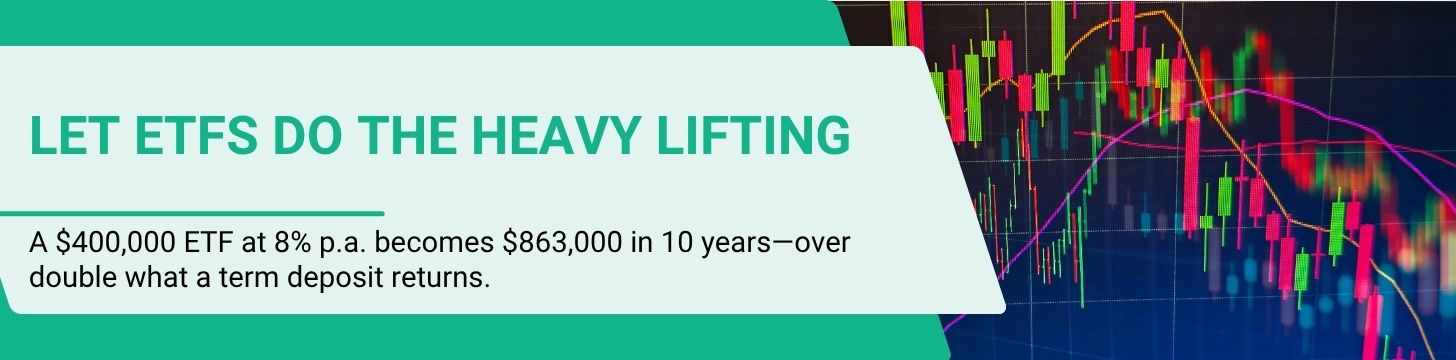
If you put $400,000 of your million into a global shares ETF earning 8% a year:
- After 10 years, your portfolio is worth roughly $863,000
- You’ve earned a total of $463,000 in gains
- The lion’s share of that gain comes from all the returns reinvested over the years
On the other hand, investing the same amount in a term deposit at 4.5%:
- After 10 years, you’ve got around $620,000
- You’ve earned a total of $220,000
This clearly shows that ETF-driven investing gets you compounding effects that double the growth of traditional investments.
Why the Engine Room is So Crucial for 2026 Investors
The Low-Cost Growth Engine Room:
- Gives you the best long-term returns
- Spreads out your risk through diversification
- Cuts costs to make compounding work its magic
- Lets you tap into global economic growth
It’s this engine that makes ETFs and shares a critical part of How to Invest 1 Million Dollars in Australia, building the momentum that drives long-term wealth creation.
Residential Property and Real Assets for Stability and Growth

Property as the Stability Anchor of a $1M Strategy
Property is the stabiliser in How to Invest 1 Million Dollars Australia 2026.
Unlike shares, property delivers capital growth and rental income, two engines for long term wealth.
Australian property has shown incredible resilience and long term performance:
- National median values hit $820,000 in 2025
- Home prices up 39% in 5 years
- Regional markets up 87.5% in 10 years
- Capital cities up 61.7% in 10 years
These figures are why property is at the heart of long term portfolio design.
Property in a 2026 Economic Cycle
With inflation at 3.2% and interest rates easing after 2024-25 highs, property is set for steady 2026-28 performance.
Core Benefits of Real Assets
- Inflation hedging (rents rise faster during inflation cycles)
- Low correlation with shares, reduces portfolio volatility
- Leverage, borrowing magnifies returns over time
Real World Property Scenario
- A $600,000 property growing at 5% pa becomes $765,000 in 5 years
- Rental yields of 4-5% adds stable income
- Combined return (growth + rent) often 8-9% in balanced markets
Effective Uses of Property in a $1M Portfolio
1. Direct Residential Investment
Best for investors looking for long term capital growth.
2. Listed Property Trusts (REITs)
Offer liquidity and exposure to commercial, industrial and retail property sectors.
3. Infrastructure Funds
Provide stable, inflation linked income from utilities, toll roads and energy assets.
Property’s Role in the Portfolio
The Stability Anchor:
- Reduces volatility during share market downturns
- Provides consistent rental income
- Offers long term durability
- Adds diversification across asset classes
This is why property and real assets are the foundation of How to Invest 1 Million Dollars Australia, so you can be stable even in uncertain times.
Strengthening Your Portfolio With Defensive Income Assets
Protecting Your $1M Portfolio from Market Ups and Downs
The seventh step in How to Invest 1 Million Dollars in Australia in 2026 is all about creating your Cashflow Safety Net – a crucial defensive layer that keeps your wealth from getting knocked around by market volatility, unexpected expenses and the like.
And that’s because, let’s face it, growth assets like shares and property can fall off a cliff during downturns.
If you don’t have defensive assets in there, you might find yourself having to sell at a loss – and that’s not exactly what you want to be doing with your portfolio.
A strong defensive sleeve is like having a financial cushion to rely on – even when market cycles get unpredictable.
Why Defensive Income Assets Matter in 2026
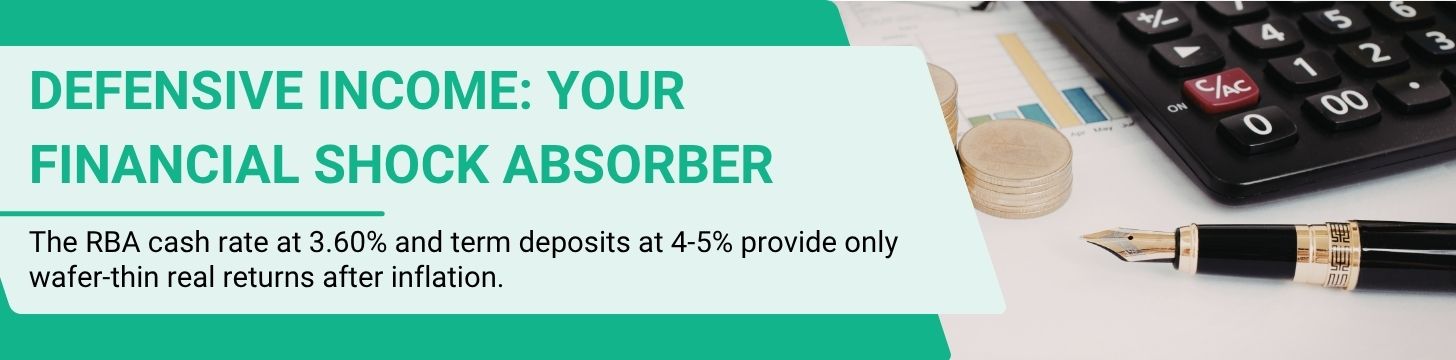
With Australia’s interest-rate environment looking like it is in 2026, defensive income assets are both super necessary and somewhat limited in real return.
Key Defensive Income Rates for 2026
- The RBA cash rate is at 3.60% – so far, so good.
- Term deposits are bringing in around 4-5% – which isn’t a bad return, but…
- High-grade bonds are around 3-4% – take a deep breath, these are still okay returns.
But let’s look at inflation – 3.2% – so even with all that, defensive assets aren’t exactly driving growth, are they? What they do do is protect your capital – making them essential for portfolio stability.
What Makes Up a Strong Safety Net
1. Cash – the Ultimate Emergency Fund
Used for all those times life takes an unexpected turn – or for making the most of a market dip.
2. Term Deposits – Predictable Returns
Good for 1-3 year holds, these provide a nice, stable return of 4-5% – all of which is much appreciated.
3. High-Grade Bonds – Low Risk, High Reward
Stable income and low risk – what’s not to like? Government and corporate bonds are a great place to put your faith.
Scenarios Like This Happen A Lot – Loss Prevention with a Safety Net
Imagine a $1M portfolio with no defensive assets at all – and you get hit by a 20% market fall.
You’d be out $200,000 in the blink of an eye.
But, with:
- 70% of your portfolio in long term growth assets
- 30% in defensive assets
The defensive layer acts as a shock absorber, providing cashflow and helping you avoid selling your growth assets at a loss.
Which is great news – because that helps protect your long-term compounding power.
The Importance of Defensive Layers in 2026
Your Cashflow Safety Net is a game-changer – it works to:
- Protect that $1M from market downturns
- Keep you financially stable for 1-3 years
- Stop you from making emotional decisions
- Give you a more stable portfolio
- Help you take advantage of dips in the market
This step is more than just a chore – it’s a vital part of How to Invest 1 Million Dollars in Australia, because when it comes to protecting your capital, it’s just as important as growing it.
Get More Out of Your Investments with Alternatives
Advantage Layer Boosts Portfolio Performance
The 8th step in How to Invest 1 Million Dollars Australia in 2026 introduces the Diversification Advantage Layer—a category of investments designed to reduce concentration risk and improve portfolio resilience.
Alternatives add exposure to assets that behave differently from shares and property.
This matters in 2026 because traditional markets will be volatile due to the inflationary-reset cycle, global rate adjustments and commodity price fluctuations.
When used correctly, alternatives smooth out long-term performance.
Alternatives in a 2026 Framework
Alternatives include:
- Infrastructure funds
- Private credit
- Unlisted property funds
- Hedge-fund style strategies
- Private equity (for wholesale investors)
These assets have low correlation with shares, so they protect when share markets fall.
Performance Illustration
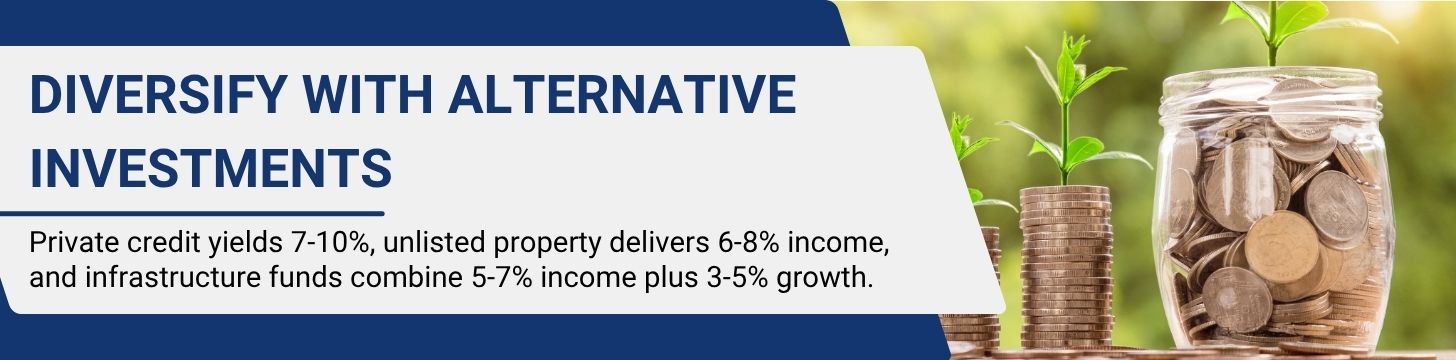
- Global infrastructure historically delivers 5–7% income + 3–5% growth
- Private credit yields sit in the 7–10% range (risk-adjusted)
- Unlisted property funds target 6–8% stable annual income
These returns smooth out market phases.
Selective Allocation Works in 2026
Australia’s 2026 environment—moderate inflation, stabilising rates and constrained housing supply—favours alternative asset performance.
Why Alternative Allocations
- They hedge inflation (especially infrastructure)
- They offer higher income than traditional bonds
- They reduce overexposure to property and shares
- They stabilise returns during market downturns
Impact of a 10% Alternatives Component
If a $1M portfolio has:
- 70% growth
- 20% defensive
- 10% alternatives
The alternatives slice:
- Reduces volatility by 5–10% in historical back-testing
- Increases average annual income through higher-yielding private credit and infrastructure
- Mitigates drawdowns when equity markets correct by 10–20%
This reduces emotional selling and keeps long-term compounding intact.
The Advantage Layer in 2026
The Diversification Advantage Layer:
- Makes the portfolio more stable
- Boosts long-term income
- Reduces shares + residential property
- Smooths out returns across market cyclesSo
Building a Protective Barrier with Smart Tax Strategies & Asset Protection

The Wealth Shield Safeguarding a $1M Portfolio
The 9th step in How to Invest 1 Million Dollars in Australia by 2026 is creating your Wealth Shield – a robust defence against wealth erosion.
This is a carefully constructed combination of tax strategies, investment structures and personal protection that prevents your wealth from being drained away unnecessarily.
A solid Wealth Shield ensures that your returns aren’t eaten away by taxes, costly legal battles or unexpected changes in your life.
Without this protection, even the best investment strategies can fall short of their true potential over the long term.
Key Factors Shaping the 2026 Tax Landscape
Australia’s 2026 tax environment is highly unfavourable, making strategic planning essential:
- High-income earners face tax rates that can hit up to 45-47%
- Investment earnings outside super can lose nearly half of their value to tax – a staggering loss.
- Borrowing costs are still elevated even though interest rates are stabilising.
- Property affordability has reached 8 times household income which has an enormous impact on investment choices
Bearing all this in mind, it’s clear that tax structures can have a bigger impact on your net returns than even the best asset choices.
Asset Ownership Structures with Strategic Benefits
1. Superannuation – A Low-Tax Haven
- Tax on earnings: A relatively low 15%
- Tax when you retire: 0% – ideal for long-term growth-orientated investments.
2. Family Trust – A Tool for Income Splitting
- Provides another layer of asset protection for your loved ones
- Allows you to distribute your wealth to those with lower incomes.
3. Investment Companies – Lower Tax Payable
- Profits retained at 25-30% – perfect for high-income earners who regularly reinvest their earnings.
Personal Protection to Safeguard Long-term Value & Wealth
A $1M portfolio is very vulnerable to unexpected events without the right insurance and protection measures in place.
Some of the key safeguards that can help you avoid financial disaster include:
- Life insurance
- Total & Permanent Disability – a critical protection against financial loss
- Income protection
- Landlord and building insurance – to protect your physical assets
- Liability cover within trusts
These protections can prevent a major financial setback from forcing the sale of your valuable growth assets.
Example of How Much You Could Lose Without a Wealth Shield
Take a high-income investor who earns $40,000 in investment income outside super:
- Tax at 45% takes $18,000
- Net income = $22,000
- This leaves you far short of your true earnings potential.
Inside super at 15% tax:
- Tax = $6,000
- Net income = $34,000
The difference is $12,000 each year – or over $120,000 over 10 years, purely as a result of choosing the right structure.
Why the Wealth Shield Matters for High-Net Worth Investors
The Wealth Shield Framework is critical to achieving long-term success because:
- It maximises your net returns and minimises unnecessary taxes
- It reduces the impact of taxes on your net returns
- It protects your family’s wealth and assets
- It ensures long-term compounding is preserved
- It gives you peace of mind knowing that your wealth is safe
This is why creating a Wealth Shield is a key component of How to Invest 1 Million Dollars in Australia, especially over the next decade from 2026 to 2036.
Performance Through Regular Review and Rebalancing
The Wealth Maintenance Cycle Preserves Growth
The final step in How to Invest 1 Million Dollars Australia in 2026 is to set up your Wealth Maintenance Cycle—the process of reviewing, adjusting and realigning your portfolio every year.
Even the best designed portfolio will drift over time. Growth assets can grow faster than defensive assets, changing your risk profile. Market cycles, interest rates, inflation and global events all change the economic landscape.
That’s why the Wealth Maintenance Cycle is important:
It keeps your portfolio aligned with your goals, not random market movements.
Portfolio Review Frequency for $1M Investors
Annual Review:
Full assessment of asset allocation, performance, tax position and financial goals.
Quarterly Check-ins:
Monitor major market movements and adjust small exposures if needed.
Trigger-Based Reviews:
Review your strategy when major life or economic events occur, such as:
- Interest rate changes
- Market corrections above 10%
- Changes in income or employment
- Property market cycles
- Tax law updates
Rebalancing in a 2026 World
If your target allocation is:
- 70% growth assets
- 30% defensive assets
But strong market performance pushes growth assets to 78%, then your portfolio is now riskier than intended.
Rebalancing gets you back to your original structure.
Statistical Logic Behind Rebalancing Discipline
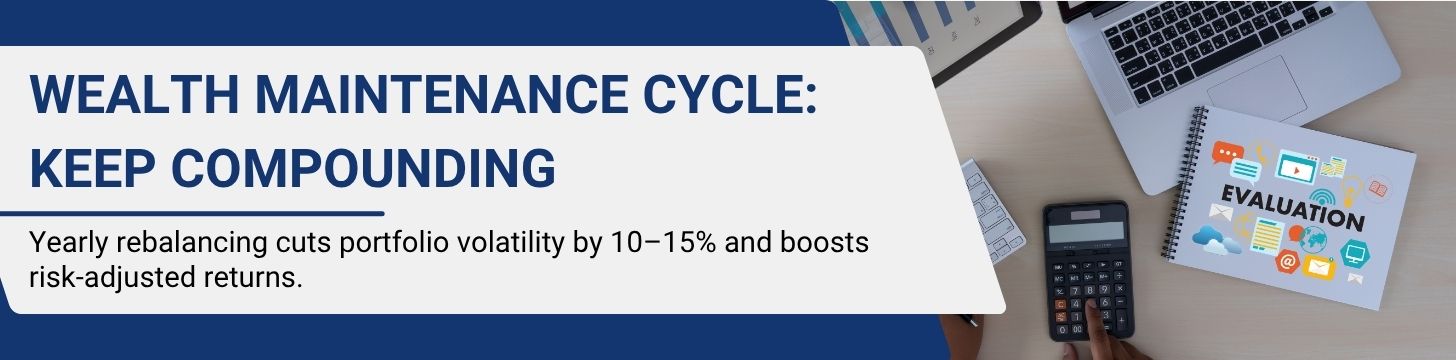
Portfolios that rebalance yearly historically show:
- Lower volatility (10–15% reduction)
- Better long-term outcomes
- Higher risk-adjusted returns (Sharpe Ratio improvements)
Loss Prevention Through Drift Control
Assume your growth assets outperform defensive assets by 12% during the year.
Without rebalancing:
- Growth allocation grows
- Defensive layer shrinks
- Portfolio becomes more vulnerable to downturns
If a correction hits:
A portfolio that drifted from 70% → 80% growth assets can lose 15–20% more during downturns.
Wealth Maintenance Cycle Keeps Momentum
The 2026 Wealth Maintenance Cycle:
- Keeps your risk stable
- Trims appreciated assets
- Ensures disciplined long-term investing
- Adapts to changing market conditions
- Keeps compounding power going without interruptionsSo that’s it for How to Invest 1 Million Dollars Australia.
FAQs — How to Invest 1 Million Dollars Australia
1. How do I invest 1 million dollars in Australia safely?
The safest way is income-focused investing across low-volatility assets.
This includes high-interest savings accounts, term deposits, government bonds, and investment-grade corporate bonds.
These assets return 3.5%–5.2% p.a. depending on the institution and term length.
A balanced portfolio may also include ASX 200 blue-chip shares which historically deliver 8–10% p.a. over long periods.
Diversification reduces risk while maintaining stable income and long-term growth.
2. How do I get passive income from 1 million dollars in Australia?
A well-structured passive income portfolio combines dividend stocks, ETFs, bond ETFs, and property income.
Fully franked dividends from ASX companies like banks and utilities yield 4–6% and franking credits increase the return.
Residential property investment — especially dual-occupancy, townhouses, or regional high-yield rentals — can produce 4–7% rental yields depending on location.
Income-focused ETFs (VAS, VHY, IHD) yield mid-4%.
With the right mix, $1M can generate $45,000–$70,000 in passive income.
3. Is property good for 1 million dollars in Australia?
Yes — property is one of Australia’s most stable wealth-building assets.
With $1M you can buy one premium asset or two medium-priced assets in strong growth areas like Perth, Adelaide, Brisbane or Melbourne’s outer ring.
Historical CoreLogic data shows Australian property values grow 6.8% p.a. long-term, some areas grow 10% p.a. during growth cycles.
A well chosen property can deliver capital growth and 4–6% rental income, dual returns.
The key is to choose suburbs with population growth, low vacancy rates, infrastructure projects and tight housing supply.
4. What’s the best portfolio split for 1 million dollars?
A good all-weather split looks like:
40% equities (ETFs + blue chips)
30% property (direct or REITs)
20% bonds / fixed income
10% cash / liquidity buffer
This split gives you growth, income and downside protection.
Equities compound long-term.
Property provides stability and rental income.
Fixed income protects during downturns.
Cash is for new opportunities.
Every investor should adjust this split based on their age, risk level, income needs and investment horizon.
5. Can I retire early with 1 million dollars in Australia?
Yes — many Australians retire early with a $1M investment plan.
With the right asset mix a balanced portfolio can produce $45,000–$70,000 per year depending on risk and expected returns.
Assuming 6–8% annual returns and a 4% safe withdrawal rate a $1M portfolio can support a lean or moderate lifestyle.
Additional income from property, part-time work or business income makes it even more sustainable.
If structured correctly $1M can be enough to retire early, especially outside of expensive capital city areas.

Valuable Insights On Property Development & Investment Opportunities
-

Top High Interest Short Term Investment Options for 2026
High Interest Savings Accounts for Liquid Cash Buffers Cash sleeve purpose and liquidity role High…
Read More -
Best Performing Managed Funds in Australia: Expert Tips & Strategies
Top-Performing Managed Funds in Australia: What Investors Need to Know In 2026, Australian investors are…
Read More -
Best Financial Advisor Perth: How to Choose the Right Expert for Your Goals
Financial Advisor Perth Key Criteria for Choosing the Best Adviser Choosing the best financial advisor…
Read More -
How to Make Money from Property Development in Australia: A Comprehensive Guide
High-Growth Cities Offering the Best Property Development Margins Australia’s property development landscape will be shaped…
Read More -
What Are the Best Low-Risk Investments in Australia for Beginners?
Low-Risk Investing in 2026: The Beginner Snapshot For Aussie beginners seeking low-risk investments in 2026,…
Read More


Our Project Site :


Exclusive waterfront living at the Lake Narracan Resort community.

Quick Links
The information provided is general in nature and does not constitute personal financial advice. The information has been prepared without taking into account your personal objectives, financial situation or needs. Before acting on any information on this website you should consider the appropriateness of the information having regard to your own objectives, financial situation and needs. All statements made on this website are made in good faith and we believe them to be accurate and reliable however do not guarantee its currency. You should seek legal or other professional advice before acting or relying on any of the content.
Please note that past performance may not be indicative of future results. Different types of investments involve varying degrees of risk, and there can be no assurance that the future performance of any specific investment, investment strategy, or product made reference to directly or indirectly on our website, blogs , newsletters.
Our Project Site :

Find premium land developments and new estates across Australia.
Exclusive waterfront living at the Lake Narracan Resort community.

Quick Links
The information provided on this website including blogs is general in nature and does not constitute personal financial advice. The information has been prepared without taking into account your personal objectives, financial situation or needs. Before acting on any information on this website you should consider the appropriateness of the information having regard to your own objectives, financial situation and needs. All statements made on this website are made in good faith and we believe them to be accurate and reliable however do not guarantee its currency. You should seek legal or other professional advice before acting or relying on any of the content.